植物研究 ›› 2026, Vol. 46 ›› Issue (1): 181-194.doi: 10.7525/j.issn.1673-5102.2026.01.016
• 研究论文 • 上一篇
张敬一凡1,2, 李谊1,2, 毕心怡1,2, 德吉1,2, 张继峰1,2,3, 郭小芳1,2( )
)
收稿日期:2025-07-16
出版日期:2026-01-20
发布日期:2026-01-20
通讯作者:
郭小芳
E-mail:gxf005@hotmail.com
作者简介:张敬一凡(1999—),女,硕士研究生,主要从事微生物生态学研究。
基金资助:
Jingyifan ZHANG1,2, Yi LI1,2, Xinyi BI1,2, Ji DE1,2, Jifeng ZHANG1,2,3, Xiaofang GUO1,2()
Received:2025-07-16
Online:2026-01-20
Published:2026-01-20
Contact:
Xiaofang GUO
E-mail:gxf005@hotmail.com
摘要:
为揭示拉鲁湿地芦苇(Phragmites australis)根际土壤细菌群落结构及其与环境因子的相关性,该研究通过土壤理化指标分析和16S rDNA扩增子高通量测序技术,对拉鲁湿地内不同采样地及区域的芦苇根际土壤细菌群落进行系统分析。共获得43 586个扩增子序列变异,注释结果涵盖64门162纲361目523科1 039属。结果表明:拉鲁湿地芦苇根际土壤细菌优势门包括变形菌门(Proteobacteria)、放线菌门(Actinobacteriota)和酸杆菌门(Acidobacteriota);优势属主要为鞘氨醇单胞菌属(Sphingomonas)。相关性分析显示,土壤中钛和全钾含量是影响芦苇根际细菌群落组成的关键环境因子。综上,拉鲁湿地芦苇根际土壤细菌资源丰富,解析其群落结构特征有助于从微生物生态学角度为拉鲁湿地的保护与管理提供科学依据。
中图分类号:
张敬一凡, 李谊, 毕心怡, 德吉, 张继峰, 郭小芳. 西藏拉鲁湿地芦苇根际土壤细菌群落多样性及其对环境因子的响应[J]. 植物研究, 2026, 46(1): 181-194.
Jingyifan ZHANG, Yi LI, Xinyi BI, Ji DE, Jifeng ZHANG, Xiaofang GUO. Diversity and Environmental Responses of the Rhizosphere Bacterial Community in Phragmites australis from the Lhalu Wetland, Xizang[J]. Bulletin of Botanical Research, 2026, 46(1): 181-194.
表1
拉鲁湿地土壤采集位点
区域 Region | 样地 Sampling site | 纬度 Latitude | 经度 Longitude |
|---|---|---|---|
西部区域(XB) Western region | T1 | 29°40′8.30″ | 91°4′7.84″ |
| T2 | 29°40′35.92″ | 91°4′57.77″ | |
| T3 | 29°40′48.46″ | 91°5′26.74″ | |
施工区域(SG) Construction region | T5 | 29°40′20.55″ | 91°6′15.49″ |
| T6 | 29°40′32.40″ | 91°6′5.18″ | |
| T7 | 29°40′50.07″ | 91°6′0.68″ | |
| T8 | 29°41′2.12″ | 91°6′3.75″ | |
居住区域(JZ) Residential region | T4 | 29°40′8.68″ | 91°6′16.09″ |
| T9 | 29°40′12.43″ | 91°6′39.05″ | |
| T10 | 29°40′25.36″ | 91°6′54.10″ | |
| T11 | 29°40′54.07″ | 91°6′52.89″ | |
栖息区域(QX) Bird habitation region | T12 | 29°40′30.67″ | 91°6′18.26″ |
| T13 | 29°40′37.04″ | 91°6′16.51″ | |
| T14 | 29°40′43.23″ | 91°6′15.20″ | |
| T15 | 29°40′26.38″ | 91°6′28.65″ | |
| T16 | 29°40′35.25″ | 91°6′32.84″ | |
| T17 | 29°40′46.40″ | 91°6′33.45″ |
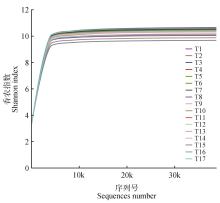
图1
基于土壤细菌ASVs水平的稀释曲线T1~T17代表17个不同的样地。
表2
拉鲁湿地各样点芦苇根际土壤元素含量 (mg·kg-1)
样地 Sampling site | 质量分数 Mass fraction | ||||||
|---|---|---|---|---|---|---|---|
| 钙Ca | 钛Ti | 铁Fe | 锰Mn | 锆Zr | 锶Sr | 铷Rb | |
| T1 | 18 300.00±1 734.94a | 1 440.00±954.83abc | 15 866.67±2 967.04c | 325.33±21.73gh | 216.00±13.75d | 147.00±24.27bcd | 103.67±11.01bc |
| T2 | 17 600.00±953.94a | 1 350.67±282.25abc | 10 900.00±264.58ef | 499.00±76.50b | 94.00±16.37f | 103.67±7.02ef | 55.00±5.57ef |
| T3 | 9 238.33±2 482.03de | 3 215.00±3 798.94a | 9 217.33±949.86f | 237.33±30.14ij | 131.00±5.56e | 127.67±14.05cde | 80.00±4.58d |
| T4 | 9 366.00±982.11de | 1 815.33±108.14abc | 17 033.33±1 858.31c | 361.33±4.04efg | 231.67±21.19cd | 150.00±10.82bcd | 116.00±13.45ab |
| T5 | 13 833.33±230.94b | 1 972.00±281.79abc | 13 033.33±850.50de | 382.33±44.52defg | 150.67±7.51e | 122.00±15.62cdef | 72.00±17.78de |
| T6 | 8 632.00±3 090.87ef | 1 561.67±110.44abc | 15 133.33±472.58cd | 293.33±9.45hi | 165.00±13.00e | 117.67±6.42def | 86.00±8.19cd |
| T7 | 11 355.00±2 602.42cd | 1 679.67±157.49abc | 16 266.66±1 703.92c | 398.33±40.53cdef | 158.00±27.07e | 133.00±11.53bcde | 87.33±18.00cd |
| T8 | 7 550.00±244.35ef | 1 679.67±106.84abc | 12 433.33±2 779.08e | 337.67±17.04fgh | 155.67±24.58e | 122.00±15.52cdef | 76.33±26.63d |
| T9 | 4 625.67±116.50gh | 580.67±61.09c | 10 769.67±771.72ef | 208.00±33.29j | 71.33±2.08f | 48.33±3.21g | 42.33±4.51f |
| T10 | 2 960.33±192.63h | 1 161.67±65.68bc | 11 466.67±57.74ef | 182.67±8.62j | 152.00±14.11e | 84.67±3.51f | 67.33±1.15de |
| T11 | 8 060.00±317.87ef | 2 099.33±114.79abc | 22 900.00±1 058.30b | 576.33±26.69a | 289.00±20.66a | 160.00±12.12abc | 125.67±6.11ab |
| T12 | 6 421.67±844.10fg | 2 267.00±606.92abc | 28 033.33±2 967.04a | 404.33±85.87cdef | 249.00±29.46bcd | 129.00±21.79bcde | 106.33±18.56abc |
| T13 | 7 557.33±504.98ef | 2 362.33±48.22abc | 25 933.33±152.75a | 411.67±10.69cde | 257.00±13.89abc | 134.00±4.58bcde | 128.00±3.61a |
| T14 | 7 490.67±84.74ef | 2 531.67±40.28ab | 26 900.00±781.02a | 409.67±37.54cde | 236.67±16.44cd | 136.33±1.15bcde | 125.33±5.03ab |
| T15 | 9 797.00±23.58cde | 2 467.00±79.30abc | 27 400.00±916.52a | 449.33±17.50bcd | 257.33±17.21abc | 168.00±13.00ab | 112.00±6.24ab |
| T16 | 12 000.00±1 819.34bc | 2 315.33±53.12abc | 27 400.00±1 248.99a | 436.67±22.90bcd | 282.00±45.13ab | 192.67±21.55a | 120.00±4.00ab |
| T17 | 9 802.00±32.08cde | 2 223.33±41.97abc | 23 066.67±737.11b | 453.67±22.59bc | 266.67±8.08abc | 120.33±66.20cdef | 117.67±4.73ab |
表3
拉鲁湿地不同样地芦苇根际土壤环境因子 (g·kg-1)
样地 Sampling site | 质量分数 Mass fraction | ||||
|---|---|---|---|---|---|
| 土壤含水量SWC | 土壤有机质SOM | 全氮TN | 全磷TP | 全钾TK | |
| T1 | 155.40±8.71gh | 22.90±0.30k | 1.33±0.02f | 0.56±0.02def | 23.10±0.30a |
| T2 | 351.13±14.94c | 99.80±0.30b | 4.08±0.30b | 0.95±0.02a | 20.70±3.00a |
| T3 | 218.00±3.12e | 48.80±2.00ef | 2.25±0.10d | 0.59±0.02cde | 23.50±2.00a |
| T4 | 178.60±2.42fg | 42.60±4.00fg | 1.80±0.20def | 0.52±0.03fg | 23.90±2.00a |
| T5 | 142.60±1.75hi | 30.20±4.00ijk | 1.42±0.30f | 0.52±0.01fg | 23.70±2.00a |
| T6 | 176.00±2.88fg | 33.60±1.20hi | 1.46±0.20ef | 0.61±0.03cd | 22.00±0.20a |
| T7 | 259.80±1.41d | 62.00±8.00d | 2.79±0.30c | 0.62±0.02c | 22.20±4.20a |
| T8 | 196.8±2.23ef | 45.80±5.00efg | 1.97±0.10de | 0.61±0.04cd | 21.80±2.00a |
| T9 | 582.00±6.26a | 230.00±13.00a | 9.72±0.30a | 0.71±0.03b | 15.90±2.00b |
| T10 | 389.33±16.34b | 77.10±6.30c | 3.05±0.30c | 0.61±0.03cd | 22.40±4.00a |
| T11 | 58.40±1.80l | 40.20±1.80gh | 1.79±0.10def | 0.55±0.04ef | 22.40±2.00a |
| T12 | 106.27±10.99jk | 24.90±2.00jk | 1.36±0.10f | 0.56±0.01def | 22.93±1.51a |
| T13 | 121.93±3.89ij | 32.70±2.00hij | 1.67±0.10ef | 0.59±0.04cde | 23.70±2.00a |
| T14 | 129.53±2.91ij | 10.10±1.10l | 0.80±0.20g | 0.49±0.02g | 24.90±0.40a |
| T15 | 92.00±9.89k | 32.20±0.80hij | 1.59±0.30ef | 0.52±0.04fg | 22.50±0.91a |
| T16 | 94.67±48.61k | 53.20±3.00e | 2.19±0.70d | 0.58±0.02cde | 22.00±1.75a |
| T17 | 92.60±1.11k | 30.80±1.00ijk | 1.52±0.20ef | 0.57±0.02cdef | 22.30±0.30a |
表4
拉鲁湿地不同区域芦苇根际土壤环境因子分析
区域 Region | 质量分数Mass fraction | |||||||||||
|---|---|---|---|---|---|---|---|---|---|---|---|---|
含水量SWC/ (g·kg-1) | 有机质SOM/ (g·kg-1) | 全氮TN/ (g·kg-1) | 全磷TP/ (g·kg-1) | 全钾TK/ (g·kg-1) | 钙Ca/ (mg·kg-1) | 钛Ti/ (mg·kg-1) | 铁Fe/ (mg·kg-1) | 锰Mn/ (mg·kg-1) | 锆Zr/ (mg·kg-1) | 锶Sr/ (mg·kg-1) | 铷Rb/ (mg·kg-1) | |
西部区域 XB | 241.51±87.01ab | 57.17±34.00b | 2.55±1.22b | 0.70±0.19a | 22.43±22.34a | 15 046.11± 4 545.99a | 2 001.89± 2 164.51ab | 11 994.67± 3 377.57c | 353.89± 122.90ab | 147.00± 55.29b | 126.11± 23.71ab | 79.56± 22.08b |
施工区域 SG | 193.80±44.67bc | 42.90±13.73b | 1.91±6.12b | 0.59±0.52b | 22.43±22.98a | 10 342.58± 3 084.90b | 1 633.75± 288.09ab | 14 216.67± 2 174.58bc | 352.92± 50.58ab | 157.33± 17.70b | 123.67± 12.44ab | 80.42± 17.40b |
居住区域 JZ | 302.08±106.17a | 97.48±81.61a | 4.09±3.44a | 0.60±0.80b | 21.15±39.39a | 6 253.00± 2 723.13c | 1 414.25± 620.30b | 15 542.42± 5 201.29b | 332.08± 164.73b | 186.00± 86.94b | 110.75± 48.80b | 87.83± 36.46b |
栖息区域 QX | 106.17±23.20c | 30.65±13.18b | 1.52±5.09b | 0.55±0.43b | 23.05±15.03a | 8 844.78± 2 057.92b | 2 361.11± 239.73a | 26 455.56± 2 078.52a | 427.56± 40.24a | 258.11± 25.47a | 146.72± 36.43a | 118.22± 10.60a |
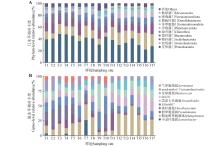
图2
拉鲁湿地不同样地芦苇根际土壤细菌组成分析A.物种相对丰度前10的门;B.物种相对丰度前10的属。横坐标中T1~T17代表17个不同的样地。
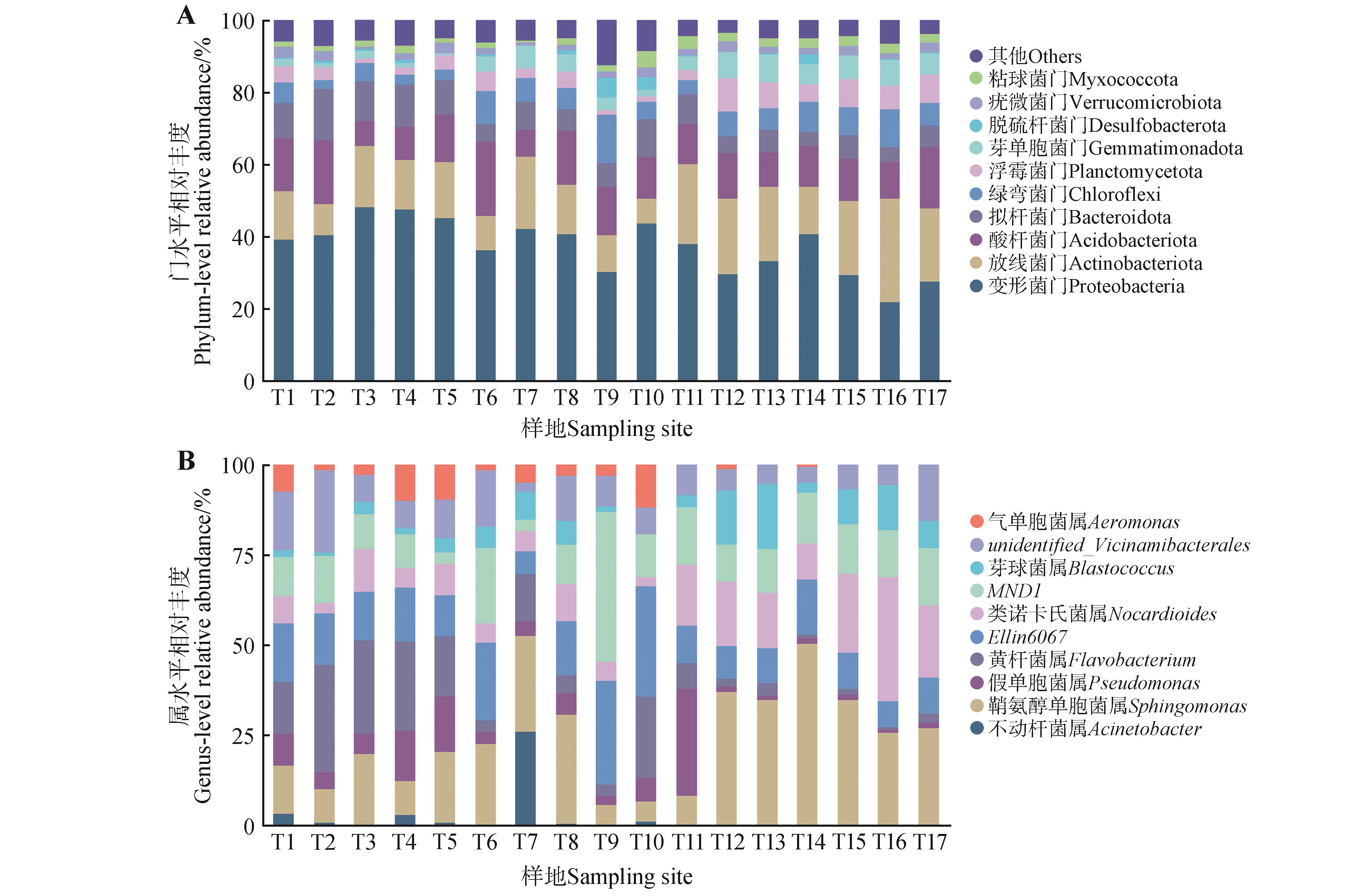
图3
拉鲁湿地不同区域芦苇根际土壤细菌组成分析A.物种相对丰度前10的门;B.物种相对丰度前10的属。XB.西部区域;SG.施工区域;JZ.居住区域;QX.栖息区域。
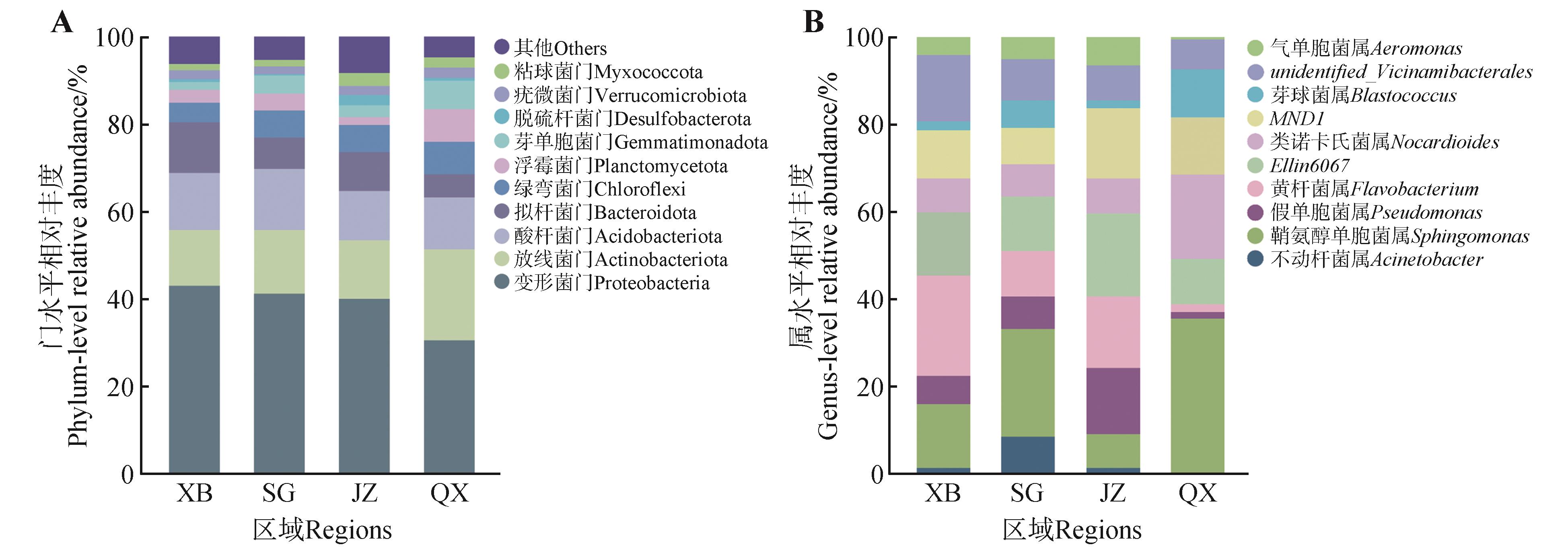
图4
拉鲁湿地芦苇根际土壤细菌多样性特征A.不同样地土壤细菌alpha多样性指数;B.不同区域细菌组内ASVs水平韦恩图分析;C.不同区域间土壤细菌多样性指数组间差异分析;不同字母表示差异显著(P<0.05)。T1~T17代表17个不同的样地;XB.西部区域;SG.施工区域;JZ.居住区域;QX.栖息区域。
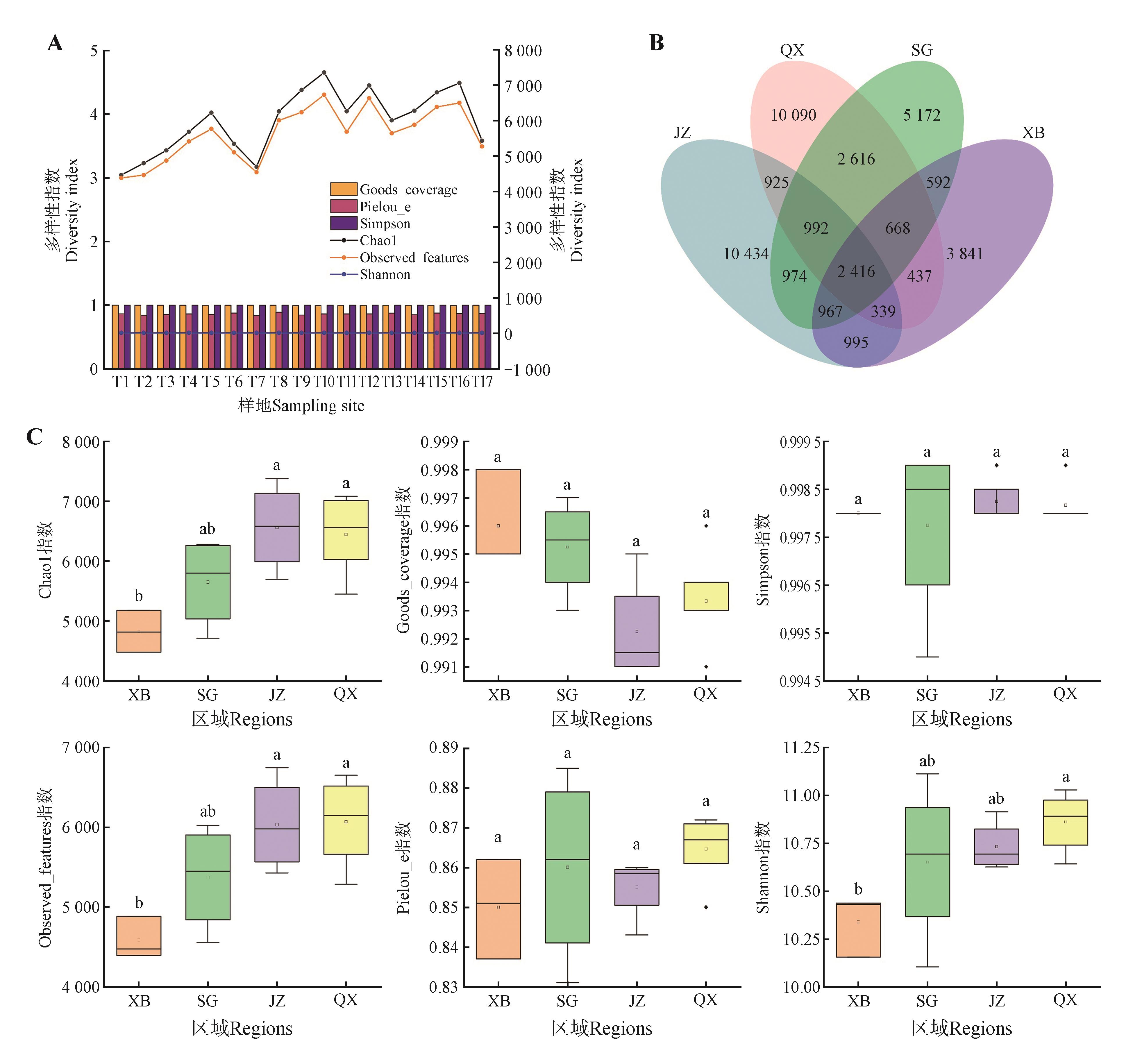
图5
基于加权Unifrac距离矩阵进行UPGMA层次聚类分析纵坐标中T1~T17代表17个不同的样地。
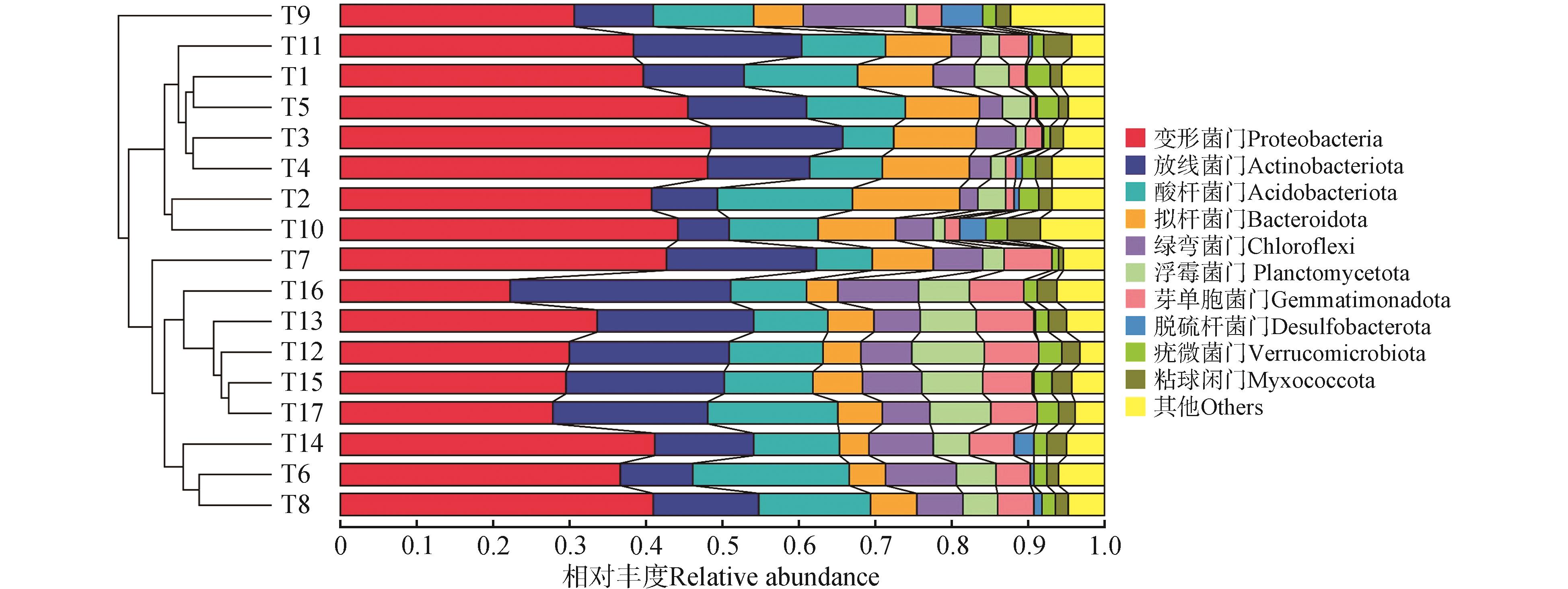
图6
拉鲁湿地芦苇根际土壤细菌群落β多样性分析A.基于Bray-Curtis距离的芦苇根际土壤细菌的主坐标分析(PCoA);B.土壤细菌群落结构在不同区域的非度量多维尺度(NMDS)分析;不同颜色的样本点及围绕在点群外围的椭圆,分别代表不同的分组。XB.西部区域;SG.施工区域;JZ.居住区域;QX.栖息区域
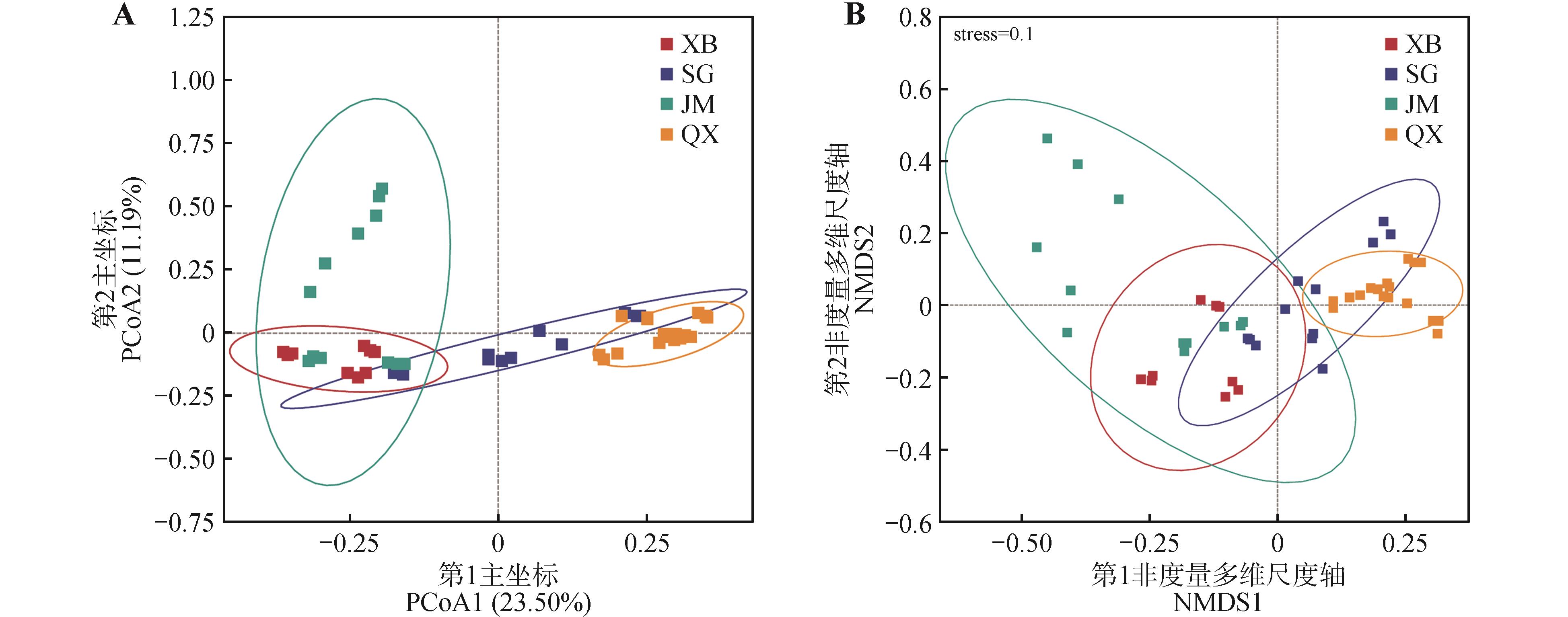
图7
拉鲁湿地芦苇根际土壤细菌多样性指数与土壤环境因子Spearman相关关系?.P<0.05;??.P<0.01;???.P<0.001.
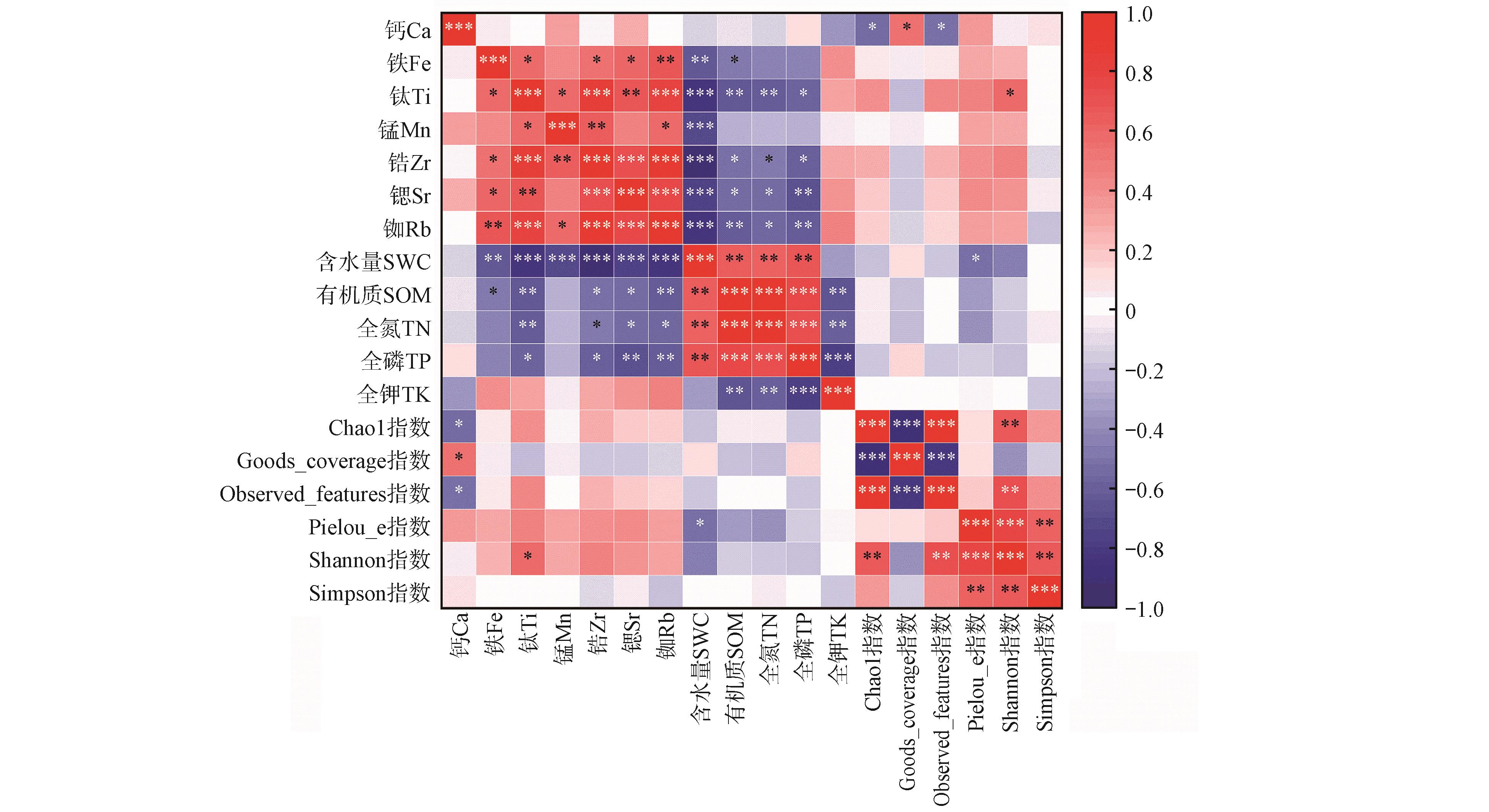
图8
拉鲁湿地芦苇根际土壤细菌群落与环境因子的相关性分析图中相同颜色代表同一组。Ca.钙;Fe.铁;Ti.钛;Mn.锰;Zr.锆;Sr.锶;Rb.铷;SWC.含水量;SOM.有机质;TN.全氮;TP.全磷;TK.全钾。
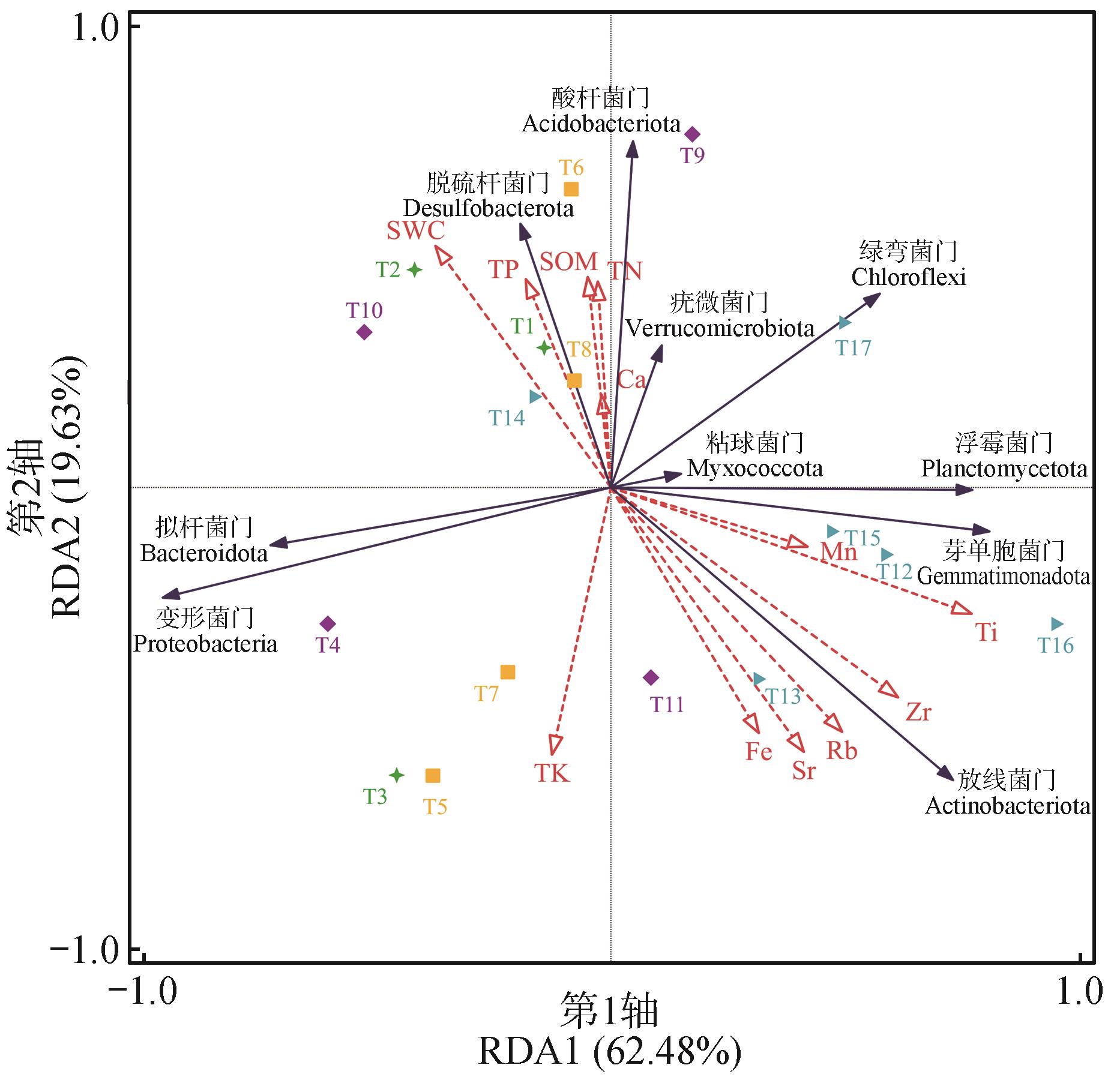
表5
拉鲁湿地芦苇根际土壤环境因子与细菌群落相关性
环境因子 Environmental factor | 解释率 Explanation rate/% | 贡献率 Contribution rate/% | 伪F值 Pseudo-F | 显著性 P |
|---|---|---|---|---|
| Ti | 39.1 | 41.1 | 9.6 | 0.002 |
| TK | 21.0 | 22.1 | 7.4 | 0.002 |
| TP | 5.1 | 5.4 | 3.3 | 0.016 |
| TN | 6.9 | 7.2 | 2.7 | 0.032 |
| Sr | 6.6 | 7.0 | 3.0 | 0.036 |
| Mn | 4.3 | 4.5 | 2.1 | 0.076 |
| Ca | 3.0 | 3.2 | 2.2 | 0.112 |
| Fe | 2.1 | 2.2 | 2.0 | 0.130 |
| SOM | 2.4 | 2.5 | 1.9 | 0.158 |
| SWC | 3.0 | 3.2 | 1.6 | 0.200 |
| Zr | 1.1 | 1.1 | 1.0 | 0.460 |
| Rb | 0.5 | 0.6 | 0.4 | 0.746 |
| [1] | 道日娜,张英,李希来,等.高寒湿地演替过程对土壤细菌多样性的影响[J].环境科学,2025,46(3):1897-1904. |
| DAO R N, ZHANG Y, LI X L,et al.Impact of alpine wetland succession to soil bacterial diversity[J].Environmental Science,2025,46(3):1897-1904. | |
| [2] | 秦卫华,李中林,楚克林.拉萨的“城市之肺”:拉鲁湿地国家级自然保护区[J].生命世界,2022(7):4-19. |
| QIN W H, LI Z L, CHU K L.Lhasa’s “lung of the city”:Lhalu Wetland National Nature Reserve[J].Life World,2022(7):4-19. | |
| [3] | 陈黎明,陈炼钢,李褆来,等.城市湿地公园生态补水调度方案对比分析[J].水资源保护,2022,38(6):162-167. |
| CHEN L M, CHEN L G, LI T L,et al.Comparative analysis of operation schemes for ecological water supply in urban wetland park[J].Water Resources Protection,2022,38(6):162-167. | |
| [4] | 巴桑,黄香,普布,等.拉鲁湿地肉鞭虫群落特征及其水环境评价[J].湿地科学,2014,12(2):182-191. |
| BA S, HANG X, PU B,et al.Community characteristics of sarcodines and flagellates and water environment evaluation in Lhalu Wetlands[J].Wetland Science,2014,12(2):182-191. | |
| [5] | 刘晓曼,庄大方,屈冉,等.基于遥感数据的1989~2009年拉鲁湿地变化研究[J].湿地科学,2013,11(4):433-437. |
| LIU X M, ZHUANG D F, QU R,et al.Change of Lalu Wetlands from 1989 to 2009 based on remote sensing data [J].Wetland Science,2013,11(4):433-437. | |
| [6] | 王佳俊,田瀚鑫,周磊,等.拉鲁湿地水生植物群落多样性与水环境因子的关系[J].环境科学,2020,41(4):1657-1665. |
| WANG J J, TIAN H X, ZHOU L,et al.Relationship between diversity of aquatic plant communities and water environmental factors in Lhalu Wetland[J].Environmental Science,2020,41(4):1657-1665. | |
| [7] | 白永飞,吕学斌,吴坚扎西,等.拉鲁湿地芦苇不同部位金属元素富集规律研究[J].环境监测管理与技术,2019,31(2):35-39. |
| BAI Y F, LÜ X B, WU J Z X,et al.Study on the enrichment of metallic element in different parts of Phragmites australis in Lhalu Wetland[J].The Administration and Technique of Environmental Monitoring,2019,31(2):35-39. | |
| [8] | WANG D L, BAI Y H, QU J H,et al.The Phragmites root-inhabiting microbiome:a critical review on its composition and environmental application[J].Engineering,2022,9(2):42-50. |
| [9] | 陈孝杨,王芳,严家平,等.覆土厚度对矿区复垦土壤呼吸昼夜变化的影响[J].中国矿业大学学报,2016,45(1):163-169. |
| CHEN X Y, WANG F, YAN J P,et al.Effect of coversoil thickness on diurnal variation characteristics of reclaimed soil respiration in coal mining areas[J].Journal of China University of Mining & Technology,2016,45(1):163-169. | |
| [10] | 肖博文.气候变化下高寒草地土壤微生物群落结构变化及季节动态[D].兰州:兰州大学,2022. |
| XIAO B W.Changes in soil microbial community structure and its seasonal dynamics in an alpine grassland under climate change[D].Lanzhou:Lanzhou University,2022. | |
| [11] | 安丽芸,李君剑,严俊霞,等.微生物多样性对土壤碳代谢特征的影响[J].环境科学,2017,38(10):4420-4426. |
| AN L Y, LI J J, YAN J X,et al.Effects of microbial diversity on soil carbon mineralization[J].Environmental Science,2017,38(10):4420-4426. | |
| [12] | 周生灵,杨乐,刘善思,等.西藏拉鲁湿地自然保护区鸟类群落季节动态[J].生物学杂志,2020,37(4):66-71. |
| ZHOU S L, YANG L, LIU S S,et al.Seasonal dynamics of bird community in Lhalu Wetland National Nature Reserve,Tibet,China[J].Journal of Biology,2020,37(4):66-71. | |
| [13] | 李伟,孙晶,熊健,等.西藏拉鲁湿地表层土壤重金属分布特征和风险评价[J].环境科学与技术,2023,46(1):92-100. |
| LI W, SUN J, XIONG J,et al.Distribution characteristics and risk assessment of heavy metals in the surface soil of Lhalu Wetland,Xizang[J].Environmental Science & Technology,2023,46(1):92-100. | |
| [14] | 刘洋,张艳秋,宋文涛,等.西藏拉鲁湿地浮游植物优势种时空动态及其生态适应性[J].湖泊科学,2024,36(6):1864-1878. |
| LIU Y, ZHANG Y Q, SONG W T,et al.The spatio-temporal dynamics and ecological adaptability of dominant phytoplankton species in Lhalu Wetland,Xizang,China[J].Journal of Lake Sciences,2024,36(6):1864-1878. | |
| [15] | 杨方典,张鹏,罗帅,等.基于宏基因组的西藏拉鲁湿地原生生物多样性研究[J].水生态学杂志,2025,46(1):81-89. |
| YANG F D, ZHANG P, LUO S,et al.Protist diversity in the Lhalu Wetland of Tibet based on metagenomic sequencing[J].Journal of Hydroecology,2025,46(1):81-89. | |
| [16] | 钟文辉,蔡祖聪.土壤管理措施及环境因素对土壤微生物多样性影响研究进展[J].生物多样性,2004, 12(4):456-465. |
| ZHONG W H, CAI Z C.Effect of soil management practices and environmental factors on soil microbial diversity:a review[J].Biodiversity Science,2004,12(4):456-465. | |
| [17] | 张玲豫,齐雅柯,焦健,等.河西走廊沙地芦苇(Phragmites australis)根际土壤微生物群落多样性[J].中国沙漠,2021,41(6):1-9. |
| ZHANG L Y, QI Y K, JIAO J,et al.Microbial community diversity of reed rhizosphere soil in different sandy land habitats of Hexi Corridor,Gansu,China[J].Journal of Desert Research,2021,41(6):1-9. | |
| [18] | 张鑫磊,金锐,杨镇,等.长江口崇明东滩湿地微生物群落结构研究[J].土壤通报,2019,50(5):1178-1184. |
| ZHANG X L, JIN R, YANG Z,et al.Microbial community structure in the Chongming eastern wetland of the Yangtze estuary[J].Chinese Journal of Soil Science,2019,50(5):1178-1184. | |
| [19] | 赵华显,阎冰,徐悦,等.北部湾红树林沉积物中微生物群落结构的时空变化分析[J].基因组学与应用生物学,2020,39(5):2161-2169. |
| ZHAO H X, YAN B, XU Y,et al.Spatiotemporal analysis of microbial community structure in the mangrove sediments in Beibu Gulf[J].Genomics and Applied Biology,2020,39(5):2161-2169. | |
| [20] | 孟妍君,秦鹏.珠江三角洲滨海湿地土壤微生物群落多样性与养分的耦合关系[J].水土保持研究,2020,27(6):77-84. |
| MENG Y J, QING P.Coupling relationship between microbial community diversity and soil nutrients in different wetlands in coastal area of Pearl River Delta[J].Research of Soil and Water Conservation,2020,27(6):77-84. | |
| [21] | 唐旖.九龙江口及台湾海峡沉积物中细菌和古菌群落结构分析[D].上海:上海大学,2021. |
| TANG Y.Community structure analysis of bacteria and archaea in sediments of the Jiulong River Estuary and the Taiwan Strait[D].Shanghai:Shanghai University,2021. | |
| [22] | 李金业,陈庆锋,李青,等.黄河三角洲滨海湿地微生物多样性及其驱动因子[J].生态学报,2021,41(15):6103-6114. |
| LI J Y, CHEN Q F, LI Q,et al.Analysis of microbial diversity and driving factors in coastal wetlands of the Yellow River Delta[J].Acta Ecologica Sinica,41(15):6103-6114. | |
| [23] | 李玉倩,马俊伟,高超,等.青藏高原高寒湿地春夏两季根际与非根际土壤反硝化速率及nirS型反硝化细菌群落特征分析[J].环境科学,2021,42(10):4959-4967. |
| LI Y Q, MA J W, GAO C,et al.Denitrification rates and nirS-type denitrifying bacteria community structure characteristics of bulk and rhizosphere soil in spring and summer in the alpine wetlands of the Qinghai-Tibet Plateau[J].Environmental Science,2021,42(10):4959-4967. | |
| [24] | 赵定蓉,陆梅,赵旭燕,等.土壤细菌群落对纳帕海高原湿地退化的响应[J].浙江农林大学学报,2024, 41(2):406-418. |
| ZHAO D R, LU M, ZHAO X Y,et al.Response of soil bacterial community to wetland degradation in the Napahai Plateau[J].Journal of Zhejiang A&F University,2024,41(2):406-418. | |
| [25] | ZHANG M Z, DARAZ U, SUN Q Y,et al.Denitrifier abundance and community composition linked to denitrification potential in river sediments[J].Environmental Science and Pollution Research,2021,28(37):51928-51939. |
| [26] | 刘辉,韦璐璐,朱龙发,等.鞘氨醇单胞菌的研究进展[J].微生物学通报,2023,50(6):2738-2752. |
| LIU H, WEI L L, ZHU L F,et al.Research progress of Sphingomonas [J].Microbiology China,2023,50(6):2738-2752. | |
| [27] | 齐雅柯.河西走廊不同生态型芦苇异速生长和根际微生物多样性研究[D].兰州:甘肃农业大学,2023. |
| QI Y K.Study on the allometry and rhizosphere microorganism diversity of different ecotypes of Phragmites australis in Hexi Corridor[D].Lanzhou:Gansu Agricultural University,2023. | |
| [28] | 陈桂鲜,吴传发,葛体达,等.土壤多功能性对微生物多样性降低的响应[J].环境科学,2022,43(11):5274-5285. |
| CHEN G X, WU C F, GE T D,et al.Response of soil multifunctionality to reduced microbial diversity[J].Environmental Science,2022,43(11):5274-5285. | |
| [29] | 王建民,潘保田.青藏高原东部黄土沉积的基本特征及其环境[J].中国沙漠,1997,17(4):395-402. |
| WANG J M, PAN B T.Loess deposit in eastern part of Qinghai-Xizang Plateau:its characteristics and environment[J].Journal of Desert Research,1997,17(4):395-402. | |
| [30] | CHEN L, WANG Z W, DU S,et al.Antimicrobial activity and functional genes of actinobacteria from coastal wetland[J].Current Microbiology,2021,78(8):3058-3067. |
| [31] | 陈晨,陈浬,李彦澄,等.贵州典型煤矸石堆场微生物群落结构及功能特征[J].微生物学通报,2023,50(12):5300-5319. |
| CHEN C, CHEN L, LI Y C,et al.Structural and functional characteristics of microbial communities of typical coal gangue dumps in Guizhou Province[J].Microbiology China,2023,50(12):5300-5319. | |
| [32] | 陈伟,季秀玲,孙策,等.纳帕海高原湿地土壤细菌群落多样性初步研究[J].中国微生态学杂志,2015, 27(10):1117-1123. |
| CHEN W, JI X L, SUN C,et al.Preliminary study on diversity of bacteria community in Napahai Plateau wetland[J].Chinese Journal of Microecology,2015,27(10):1117-1123. | |
| [33] | BAUER M, KUBE M, TEELING H,et al.Whole genome analysis of the marine Bacteroidetes ‘Gramella forsetii’ reveals adaptations to degradation of polymeric organic matter[J].Environmental Microbiology,2006,8(12):2201-2213. |
| [34] | 支君,段文标,高明,等.土地利用方式对土壤细菌群落结构和功能的影响[J].植物研究,2025,45(1):22-33. |
| ZHI J, DUAN W B, GAO M,et al.Impact of land use patterns on the structure and function of soil bacterial communities[J].Bulletin of Botanical Research,2025,45(1):22-33. | |
| [35] | COLUCCIA M, BESAURY L.Acidobacteria members harbour an abundant and diverse carbohydrate-active enzymes(cazyme) and secreted proteasome repertoire,key factors for potential efficient biomass degradation[J].Molecular Genetics and Genomics,2023,298(5):1135-1154. |
| [36] | ZEGLIN L H, DAHM C N, BARRETT J E,et al.Bacterial community structure along moisture gradients in the parafluvial sediments of two ephemeral desert streams[J].Microbial Ecology,2011,61(3):543-556. |
| [37] | 解维俊,赵玉庭,刘元进,等.大钦岛不同养殖年限深水网箱沉积物微生物群落结构分析[J].海洋科学,2022,46(12):31-40. |
| XIE W J, ZHAO Y T, LIU Y J,et al.Analysis of the microbial community structure of deep-water net tank sediments of Daqin Island at different culture years[J].Marine Sciences,2022,46(12):31-40. | |
| [38] | 赵玉卉,路等学,金辉,等.甘肃省野生羊肚菌根际细菌群落与土壤环境因子相关性研究[J].微生物学通报,2022,49(2):514-528. |
| ZHAO Y H, LU D X, JIN H,et al.Relationship between the bacterial community and environmental factors in the rhizosphere soil of wild morels in Gansu[J].Microbiology China,2022,49(2):514-528. |
| [1] | 彭婉婷, 陈金宇, 杨帆, 李焮玉, 郭芯怡, 魏祎, 王洪义, 王智慧. 三种不同草地植物叶际微生物多样性对比分析[J]. 植物研究, 2026, 46(3): 531-541. |
| [2] | 买凯乐, 张象君, 何振革, 梁梅华, 劳广杰, 陶玉姣. 中国马蹄荷群落植物多样性及其驱动机制[J]. 植物研究, 2026, 46(1): 167-180. |
| [3] | 张珊珊, 阮孙美, 杨文忠. 云南金花茶的遗传多样性评价和核心种质构建[J]. 植物研究, 2025, 45(6): 909-918. |
| [4] | 王兰, 周迪, 薛曌, 王东旭, 郭小芳, 德吉. 不同生长时期青稞种子内生细菌群落动态研究[J]. 植物研究, 2025, 45(6): 965-974. |
| [5] | 白宏超, 赵熙明, 邓睿, 刘宇宁, 杜玉啸, 郑宝江. 中国野生茶藨子属物种多样性与分布格局[J]. 植物研究, 2025, 45(6): 975-983. |
| [6] | 岑念, 任柳伊, 白新祥, 李美君. 四川省野生凤仙花属物种多样性与地理分布[J]. 植物研究, 2025, 45(6): 984-996. |
| [7] | 龙姿羽, 王志成, 赵蕊, 刘冰, 陈功锡. 德夯地质公园岩溶河谷源头瀑布草本群落植物多样性[J]. 植物研究, 2025, 45(5): 707-721. |
| [8] | 汤嘉莹, 张进坤, 胡继文, 王福德, 辛培尧, 麻文俊. 大兴安岭地区野生芍药居群表型多样性[J]. 植物研究, 2025, 45(2): 299-314. |
| [9] | 高智远, 司孟鑫, 王彪, 马和平. 林芝地区典型区域藓类植物多样性与区系分析[J]. 植物研究, 2024, 44(6): 890-900. |
| [10] | 张喜亭, 张建宇, 仲召亮, 王文杰. 大兴安岭绰纳河保护区植物多样性特征[J]. 植物研究, 2024, 44(5): 730-737. |
| [11] | 秦斗文, 刘伟强, 田吉婷, 唐楠, 巨秀婷. 基于SRAP分子标记的郁金香遗传多样性分析[J]. 植物研究, 2024, 44(5): 783-792. |
| [12] | 张志文, 白宏超, 刘争, 李文光, 杨光, 郑宝江. 东北地区野生茶藨子属物种多样性与分布格局[J]. 植物研究, 2024, 44(2): 192-199. |
| [13] | 文妍莉, 李嵘. 滇产单子叶植物的多样性格局与保护[J]. 植物研究, 2024, 44(2): 200-209. |
| [14] | 马钰琦, 李宇惠, 林琳, 沈悦, 顾钰峰, 王发国. 深圳双扇蕨依存环境的植物群落学特征[J]. 植物研究, 2024, 44(1): 34-44. |
| [15] | 穆怀志, 王清玉, 张玥, 吕松瞳, 靳旭红, 张骁, 夏富才. 基于叶片和果实性状的糠椴天然居群表型变异及多样性分析[J]. 植物研究, 2023, 43(6): 826-834. |
| 阅读次数 | ||||||
|
全文 |
|
|||||
|
摘要 |
|
|||||