Bulletin of Botanical Research ›› 2026, Vol. 46 ›› Issue (3): 481-492.doi: 10.7525/j.issn.1673-5102.2026.03.009
• Original Paper • Previous Articles Next Articles
Siqi WANG, Yunjie BI, Huixian LI, Zhengbao SONG, Runke LIU, Ruixin GAO( )
)
Received:2025-11-20
Online:2026-05-20
Published:2026-06-01
Contact:
Ruixin GAO
E-mail:ruixingao@126.com
CLC Number:
Siqi WANG, Yunjie BI, Huixian LI, Zhengbao SONG, Runke LIU, Ruixin GAO. Effect of Exogenous Gibberellin on Seed Germination of Agastache rugosa under Salt Stress[J]. Bulletin of Botanical Research, 2026, 46(3): 481-492.
Add to citation manager EndNote|Ris|BibTeX
URL: https://bbr.nefu.edu.cn/EN/10.7525/j.issn.1673-5102.2026.03.009
Table 1
Effect of different NaCl concentrations stress on the germination index of Agastache rugosa seeds
处理 Treatment | 发芽势 Germination potential/% | 发芽率 Germination rate/% | 发芽指数 Germination index |
|---|---|---|---|
| CK | 70.67±9.32a | 78.00±0.10a | 11.14±0.01a |
| 50 mmol·L-1 NaCl | 39.30±0.10b | 70.00±0.10b | 10.00±0.10b |
| 75 mmol·L-1 NaCl | 36.60±0.10b | 57.60±0.10c | 6.81±0.01c |
| 100 mmol·L-1 NaCl | 36.00±0.10b | 40.60±0.10d | 5.81±0.01d |
| 125 mmol·L-1 NaCl | 23.30±0.10c | 17.00±0.10e | 1.62±0.01e |
| 150 mmol·L-1 NaCl | 6.00±0.10d | 11.00±0.10f | 0.86±0.01f |
Table 2
Effects of different mass concentrations of GA3 on the germination of Agastache rugosa seeds under NaCl stress
处理 Treatment | 发芽势 Germination potential/% | 发芽率 Germination rate/% | 发芽指数 Germination index |
|---|---|---|---|
| 100 mmol·L-1 NaCl | 36.00±1.00a | 40.60±0.10b | 5.81±0.01b |
| 100 mmol·L-1 NaCl+50 mg·L-1 GA₃ | 25.67±1.00d | 66.67±6.11a | 9.52±0.01a |
| 100 mmol·L-1 NaCl+100 mg·L-1 GA₃ | 34.67±1.00ab | 72.33±2.08a | 10.33±0.01a |
| 100 mmol·L-1 NaCl+150 mg·L-1 GA₃ | 31.33±1.00c | 73.33±4.51a | 10.48±0.01a |
| 100 mmol·L-1 NaCl+200 mg·L-1 GA₃ | 32.67±1.00bc | 72.67±7.51a | 10.38±1.00a |
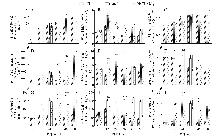
Fig.1
Effect of exogenously applied GA3 on physiological and biochemical parameters of Agastache rugosa seeds under NaCl stressThe markers *,**,***,****, ns represented different levels of significance P<0.05,P<0.01, P<0.001,P<0.000 1,no significant difference,respectively.
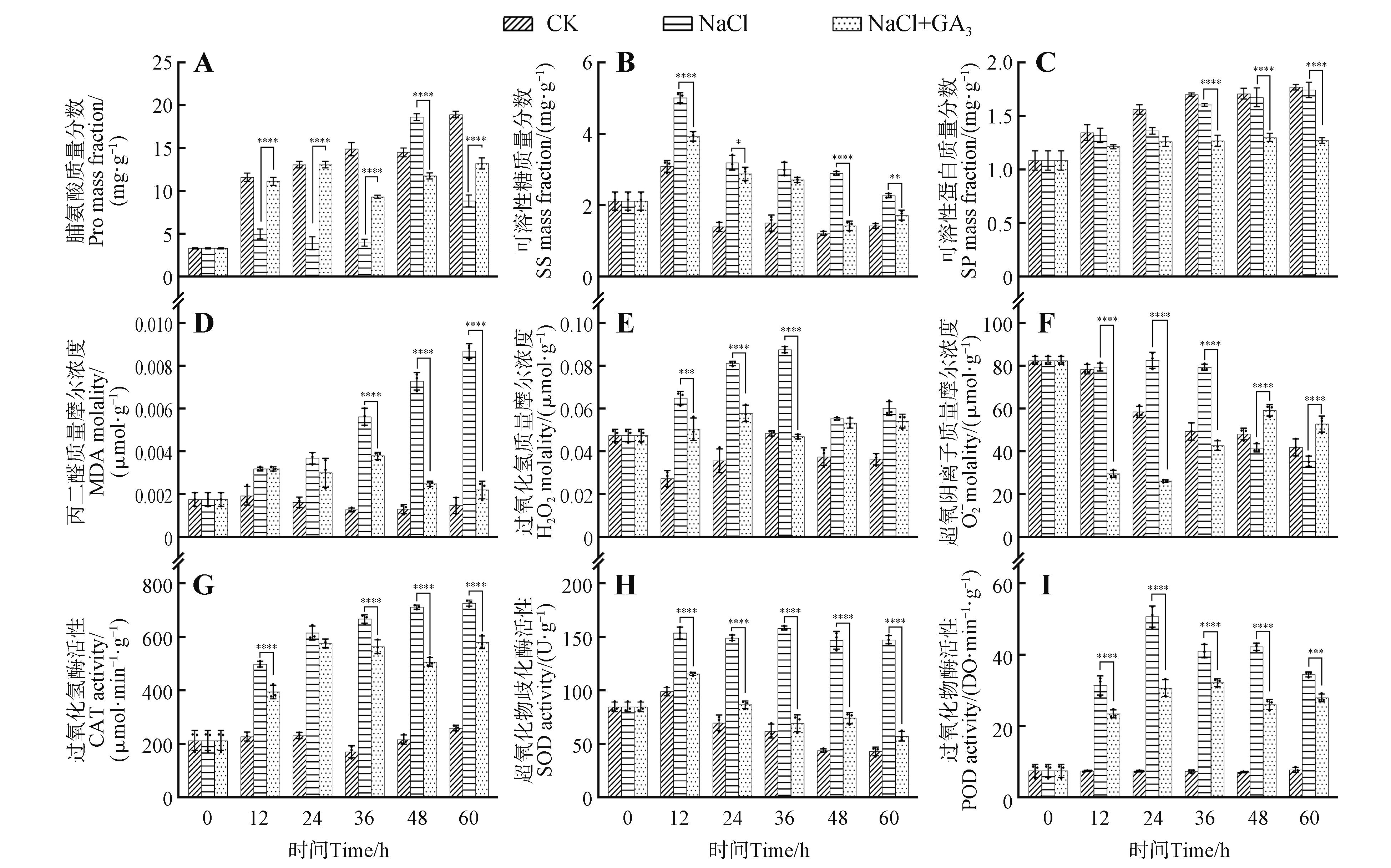
Table 3
Number of differentially expressed genes in seeds between the NaCl treatment group and NaCl+GA3 treatment group at 24 h and 48 h
比较组别 Compared group | 差异表达基因总数量 Total number of differentially expressed genes | 上调基因数量 Number of up-regulated genes | 下调基因数量 Number of down-regulated genes |
|---|---|---|---|
NaCl+GA3处理24 h与NaCl处理24 h对比 NG24-vs-N24 | 825 | 447 | 378 |
NaCl+GA3处理48 h与NaCl处理48 h对比 NG48-vs-N48 | 3 402 | 436 | 2 966 |
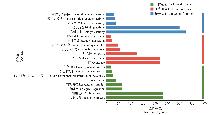
Fig.2
GO functional annotation of differentially expressed genes in seeds treated with NaCl+GA3 vs NaCl for 24 h
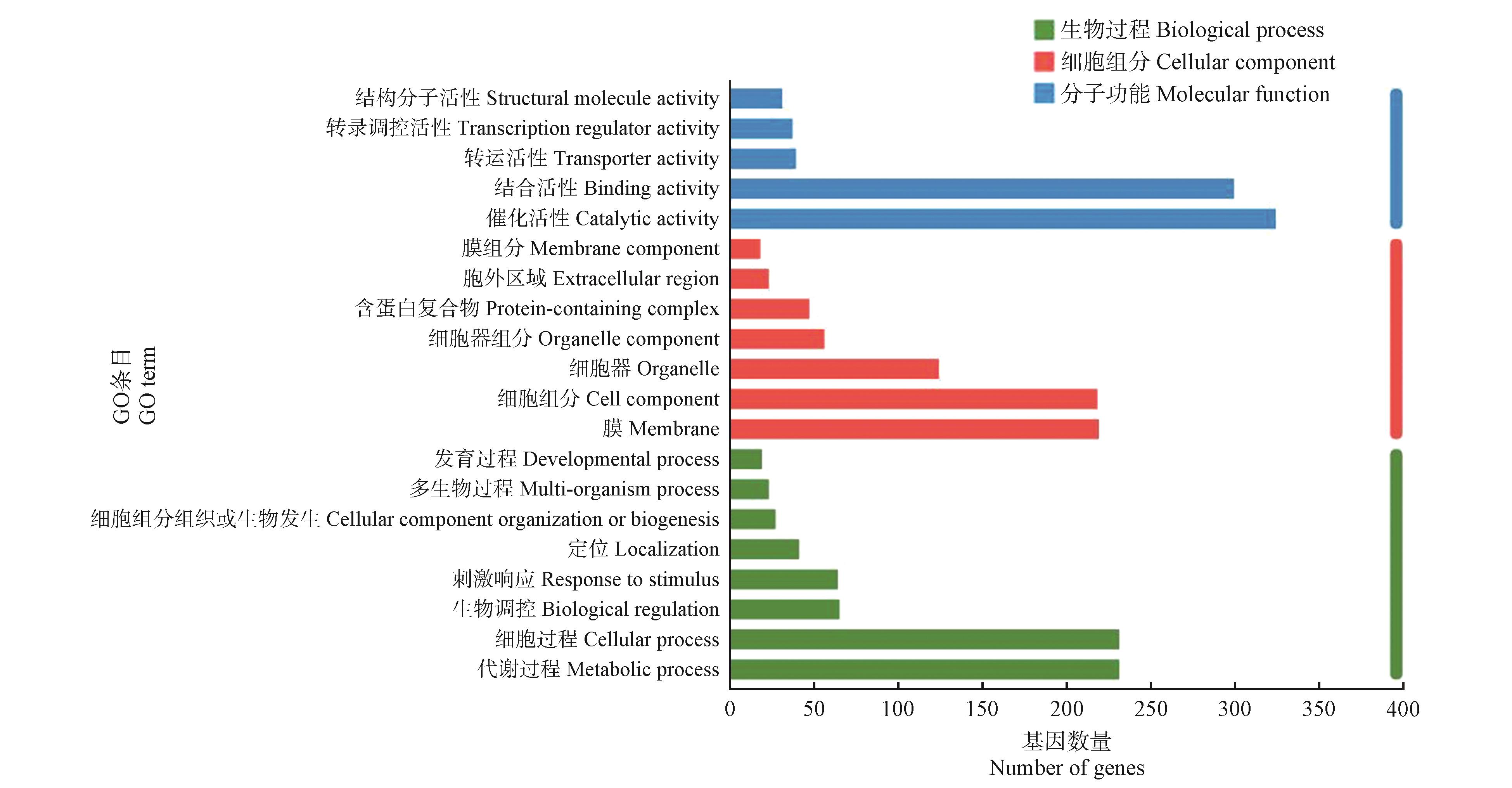
Fig.3
GO functional annotation of differentially expressed genes in seeds treated with NaCl+GA3 vs NaClfor 48 h
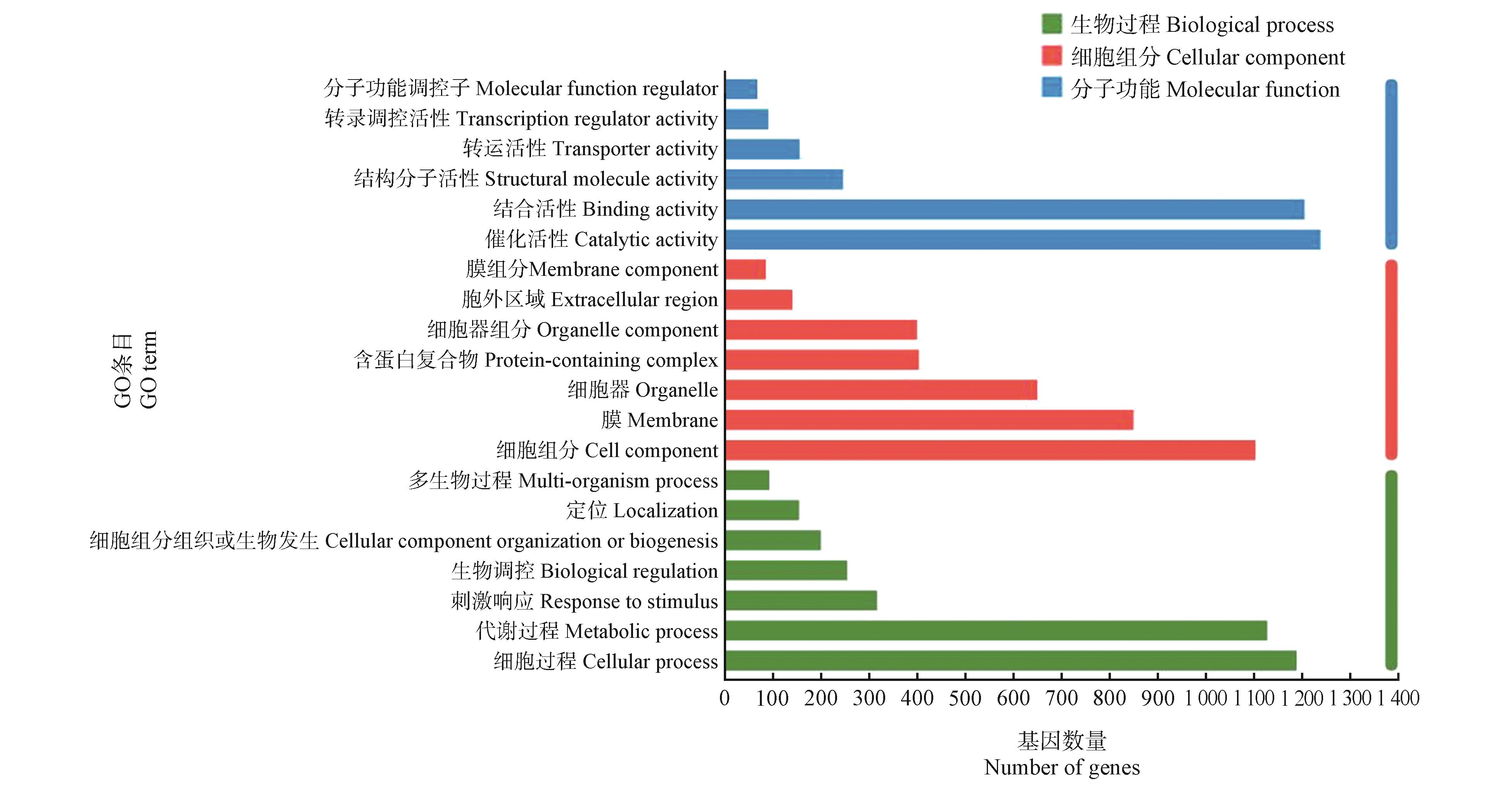

Fig.4
KEGG enrichment map of differentially expressed genes in seeds treated with NaCl+GA3 vs NaCl for 24 h
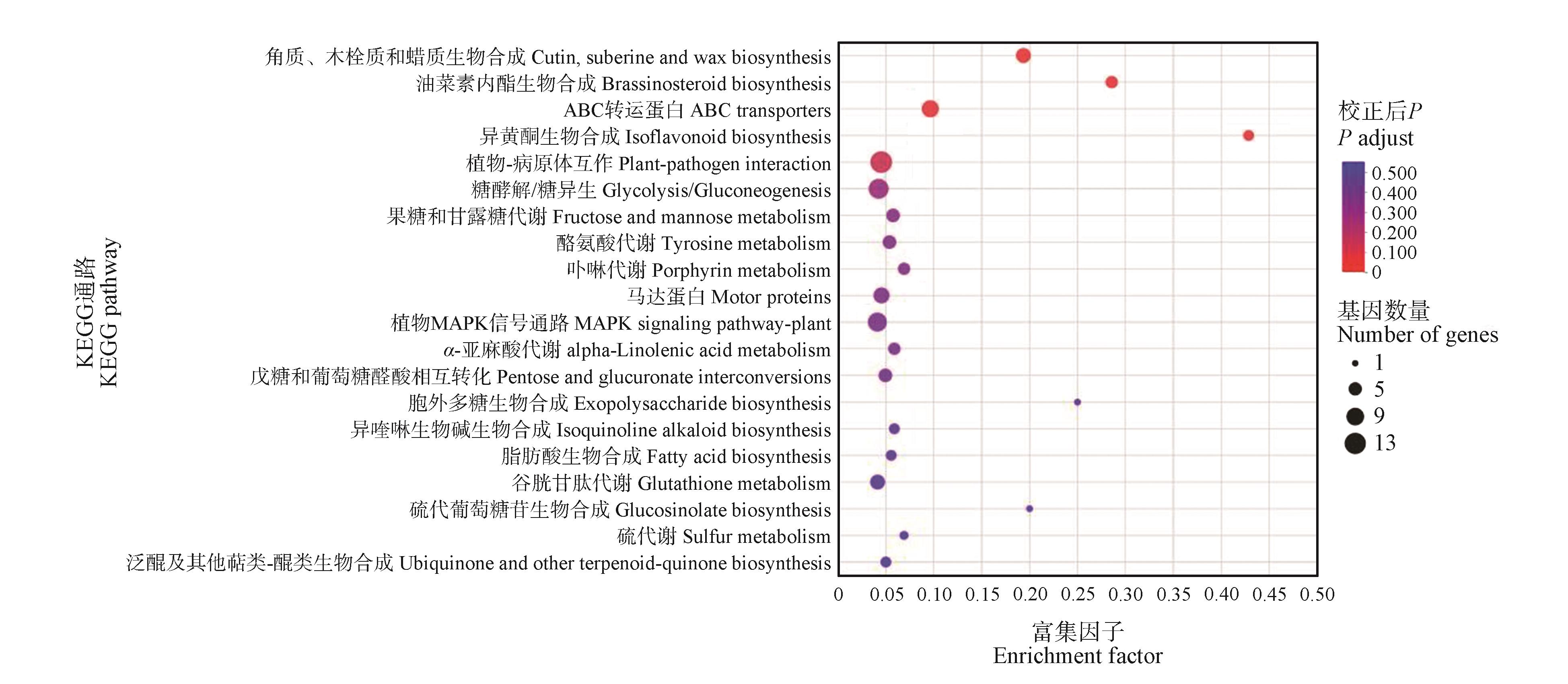
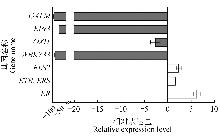
Fig.5
Gene expression level of MAPK signaling pathway in seeds treated with NaCl+GA3 vs NaCl for 24 h
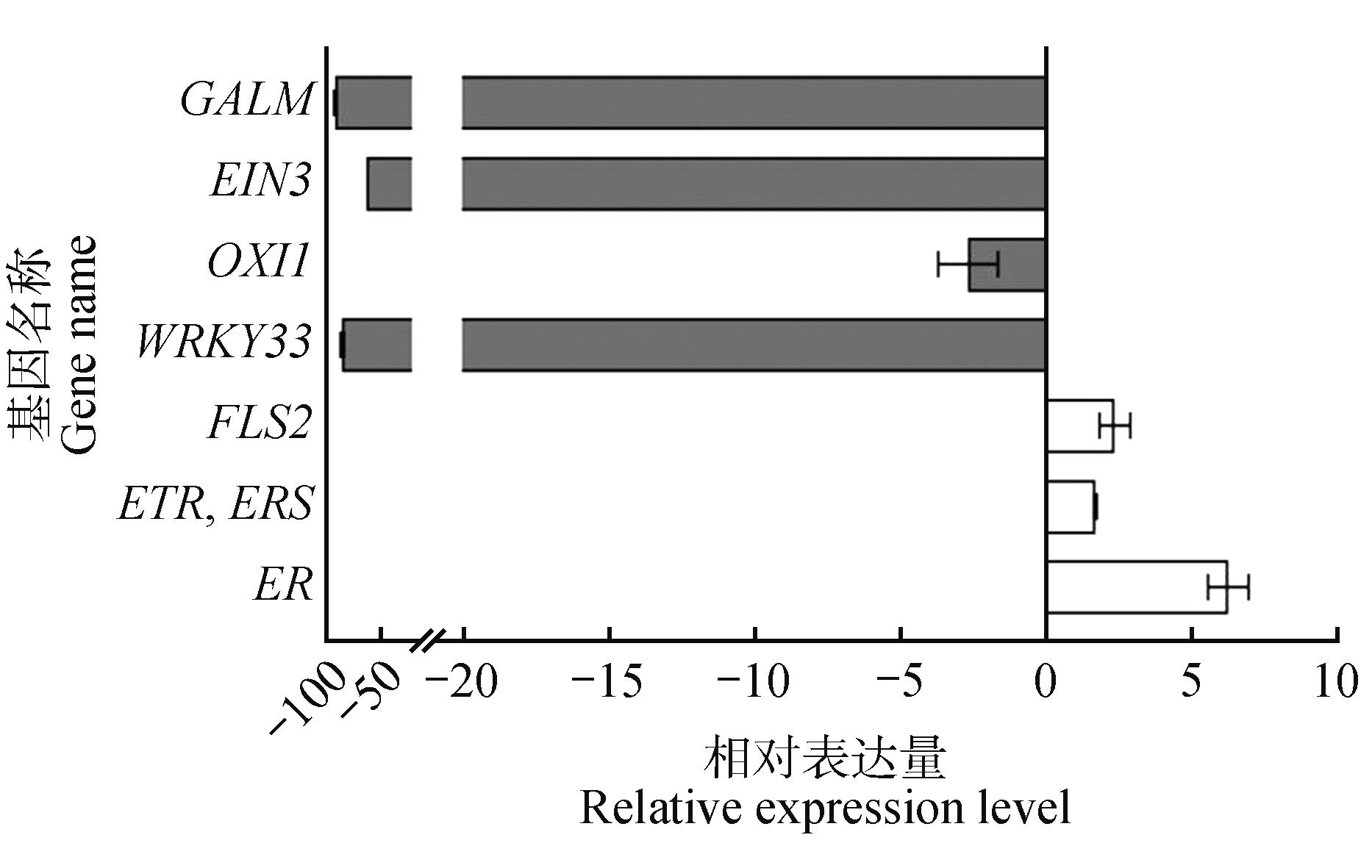
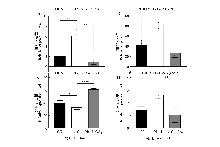
Fig.6
Relative expression levels of germination-related genes in Agastache rugosa seeds under different treatments for 24 hThe markers *,**,***,****,ns represented different levels of significance P<0.05,P<0.01,P<0.001,P<0.0001,no significant difference,respectively.
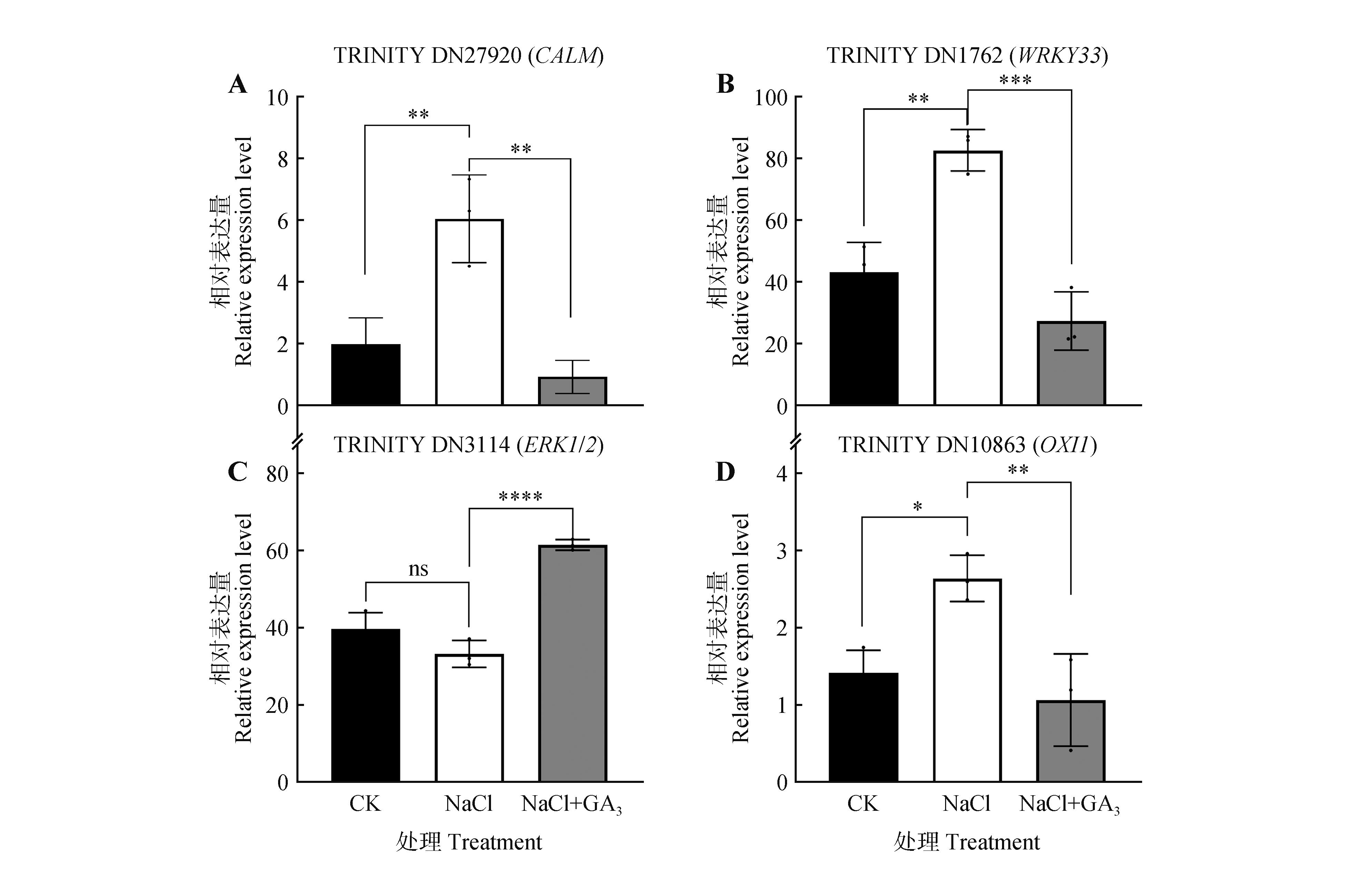
Fig.7
KEGG enrichment map of differentially expressed genes in seeds treated with NaCl+GA3 vs NaCl for 48 h
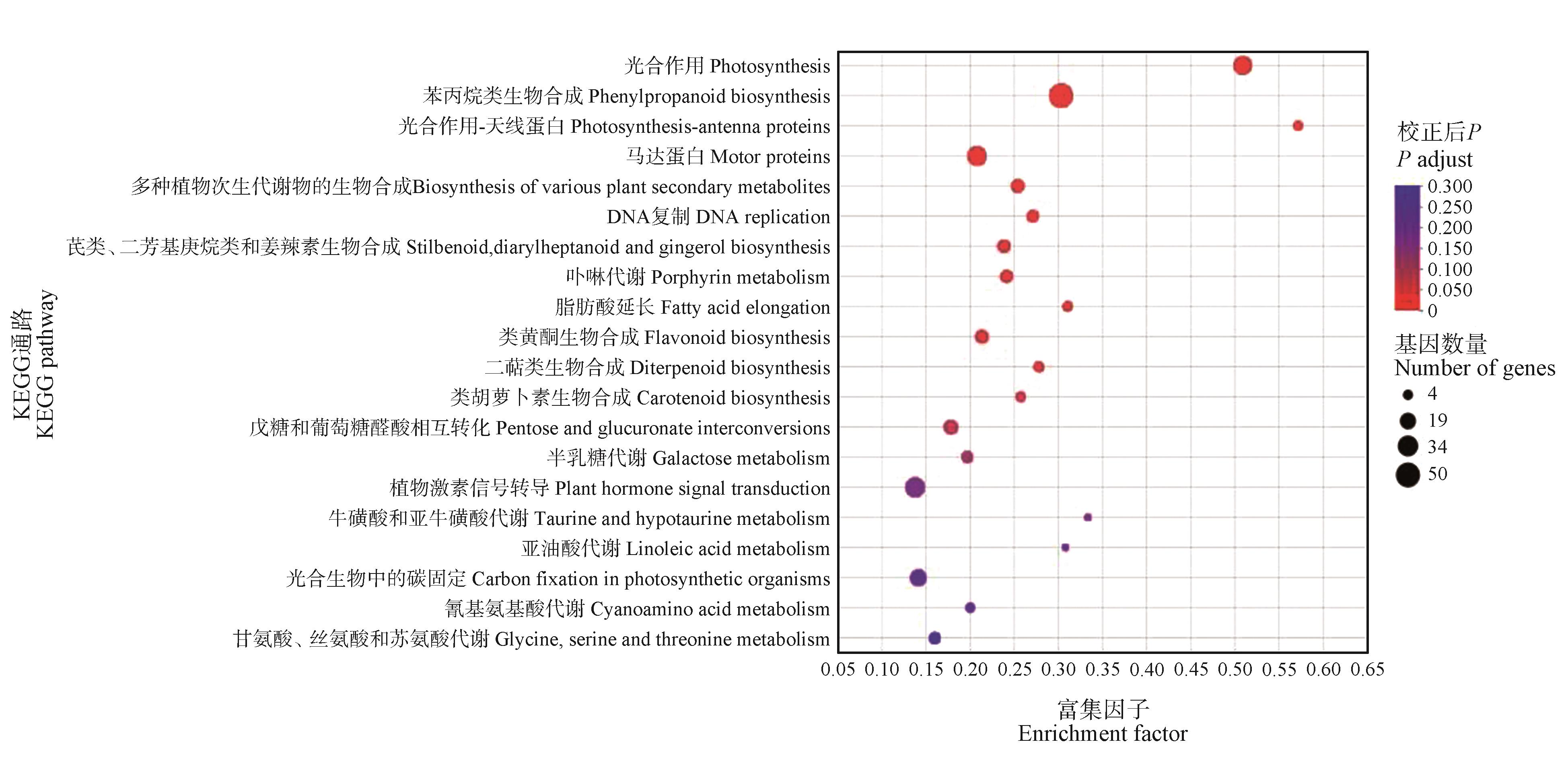
Fig.8
Expression level of MAPK signaling pathway genes in Agastache rugosa seeds treated with NaCl+GA3 vs NaCl for 48 h
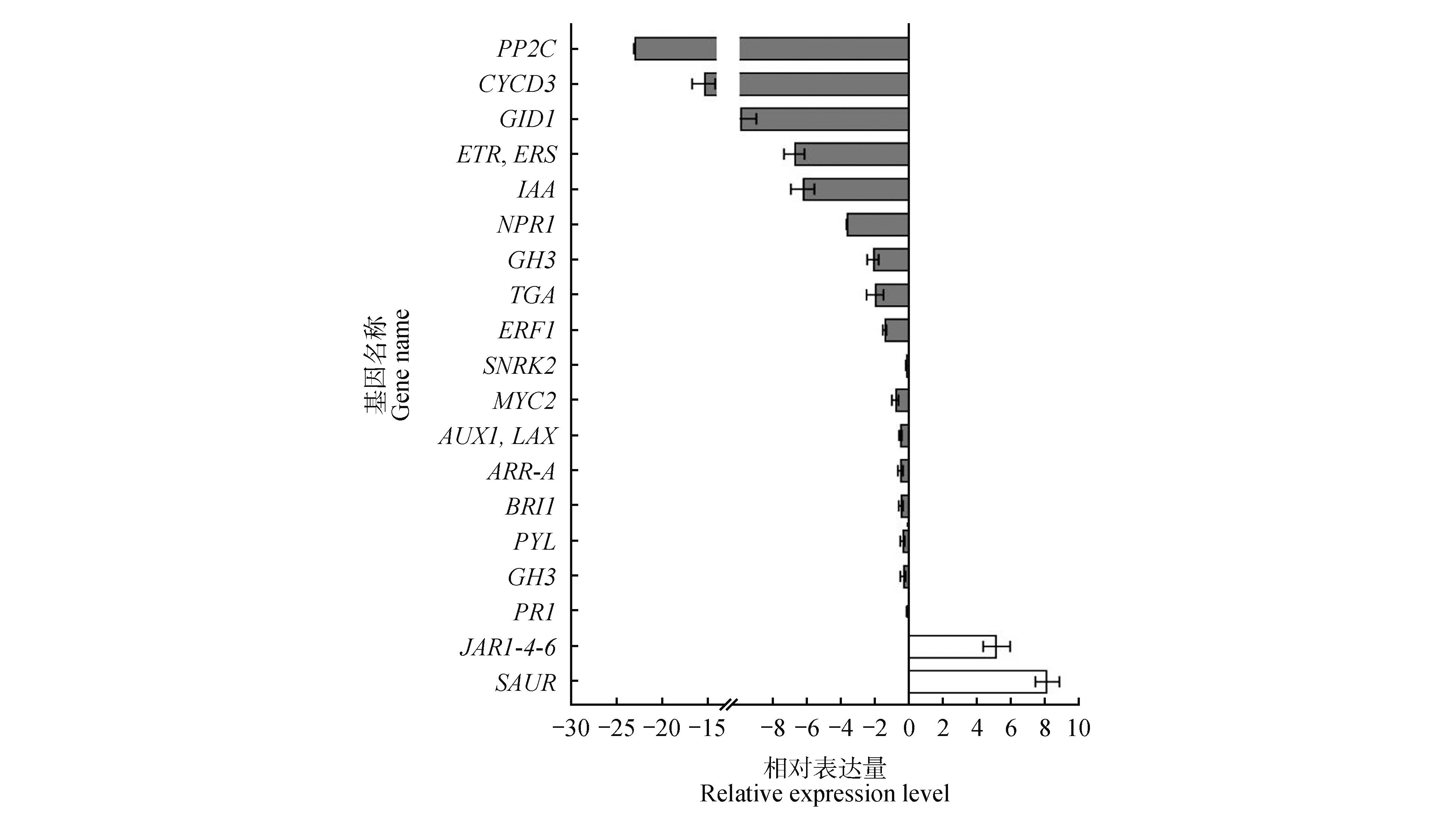
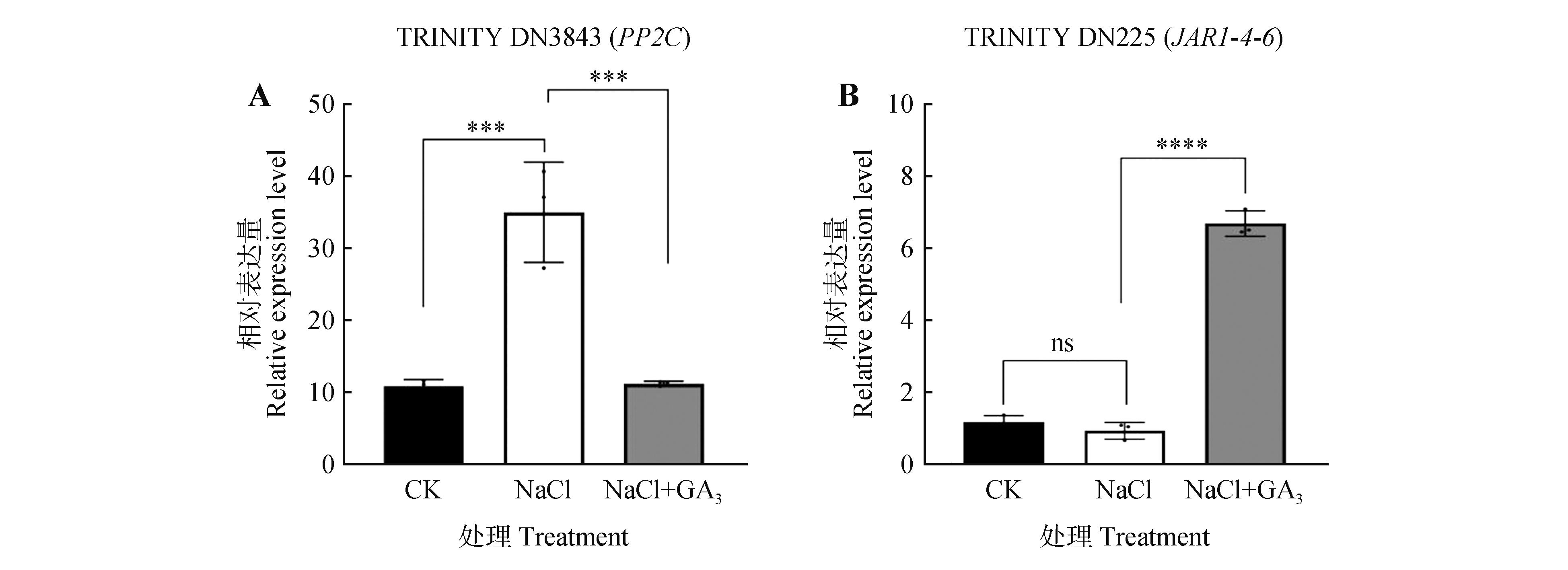
Fig.9
Expression level of germination-related genes in Agastache rugosa seeds under different treatments for 48 hThe markers ***,****,ns represented different levels of significance P<0.001,P<0.000 1,no significant difference,respectively.
| [1] | 周繇.中国东北药用植物资源图志[M].哈尔滨:黑龙江科学技术出版社,2021:5600. |
| ZHOU Y.Atlas of medicinal plant resource in the northeast of China[M].Harbin:Heilongjiang Science and Technology Press,2021:5600. | |
| [2] | 任琦琦,刘洋洋,冯剑,等.经典名方中藿香类药材的本草考证[J].中国实验方剂学杂志,2023,29(6):1-13. |
| REN Q Q, LIU Y Y, FENG J,et al.Herbal textual research on Huoxiang in famous classical formulas[J].Chinese Journal of Experimental Traditional Medical Formulae,2023,29(6):1-13. | |
| [3] | 李玉梅,姜云天,曲广男.盐胁迫对东北藿香种子萌发的影响[J].中药材,2019,42(11):2491-2496. |
| LI Y M, JIANG Y T, QU G N.Effects of salt stress on germination of Agastache rugosa seeds[J].Journal of Chinese Medicinal Materials,2019,42(11):2491-2496. | |
| [4] | JAMEEL J, ANWAR T, MAJEED S,et al.Effect of salinity on growth and biochemical responses of brinjal varieties:implications for salt tolerance and antioxidant mechanisms[J].BMC Plant Biology,2024,24(1):128. |
| [5] | LAMSAADI N, FARSSI O, MOUKHTARI AEL,et al.Different approaches to improve the tolerance of aromatic and medicinal plants to salt stressed conditions[J].Journal of Applied Research on Medicinal and Aromatic Plants,2024,39:100532. |
| [6] | 高赢,王晶,路金才,等.藿香种子的发芽特性研究[J].种子,2017,36(6):105-107. |
| GAO Y, WANG J, LU J C,et al.Study on seeds germination characteristics of Agastache rugosa(Fisch et Mey) O.Kuntze[J].Seed,2017,36(6):105-107. | |
| [7] | ZHANG Y, FU C H, ZHOU R R,et al.Effect of prechilling and exogenous gibberellin on seed germination of Primulina eburnea:a calcium-rich vegetable[J].Seed Science and Technology,2023,51(1):1-6. |
| [8] | 陈本菊,刘容,李振华,等.外源赤霉素浸种对盐胁迫下高羊茅种子萌发和幼苗生长的影响[J].草原与草坪,2024,44(4):103-112. |
| CHEN B J, LIU R, LI Z H,et al.Effects of soaking seeds with exogenous gibberellin on seed germination and seedling growth of tall fescue under salt stress[J].Grassland and Turf,2024,44(4):103-112. | |
| [9] | 胡纪龙,崔仕方,闫钘,等.外源赤霉素对干旱胁迫下中华常春藤生理特性的影响[J].云南农业大学学报(自然科学),2024,39(4):110-118. |
| HU J L, CUI S F, YAN X,et al.Effects of exogenous gibberellic acid on physiological characteristics of Hedera nepalensis var. sinensis under drought stress[J].Journal of Yunnan Agricultural University (Natural Science),2024,39(4):110-118. | |
| [10] | 王楠,高静,黄文静,等.赤霉素浸种时长和施用浓度对重度干旱和盐胁迫下黄芪幼苗发育的影响[J].生态学杂志,2019,38(9):2693-2701. |
| WANG N, GAO J, HUANG W J,et al.The effects of concentration and duration of seed soaking by GA3 on the development of Astragalus membranaceus seedlings under severe drought and salt stresses[J].Chinese Journal of Ecology,2019,38(9):2693-2701. | |
| [11] | 郑知临,曹红利,王鹏杰,等.茶树种子发育过程的转录组分析[J].西北植物学报,2019,39(9):1534-1542. |
| ZHENG Z L, CAO H L, WANG P J,et al.Transcriptomics analysis of Camellia sinensis seed in three different development stages[J].Acta Botanica Boreali-Occidentalia Sinica,2019,39(9):1534-1542. | |
| [12] | HENRY R J, FURTADO A, RANGAN P.Wheat seed transcriptome reveals genes controlling key traits for human preference and crop adaptation[J].Current Opinion in Plant Biology,2018,45:231-236. |
| [13] | 高诗文.白刺属植物种子休眠、萌发抗逆性与土壤种子持久性研究[D].兰州:兰州大学,2021. |
| GAO S W.Study on seed dormancy,germination resistance to adverse stresses and soil seed persistence in genus Nitraria [D].Lanzhou:Lanzhou University,2021. | |
| [14] | 何欣月.黄土丘陵区典型乡土植物种子萌发对温度和水分的响应[D].西安:陕西师范大学,2021. |
| HE X Y.Responses of seed germination of typical native plants to temperature and moisture in the loess hilly region[D].Xi’an:Shaanxi Normal University,2021. | |
| [15] | 姬东玲.穗分化期高温胁迫下茉莉酸甲酯对水稻穗形态建成的调控机理[D].扬州:扬州大学,2024. |
| JI D L.Regulation mechanism of methyl jasmonate on panicle morphogenesis in rice under high temperature stress during the panicle differentiation stage[D].Yangzhou:Yangzhou University,2024. | |
| [16] | GRZYBOWSKA D, ŻARCZYŃSKA K, SOBIECH P,et al.Persistently high concentrations of β-hydroxybutyrate affect hepatic SOD2 expression and blood SOD activity in high-yielding dairy cows[J].BMC Veterinary Research,2025,21(1):12. |
| [17] | CENDRON A, CHIANESE M, ZARZYCKI K,et al.Chelating properties of N6O-donors toward Cu(II) ions:speciation in aqueous environments and catalytic activity of the dinuclear complexes[J].Molecules,2024,29(23):5708. |
| [18] | STEADMAN K J, PRITCHARD H W, DEY P M.Tissue-specific soluble sugars in seeds as indicators of storage category[J].Annals of Botany,1996,77(6):667-674. |
| [19] | 张兰兰,张欣欣,孙阎.三花龙胆不同器官可溶性糖和龙胆苦苷含量的动态研究[J].中国农学通报,2017,33(9):78-83. |
| ZHANG L L, ZHANG X X, SUN Y.Dynamic study on soluble sugar and gentiopicroside content in different organs of Gentiana triflora Pall.[J].Chinese Agricultural Science Bulletin,2017,33(9):78-83. | |
| [20] | 张丽娜.广藿香提取物对黄瓜炭疽病菌抑制作用研究[D].哈尔滨:黑龙江大学,2023. |
| ZHANG L N.Study on the inhibitory effect of Pogostemon cablin extract on Colletotrichum orbiculare [D].Harbin:Heilongjiang University,2023. | |
| [21] | 郑涛.广藿香酮抑制破骨细胞分化治疗乳腺癌骨溶解的机制研究[D].长沙:中南大学,2023. |
| ZHENG T.The mechanism of pogostone inhibiting osteoclast differentiation in the treatment of breast cancer osteolysis[D].Changsha:Central South University,2023. | |
| [22] | 任方方.外源GA3对NaCl胁迫下泡桐种子萌发及幼苗生理特性的影响[D].郑州:河南农业大学,2021. |
| REN F F.The effects of exogenous gibberellin on the seed germination and seedling physiological characteristics of Paulownia under salt stress[D].Zhengzhou:Henan Agricultural University,2021. | |
| [23] | 陈红,许凌欣,王梦琦,等.外源赤霉素和褪黑素对三种胁迫下白三叶种子萌发、幼苗生长及生理的影响[J].草地学报,2024,32(3):781-792. |
| CHEN H, XU L X, WANG M Q,et al.Effects of exogenous gibberellin and melatonin on seed germination,seedling growth and physiology of Trifolium repens under three stresses[J].Acta Agrestia Sinica,2024,32(3):781-792. | |
| [24] | 张婷婷,刘宇乐,陈红,等.不同外源物质对盐、碱及干旱胁迫下草木樨种子萌发、幼苗生长及生理的影响[J].草业学报,2024,33(8):122-132. |
| ZHANG T T, LIU Y L, CHEN H,et al.Effects of different exogenous substances on the seed germination,seedling growth,and physiology of Melilotus suaveolens under salt,alkali,and drought stress[J].Acta Prataculturae Sinica,2024,33(8):122-132. | |
| [25] | 李静,房震,叶春秀.新疆野苹果种子MsWRKY33基因的克隆、亚细胞定位及表达分析[J].西北农业学报,2024,33(12):2328-2336. |
| LI J, FANG Z, YE C X.Cloning,subcellular localization and expression analysis of MsWRKY33 gene in Malus sieversii seeds[J].Acta Agriculturae Boreali-Occidentalis Sinica,2024,33(12):2328-2336. | |
| [26] | 陈明媛.褪黑素对盐旱胁迫下棉花种子萌发和幼苗生理代谢的调节效应[D].石河子:石河子大学,2023. |
| CHEN M Y.Effect of melatonin on cotton seed germination and seedling physiological metabolism under salt and drought stress[D].Shihezi:Shihezi University,2023. | |
| [27] | 董美灵.云南常见四种牧草种子萌发和幼苗生长抗旱性分析[D].昆明:云南农业大学,2023. |
| DONG M L.Analysis on seed germination and seedling growth resistance of four common grasses in Yunnan Province[D].Kunming:Yunnan Agricultural University,2023. | |
| [28] | 郭馨平.大白菜幼苗对铅胁迫的生理响应及外源褪黑素缓解作用研究[D].泰安:山东农业大学,2023. |
| GUO X P.Physiological response of Chinese cabbage seedlings to lead stress and the relieving effect of exogenous melatonin[D].Tai’an:Shandong Agricultural University,2023. | |
| [29] | 蒋健.外源褪黑素对低温胁迫下花椰菜种子萌发及幼苗生长的影响[D].泰安:山东农业大学,2023. |
| JIANG J.Effect of exogenous melatonin on seed germination and seedling growth of cauliflower under low temperature stress[D].Tai’an:Shandong Agricultural University,2023. | |
| [30] | 武宇昕.盐胁迫下丸化对高粱种子萌发及幼苗生长的影响[D].沈阳:沈阳农业大学,2023. |
| WU Y X.Effects of seed pelleting on seed germination and seedling growth of sorghum under salt stress[D].Shenyang:Shenyang Agricultural University,2023. |
| [1] | Banghuan WANG, Jiaxin LI, Qi PAN, Yueqin LIANG, Aiping WU, Shuangjiao FENG, Ju GU, Zixiang YANG, Ping LIU, Chao WANG. Tissue Structure, Hormone Levels, and Molecular Changes in Horned Galls Before and After Dehiscence [J]. Bulletin of Botanical Research, 2026, 46(3): 493-504. |
| [2] | Wenbin DING, Yuehan HU, Yinjia BAI, Yuhan YANG, Hua XUE. Expression Characteristics and Functional Analysis of PtNF-Ys Gene during Early Flower Development in Pinus tabuliformis [J]. Bulletin of Botanical Research, 2026, 46(2): 195-208. |
| [3] | Yijiao LIU, Jiqing ZHAO, Jinhuan CHEN. Cloning and Functional Study of the LrMYB64 Gene in Lyciumruthenicum [J]. Bulletin of Botanical Research, 2026, 46(2): 231-245. |
| [4] | Lipeng ZHANG, Mei WU, Hongpeng WANG, Tianyu LI. Salt Stress-related RcNAC22 Gene Cloning and Function Analysis in Rhodiolacrenulata [J]. Bulletin of Botanical Research, 2026, 46(2): 246-258. |
| [5] | Haiyan CAO, Kaiwen TIAN, Xiaoyu JIA, Xuefeng HAO, Zhuping JIN. The Role of AtMST1 in Regulating Salt Tolerance via H2S Synthesis in Arabidopsis Revealed by CRISPR/Cas9 Knockout [J]. Bulletin of Botanical Research, 2026, 46(2): 259-269. |
| [6] | Qinxiang CHANG, Wenxin GAO, Donghong ZHANG, Lin LI, Qiang ZHANG, Zongsuo LIANG. Research Progress on the Seed Dormancy and Germination of Astragalus membranaceus and Astragalus membranaceus var. mongholicus [J]. Bulletin of Botanical Research, 2026, 46(1): 25-37. |
| [7] | Zhiyu LUO, Jingya YU, Qingqing ZHENG, Faqi ZHANG. Seed Germination Characteristics and Chromosome Karyotype of Different Provenances of Artemisia hedinii [J]. Bulletin of Botanical Research, 2025, 45(6): 898-908. |
| [8] | Xinyu CHENG, Mengqiao GUO, Haiyun GUAN, Jian RU, Yan BAI, Lianjin GUO. Light Requirements for Germination of Emmenopterys henryi Oliv. Seeds and Transcriptome Response Analysis [J]. Bulletin of Botanical Research, 2025, 45(4): 546-557. |
| [9] | Man MEI, Chencan WANG, Hongxia LIN, Yuqian ZHANG, Wenjing DING, Yuanyuan ZHAO. Application and Prospect of Spatial Transcriptome Technology in Plant Research [J]. Bulletin of Botanical Research, 2025, 45(1): 3-14. |
| [10] | Xiuying MA, Jinke LI, Xiaoyang ZHOU, Shaoliang CHEN. Research Progress of Ca2+-ATPase Involved in Regulation of Plant Salt Tolerance [J]. Bulletin of Botanical Research, 2024, 44(5): 641-654. |
| [11] | Hengfeng ZHANG, Yangwu HE, Huanchao ZHANG, Qingcui WEI. Metabolomics Analysis of Lagerstroemia indica in Response to Salt and Alkali Stress [J]. Bulletin of Botanical Research, 2024, 44(3): 420-430. |
| [12] | Fazhi FANG, Huiying GUI, Zhaojia LI, Xiaofeng ZHANG. Physiological Adaptation of Six Mangrove Seedlings to Different Salinity [J]. Bulletin of Botanical Research, 2023, 43(6): 881-889. |
| [13] | Lei XU, Xiao XU, Qinsong LIU. Effects of Exogenous Salicylic Acid on Antioxidant System and Gene Expression of Davidia involucrata Seedlings under Salt Stress [J]. Bulletin of Botanical Research, 2023, 43(4): 572-581. |
| [14] | Zhanmin ZHENG, Yubing SHANG, Guangbo ZHOU, Di XIAO, Yi LIU, Xiangling YOU. Genetic Transformation and Function Analysis of PsnHB13 and PsnHB15 of Populus simonii × Populus nigra [J]. Bulletin of Botanical Research, 2023, 43(3): 340-350. |
| [15] | Chunjing JIAO, Mingyue LI, Peng ZHANG. Effects of Exogenous Hormones Soaking and Osmotic Treatment on Thermal Dormancy of Seeds of Fraxinus mandshurica [J]. Bulletin of Botanical Research, 2023, 43(3): 370-378. |
| Viewed | ||||||
|
Full text |
|
|||||
|
Abstract |
|
|||||