Bulletin of Botanical Research ›› 2026, Vol. 46 ›› Issue (1): 145-157.doi: 10.7525/j.issn.1673-5102.2026.01.013
• Original Paper • Previous Articles Next Articles
Xiwen ZHANG1, Tingting CHEN1, Fude WANG2, Qi GUO2, Weicai YANG3, Xing WEI1, Jiacun GU1( )
)
Received:2025-11-04
Online:2026-01-20
Published:2026-01-20
Contact:
Jiacun GU
E-mail:gjcnefu@163.com
CLC Number:
Xiwen ZHANG, Tingting CHEN, Fude WANG, Qi GUO, Weicai YANG, Xing WEI, Jiacun GU. Analysis of Twig and Needle Traits and Evaluation of Drought Tolerance in Larix olgensis Clones[J]. Bulletin of Botanical Research, 2026, 46(1): 145-157.
Add to citation manager EndNote|Ris|BibTeX
URL: https://bbr.nefu.edu.cn/EN/10.7525/j.issn.1673-5102.2026.01.013
Table 1
Twig and needle traits of Larix olgensis clones examined
器官 Organs | 性状 Traits | 缩写 Abbreviation | 与耐旱性的理论相关性 Theoretical correlation with drought tolerance | 定义 Definition |
|---|---|---|---|---|
针叶 Needle | 表皮厚度 Epidermis thickness/μm | TE | + | 叶表皮细胞厚度[ Thickness of needle epidermal cell |
皮层厚度 Cortical thickness/μm | TC | + | 叶皮层细胞厚度[ Thickness of needle cortical cell | |
比叶面积 Specific leaf area/(cm2·g-1) | ASL | - | 单位叶质量可用于水分流失的叶表面积[ Amount of needle surface area per unit of needle mass that is available for water loss | |
水分利用效率 Water-use efficiency/(μmol·mol-1) | EWU | + | 固定的光合产物与水分损失的比率[ Ratio of carbon acquisition to water loss | |
气孔蒸腾指数 Stomatal transpiration/(%·h-1) | TS | - | 气孔完全闭合前的水分流失 [ Loss of water through needle cuticle before stomata are fully closed | |
残余蒸腾指数 Residual transpiration/(%·h-1) | TR | - | 气孔完全闭合后的水分流失[ Loss of water through needle cuticle while stomata are closed | |
枝 Twig | 水力直径 Hydraulic diameter/μm | Dh | - | 所有管胞的加权水力直径 [ Hydraulically weighted tracheid diameter |
理论导水率 Potential specific hydraulic conductivity/(kg·m-1·MPa-1·s-1) | Ks | - | 单位压力梯度下的水通量[ Water flux of plants under a unit pressure gradient | |
细胞壁加固指数 Thickness to span ratio | (t/b)2 | + | 管胞双壁厚度与跨度比值的平方[ Square of the ratio of double wall thickness to lumen diameter |
Table 2
Descriptive statistics and ANOVA of twig and needle traits in Larix olgensis clones
统计指标 Statistical index | 表皮厚度 TE/μm | 皮层厚度 TC/μm | 比叶面积 ASL/(cm2·g-1) | 水分利用效率 EWU/(μmol·mol-1) | 气孔蒸腾指数 TS/(%·h-1) | 残余蒸腾指数 TR/(%·h-1) | 水力直径 Dh/μm | 理论导水率Ks/ (kg·m-1·MPa-1·s-1) | 细胞壁加固 指数(t/b)2 |
|---|---|---|---|---|---|---|---|---|---|
平均值(±标准误) Mean±SE | 27.75±0.61 | 30.43±0.70 | 145.34±3.44 | 56.08±2.48 | 1.51±0.08 | 0.25±0.02 | 8.98±0.11 | 1.25±0.05 | 0.16±0.01 |
变异系数 CV/% | 11.06 | 11.53 | 11.83 | 22.15 | 24.94 | 39.24 | 6.15 | 18.63 | 25.26 |
最大值 Maximum | 32.57 | 38.26 | 173.54 | 76.17 | 2.04 | 0.46 | 10.02 | 1.69 | 0.26 |
最大值对应无性系 The clone with the maximum | 105 | 246 | 809 | 170 | 556 | 565 | 449 | 447 | 338 |
最小值 Minimum | 17.18 | 24.16 | 93.75 | 37.42 | 0.62 | 0.09 | 8.01 | 0.89 | 0.10 |
最小值对应无性系 The clone with the minimum | 181 | 181 | 447 | 105 | 565 | 410 | 774 | 774 | 129 |
| F | 2.82 | 3.42 | 3.90 | 8.67 | 4.40 | 4.26 | 1.08 | 1.29 | 1.30 |
| P | 0.001 | 0.001 | 0.001 | 0.001 | 0.001 | 0.001 | 0.398 | 0.230 | 0.218 |
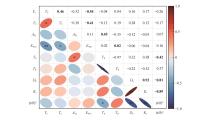
Fig.1
Correlations among twig and needle traits in Larix olgensis clonesTE. Epidermis thickness; TC. Cortical thickness; ASL. Specific leaf area; EWU. Water-use efficiency; TS. Stomatal transpiration; TR. Residual transpiration; Dh. Hydraulic diameter; Ks. Potential specific hydraulic conductivity;(t/b)2. Thickness to span ratio.** indicated a significant difference at the P=0.01 level; * indicated a significant difference at the P=0.05 level.
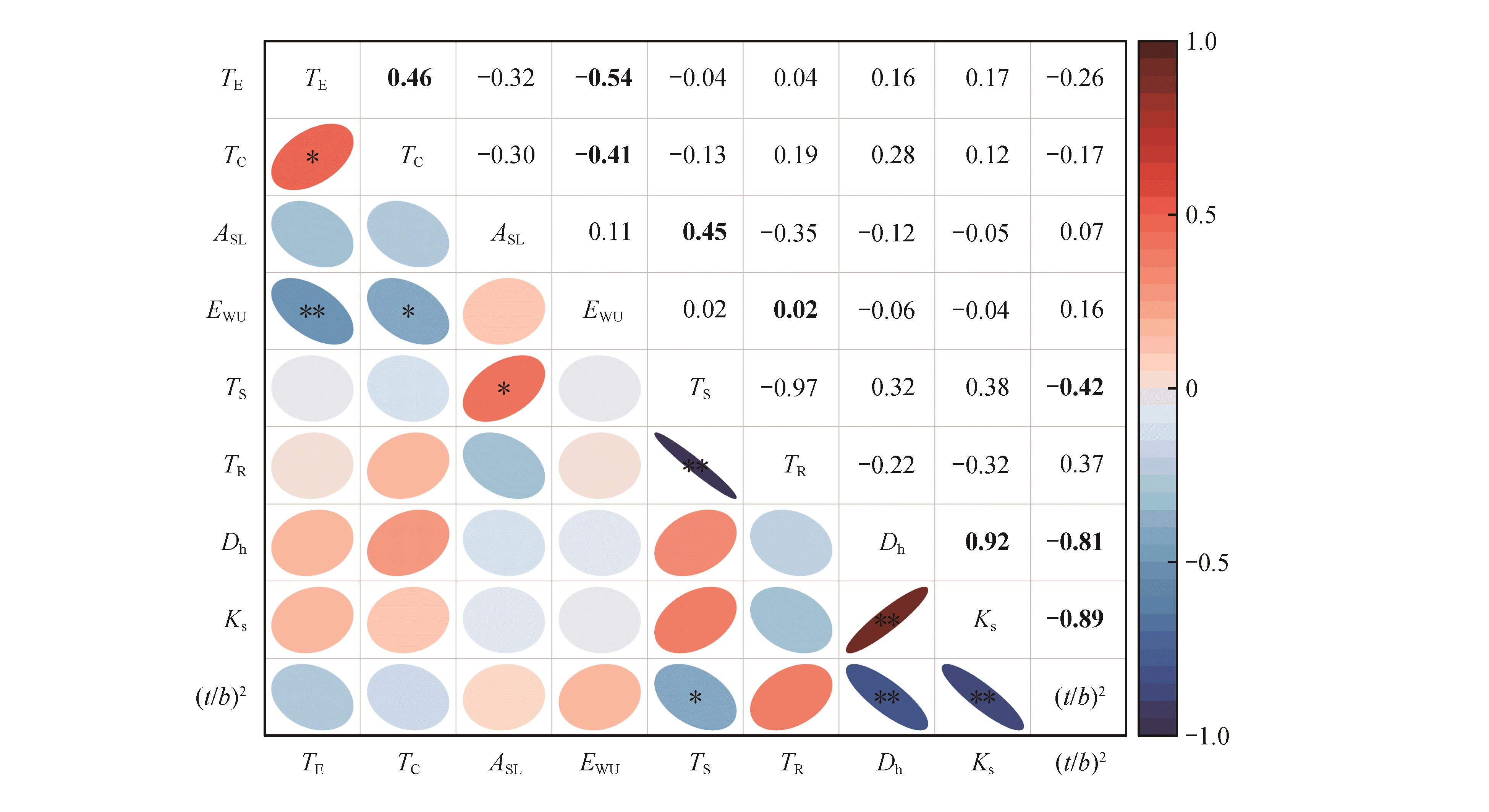
Table 3
Evaluation of drought tolerance based on membership function values of twig and needle traits in Larix olgensis clones
无性系 Clones | 隶属函数值 Membership function values | 平均隶属函数值 Mean membership function values | 排序 No. | ||||||||
|---|---|---|---|---|---|---|---|---|---|---|---|
表皮厚度 TE | 皮层厚度 TC | 比叶面积 ASL | 水分利用效率 EWU | 气孔蒸腾指数 TS | 残余蒸腾指数 TR | 水力直径 Dh | 理论导水率 Ks | 细胞壁加固指数 (t/b)2 | |||
| 338 | 0.63 | 0.13 | 0.53 | 0.97 | 0.85 | 0.13 | 0.71 | 0.88 | 1.00 | 0.65 | 1 |
| 774 | 0.75 | 0.48 | 0.53 | 0.28 | 0.18 | 0.81 | 1.00 | 1.00 | 0.62 | 0.63 | 2 |
| 128 | 0.61 | 0.43 | 0.22 | 0.97 | 0.39 | 0.57 | 0.70 | 0.71 | 0.80 | 0.60 | 3 |
| 125 | 0.62 | 0.57 | 0.18 | 0.85 | 0.10 | 0.78 | 0.72 | 0.86 | 0.54 | 0.58 | 4 |
| 214 | 0.81 | 0.33 | 0.49 | 0.29 | 0.48 | 0.51 | 0.73 | 0.79 | 0.64 | 0.56 | 5 |
| 721 | 0.71 | 0.56 | 0.39 | 0.33 | 0.70 | 0.30 | 0.65 | 0.83 | 0.55 | 0.56 | 6 |
| 565 | 0.93 | 0.89 | 0.37 | 0.03 | 1.00 | 0 | 0.72 | 0.79 | 0.28 | 0.56 | 7 |
| 476 | 0.71 | 0.61 | 0.60 | 0.85 | 0.72 | 0.14 | 0.52 | 0.58 | 0.23 | 0.55 | 8 |
| 282 | 0.61 | 0.64 | 0.42 | 0.73 | 0.61 | 0.33 | 0.50 | 0.61 | 0.40 | 0.54 | 9 |
| 597 | 0.78 | 0.57 | 0.23 | 0.33 | 0.29 | 0.68 | 0.61 | 0.66 | 0.36 | 0.50 | 10 |
| 105 | 1.00 | 0.60 | 0.78 | 0 | 0.55 | 0.40 | 0.50 | 0.45 | 0.24 | 0.50 | 11 |
| 643 | 0.44 | 0.29 | 0.16 | 0.27 | 0.42 | 0.49 | 0.73 | 0.84 | 0.66 | 0.48 | 12 |
| 66 | 0.69 | 0.28 | 0.26 | 0.20 | 0.42 | 0.50 | 0.59 | 0.75 | 0.58 | 0.47 | 13 |
| 181 | 0 | 0 | 0.29 | 0.92 | 0.25 | 0.73 | 0.98 | 0.75 | 0.34 | 0.47 | 14 |
| 246 | 0.83 | 1.00 | 0.26 | 0.17 | 0.24 | 0.68 | 0.33 | 0.50 | 0.20 | 0.47 | 15 |
| 477 | 0.86 | 0.65 | 0.31 | 0.33 | 0.44 | 0.41 | 0.44 | 0.45 | 0.30 | 0.47 | 16 |
| 170 | 0.68 | 0.28 | 0.14 | 1.00 | 0.17 | 0.77 | 0.36 | 0.32 | 0.19 | 0.44 | 17 |
| 809 | 0.77 | 0.05 | 0 | 0.27 | 0.19 | 0.77 | 0.74 | 0.77 | 0.32 | 0.43 | 18 |
| 184 | 0.58 | 0.12 | 0.09 | 0.72 | 0.48 | 0.45 | 0.55 | 0.51 | 0.29 | 0.42 | 19 |
| 447 | 0.71 | 0.42 | 1.00 | 0.55 | 0.45 | 0.50 | 0.05 | 0 | 0.05 | 0.42 | 20 |
| 519 | 0.73 | 0.55 | 0.37 | 0.63 | 0.17 | 0.79 | 0.19 | 0.22 | 0.07 | 0.41 | 21 |
| 410 | 0.80 | 0.23 | 0.29 | 0.44 | 0.01 | 1.00 | 0.38 | 0.35 | 0.18 | 0.41 | 22 |
| 556 | 0.81 | 0.64 | 0.34 | 0.08 | 0 | 0.89 | 0.10 | 0.19 | 0.09 | 0.35 | 23 |
| 129 | 0.77 | 0.22 | 0.32 | 0.64 | 0.17 | 0.70 | 0.08 | 0.03 | 0 | 0.33 | 24 |
| 449 | 0.35 | 0.56 | 0.28 | 0.19 | 0.01 | 0.88 | 0 | 0.06 | 0.01 | 0.26 | 25 |
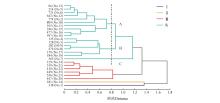
Fig.2
Cluster analysis for drought tolerance in Larix olgensis clones based on twig and needle traitsⅠ. Comprehensive and strong drought-tolerant; Ⅱ and Ⅳ. Moderate drought-tolerant; Ⅲ. Drought-sensitive; A, B and C. Subgroups of moderate drought-tolerant.
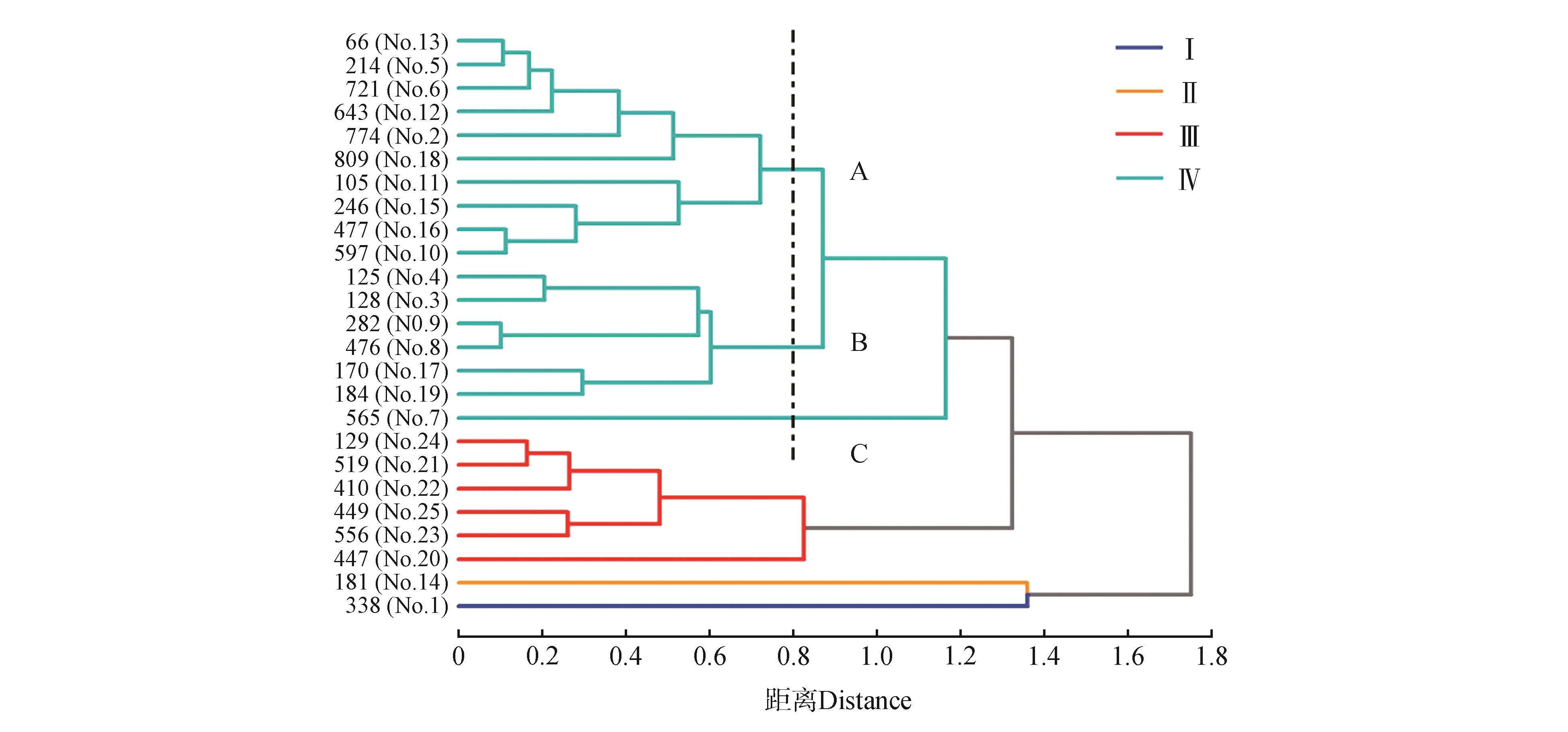
Table 4
Characterization and ranking of twig and needle traits among moderate drought-tolerant subgroups in Larix olgensis clones
亚类 Subgroups | 无性系 Clones | 表皮厚度 TE/μm | 皮层厚度 TC/μm | 比叶面积 ASL/(cm2·g-1) | 水分利用效率 EWU/(μmol·mol-1) | 气孔蒸腾指数 TS/(%·h-1) | 残余蒸腾指数 TR/(%·h-1) | 水力直径 Dh/μm | 理论导水率 Ks/ (kg·m-1·MPa-1·s-1) | 细胞壁 加固指数 (t/b)2 | 排序 No. |
|---|---|---|---|---|---|---|---|---|---|---|---|
| A | 774 | 28.78 | 30.92 | 130.96 | 48.42 | 1.78 | 0.16 | 8.01 | 0.89 | 0.20 | 2 |
| 214 | 29.68 | 28.81 | 134.22 | 48.75 | 1.36 | 0.27 | 8.55 | 1.06 | 0.20 | 5 | |
| 721 | 28.14 | 32.03 | 142.39 | 50.12 | 1.04 | 0.35 | 8.72 | 1.03 | 0.19 | 6 | |
| 597 | 29.17 | 32.25 | 154.89 | 50.31 | 1.62 | 0.21 | 8.79 | 1.16 | 0.16 | 10 | |
| 105 | 32.57 | 32.59 | 111.56 | 37.42 | 1.25 | 0.31 | 9.02 | 1.33 | 0.14 | 11 | |
| 643 | 23.98 | 28.24 | 160.62 | 47.76 | 1.45 | 0.28 | 8.55 | 1.02 | 0.21 | 12 | |
| 66 | 27.86 | 28.07 | 152.59 | 45.20 | 1.45 | 0.28 | 8.83 | 1.09 | 0.19 | 13 | |
| 246 | 29.94 | 38.26 | 153.02 | 43.90 | 1.70 | 0.21 | 9.35 | 1.29 | 0.13 | 15 | |
| 477 | 30.41 | 33.35 | 148.73 | 50.22 | 1.41 | 0.31 | 9.13 | 1.33 | 0.15 | 16 | |
| 809 | 28.96 | 24.82 | 173.54 | 48.00 | 1.77 | 0.17 | 8.54 | 1.08 | 0.15 | 18 | |
| B | 128 | 26.52 | 30.28 | 155.83 | 74.92 | 1.48 | 0.25 | 8.61 | 1.12 | 0.23 | 3 |
| 125 | 26.70 | 32.19 | 159.11 | 70.50 | 1.89 | 0.17 | 8.58 | 1.00 | 0.19 | 4 | |
| 476 | 28.14 | 32.75 | 125.89 | 70.17 | 1.01 | 0.41 | 8.97 | 1.23 | 0.14 | 8 | |
| 282 | 26.50 | 33.15 | 140.39 | 65.85 | 1.17 | 0.34 | 9.01 | 1.20 | 0.17 | 9 | |
| 170 | 27.68 | 28.08 | 161.98 | 76.17 | 1.80 | 0.17 | 9.29 | 1.44 | 0.13 | 17 | |
| 184 | 26.14 | 25.90 | 166.43 | 65.32 | 1.35 | 0.30 | 8.92 | 1.28 | 0.15 | 19 | |
| C | 565 | 31.46 | 36.65 | 144.09 | 38.72 | 0.62 | 0.46 | 8.57 | 1.06 | 0.15 | 7 |
| 181 | 17.18 | 24.16 | 150.60 | 72.89 | 1.69 | 0.19 | 8.05 | 1.09 | 0.16 | 14 |
Fig.3
Principal component analysis of twig and needle traits in Larix olgensis clonesTE. Epidermic thickness; TC. Cortical thickness; ASL. Specific leaf area; EWU. Water-use efficiency; TS. Stomatal transpiration; TR. Residual transpiration; Dh. Hydraulic diameter; Ks. Potential specific hydraulic conductivity;(t/b)2. Thickness to span ratio. Needle traits were displayed in black; while twig traits were displayed in brown.
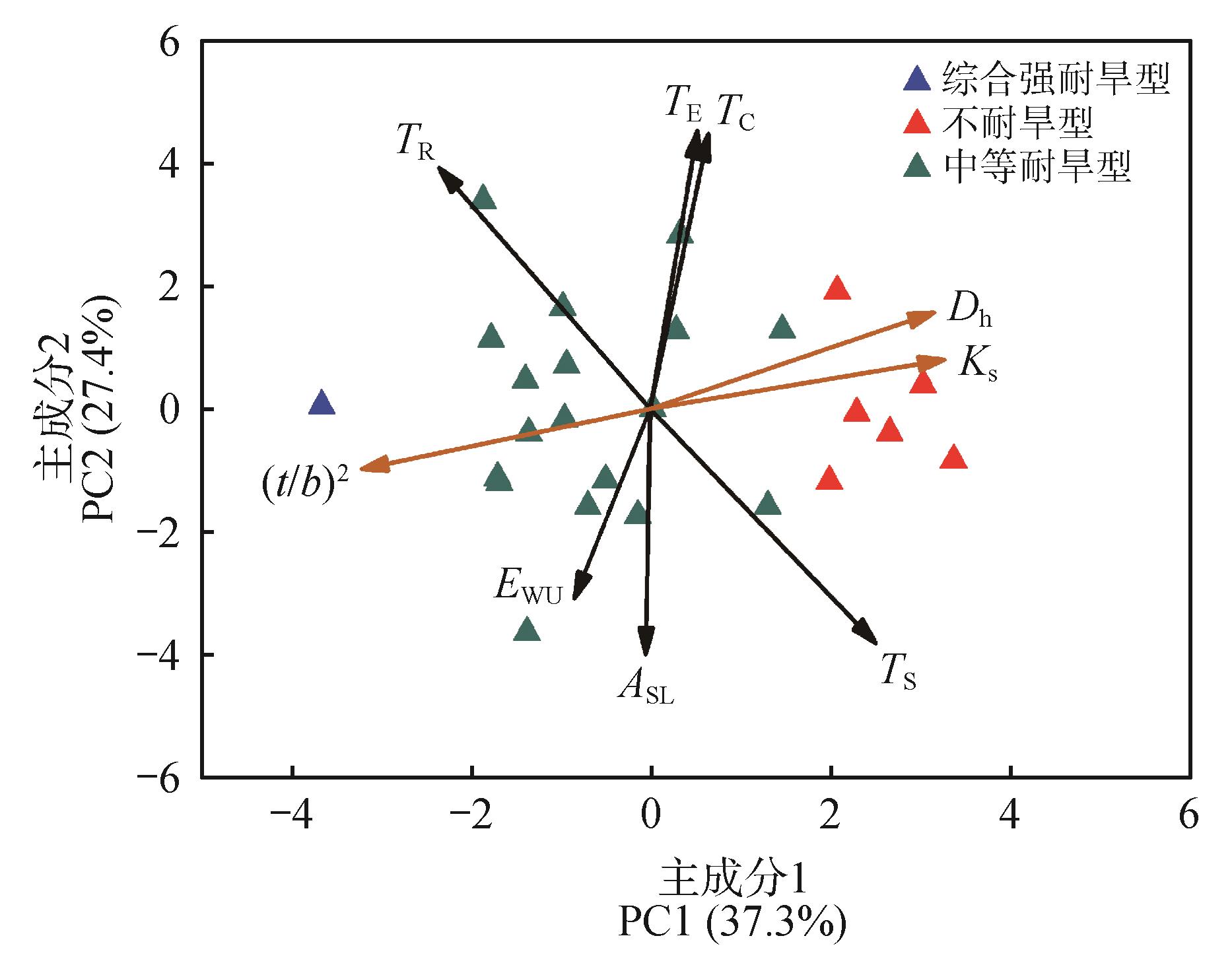
Table 5
Principal component loading matrix of twig and needle traits in Larix olgensis clones
性状 Traits | 主成分Ⅰ Principal component Ⅰ | 主成分Ⅱ Principal component Ⅱ |
|---|---|---|
| 表皮厚度TE | 0.07 | 0.45 |
| 皮层厚度TC | 0.10 | 0.45 |
| 比叶面积ASL | -0.01 | -0.40 |
| 水分利用效率EWU | -0.12 | -0.31 |
| 气孔蒸腾指数TS | 0.38 | -0.38 |
| 残余蒸腾指数TR | -0.35 | 0.39 |
| 水力直径Dh | 0.48 | 0.16 |
| 理论导水率Ks | 0.50 | 0.08 |
| 细胞壁加固指数(t/b)2 | -0.48 | -0.10 |
| 特征值Eigenvalue | 3.33 | 2.46 |
贡献率 Contribution rate/% | 37.28 | 27.36 |
累计贡献率 Cumulative contribution rate/% | 37.28 | 64.64 |
| [1] | KLESSE S, WOHLGEMUTH T, MEUSBURGER K,et al.Long-term soil water limitation and previous tree vigor drive local variability of drought-induced crown dieback in Fagus sylvatica [J].Science of The Total Environment,2022,851:157926. |
| [2] | DUAN H L, DUURSMA R A, HUANG G M,et al.Elevated [CO2] does not ameliorate the negative effects of elevated temperature on drought-induced mortality in Eucalyptus radiata seedlings[J].Plant,Cell & Environment,2014,37(7):1598-1613. |
| [3] | 程莉,李玉霖,宁志英,等.木本植物应对干旱胁迫的响应机制:基于水力学性状视角[J].生态学报,2024,44(7):2688-2705. |
| CHENG L, LI Y L, NING Z Y,et al.Response mechanisms of woody plants to drought stress:a review based on plant hydraulic traits[J].Acta Ecologica Sinica,2024,44(7):2688-2705. | |
| [4] | MCDOWELL N G, ALLEN C D, MARSHALL L.Growth,carbon-isotope discrimination,and drought-associated mortality across a Pinus ponderosa elevational transect[J].Global Change Biology,2010,16(1):399-415. |
| [5] | SENF C, PFLUGMACHER D, YANG Z Q,et al.Canopy mortality has doubled in Europe’s temperate forests over the last three decades[J].Nature Communications,2018,9(1):4978. |
| [6] | ALLEN C D, MACALADY A K, CHENCHOUNI H,et al.A global overview of drought and heat-induced tree mortality reveals emerging climate change risks for forests[J].Forest Ecology and Management,2010,259(4):660-684. |
| [7] | BRESHEARS D D, COBB N S, RICH P M,et al.Regional vegetation die-off in response to global-change-type drought[J].Proceedings of the National Academy of Sciences of the United States of America,2005,102(42):15144-15148. |
| [8] | YANG X W, YAN H L, HAO C H,et al.Climate of origin shapes variations in wood anatomical properties of 17 Picea species[J].BMC Plant Biology,2024,24(1):414. |
| [9] | ZHAO H, HUANG X, MA B L,et al.Productive poplar genotypes exhibited temporally stable low stem embolism resistance and hydraulic resistance segmentation at the stem-leaf transition[J].Plant,Cell & Environment,2025,48(2):992-1004. |
| [10] | KEYSER-GIBSON A, NACKLEY L, SUN Y P,et al.Plasticity in plant hydraulic traits:an evaluation of a common-taxa experiment across a climatic gradient in the Western U.S.[J/OL].Plants People Planet,(2025-10-06)[2025-10-30].. |
| [11] | MORAN E, LAUDER J, MUSSER C,et al.The genetics of drought tolerance in conifers[J].New Phytologist,2017,216(4):1034-1048. |
| [12] | EILMANN B, DE VRIES S M G, DEN OUDEN J,et al.Origin matters!Difference in drought tolerance and productivity of coastal Douglas-fir(Pseudotsuga menziesii (Mirb.)) provenances[J].Forest Ecology and Management,2013,302:133-143. |
| [13] | VON MOLER E R, NELSON A S.Perspectives on drought preconditioning treatments with a case study using western larch[J].Frontiers in Plant Science,2021,12:741027. |
| [14] | TESKEY R, WERTIN T, BAUWERAERTS I,et al.Responses of tree species to heat waves and extreme heat events[J].Plant,Cell & Environment,2015,38(9):1699-1712. |
| [15] | 赵丽,包秀兰,王福德,等.15种云杉针叶解剖结构与其抗旱性研究[J].西北林学院学报,2025,40(3):119-127. |
| ZHAO L, BAO X L, WANG F D,et al.Needle anatomical structure and drought resistance of 15 spruce species[J].Journal of Northwest Forestry University,2025,40(3):119-127. | |
| [16] | MCDOWELL N, POCKMAN W T, ALLEN C D,et al.Mechanisms of plant survival and mortality during drought:why do some plants survive while others succumb to drought?[J].New Phytologist,2008,178(4):719-739. |
| [17] | 王孟珂,田梦妮,毕泉鑫,等.基于气孔性状的文冠果种质资源抗旱性评价及抗旱资源筛选[J].植物研究,2021,41(6):957-964. |
| WANG M K, TIAN M N, BI Q X,et al.Evaluation of drought tolerance based on stomatal characters and selection of germplasm resources from Xanthoceras sorbifolia [J].Bulletin of Botanical Research,2021,41(6):957-964. | |
| [18] | 魏斌,李毅,苏世平.外源脯氨酸对自然干旱下白刺叶片气孔的影响[J].植物研究,2022,42(3):492-501. |
| WEI B, LI Y, SU S P.The effect of exogenous proline on the stomata of Nitraria tangutorum leaves under natural drought[J].Bulletin of Botanical Research,2022,42(3):492-501. | |
| [19] | GRACE J.Cuticular water loss unlikely to explain tree-line in Scotland[J].Oecologia,1990,84(1):64-68. |
| [20] | 王佳佳.水分梯度下柠条锦鸡儿叶功能属性的干旱适应性研究[D].杨凌:西北农林科技大学,2016. |
| WANG J J.The drought adaptation of leaf functional traits in Caragana korshinskii Kom.under water gradient[D].Yangling:Northwest A&F University,2016. | |
| [21] | 王楠,王晶晶,王传宽,等.兴安落叶松水分利用效率对模拟气候变暖的响应[J].植物研究,2025,45(5):686-694. |
| WANG N, WANG J J, WANG C K,et al.Responses of water use efficiency in Larix gmelinii to simulated climate warming[J].Bulletin of Botanical Research,2025,45(5):686-694. | |
| [22] | ROWLAND L, COSTA A C L DA, GALBRAITH D R,et al.Death from drought in tropical forests is triggered by hydraulics not carbon starvation[J].Nature,2015,528(7580):119-122. |
| [23] | SASANI N, PÂQUES L E, BOULANGER G,et al.Physiological and anatomical responses to drought stress differ between two larch species and their hybrid[J].Trees,2021,35(5):1467-1484. |
| [24] | ZHANG Y B, HUANG X Y, SCALON M C,et al.Mistletoes have higher hydraulic safety but lower efficiency in xylem traits than their hosts[J].New Phytologist,2025,245(2):607-624. |
| [25] | SONG Y J, STERCK F, ZHOU X Q,et al.Drought resilience of conifer species is driven by leaf lifespan but not by hydraulic traits[J].New Phytologist,2022,235(3):978-992. |
| [26] | 胥生荣,张恩和,马瑞丽,等.干旱胁迫及复水对耐旱枸杞水力学特性的影响[J].中国生态农业学报,2017,25(8):1190-1197. |
| XU S R, ZHANG E H, MA R L,et al.Hydraulic characteristics of Lycium barbarum L. seedlings under drought stress and re-watering conditions[J].Chinese Journal of Eco-Agriculture,2017,25(8):1190-1197. | |
| [27] | 李卓龙,毕宇,贾宝鹏,等.黑龙江省9个杨树品种的抗旱性分析[J].森林工程,2025,41(6):1206-1217. |
| LI Z L, BI Y, JIA B P,et al.Analysis of drought resistance in nine poplar varieties in Heilongjiang province[J].Forest Engineering,2025,41(6):1206-1217. | |
| [28] | 于晓池,杨桂娟,董菊兰,等.梓属5个种对干旱胁迫的生理响应[J].植物研究,2021,41(1):44-52. |
| YU X C, YANG G J, DONG J L,et al.Physiological responses to drought stress of five species from Catalpa Scop[J].Bulletin of Botanical Research,2021,41(1):44-52. | |
| [29] | GUIZANI A, ASKRI H, AMENTA M L,et al.Drought responsiveness in six wheat genotypes:identification of stress resistance indicators[J].Frontiers in Plant Science,2023,14:1232583. |
| [30] | 张磊.干旱胁迫下长白落叶松家系变异的研究[D].哈尔滨:东北林业大学,2014. |
| ZHANG L.Research on Larix olgensis families’ variation under drought stress[D].Harbin:Northeast Forestry University,2014. | |
| [31] | NING Q R, GONG X W, LI M Y,et al.Differences in growth pattern and response to climate warming between Larix olgensis and Pinus koraiensis in northeast China are related to their distinctions in xylem hydraulics[J].Agricultural and Forest Meteorology,2022,312:108724. |
| [32] | 王乐乐,周正虎,金鹰,等.东北温带森林20种乔木树种叶片干旱容忍性特征[J].应用生态学报,2022,33(1):1-8. |
| WANG L L, ZHOU Z H, JIN Y,et al.Drought tolerance traits of leaves of 20 tree species in temperate forest of northeast China[J].Chinese Journal of Applied Ecology,2022,33(1):1-8. | |
| [33] | 王庆彬,王恩姮,姜中珠,等.黑土区常见树种水分生理适应性及抗旱特性[J].东北林业大学学报,2009,37(1):8-9. |
| WANG Q B, WANG E H, JIANG Z Z,et al.Water adaptability and drought-resistance of common tree species in typical black soil region[J].Journal of Northeast Forestry University,2009,37(1):8-9. | |
| [34] | 许军,杜俊婕,张磊,等.长白落叶松生长与材性分析及优良无性系选择[J].森林工程,2025,41(6):1182-1192. |
| XU J, DU J J, ZHANG L,et al.Growth and wood quality analysis of Larix olgensis and selection of superior clonal lines[J].Forest Engineering,2025,41(6):1182-1192. | |
| [35] | 高艳如,王军辉,麻文俊,等.不同种源和家系红皮云杉细根形态与生物量垂直分布特征[J].植物研究,2024,44(3):380-388. |
| GAO Y R, WANG J H, MA W J,et al.Characteristics of fine root morphology and biomass vertical distribution from different provenances and families of Picea koraiensis [J].Bulletin of Botanical Research,2024,44(3):380-388. | |
| [36] | BANSAL S, HARRINGTON C A, GOULD P J,et al.Climate-related genetic variation in drought-resistance of Douglas-fir (Pseudotsuga menziesii)[J].Global Change Biology,2015,21(2):947-958. |
| [37] | HASANUZZAMAN M, CHAKRABORTY K, ZHOU M X,et al.Measuring residual transpiration in plants:a comparative analysis of different methods[J].Functional Plant Biology,2023,50(12):983-992. |
| [38] | 卫星.干旱胁迫对水曲柳苗木细根衰老的影响[D].哈尔滨:东北林业大学,2009. |
| WEI X.Fine root senescence of Manchurian ash seedlings under drought stress[D].Harbin:Northeast Forestry University,2009. | |
| [39] | POORTER L, MCDONALD I, ALARCÓN A,et al.The importance of wood traits and hydraulic conductance for the performance and life history strategies of 42 rainforest tree species[J].New Phytologist,2010,185(2):481-492. |
| [40] | HACKE U G, SPERRY J S, POCKMAN W T,et al.Trends in wood density and structure are linked to prevention of xylem implosion by negative pressure[J].Oecologia,2001,126(4):457-461. |
| [41] | LU S B, CHEN Y M, SARDANS J,et al.Water and nutrient use efficiency of three tree species in monoculture and mixed stands and potential drivers in the Loess Hilly Region,China[J].Plant and Soil,2024,496(1):657-675. |
| [42] | FARQUHAR G D, O'LEARY M H, BERRY J A.On the relationship between carbon isotope discrimination and the intercellular carbon dioxide concentration in leaves[J].Australian Journal of Plant Physiology,1982,9(2):121-137. |
| [43] | LI Z M, GAO C J, CHE F X,et al.Trunk distortion weakens the tree productivity revealed by half-sib progeny determination of Pinus yunnanensis [J].BMC Plant Biology,2024,24(1):629. |
| [44] | 季子敬,全先奎,王传宽.兴安落叶松针叶解剖结构变化及其光合能力对气候变化的适应性[J].生态学报,2013,33(21):6967-6974. |
| JI Z J, QUAN X K, WANG C K.Variations in leaf anatomy of Larix gmelinii reflect adaptation of its photosynthetic capacity to climate changes[J].Acta Ecologica Sinica,2013,33(21):6967-6974. | |
| [45] | FRANKS S J, WEBER J J, AITKEN S N.Evolutionary and plastic responses to climate change in terrestrial plant populations[J].Evolutionary Applications,2014,7(1):123-139. |
| [46] | KERR K L, FICKLE J C, ANDEREGG W R L.Decoupling of functional traits from intraspecific patterns of growth and drought stress resistance[J].New Phytologist,2023,239(1):174-188. |
| [47] | 刘炳妤,黄桂华,梁坤南,等.柚木无性系光合生理特征与生长综合评价[J].植物研究,2020,40(2):209-216. |
| LIU B Y, HUANG G H, LIANG K N,et al.Evaluation of photosynthetic characteristics and growth traits in teak (Tectona grandis L.f) clones[J].Bulletin of Botanical Research,2020,40(2):209-216. | |
| [48] | 罗丹丹,王传宽,金鹰.植物水分调节对策:等水与非等水行为[J].植物生态学报,2017,41(9):1020-1032. |
| LUO D D, WANG C K, JIN Y.Plant water-regulation strategies:isohydric versus anisohydric behavior[J].Chinese Journal of Plant Ecology,2017,41(9):1020-1032. | |
| [49] | ANFODILLO T, PASQUA DI BISCEGLIE D, URSO T.Minimum cuticular conductance and cuticle features of Picea abies and Pinus cembra needles along an altitudinal gradient in the Dolomites(NE Italian Alps)[J].Tree Physiology,2002,22(7):479-487. |
| [50] | WOODRUFF D R, MEINZER F C, LACHENBRUCH B.Height-related trends in leaf xylem anatomy and shoot hydraulic characteristics in a tall conifer:safety versus efficiency in water transport[J].New Phytologist,2008,180(1):90-99. |
| [51] | CAI K W, ZHOU X Y, LI X,et al.Insight into the multiple branches traits of a mutant in Larix olgensis by morphological,cytological,and transcriptional analyses[J].Frontiers in Plant Science,2021,12:787661. |
| [52] | 江燕东,彭正东,徐琪,等.喜旱莲子草叶片、细根功能性状对异质生境的响应[J].植物研究,2024,44(3):410-419. |
| JIANG Y D, PENG Z D, XU Q,et al.Responses of leaf and fine root functional traits of Alternanthera philoxeroides to heterogeneous habitats[J].Bulletin of Botanical Research,2024,44(3):410-419. |
| [1] | Hanshi WANG, Xiao LI, Zhongyi PANG, Yanhui PENG, Ruixue WANG, Taijin ZHANG, Yang LIU, Xiyang ZHAO, Chunli ZHAO, Luping JIANG. Screening of Superior Poplar Clones Based on Multi-Trait Comprehensive Evaluation [J]. Bulletin of Botanical Research, 2026, 46(2): 378-392. |
| [2] | Nan WANG, Jingjing WANG, Chuankuan WANG, Xiankui QUAN. Responses of Water Use Efficiency in Larix gmelinii to Simulated Climate Warming [J]. Bulletin of Botanical Research, 2025, 45(5): 686-694. |
| [3] | Shang LIU, Jinhua WANG, Hasi YU, Chang LIU. Effects of Constitutive Overexpression of PagPYL4 Gene on Drought Tolerance and Growth of 84K poplar [J]. Bulletin of Botanical Research, 2025, 45(5): 722-730. |
| [4] | Ting LIU, Mingyue LI, Meiru ZHU, Hao XIN, Bowen DONG, Peng ZHANG. Differences in Seed Dormancy Among Different Clones of Fraxinus mandshurica [J]. Bulletin of Botanical Research, 2024, 44(5): 711-720. |
| [5] | Anying HUANG, Dean XIA, Yang ZHANG, Dongchen NA, Qing YAN, Zhigang WEI. Cloning and Drought Tolerance Expression Analysis of PtrWRKY51 Gene in Populus trichocarpa [J]. Bulletin of Botanical Research, 2022, 42(6): 1005-1013. |
| [6] | Huixiao YANG, Fang XU, Xiaohui YANG, Huanqin LIAO, Weihua ZHANG, Wen PAN. Effects of Different Water and Nutrient Treatments on Growth and Biomass Distribution of Eucalyptus urophylla Clones [J]. Bulletin of Botanical Research, 2022, 42(4): 667-676. |
| [7] | Xueyan ZHOU, Biying WANG, Xuefeng HAO, Xinguo HU, Jiangtao WU, Kai LANG, Qinbo HU, Xiyang ZHAO. Genetic Variation and Joint Selection of Growth and Wood Traits in Half-sib Families of Larix olgensis [J]. Bulletin of Botanical Research, 2022, 42(3): 383-393. |
| [8] | Yuning Yang, Hao Dong, Shiwei Dong, Nairui Wang, Yue Song, Hanguo Zhang, Shujuan Li. Cloning and Expression Analysis of Transcription Factor LobHLH34 from Larix olgensis [J]. Bulletin of Botanical Research, 2022, 42(1): 112-120. |
| [9] | Dandan Zhang, Xiang Li, Biying Wang, Xihe Wang, Quan Sun, Yunyang Wu, Pingyang Li, Deyao Li, Yulei Li, Xiyang Zhao. Variation Analysis of Growth Traits of Larix olgensis Parental Clones in Seed Orchards [J]. Bulletin of Botanical Research, 2022, 42(1): 130-137. |
| [10] | Jiaming Zhao, Erqin Fan, Yi Liu, Zhi Wang, Junhui Wang, Guanzheng Qu. Cloning and Bioinformatics Analysis of CbuATX1,CbuATX1-like and CbuATX2 Genes from Catalpa bungei [J]. Bulletin of Botanical Research, 2022, 42(1): 47-61. |
| [11] | Fang WANG, Lu-Ping JIANG, Qin-Hui ZHANG, Zhi-Min LU, Yu-Chun YANG, Jian-Qiu ZHANG, Xi-Yang ZHAO. Stability Analysis and Genetic Variation in Seedling Growth of 51 Larix olgensis Clones from Different Sites [J]. Bulletin of Botanical Research, 2021, 41(3): 336-343. |
| [12] | Ting-Yan LIU, Long-Fei HAO, Xu-Fu WANG, Hai-Xia YAN, Shu-Lan BAI. Effects of Nitrogen Deposition and Ectomycorrhizal Fungi on Root Architecture and Rhizosphere Soil Enzyme Activities of Larix olgensis Seedlings [J]. Bulletin of Botanical Research, 2021, 41(1): 145-151. |
| [13] | Ying LIU. Tissue Culture via Seed Embryo for Michelia macclurei [J]. Bulletin of Botanical Research, 2021, 41(1): 79-88. |
| [14] | ZHANG Lei, XIONG Huan-Huan, CAO Qing, ZHAO Jia-Li, ZHANG Han-Guo. Drought Resistance of Larch NAC Gene by Transient Genetic Transformation [J]. Bulletin of Botanical Research, 2020, 40(3): 394-400. |
| [15] | LIU Bing-Yu, HUANG Gui-Hua, LIANG Kun-Nan, WANG Xi-Yang, CHEN Tian-Yu, ZHOU Zai-Zhi, YANG Guang. Evaluation of Photosynthetic Characteristics and Growth Traits in Teak(Tectona grandis L.f) Clones [J]. Bulletin of Botanical Research, 2020, 40(2): 209-216. |
| Viewed | ||||||
|
Full text |
|
|||||
|
Abstract |
|
|||||