Bulletin of Botanical Research ›› 2026, Vol. 46 ›› Issue (5): 813-826.doi: 10.7525/j.issn.1673-5102.2026.05.004
• Original Paper • Previous Articles Next Articles
Wenlong ZHAO1,2,3, Jiayi CAO2, Yulu NIU2, Jie GAO2, Jinbao ZHANG2,3, Honggang CHEN2,3, Wen LI4, Ling JIN1,2,3( )
Received:2026-02-25
Online:2026-08-28
Published:2026-10-10
Contact:
Ling JIN
E-mail:zyxyjl@163.com
CLC Number:
Wenlong ZHAO, Jiayi CAO, Yulu NIU, Jie GAO, Jinbao ZHANG, Honggang CHEN, Wen LI, Ling JIN. Multidimensional Analysis of the Dynamic Evolution of Volatile Components during the Formation of ‘Worm-Like Rings’ in Notopterygium incisum and Identification of Key Markers[J]. Bulletin of Botanical Research, 2026, 46(5): 813-826.
Add to citation manager EndNote|Ris|BibTeX
URL: https://bbr.nefu.edu.cn/EN/10.7525/j.issn.1673-5102.2026.05.004

Fig.1
A sample of Notopterygium incisumA. A plant before formation of ‘worm-like rings’;B. A plant after formation of ‘worm-like rings’.

Table 1
Information of N. incisum samples tested by electronic nose
药材编号 Herbal medicine number | 部位 Part | 采集时间 Collection time |
|---|---|---|
| 1 | 地下部分 Underground parts | 2024年7月 July 2024 |
| 2 | 地下部分 Underground parts | 2024年8月 August 2024 |
| 3 | 根 Roots | 2024年8月 August 2024 |
| 4 | 根茎 Rhizoma | 2024年8月 August 2024 |
| 5 | 叶 Leaf | 2024年8月 August 2024 |
| 6 | 茎 Stem | 2024年8月 August 2024 |
Table 2
Information of N. incisum samples analyzed by GC-MS
药材编号 Herbal medicine number | 部位 Part | 样本数量 Sample number | 采集时间 Collection time |
|---|---|---|---|
| ZO | 地下部分(“蚕环”形成前) Underground part(before the ‘worm-like rings’ formation) | 3 | 2024年7月 July 2024 |
| HE | 根茎(“蚕环”形成后) Rhizoma(after the ‘worm-like rings’ formation) | 3 | 2024年8月 August 2024 |
Table 3
List of GC-MS experimental instruments
仪器或部件 Instrument or part | 型号 Model | 品牌 Brand |
|---|---|---|
气相色谱 Gas chromatography | 7890B | Agilent |
质谱仪 Mass spectrometer | 5977B | Agilent |
色谱柱 Chromatographic column | DB-Wax (30 m×250 μm×0.25 μm) | Agilent |
固相微萃取纤维头 SPME fiber | 50/30 µm DVB/CAR/PDMS, StableFlex(2 cm) | Supelco |
Table 4
Information on the 10 metal oxide sensors
阵列序号 Array serial number | 传感器名称 Sensor name | 性能描述 Performance description |
|---|---|---|
| 1 | W1C | 芳香成分灵敏 Sensitive to aromatic compounds |
| 2 | W5S | 灵敏度大,对氮氧化合物很灵敏 High sensitivity; highly sensitive to nitrogen oxides |
| 3 | W3C | 氨水,对芳香成分灵敏 Ammonia solution, sensitive to aromatic compounds |
| 4 | W6S | 主要对氢气有选择性 It is primarily selective for hydrogen |
| 5 | W5C | 检测烷烃、芳香化合物 Detection of alkanes and aromatic compounds |
| 6 | W1S | 对甲烷灵敏 Sensitive to methane |
| 7 | W1W | 对硫化物灵敏,对多种萜烯类和有机硫化物灵敏 Sensitive to sulfides, as well as various terpenes and organic sulfides |
| 8 | W2S | 对乙醇及部分芳香型化合物灵敏 Sensitive to ethanol and certain aromatic compounds |
| 9 | W2W | 对芳香成分及有机硫化物灵敏 Sensitive to aromatic compounds and organic sulfides |
| 10 | W3S | 对烷烃灵敏 Sensitive to alkanes |
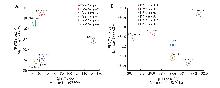
Fig.2
PCA and LDA analysis of different N. incisum samplesA.PCA of different samples of N. incisum; B.LDA of different samples of N. incisum.
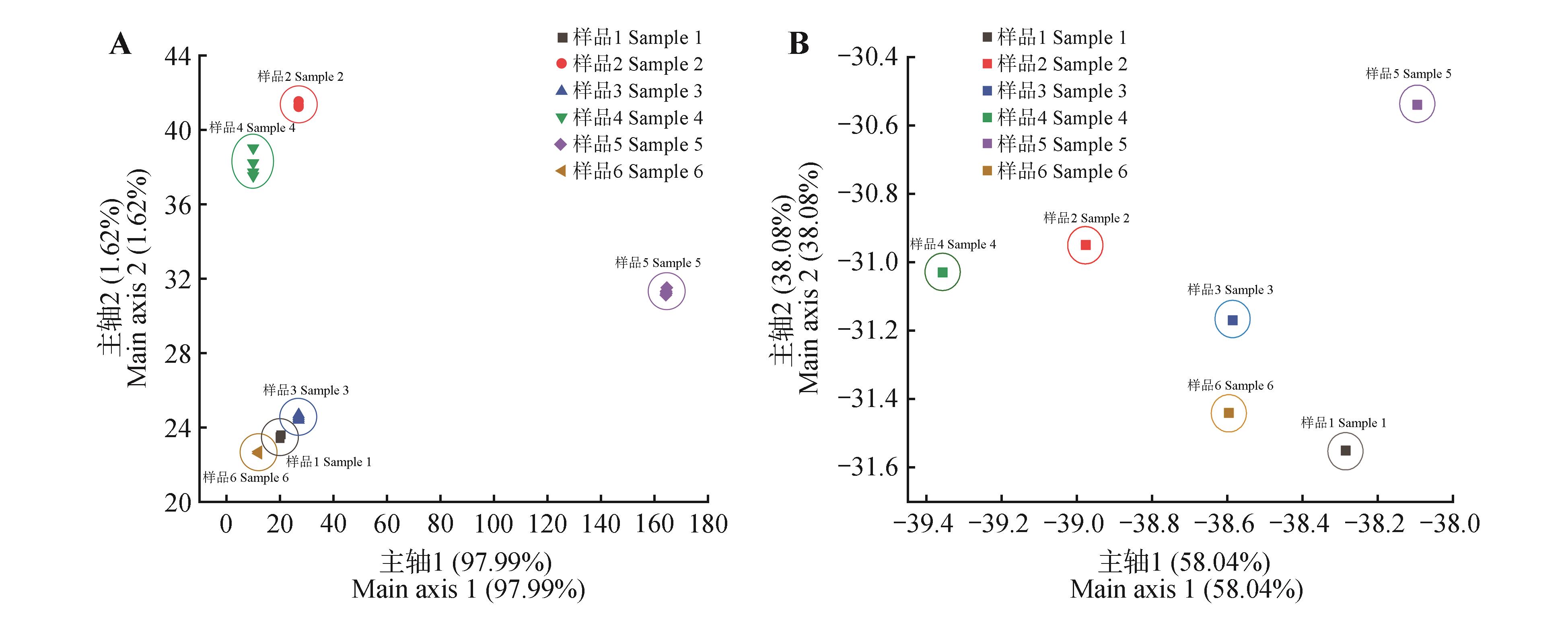
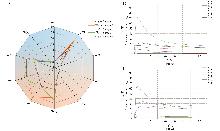
Fig.3
Radar chart and E-nose response intensity of different N. incisum samplesA.Radar chart of different N. incisum samples; B.Electronic nose response intensity of N. incisum samples before ‘worm-like rings’ formation (ZO); C. Electronic nose response intensity of N. incisum samples after ‘worm-like rings’ formation(HE).
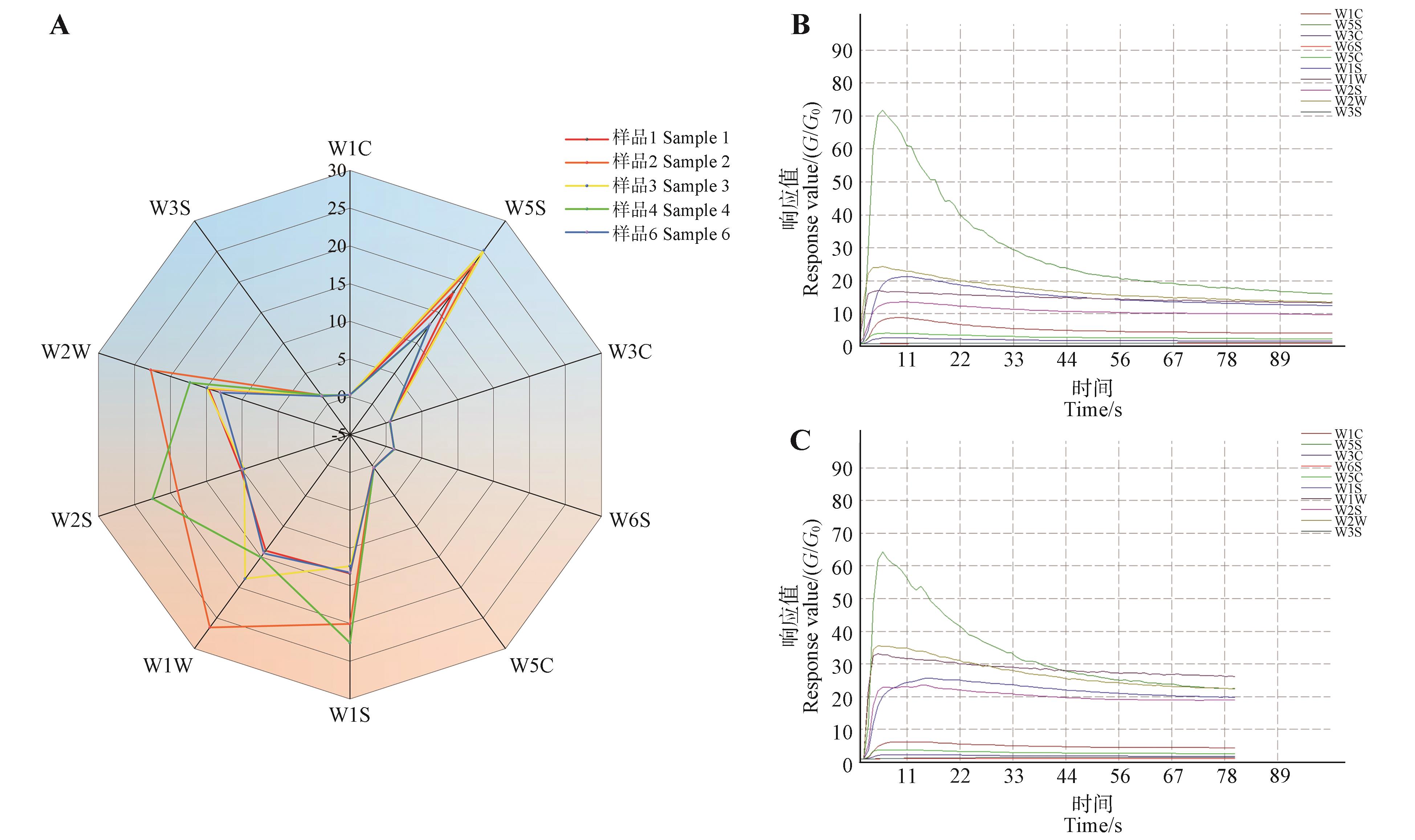
Fig.4
GC-MS total ion current diagram of different N. incisum samplesA. ZO refers to samples taken before the formation of the ‘worm-like rings’ in N. incisum; B. HE refers to samples taken after the formation of the ‘worm-like rings’ in N. incisum.
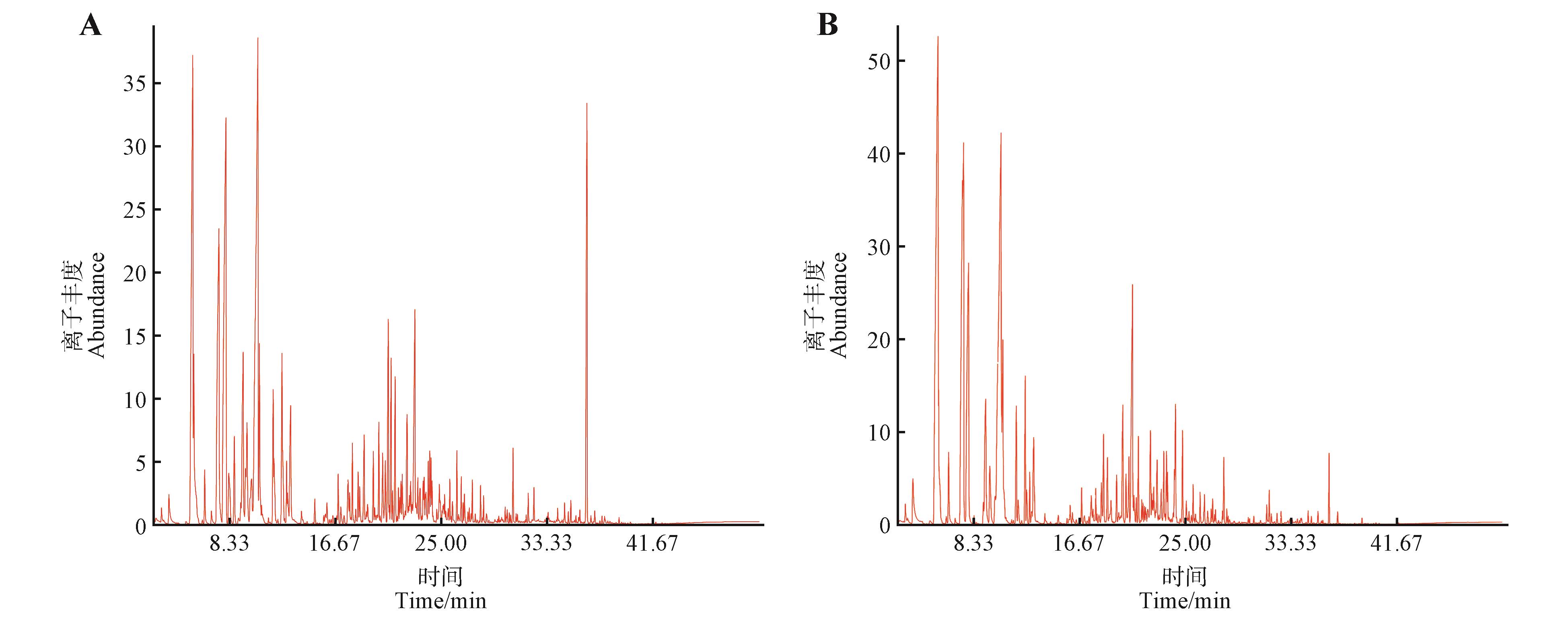

Fig.5
Classification and percentage of metabolites in N. incisumA. Metabolite classification chart; B. Number of different types of compounds; C. Percentage of different types of compounds.
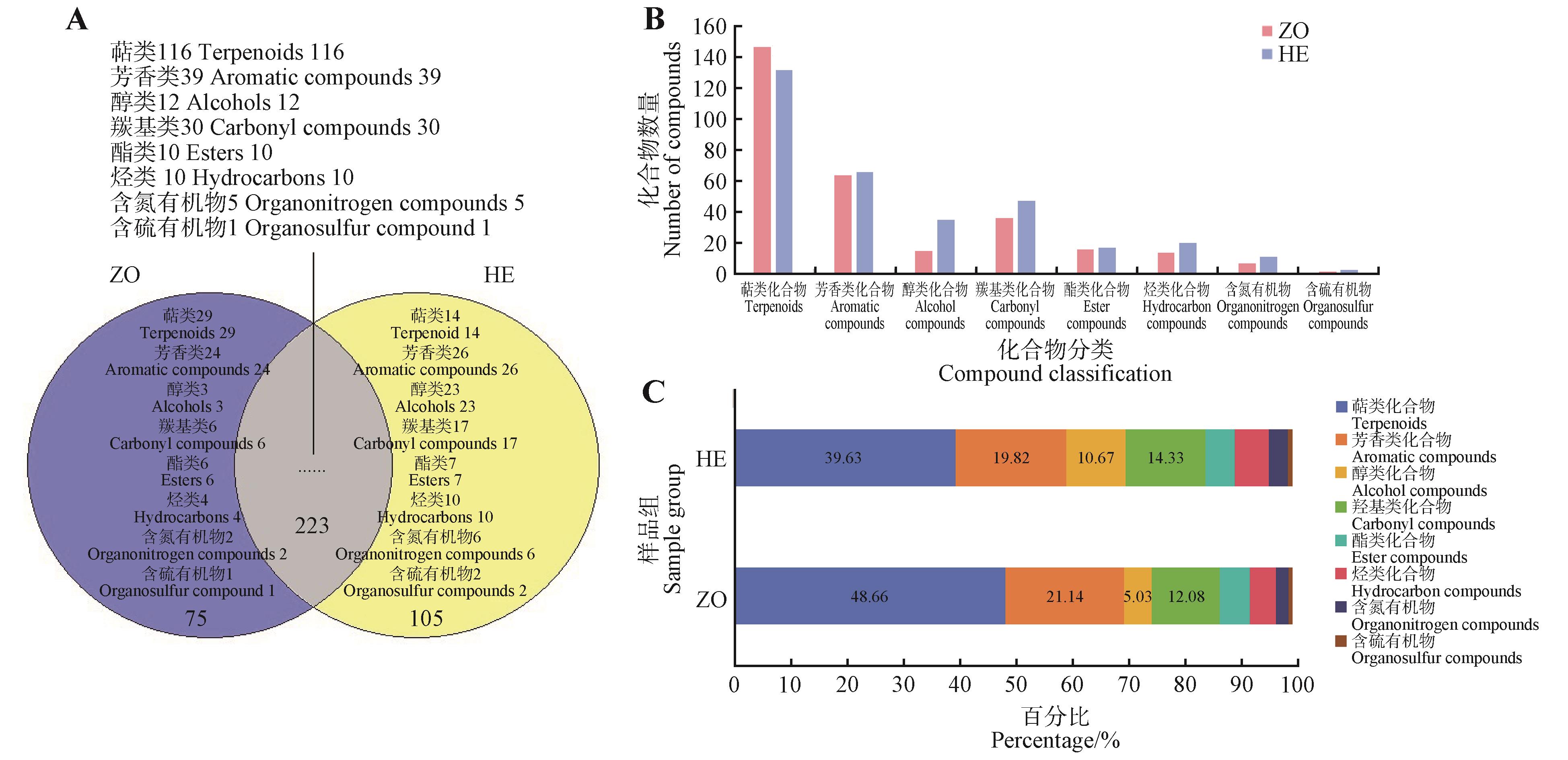
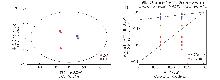
Fig.6
PCA and OPLS-DA of ZO versus HE
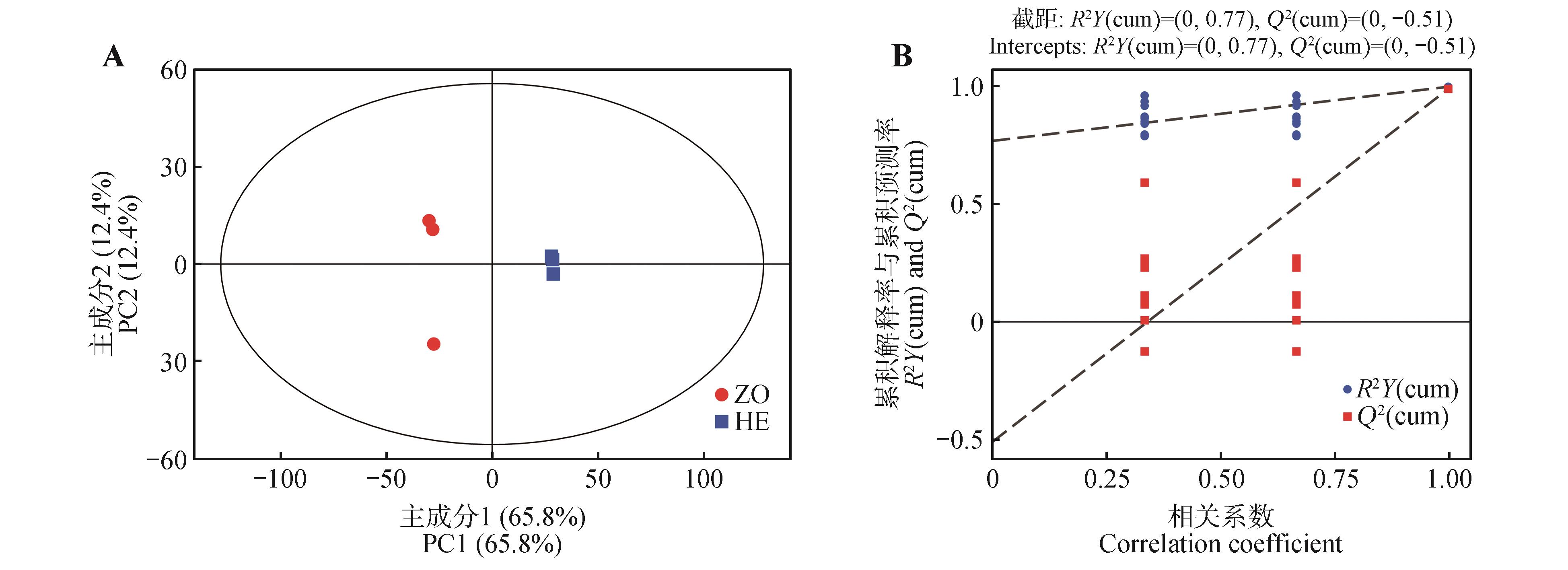
Table5
Differences in components between different N. incisum samples
化学分类 Chemical classification | 成分名称 Ingredient name | 相对含量 Relative content/(10-6)% | VIP | P | Log2FC | 显著性 Significance | |
|---|---|---|---|---|---|---|---|
| ZO | HE | ||||||
萜类 Terpenoids | α,α-二甲基-4-亚甲基环己烷甲醇 Cyclohexanemethanol,alpha,alpha-dimethyl-4-methylene- | 2.649 | 35 584.600 | 1.278 | <0.001 | 13.713 | *** |
桉叶油醇 Eucalyptol | 34 693.700 | 200 768.900 | 1.231 | <0.001 | 2.533 | *** | |
伞柳酮 Bicyclo[3.1.0]hex-3-en-2-one,4-methyl-1-(1-methylethyl)- | 2 575.850 | 88.676 | 1.111 | <0.001 | -4.860 | *** | |
吉马酮 3,7-Cyclodecadien-1-one,3,7-dimethyl-10- (1-methylethylidene)-,(E,E)- | 5 466.710 | 2.984 | 1.279 | 0.001 | -10.834 | *** | |
(3S,6S)-6-异丙基-3-甲基-2-(丙烷-2-烯胺)-3-乙烯基环己酮 (3S,6S)-6-Isopropyl-3-methyl-2-(propan-2-ylidene)- 3-vinylcyclohexanone | 3 611.270 | 2.984 | 1.278 | 0.001 | -10.241 | *** | |
α-可巴烯-11-醇 Tricyclo[4.4.0.0(2,7)]dec-8-ene-3-methanol,alpha,alpha, 6,8-tetramethyl-,stereoisomer | 4 534.500 | 2.984 | 1.278 | 0.002 | -10.570 | ** | |
(4aR,8aR)-5,8a-二甲基-3-(丙-2-亚基)-1,2,4,4a,7,8-六氢萘 Selina-3,7(11)-diene | 6 164.300 | 2.984 | 1.278 | 0.004 | -11.012 | ** | |
4(15),5,10(14)-大根香叶三烯-1-醇 (1R,7S,E)-7-Isopropyl-4,10-dimethylenecyclodec-5-enol | 44 995.200 | 1 249.380 | 1.278 | 0.005 | -5.170 | ** | |
醇类 Alcohols | (3R,6R)-2,2,6-三甲基-6-乙烯基四氢-2H-吡喃-3-醇 (3R,6R)-2,2,6-Trimethyl-6-vinyltetrahydro-2H-pyran-3-ol | 5 802.590 | 30 678.900 | 1.266 | <0.001 | 2.402 | *** |
顺式α,α,5-三甲基-5-乙烯基四氢呋喃-2-甲醇 2-Furanmethanol,5-ethenyltetrahydro-alpha, alpha,5-trimethyl-,cis- | 23 803.300 | 123 261.500 | 1.261 | <0.001 | 2.372 | *** | |
(1aR,4S,7R,7aS,7bR)-1,1,4,7-四甲基-1a,2,3,4,6,7, 7a,7b-辛氢-1H-环丙烷-4-醇 (1aR,4S,7R,7aS,7bR)-1,1,4,7-Tetramethyl-1a,2,3,4,6,7, 7a,7b-octahydro-1H-cyclopropa[e]azulen-4-ol | 7 997.220 | 1 438.210 | 1.264 | <0.001 | -2.475 | *** | |
芳香类 Aromatic compounds | 苯乙醛 Benzeneacetaldehyde | 17 120.800 | 75 189.000 | 1.250 | <0.001 | 2.135 | *** |
芹菜脑 Apiol | 9 739.830 | 2.984 | 1.278 | 0.003 | -8.350 | ** | |
烯烃类 Alkenes | 2,2-二甲基-3-庚酮 2,2-Dimethyl-3-heptanone | 2.650 | 13 165.000 | 1.278 | <0.001 | 12.279 | *** |
1,3-二甲基-1-环己烯 1,3-Dimethyl-1-cyclohexene | 2 164.760 | 255 318.400 | 1.044 | <0.001 | 6.882 | *** | |
酯类 Esters | 乙酸3-甲基戊酯 3-Methylpentyl acetate | 2.650 | 196 826.500 | 1.278 | <0.001 | 16.181 | *** |
11,14-十八碳二烯酸甲酯 11,14-Octadecadienoic acid,methyl ester | 3 335.620 | 1 025.690 | 1.171 | 0.001 | -1.701 | ** | |
硫醚类 Thioethers | 1,2-双(叔丁硫基)乙烷 Propane,2,2′-[1,2-ethanediylbis(thio)]bis[2-methyl- | 2.650 | 114 391.900 | 1.278 | <0.001 | 15.398 | *** |
Table 6
Sensory thresholds and ROAV between different N. incisum samples
化学分类 Chemical classification | 成分名称 Ingredient name | 气味特征 Odor characteristics | 感觉阈值 Sensitivity threshold/10-9 | ROAV /10-6 | |
|---|---|---|---|---|---|
| ZO | HE | ||||
醛类 Aldehydes | 正丁醛 Butanal | 木质香,辛辣味,花香和草香 Woody,spicy,floral,and grassy notes | 9.0 | 7 082.519 | 3 499.010 |
2-甲基丁醛 Butanal,2-methyl- | 焦味,呛味和酸味 Burnt,acrid,and acidity notes | 1.0 | 223 359.521 | 675 143.521 | |
庚醛 Heptanal | 草香,清新味,酸味,刺鼻味和穿透性果香 Grassy,fresh,acidity,pungent,and pronounced fruity notes | 3.0 | 4.953 | 9 953.313 | |
芳香醛 Aromatic aldehydes | 苯乙醛 Benzeneacetaldehyde | 花香,苦味,果香和辛辣味 Floral,bitter,fruity,and spicy notes | 4.0 | 24 003.219 | 112 634.827 |
酯类 Esters | 乙酸乙酯 Ethyl acetate | 香甜,果香,茴香和草香 Sweet,fruity,aniseed,and grassy notes | 5.0 | 3867.515 | 19 343.970 |
2-丙烯酸乙酯 2-Propenoic acid,ethyl ester | 果香,刺鼻的穿透性气味,酸味和辛辣味 Fruity,penetrating odor,acidity,and spicy notes | 0.2 | 74.301 | 588 937.491 | |
庚酸乙酯 Heptanoic acid,ethyl ester | 果香 Fruity notes | 2.0 | 9 237.770 | 19 914.751 | |
γ-丁内酯 Butyrolactone | 焦糖味,甜味和烤坚果味 Caramel,sweet,and roasted nutty flavor notes | 20 000.0 | 9.302 | 0.001 | |
丙酸香叶酯 Geranyl propionate | 苦味和花香 Bitter and floral notes | 10.0 | 71 442.880 | 163 689.300 | |
γ-癸内酯 2(3H)-Furanone,5-hexyldihydro- | 焦糖味,甜味和果香 Caramel,sweet,and fruity notes | 1.0 | 105 806.259 | 17.877 | |
棕榈酸乙酯 Hexadecanoic acid,ethyl ester | 蜡味,果香和香脂味 Waxy,fruity,and balsamic notes | 2 000.0 | 25.463 | 0.009 | |
芳香酯 Aromatic esters | 苯乙酸乙酯 Benzeneacetic acid,ethyl ester | 茴香,甜味,苦味,花香和果香 Aniseed,sweet,bitter,floral,and fruity notes | 650.0 | 305.926 | 109.623 |
醇类 Alcohols | (Z)-3-己烯-1-醇 3-Hexen-1-ol,(Z)- | 草香和果香 Grassy and fruity notes | 70.0 | 10 864.542 | 2 084.448 |
芳香醇 Aromatic alcohols | 苯乙醇 Phenylethyl alcohol | 玫瑰香,花香,苦味和果香 Rose,floral,bitter,and fruity notes | 1 000.0 | 3 431.055 | 10 346.501 |
芳香酚 Phenolic compounds | 4-烯丙基-2,6-二甲氧基苯酚 Phenol,2,6-dimethoxy-4-(2-propenyl)- | 焦香,烟熏味,甜味和花香 Toasty,smoky,sweet,and floral notes | 1 200.0 | 98.006 | 0.014 898 |
芳香类 Aromatic compounds | 对二甲苯 p-Xylene | 甜味 Sweet | 50.0 | 0.297 | 365.111 |
萜类 Terpenoids | 桉叶油醇 Eucalyptol | 胡椒味,草香,香甜,樟脑和清凉薄荷香 Peppery,grassy,sweet,camphor,and minty notes | 1.0 | 194 561.709 | 1 203 025.158 |
顺式α,α,5-三甲基-5-乙烯基四氢 呋喃-2-甲醇 2-Furanmethanol,5-ethenyltetrahydro-alpha,alpha,5-trimethyl-,cis- | 茴香,樟脑味,花香,草香和木质香 Aniseed,camphor,floral,grassy,and woody notes | 320.0 | 417.151 | 2 308.106 | |
α-松油醇 alpha-Terpineol | 茴香,柑橘香,花香,清凉薄荷香和木质香 Aniseed,citrus scent,floral,minty,and woody notes | 280.0 | 4 085.599 | 13 374.738 | |
D-香芹酮 D-Carvone | 茴香 Aniseed | 2.7 | 1 122 716.468 | 307 490.814 | |
香茅醇 Citronellol | 苦味,柑橘香,花香和清新玫瑰香气 Bitter,citrus scent,floral,and fragrance of roses | 11.0 | 23 361.970 | 74 404.203 | |
紫苏醇 p-Mentha-1,8-dien-7-ol | 芳樟味和辛辣味 Linalool and spicy notes | 7 000.0 | 89.313 | 9.965 | |
石竹烯氧化物 Caryophyllene oxide | 草香和甜味 Grassy and sweet | 200.0 | 172.972 | 1.585 | |
香芹酚 Phenol,2-methyl-5-(1-methylethyl)- | 木质香,樟脑,药用烟雾气味和茴香 Woody,camphor,the scent of medicinal smoke,and aniseed notes | 2 290.0 | 20.4201 | 47.868 | |
(Z)-橙花叔醇 Nerolidol,cis- | 蜡味 Waxy notes | 10.0 | 562.726 | 11 582.811 | |
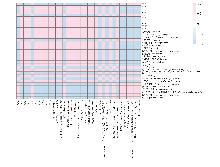
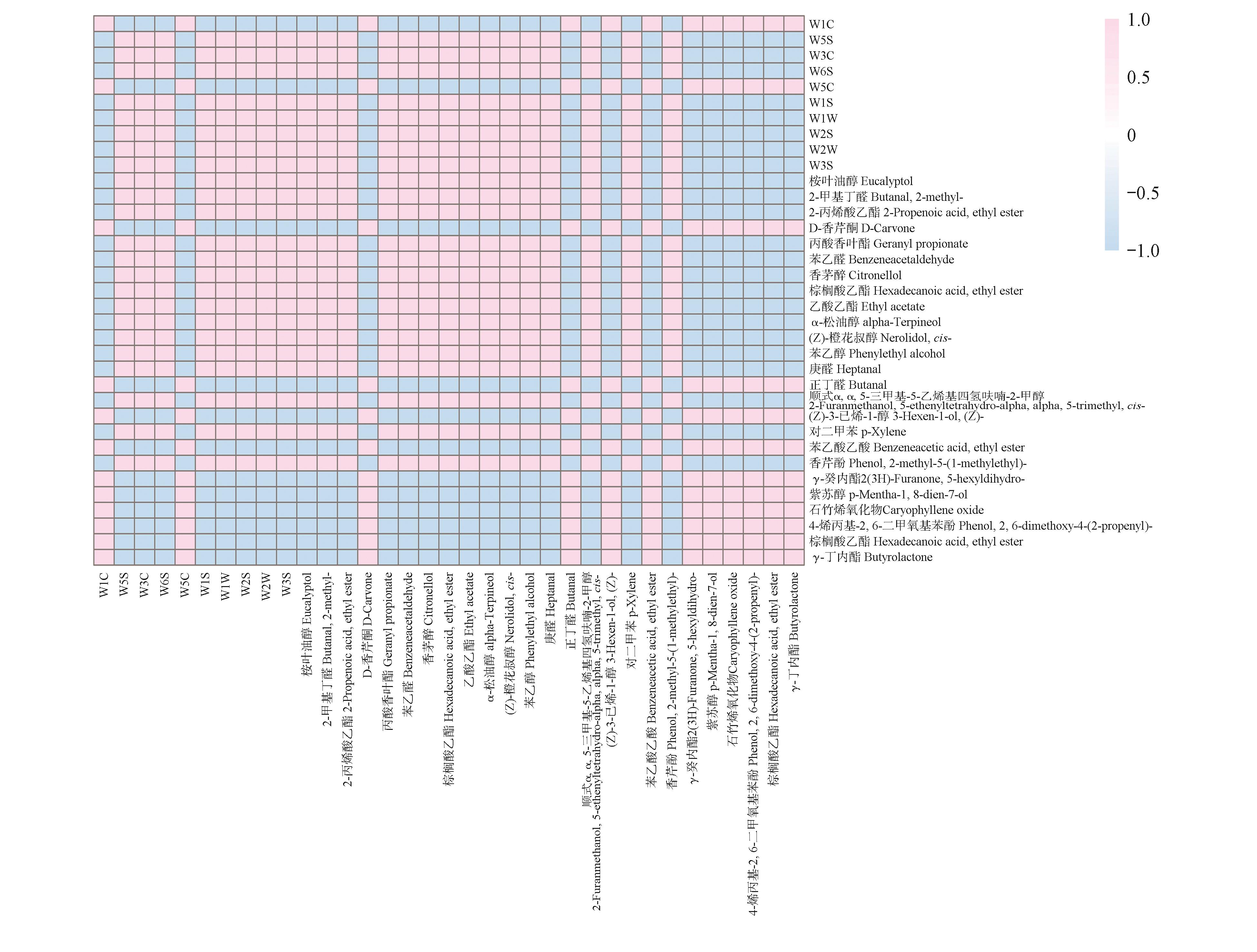
Fig.7
Heatmap of correlations between electronic nose and GC-MS of N. incisumColors in the figure ranged from blue to pink,representing Spearman’s correlation coefficients from -1.0 to 1.0. Blue indicated negative correlation,pink indicated positive correlation,and white indicated no correlation (0). The darker the color,the stronger the correlation.
| [1] | 国家药典委员会.中华人民共和国药典:2025年版:一部[M].北京:中国医药科技出版社,2025:197-198. |
| China Pharmacopoeia Commission.Pharmacopoeia of the People’s Republic of China: 2025 Edition: Volume Ⅰ[M].Beijing:China Medical Science and Technology Press,2025:197-198. | |
| [2] | 陈虹宇.羌活质量特征及商品规格等级研究[D].成都: 成都中医药大学,2016. |
| Chen Hongyu.Study on quality characteristics and commercial grade specifications of Notopterygium incisum [D].Chengdu:Chengdu University of Traditional Chinese Medicine,2016. | |
| [3] | 吴仪洛.本草从新[M].上海:上海科学技术出版社,1958:17-18. |
| WU Yiluo.Bencao Congxin[M].Shanghai:Shanghai Science and Technology Press,1958:17-18. | |
| [4] | Hu J, Huang W X, Zhang F T,et al.Variability of volatile compounds in the medicinal plant Dendrobium officinale from different regions[J].Molecules,2020,25(21):5046. |
| [5] | 郭培,郎拥军,张国桃.羌活化学成分及药理活性研究进展[J].中成药,2019,41(10):2445-2459. |
| Guo Pei, Lang Yongjun, Zhang Guotao.Research progress on chemical constituents and pharmacological activities of Notopterygium incisum [J].Chinese Traditional Patent Medicine,2019,41(10):2445-2459. | |
| [6] | 汤露环,吴梦茹,陈妍妍,等.羌活抗类风湿性关节炎活性成分及作用机制的研究进展[J].中草药,2024,55(9):3137-3145. |
| Tang Luhuan, Wu Mengru, Chen Yanyan,et al.Active components and mechanism of Notopterygii Rhizoma et Radix in treatingrheumatoid arthritis[J].Chinese Traditional and Herbal Drugs,2024,55(9):3137-3145. | |
| [7] | 马丽梅,杨军丽.羌活药材的化学成分和药理活性研究进展[J].中草药,2021,52(19):6111-6120. |
| Ma Limei, Yang Junli.Research progress on chemical constituents and pharmacological activities of Notopterygii Rhizoma et Radix[J].Chinese Traditional and Herbal Drugs,2021,52(19):6111-6120. | |
| [8] | 徐浩然,王婷玉,兰乾敏,等.基于智能感官技术的不同种类蜂花粉风味差异分析[J].中国调味品,2025,50(8):192-196. |
| Xu Haoran, Wang Tingyu, Lan Qianmin,et al.Analysis of flavor differences of different kinds of bee pollen based on intelligent sensory technology[J].China Condiment,2025,50(8):192-196. | |
| [9] | Chen H, Huo D X, Zhang J L.Gas recognition in E-nose system:a review[J].IEEE Transactions on Biomedical Circuits and Systems,2022,16(2):169-184. |
| [10] | 熊青青,范俊俊,马敬泽,等.基于电子鼻技术的樱花花香测定方法的建立[J].经济林研究,2024,42(3):281-288. |
| Xiong Qingqing, Fan Junjun, Ma Jingze,et al.Establishment of determination method of cherry blossom fragrance based on electronic nose technology[J].Nonwood Forest Research,2024,42(3):281-288. | |
| [11] | Bojko B.Solid-phase microextraction:a fit-for-purpose technique in biomedical analysis[J].Analytical and Bioanalytical Chemistry,2022,414(24):7005-7013. |
| [12] | Song S Y, Ahn M S, Mekapogu M,et al.Analysis of floral scent and volatile profiles of different Aster species by E-nose and HS-SPME-GC-MS[J].Metabolites,2023,13(4):503. |
| [13] | Zhong L A, Zou X, Wu S Q,et al.Volatilome and flavor analyses based on e-nose combined with HS-GC-MS provide new insights into ploidy germplasm diversity in Platostoma palustre [J].Food Research International,2024,183:114180. |
| [14] | Ma Z C, Liu G Q, Yang Z J,et al.Species differentiation and quality evaluation for Atractylodes medicinal plants by GC/MS coupled with chemometric analysis[J].Chemistry & Biodiversity,2023,20(8):e202300793. |
| [15] | Cai X, Mai R Z, Zou J J,et al.Analysis of aroma-active compounds in three sweet osmanthus (Osmanthus fragrans) cultivars by GC-olfactometry and GC-MS[J].Journal of Zhejiang University:Science B,2014,15(7):638-648. |
| [16] | 李丽霞,张浩,林宇浩,等.电子鼻结合GC-MS鉴别不同部位的三七粉[J].食品科学,2023,44(20):321-329. |
| Li Lixia, Zhang Hao, Lin Yuhao,et al.Identification of Panax notoginseng powders from different root parts using electronic nose and gas chromatography-mass spectrometry[J].Food Science,2023,44(20):321-329. | |
| [17] | 黄得栋,何微微,晋玲,等.基于电子鼻技术区分不同产地的南五味子[J].中国实验方剂学杂志,2017, 23(23):22-26. |
| Huang Dedong, He Weiwei, Jin Ling,et al.Distinguish Schisandrae Sphenantherae Fructus from different producing areas based on electronic nose technology[J].Chinese Journal of Experimental Traditional Medical Formulae,2017,23(23):22-26. | |
| [18] | 曹森,赵成飞,马风伟,等.基于电子鼻和GC-MS评价不同采收期天麻的芳香品质[J].北方园艺,2019(19):87-94. |
| Cao Sen, Zhao Chengfei, Ma Fengwei,et al.Aroma quality of different harvesting period Gastrodia elata by electronic nose and gas chromatography-mass spectrometry[J].Northern Horticulture,2019(19):87-94. | |
| [19] | 陈艳,高嵩,黄晓雅,等.基于电子鼻和气相色谱-离子迁移谱法分析不同干燥方式对红花挥发性物质的影响[J].中国食品添加剂,2025,36(1):127-135. |
| Chen Yan, Gao Song, Huang Xiaoya,et al.Effects of different drying methods on the volatile compounds of safflower using electronic nose and GC-IMS analysis[J].China Food Additives,2025,36(1):127-135. | |
| [20] | 冯绘敏,侯一哲,黄天赐,等.电子传感技术在中药材及农产品分析领域的应用研究进展[J].分析测试技术与仪器,2020,26(4):239-248. |
| Feng Huimin, Hou Yizhe, Huang Tianci,et al.Application and research progress in electronic sensing technology in traditional Chinese medicine and agricultural products[J].Analysis and Testing Technology and Instruments,2020,26(4):239-248. | |
| [21] | 刘登勇,周光宏,徐幸莲.确定食品关键风味化合物的一种新方法:“ROAV”法[J].食品科学,2008,29(7):370-374. |
| Liu Dengyong, Zhou Guanghong, Xu Xinglian.“ROAV” method:a new method for determining key odor compounds of Rugao Ham[J].Food Science,2008,29(7):370-374. | |
| [22] | 李建军,董倩倩,赵一,等.基于电子鼻和电子舌技术对不同金银花酒的鉴别分析[J].现代食品科技,2022,38(11):308-312. |
| Li Jianjun, Dong Qianqian, Zhao Yi,et al.Identification and analysis of different honeysuckle wines using electronic nose and tongue technology[J].Modern Food Science and Technology,2022,38(11):308-312. | |
| [23] | 刘阿静,王娟,王波,等.基于电子鼻与多元统计分析鉴别当归产地的研究[J].质量安全与检验检测,2022,32(1):1-5. |
| Liu Ajing, Wang Juan, Wang Bo,et al.Identification of Angelica origin using electronic nose and multivariate statistical analysis[J].Quality Safety Inspection and Testing,2022,32(1):1-5. | |
| [24] | 欧阳辉发,李林致,吴佳颖,等.基于感官评价和电子鼻技术表征2种羌活挥发油气味特征及无损检测模型建立[J].药物分析杂志,2024,44(11):1852-1862. |
| Ouyang Huifa, Li Linzhi, Wu Jiaying,et al.Flavor characterization of two kinds of Notopterygii Rhizoma et Radix volatile oils based on sensory evaluation and electronic nose technology,and establishment of nondestructive detection models[J].Chinese Journal of Pharmaceutical Analysis,2024,44(11):1852-1862. | |
| [25] | 刘爽,朱小玲,孙国园,等.基于电子鼻和气相色谱技术筛选石菖蒲的质量标志物[J].内蒙古大学学报(自然科学版),2024,55(4):420-429. |
| Liu Shuang, Zhu Xiaoling, Sun Guoyuan,et al.Screening of quality markers of Acorus calamus based on electronic nose and gas chromatographic techniques[J].Journal of Inner Mongolia University (Natural Science Edition),2024,55(4):420-429. | |
| [26] | Lee D K, Ahn S, Cho H Y,et al.Metabolic response induced by parasitic plant-fungus interactions hinder amino sugar and nucleotide sugar metabolism in the host[J].Scientific Reports,2016,6:37434. |
| [27] | 任东,姜晓娅,雷京奇,等.基于电子鼻结合顶空-气相色谱-质谱法研究草果仁3种不同炮制品的差异[J].中草药,2024,55(15):5070-5082. |
| Ren Dong, Jiang Xiaoya, Lei Jingqi,et al.Research on differences of three different processed products of seeds of Tsaoko Fructus based on electronic nose combined with HS-GC-MS[J].Chinese Traditional and Herbal Drugs,2024,55(15):5070-5082. | |
| [28] | Reinke S N, Galindo-Prieto B, Skotare T,et al.OnPLS-based multi-block data integration:a multivariate approach to interrogating biological interactions in asthma[J].Analytical Chemistry,2018,90(22):13400-13408. |
| [29] | 胡双燕,陈敬忠,孙庆文,等.基于GC-MS技术的大果木姜子代谢组学特征研究[J].中华中医药学刊,2025,43(8):119-122. |
| Hu Shuangyan, Chen Jingzhong, Sun Qingwen,et al.Study on metabonomics characteristics of Daguomujiangzi(Fructus Cinnamomi) based on GC-MS technology[J].Chinese Archives of Traditional Chinese Medicine,2025,43(8):119-122. | |
| [30] | 王维皓,杨立新.羌活挥发性成分GC-MS分析[J].中国实验方剂学杂志,2020,26(23):153-160. |
| Wang Weihao, Yang Lixin.GC-MS analysis of volatile oil of Notopterygium inchum and Notopterygium franchetii [J].Chinese Journal of Experimental Traditional Medical Formulae,2020,26(23):153-160. | |
| [31] | 郭慧清,李娅琦,王梓轩,等.不同商品规格羌活药材的HPLC指纹图谱分析[J].中国实验方剂学杂志,2019,25(7):184-188. |
| Guo Huiqing, Li Yaqi, Wang Zixuan,et al.HPLC fingerprint analysis of Notopterygii Rhizoma et Radix with different commercial specifications[J].Chinese Journal of Experimental Traditional Medical Formulae,2019,25(7):184-188. | |
| [32] | 郭慧清.不同商品规格羌活药材的化学成分差异及谱效关系研究[D].北京:北京中医药大学,2019. |
| Guo Huiqing.Study on chemical composition differences and spectrum-effect relationship of NotopterygiiRhizoma et Radix with different commercial specifications[D].Beijing:Beijing University of Chinese Medicine,2019. | |
| [33] | 邹赋吉.栽培措施对羌活生长及有效成分的影响[D].雅安:四川农业大学,2023. |
| Zou Fuji.Effects of cultivation measures on the growth and effective components of Notopterygium incisum [D].Ya’an:Sichuan Agricultural University,2023. |
| [1] | Xueqing ZHAO, Li JIANG, Bing ZHAO, Rong CONG, Xiaoxu DONG. Differential Analysis of Volatile Compounds in Different Organs of Apocynum venetum Based on HS-SPME-GC-MS [J]. Bulletin of Botanical Research, 2026, 46(5): 827-837. |
| [2] | Xiangbo CHEN, Fangzhou LIU, Yibing FENG. Testing and Clustering Analysis of Floral Scent Compounds of Calycanthus [J]. Bulletin of Botanical Research, 2026, 46(3): 517-530. |
| [3] | Yongchang XUE, Hexian WANG, Di ZHAO, Jing GUO, Ao LI. Research Progress on the Biosynthesis and Functions of Plant Terpenoids [J]. Bulletin of Botanical Research, 2025, 45(4): 479-490. |
| [4] | Yunze YU, Ying YU, Shuwen ZHAO, Yinping JIN, Shifeng PANG, Hao ZHANG, Liwei XING, Yuyang SUN, Jing GUO. Comparative Analysis of Differential Components of Three Origins ofAsari Radix et Rhizoma in Changbai Mountain Forest Region [J]. Bulletin of Botanical Research, 2025, 45(1): 66-76. |
| [5] | Zhiyuan CHENG, Yanjiang ZHANG, Yue SHEN, Guang LI, Qin CHEN, Jie LI, Yanhong XING. Metabolomics Analysis of Lilium davidii var. unicolor in Response to Autotoxicity Stress [J]. Bulletin of Botanical Research, 2024, 44(5): 793-804. |
| [6] | Qingqing HUO, Yuxin XIA, Jiale LI, Wei HAN, Shuya ZHANG, Zhe ZHANG, Meiling XIA, Wenhua GUO, Xiangling YOU. Effect of Expression of Aeβ-AS gene from Aralia elata on the Content of Saponins in Nicotiana tabacum L. [J]. Bulletin of Botanical Research, 2023, 43(5): 779-786. |
| [7] | Yanjun REN, Yu SUN, Xiaorui GUO, Mingyuan XU, Wenda SHAO, Kexin WU. Analysis of Metabolic Characteristics of Different Organs of Acanthopanax senticosus and Acanthopanax sessiliflorus Based on GC-MS [J]. Bulletin of Botanical Research, 2023, 43(3): 439-446. |
| [8] | Yan WU, Sai LI, Kexin WU, Liqiang MU. Differences in Leaf Metabolism of Wild Rosa acicularis and Rosa acicularis ‘Luhe’ Based on GC-MS [J]. Bulletin of Botanical Research, 2022, 42(6): 1070-1078. |
| [9] | Yuqi Zhang, Xin Su, Zhiqiang You, Jinbo Fu, Yaguang Zhan, Jing Yin. [J]. Bulletin of Botanical Research, 2022, 42(2): 289-298. |
| [10] | Long-Jie LIU, Ke-Xin WU, Yun-Fei DIAO, Zhong-Yue LI, Li-Qiang MU. Metabolic Differences Between Wild and Cultivated Species of Taxus cuspidata Based on GC-MS [J]. Bulletin of Botanical Research, 2021, 41(5): 798-806. |
| [11] | ZHI Hui, AI Dan, WU Ke-Xin, GUO Yun, XU Ming-Yuan, TANG Zhong-Hua. Comparison on Chemical Constituents between Potentilla chinensis and P.acaulis using GC-MS by Metabolomics Approach [J]. Bulletin of Botanical Research, 2020, 40(5): 718-727. |
| [12] | ZHU Xiao-Jie, ZHOU Xiang-Yu, FAN Hang, GAO Xi-Feng, YANG Lei. Comparative Analysis on Volatile Terpenoids in Nine Aromatic Plants of Lamiaceae [J]. Bulletin of Botanical Research, 2020, 40(5): 696-705. |
| [13] | TAN Yong-Jia, GAO Cui-Fang, CHEN Xue-Lin. Comparison of Essential Oil Components in Ajania tenuifolia(Jacq.) Tzvel. at Different Altitudes [J]. Bulletin of Botanical Research, 2020, 40(5): 782-788. |
| [14] | ZHANG Yu-Ting, WANG Xiao-Fei, NI Yan-Yan, LIU Jian-Feng, JIANG Ze-Ping. Component Analysis of Volatile Organic Compounds Released by Branch and Leaf of Quercus variabilis and Response to Mechanical Injury in Beijing Pinggu [J]. Bulletin of Botanical Research, 2019, 39(1): 35-44. |
| [15] | HU Wen-Jie, LUO Hui, ZOU Lin-Hai, LI Guan-Xi. Chemical Components and Antioxidant Activity of Volatile Oil from Pine Needles of Cedrus deodara [J]. Bulletin of Botanical Research, 2017, 37(4): 621-627. |
| Viewed | ||||||
|
Full text |
|
|||||
|
Abstract |
|
|||||