Bulletin of Botanical Research ›› 2026, Vol. 46 ›› Issue (5): 827-837.doi: 10.7525/j.issn.1673-5102.2026.05.005
• Original Paper • Previous Articles Next Articles
Xueqing ZHAO1, Li JIANG2( ), Bing ZHAO1(), Rong CONG1, Xiaoxu DONG1
Received:2026-03-02
Online:2026-08-28
Published:2026-10-10
Contact:
Li JIANG, Bing ZHAO
E-mail:jiangli@ms.xjb.ac.cn;bingzhao@nwsuaf.edu.cn
CLC Number:
Xueqing ZHAO, Li JIANG, Bing ZHAO, Rong CONG, Xiaoxu DONG. Differential Analysis of Volatile Compounds in Different Organs of Apocynum venetum Based on HS-SPME-GC-MS[J]. Bulletin of Botanical Research, 2026, 46(5): 827-837.
Add to citation manager EndNote|Ris|BibTeX
URL: https://bbr.nefu.edu.cn/EN/10.7525/j.issn.1673-5102.2026.05.005
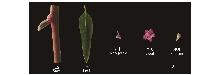
Fig.1
Tissues and organs of A. venetum
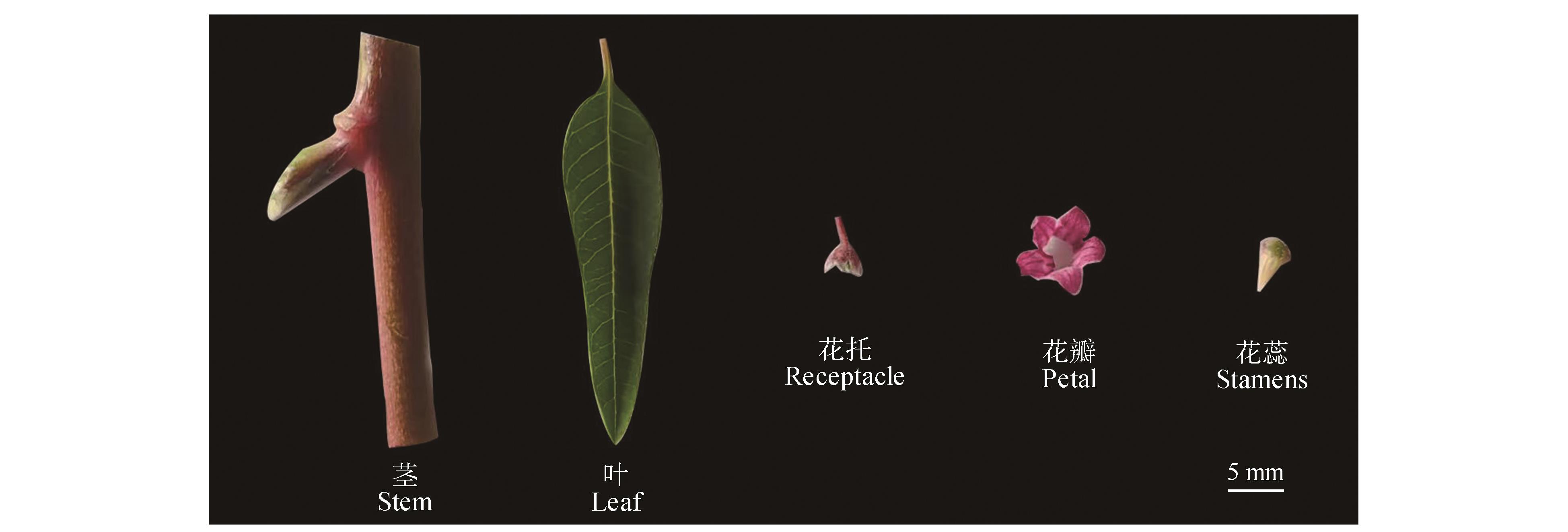
Table 1
Types and relative contents of major volatile components in different tissues and organs of A. venetum
| 序号Number | 类别 Category | 挥发性成分 Volatile components | 相对含量 Relative content/% | ||||
|---|---|---|---|---|---|---|---|
花蕊 Stamens | 花瓣 Petal | 花托 Receptacle | 茎 Stem | 叶 Leaf | |||
| 1 | 醇类 Alcohols | 乙醇 Ethanol | 1.95±0.08cd | 2.85±0.29bc | 38.72±2.19a | 0.93±0.03d | 4.31±0.06b |
| 2 | 苯乙醇 Phenylethyl alcohol | 38.03±3.81a | 19.98±0.90b | 0.79±0.05c | — | — | |
| 3 | 苯甲醇 Benzyl alcohol | 9.61±0.93a | 1.35±0.19b | — | — | — | |
| 4 | 3-甲基-1-丁醇 3-Methyl-1-butanol | 1.74±0.20a | 0.99±0.05b | 0.40±0.05c | — | — | |
| 5 | 2-甲基-1-丁醇 2-Methyl-1-butanol | 0.23±0.02c | 0.43±0.11b | 1.38±0.05a | — | — | |
| 6 | (Z)-3-己烯-1-醇 (Z)-3-Hexen-1-ol | — | — | 1.20±0.02 | — | — | |
| 7 | 1-己醇 1-Hexanol | — | — | 0.16±0.01b | — | 22.20±0.96a | |
| 8 | 1-戊烯-3-醇 1-Penten-3-ol | — | — | — | — | 18.00±0.86 | |
| 9 | 醛类 Aldehydes | 己醛 Hexanal | 1.39±0.16a | 0.73±0.25b | 0.67±0.01b | — | — |
| 10 | 苯乙醛 Benzeneacetaldehyde | 5.45±0.65b | 10.54±0.32a | — | — | — | |
| 11 | 壬醛 Nonanal | 0.73±0.12b | 1.18±0.01a | 0.88±0.05b | — | — | |
| 12 | 乙醛 Acetaldehyde | — | 2.51±0.39a | — | 0.80±0.14b | — | |
| 13 | 戊醛 Pentanal | — | 1.84±0.03a | 0.20±0.02b | — | — | |
| 14 | (4E)-4-壬烯醛 (4E)-4-Nonenal | — | — | 0.75±0.04 | — | — | |
| 15 | 癸醛 Decanal | — | — | 1.17±0.07 | — | — | |
| 16 | (2E,6Z)-2,6-壬二烯醛 (2E,6Z)-2,6-Nonadienal | — | — | 7.37±0.71 | — | — | |
| 17 | (2E)-2-壬烯醛 (2E)-2-Nonenal | — | — | 11.34±0.84 | — | — | |
| 18 | (2E)-2-己烯醛 (2E)-2-Hexenal | — | — | 0.12±0.01 | — | — | |
| 19 | 3-甲基丁醛 3-Methyl-butanal | — | 0.38±0.04a | 0.08±0.01b | — | — | |
| 20 | 酮类 Ketones | 苯乙酮 Acetophenone | 25.97±1.12b | 41.89±2.47a | 7.90±0.98c | — | — |
| 21 | 6-甲基-5-庚烯-2-酮 6-Methyl-5-hepten-2-one | 0.39±0.05b | 1.35±0.18a | — | — | — | |
| 22 | 2-戊酮 2-Pentanone | — | — | 1.20±0.07 | — | — | |
| 23 | 1-戊烯-3-酮 1-Penten-3-one | — | — | — | — | 3.62±0.07 | |
| 24 | 酯类 Esters | 苯甲酸乙酯 Ethyl benzoate | 4.22±0.64b | 3.99±0.33b | 12.28±0.56a | — | — |
| 25 | 水杨酸甲酯 Methyl salicylate | 1.91±0.19b | 3.01±0.21a | 1.51±0.14c | — | — | |
| 26 | 乙酸苯乙酯 Phenethyl acetate | 6.48±0.73a | 4.00±0.64b | — | — | — | |
| 27 | 乙酸乙酯 Ethyl acetate | — | — | 0.61±0.02b | 0.79±0.09a | — | |
| 28 | 乙酸异戊酯 Isoamyl acetate | — | 0.57±0.04a | 0.11±0.01b | — | — | |
| 29 | 烷烃类 Alkanes | 4,6-二甲基十二烷 4,6-Dimethyldodecane | 0.40±0.05 | — | — | — | — |
| 30 | 正己烷 n-Hexane | — | — | — | 0.23±0.01 | — | |
| 31 | 硅氧烷类 Siloxanes | 八甲基环四硅氧烷 Octamethylcyclotetrasiloxane | — | — | 0.16±0.01 | — | — |
| 32 | 六甲基环三硅氧烷 Hexamethylcyclotrisiloxane | 0.16±0.02a | 0.11±0.05a | 0.14±0.01a | 0.16±0.01a | — | |
| 33 | 十二甲基环六硅氧烷 Dodecamethylcyclohexasiloxane | 0.16±0.01b | 0.11±0.01c | 0.16±0.01b | 0.20±0.02a | — | |
| 34 | 十甲基环五硅氧烷 Decamethylcyclopentasiloxane | — | — | — | 0.22±0.02 | — | |
| 35 | 十六甲基七硅氧烷 Hexadecamethylheptasiloxane | — | — | — | 0.08±0.01 | — | |
| 36 | 萜烯类 Terpenoids | 石竹烯 Caryophyllene | 0.41±0.05b | 0.24±0.18b | 0.47±0.04b | 8.16±1.11a | 8.76±0.43a |
| 37 | α-蒎烯 α-Pinene | — | — | 0.11±0.01b | 3.35±2.37a | — | |
| 38 | β-古巴烯 β-Copaene | — | — | 1.90±0.05c | 11.19±1.07a | 9.17±0.44b | |
| 39 | 古巴烯 Copaene | — | — | — | 0.56±0.10 | — | |
| 40 | β-红没药烯 β-Bisabolene | — | — | 7.93±0.94b | 9.90±0.43a | — | |
| 41 | 依兰烯 Ylangene | — | — | — | 2.57±0.16 | — | |
| 42 | δ-芹子烯 δ-Selinene | — | — | — | 0.06±0.01 | — | |
| 43 | γ-木罗烯 γ-Muurolene | — | — | — | 1.17±0.15 | — | |
| 44 | α-荜澄茄烯 α-Cubebene | — | — | — | 0.29±0.04 | — | |
| 45 | (1S)-6,6-二甲基-2-亚甲基双环[3.1.1]庚烷 (1S)-6,6-Dimethyl-2-methylenebicyclo[3.1.1]heptane | — | — | — | 2.82±0.21 | — | |
| 46 | (3R-反式)-4-乙烯基-4-甲基-3-(1-甲基乙 烯基)-1-(1-甲基乙基)环己烯 (3R-trans)-4-ethenyl-4-methyl-3-(1-methylethenyl)-1-(1-methylethyl)cyclohexene | — | — | — | 13.30±0.10a | 3.23±0.13b | |
| 47 | [1S-(1α,2β,4β)]-1-乙烯基-1-甲基-2,4-双(1-甲基乙烯基)环己烷 [1S-(1α,2β,4β)]-1-ethenyl-1-methyl-2,4- bis(1-methylethenyl)cyclohexane | — | — | — | 0.54±0.03 | — | |
| 48 | (+)-表双环倍半水芹烯 (+)-epi-Bicyclosesquiphellandrene | — | — | — | 0.24±0.02 | — | |
| 49 | [4aR-(4aα,7α,8aβ)]-十氢-4a-甲基-1-亚甲基-7-(1-甲基乙烯基)萘 [4aR-(4aα,7α,8aβ)]-decahydro-4a-methyl-1-methylene-7-(1-methylethenyl)naphthalene | — | — | — | 0.44±0.11 | — | |
| 50 | (±)-(1α,4aβ,8aα)-1,2,4a,5,8,8a-六氢-4,7-二甲基-1-(1-甲基乙基)萘 (±)-(1α,4aβ,8aα)-1,2,4a,5,8,8a-hexahydro-4,7-dimethyl-1-(1-methylethyl)naphthalene | — | — | — | 0.87±0.13 | — | |
| 51 | (1S-顺式)-1,2,3,5,6,8a-六氢-4,7-二甲基-1-(1-甲基乙基)萘 (1S-cis)-1,2,3,5,6,8a-hexahydro-4,7-dimethyl-1-(1-methylethyl)naphthalene | — | — | — | 1.14±0.13 | — | |
| 52 | 芳烃类及其他 Aromatic hydrocarbons and others | 苯 Benzene | — | — | — | 39.84±1.20a | 30.67±0.47b |
| 53 | N-苯基甲酰胺 N-Phenylformamide | — | 1.33±0.11 | — | — | — | |
| 54 | 苯甲腈 Benzonitrile | — | 0.54±0.07 | — | — | — | |
| 55 | (2S)-2-氨基-N-乙基丙酰胺 (2S)-2-Amino-N-ethylpropanamide | 0.69±0.04 | — | — | — | — | |
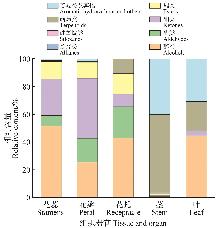
Fig.2
Relative contents of major volatile components in different tissues and organs of A. venetum
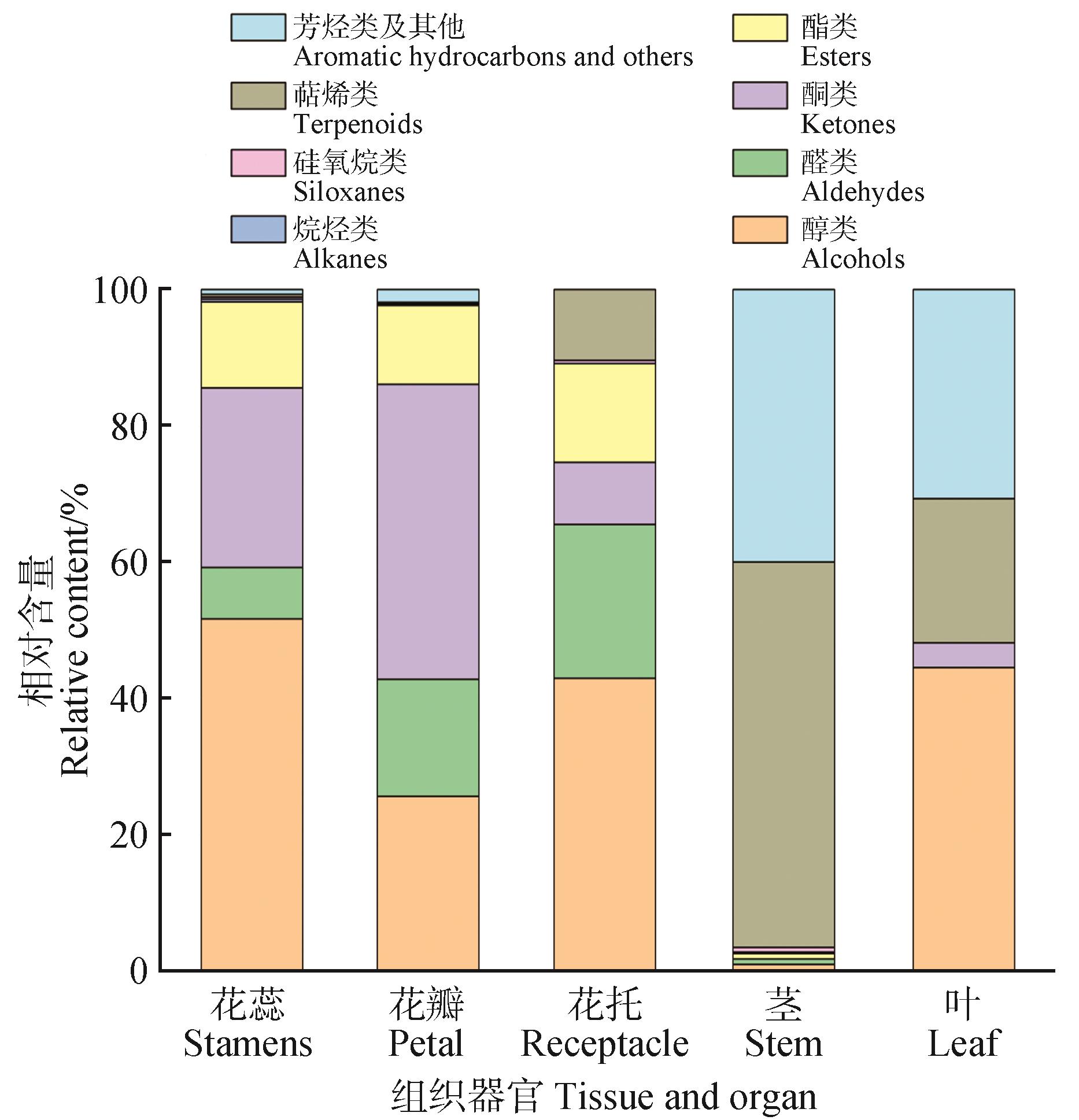
Fig.3
Principal component analysis of major volatile compounds in different tissues and organs of A. venetum
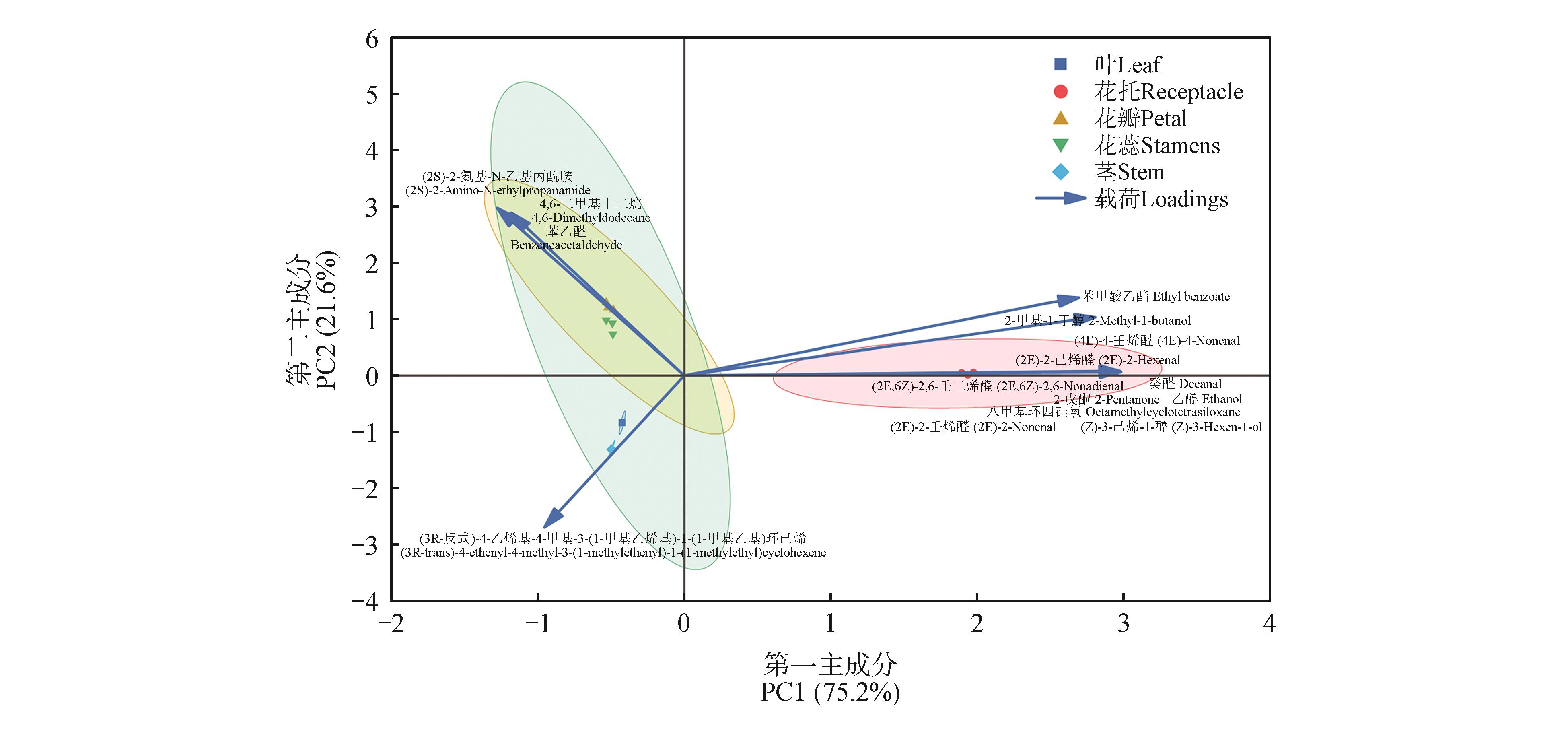
Fig.4
Radar chart of odor types of major volatile compounds in different tissues and organs of A. venetum
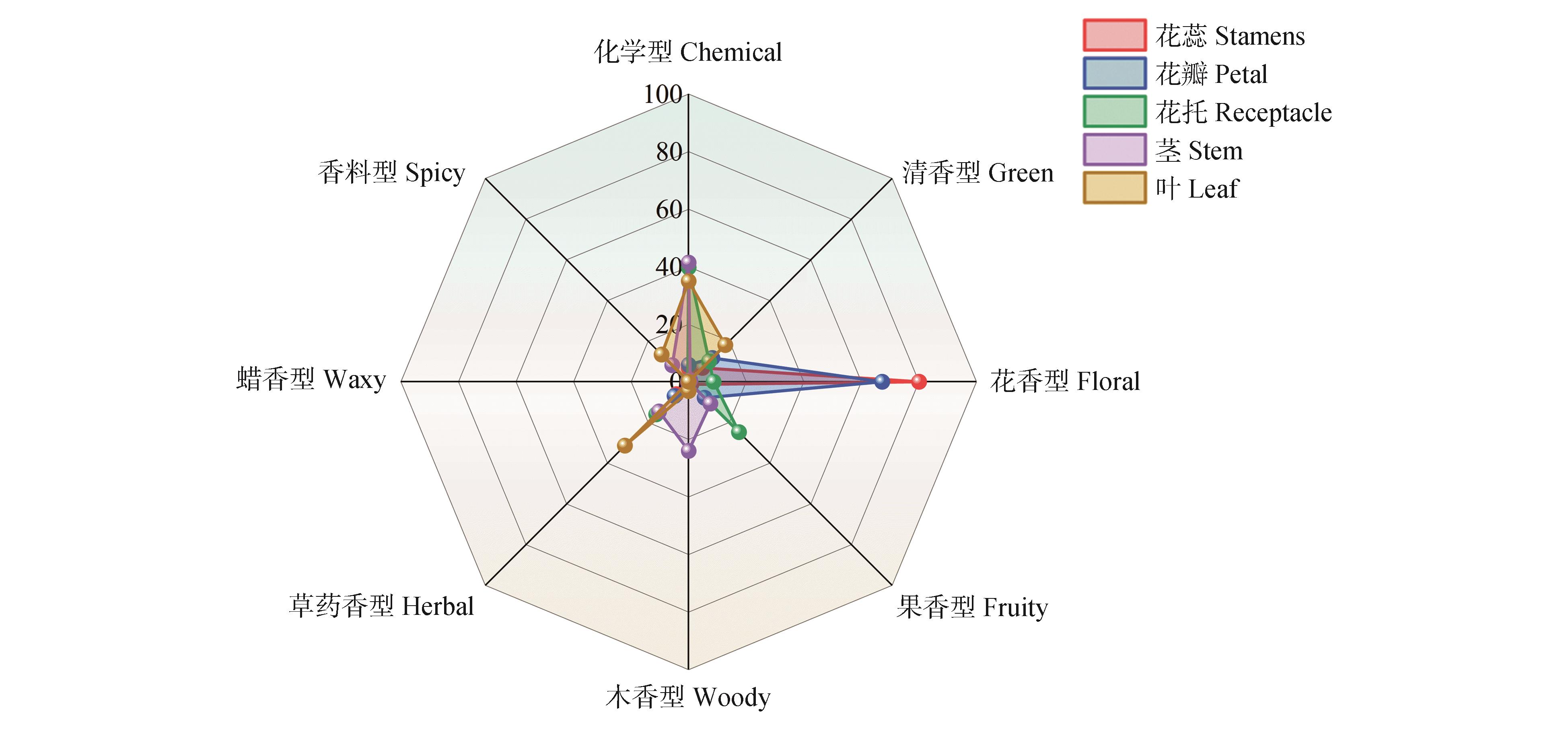
Fig.5
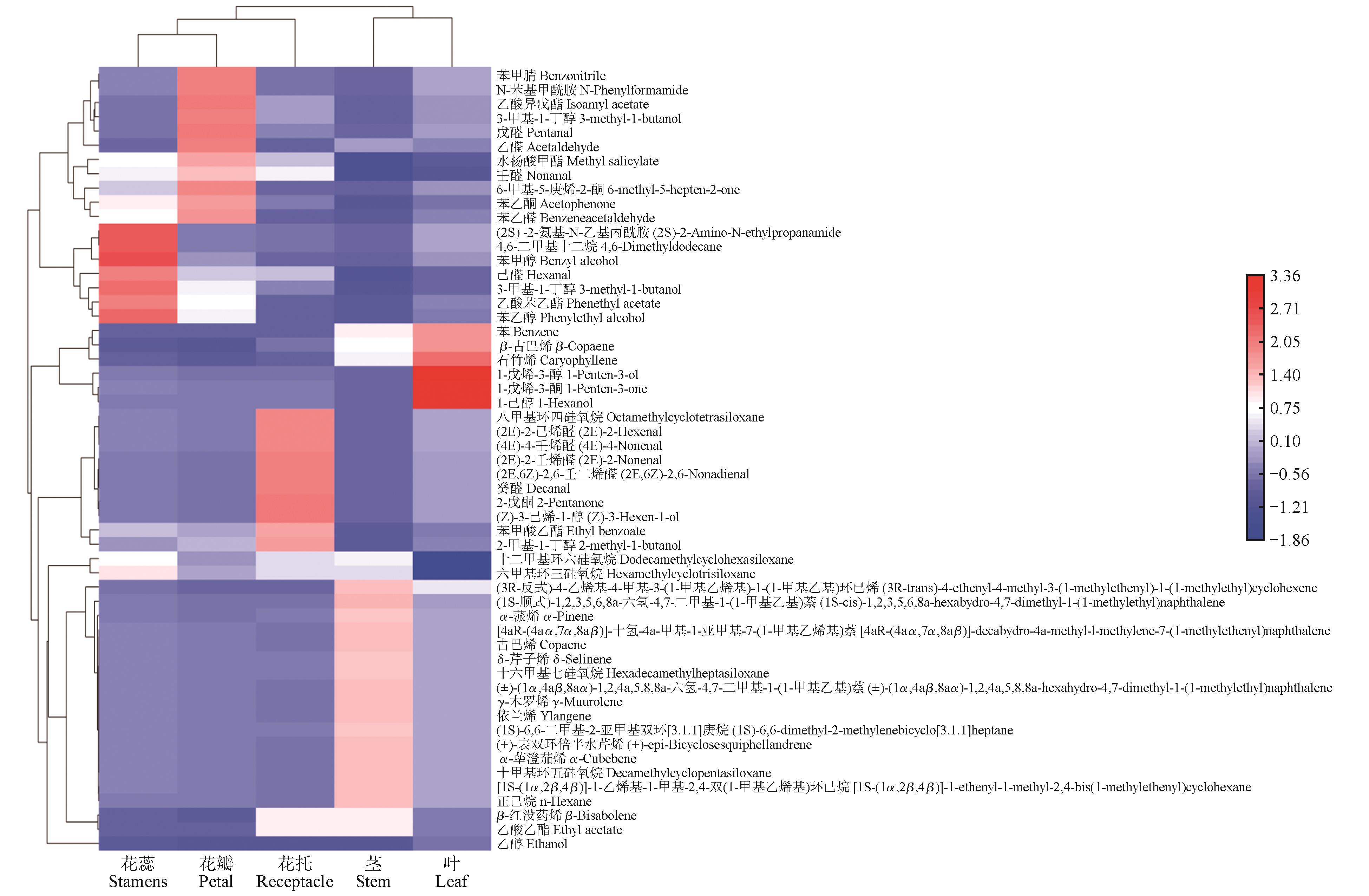
Heatmap and hierarchical clustering analysis of major volatile compounds in different tissues and organs of A. venetum
| [1] | Xu H, Turlings T C J.Plant volatiles as mate-finding cues for insects[J].Trends in Plant Science,2018,23(2):100-111. |
| [2] | 牛早柱,陈展,赵艳卓,等.15个不同葡萄品种果实香气成分的GC-MS分析[J].华北农学报,2019,34():85-91. |
| Niu Zaozhu, Chen Zhan, Zhao Yanzhuo,et al.Analysis of aromatic components from the berries of fifteen grape varieties by GC-MS[J].Acta Agriculturae Boreali-Sinica,2019,34(S1):85-91. | |
| [3] | 卢慰.紫牡丹乌龙茶香气成分的SPME/HS-GC-MS分析[J].食品研究与开发,2018,39(20):161-165. |
| Lu Wei.The analysis on volatile compositions of purple peony oolong tea by SPME/HS-GC-MS[J].Food Research and Development,2018,39(20):161-165. | |
| [4] | Li X L, Wang Z H, Hou C W,et al.Identification and characterization of volatile organic compounds based on GC-IMS technology in different organs of Lilium brownii var.viridulum and after bud-removal and non-bud-removal treatments[J].Molecules,2025,30(6):1238. |
| [5] | 王丽莎,胡雪敏,青艳,等.罗布麻的主要化学成分与作用及其在纺织领域的应用[J].毛纺科技,2024,52(9):137-143. |
| Wang Lisha, Hu Xuemin, Yan Qing,et al.The main chemical components and functions of Apocynum venetum and its application in textile field[J].Wool Textile Journal,2024,52(9):137-143. | |
| [6] | 王亚宁.新疆罗布麻花有效成分提取工艺及其降血脂、抗氧化药理作用研究[D].郑州:河南中医学院,2014:53. |
| Wang Yaning.The study of extraction process of effective components and hypolipidemic antioxidant pharmacological of action on Xinjiang Apocynum venetum flowers[D].Zhengzhou:Henan College of Chinese Medicine,2014:53. | |
| [7] | 何伟,王莉,刘磊,等.罗布麻茶改善睡眠功能实验研究[J].世界中医药,2022,17(23):3356-3359. |
| He Wei, Wang Li, Liu Lei,et al. Apocynum venetum tea improves animal sleep[J].World Chinese Medicine,2022,17(23):3356-3359. | |
| [8] | 李赛男.传统中药罗布麻花、玫瑰花中黄酮类化合物的分离提取及活性评价研究[D].长春:长春师范学院,2012:107. |
| Li Sainan.Study on extraction,isolation and activity of the flavonoids from traditional Chinese medicine Apocynum flowers and rose flowers[D].Changchun:Changchun Normal University,2012:107. | |
| [9] | 李珊,王宁,乔杨波,等.罗布麻茶黄酮的分离富集及其抗氧化、抗疲劳活性[J].食品工业科技,2019,40(23):54-59. |
| Li Shan, Wang Ning, Qiao Yangbo,et al.Separation and enrichment of flavonoids from Apocynum venetun tea and their antioxidant and antifatigue activities[J].Science and Technology of Food Industry,2019,40(23):54-59. | |
| [10] | 刘斌,陈孝娟,于萍.新疆栽培种和野生种罗布麻叶中总黄酮含量分析[J].海峡药学,2017,29(2):41-43. |
| Liu Bin, Chen Xiaojuan, Yu Ping.Analyses of total flavonoid contents in leaves of cultivated and wild Apocynum venetum in Xinjiang Province[J].Strait Pharmaceutical Journal,2017,29(2):41-43. | |
| [11] | 吴倩,马浩,隗亚军,等.二茬次罗布白麻和罗布红麻叶不同采收期精油成分的GC-MS分析[J].中国麻业科学,2024,46(3):175-183. |
| Wu Qian, Ma Hao, Wei Yajun,et al.GC-MS analysis of chemical components of essential oil from the leaves of second harvest of Apocynum venetum L.and Poacynum hendersonii (Hook.f.) woods at different harvesting periods[J].Plant Fiber Sciences in China,2024,46(3):175-183. | |
| [12] | 回瑞华,侯冬岩,李铁纯,等.不同产地罗布麻叶脂溶性成分的比较分析[J].鞍山师范学院学报,2018,20(2):48-52. |
| Hui Ruihua, Hou Dongyan, Li Tiechun, et al.Comparative analysis of lipid soluble components of Apocynum leaves in different sources[J].Journal of Anshan Normal University,2018,20(2):48-52. | |
| [13] | 王苗苗,韩飞,李慕春.罗布麻茎伤流液成分研究[J].化学研究,2017,28(2):173-176. |
| Wang Miaomiao, Han Fei, Li Muchun.Research of components in Apocynum venetum stem bleeding sap[J].Chemical Research,2017,28(2):173-176. | |
| [14] | 陈龙,王伟,王如峰,等.罗布麻花中挥发性成分的气-质联用分析[J].中国中药杂志,2006,31(18):1542-1543. |
| Chen Long, Wang Wei, Wang Rufeng,et al.Gas chromatography-mass spectrometry analysis of volatile components in Apocynum venetum flowers [J].China Journal of Chinese Materia Medica,2006,31(18):1542-1543. | |
| [15] | 王丽丽,赵晨,何楠,等.罗布麻花脂溶性成分分析[J].河南大学学报(医学版),2017,36(4):260-262. |
| Wang Lili, Zhao Chen, He Nan,et al.Analysis of fat-soluble constituents from flowers of Apocynum venetum L.[J].Journal of Henan University(Medical Science),2017,36(4):260-262. | |
| [16] | Borda A M, Clark D G, Huber D J,et al.Effects of ethylene on volatile emission and fragrance in cut roses:the relationship between fragrance and vase life[J].Postharvest Biology and Technology,2011,59(3):245-252. |
| [17] | 向林,陈龙清.花香的基因工程研究进展[J].中国农业科学,2009,42(6):2076-2084. |
| Xiang Lin, Chen Longqing.Adavances in genetic engineering of floral scent[J].Scientia Agricultura Sinica,2009,42(6):2076-2084. | |
| [18] | Dudareva N, Pichersky E. Biology of floral scent[M].Boca Raton:CRC Press,2006. |
| [19] | 徐碧玉.茶梅[M].杭州:浙江科学技术出版社,2007. |
| Xu Biyu.Sasanqua[M].Hangzhou:Zhejiang Science & Technology Press,2007. | |
| [20] | Dönmez S.Determination of volatile components of Citrus flowers and leaves growing in Hatay,Türkiye[J].BioResources,2024,19(2):2935-2947. |
| [21] | 尹鹏,孔亚帅,潘蓉,等.基于UHPLC-Q-Exactive-MS分析不同香型信阳毛尖茶中的非挥发性成分[J].现代食品科技,2025,41(11):306-312. |
| Yin Peng, Kong Yashuai, Pan Rong,et al.Analysis of non-volatile compounds in Xinyang Maojian tea with different aroma types based on UHPLC-Q-exactive-MS[J].Modern Food Science and Technology,2025,41(11):306-312. | |
| [22] | 张莹,李辛雷,王雁,等.文心兰不同花期及花朵不同部位香气成分的变化[J].中国农业科学,2011,44(1):110-117. |
| Zhang Ying, Li Xinlei, Wang Yan,et al.Changes of aroma components in Oncidium sharry baby in different florescence and flower parts[J].Scientia Agricultura Sinica,2011,44(1):110-117. | |
| [23] | 周琦,赵峰,张慧会,等.香水莲花花香测试条件优化及不同部位挥发性物质成分研究[J].分子植物育种,2025,23(22):7587-7599. |
| Zhou Qi, Zhao Feng, Zhang Huihui,et al.Optimization of test conditions and the study on volatile components in different parts of Nymphaea hybrid[J].Molecular Plant Breeding,2025,23(22):7587-7599. | |
| [24] | 陈翠花,周永逸,薛佳,等.基于HPLC的罗布麻与白麻不同部位活性成分比较分析[J].中国现代中药,2023,25(5):1010-1019. |
| Chen Cuihua, Zhou Yongyi, Xue Jia,et al.Comparative analysis of active components in different parts of Apocynum venetum L.and Apocynum pictum schrenk based on high performance liquid chromatography[J].Modern Chinese Medicine,2023,25(5):1010-1019. | |
| [25] | 雷菁清,肖明,孙小凤,等.野生植物资源罗布麻研究现状[J].食品研究与开发,2021,42(8):207-211. |
| Lei Jingqing, Xiao Ming, Sun Xiaofeng,et al.Research status of Apocynum venetum in wild plant resources[J].Food Research and Development,2021,42(8):207-211. | |
| [26] | 许红娟,陈之林,杜致辉,等.蕙兰守良梅花朵不同部位的花香成分[J].贵州农业科学,2019,47(10):87-91. |
| Xu Hongjuan, Chen Zhilin, Du Zhihui,et al.Aromatic constituents of different parts of flowers of Cymbidium hybrid ‘Shouliangmei’[J].Guizhou Agricultural Sciences,2019,47(10):87-91. | |
| [27] | Feng Y, Cheng X, Lu Y,et al.Gas chromatography-mass spectrometry analysis of floral fragrance-related compounds in scented rose (Rosa hybrida) varieties and a subsequent evaluation on the basis of the analytical hierarchy process[J].Plant Physiology and Biochemistry,2022,185:368-377. |
| [28] | Da Silva I T F A, Magalhães D M, Borges M,et al.Exploitation of herbivore-induced cotton volatiles by the parasitic wasp Bracon vulgaris reveals a dominant chemotactic effect of terpenoids[J].BioControl,2022,67(2):135-148. |
| [29] | Li C Y, Zha W J, Li W,et al.Advances in the biosynthesis of terpenoids and their ecological functions in plant resistance[J].International Journal of Molecular Sciences,2023,24(14):11561. |
| [30] | Cheng R W, Yang S Q, Wang D L,et al.Advances in the biosynthesis of plant terpenoids:models, mechanisms,and applications [J].Plants,2025,14(10):1428. |
| [31] | Wang Y, Bian X K, Zhang L,et al.The essential oil of Kochia scoparia (L.) Schrad.as a potential repellent against stored-product insects[J].Environmental Science and Pollution Research,2023,30(59):124416-124424. |
| [32] | Karabörklü S, Ayvaz A.A comprehensive review of effective essential oil components in stored-product pest management[J].Journal of Plant Diseases and Protection,2023,130(3):449-481. |
| [33] | 刘宁,哈尼帕·哈再斯,喻春明,等.罗布麻茎叶粗提物及脱胶纤维的抑菌活性分析[J].中国麻业科学,2021,43(1):32-38. |
| Liu Ning,Hanipa·Hazaisi, Yu Chunming,et al.Antimicrobial activity analysis of Apocynum leaf and stem rough extract and degummed fibers[J].Plant Fiber Sciences in China,2021,43(1):32-38. | |
| [34] | 吕锐,苏冬梅,孟林,等.罗布麻纤维的抗菌性能研究[J].青岛大学医学院学报,2006,42(1):71-72. |
| Rui Lü, Su Dongmei, Meng Lin,et al.Antibiotic property of Apocynum venetum [J].Acta Academiae Medicinae Qingdao Universitatis,2006,42(1):71-72. | |
| [35] | 韦节彬.罗布麻保健功能衬衣面料的开发[J].毛纺科技,2013,41(2):19-21. |
| Wei Jiebin.Development of venetum healthy shirt fabric with Apoacynum [J].Wool Textile Journal,2013,41(2):19-21. | |
| [36] | Mastelić J, Jerković I, Mesić M L.Volatile constituents from flowers,leaves,bark and wood of Prunus mahaleb L.[J].Flavour and Fragrance Journal,2006,21(2):306-313. |
| [37] | Diot A, Groth G, Blanchet S,et al.Responses of animals and plants to physiological doses of ethanol:a molecular messenger of hypoxia?[J].The FEBS Journal,2024,291(6):1102-1110. |
| [38] | Feng D D, Jian H Y, Zhang H,et al.Comparison of volatile compounds between wild and cultivated roses[J].HortScience,2022,57(5):657-663. |
| [39] | Sheng X J, Lin Y N, Cao J M,et al.Comparative evaluation of key aroma-active compounds in sweet Osmanthus (Osmanthus fragrans Lour.) with different enzymatic treatments[J].Journal of Agricultural and Food Chemistry,2021,69(1):332-344. |
| [1] | Xi ZHEN, Xuyang LIU, Wenjie LI, Feng ZHANG, Yue SU, Yao XIAO, Jie ZHANG, Tao WAN. Characteristics of Apocynum venetum Community and Its Relationship to Climatic Factors [J]. Bulletin of Botanical Research, 2024, 44(3): 448-458. |
| Viewed | ||||||
|
Full text |
|
|||||
|
Abstract |
|
|||||