Bulletin of Botanical Research ›› 2026, Vol. 46 ›› Issue (5): 938-947.doi: 10.7525/j.issn.1673-5102.2026.05.014
• Original Paper • Previous Articles Next Articles
Xiaoyan WANG, Haonan WANG, Qianqian HE, Luting JIA, Shuai ZHANG, Pengfei WANG( )
Received:2026-04-17
Online:2026-08-28
Published:2026-10-10
Contact:
Pengfei WANG
E-mail:pengfeiwang2004@163.com
CLC Number:
Xiaoyan WANG, Haonan WANG, Qianqian HE, Luting JIA, Shuai ZHANG, Pengfei WANG. Effects of Substrate Irrigation with Growth Retardants on Rooting of Cerasus humilis Softwood Cuttings[J]. Bulletin of Botanical Research, 2026, 46(5): 938-947.
Add to citation manager EndNote|Ris|BibTeX
URL: https://bbr.nefu.edu.cn/EN/10.7525/j.issn.1673-5102.2026.05.014
Table 1
Treatments with different concentrations of growth retardants
处理 Treatment | 生长延缓剂 Growth retardant | 质量浓度 Mass concentration/(mg·L-1) |
|---|---|---|
| CK | 清水 | — |
| P1 | PP333 | 100 |
| P2 | PP333 | 200 |
| P3 | PP333 | 300 |
| S1 | S3307 | 25 |
| S2 | S3307 | 50 |
| S3 | S3307 | 100 |
Table 2
50 mg·L-1 S3307 treatments with different irrigation periods
处理 Treatment | 生长延缓剂 Growth retardant | 质量浓度 Mass concentration/ (mg·L-1) | 浇灌时期 Irrigation period |
|---|---|---|---|
| CK | 清水 | — | — |
| S-7 d | S3307 | 50 | 扦插后7 d |
| S-14 d | S3307 | 50 | 扦插后14 d |
| S-21 d | S3307 | 50 | 扦插后21 d |
Table 3
Rooting characteristics of cuttings under substrate irrigation with different growth retardants
处理 Treatment | 生根率 Rooting rate/% | 腐烂率 Rotting rate/% | 愈伤率 Callus rate/% | 总根长 Total root length/cm | 根表面积 Root surface area/cm2 | 根体积 Root volume/cm3 | 分支数量 Branch number |
|---|---|---|---|---|---|---|---|
| CK | 37.09±2.29c | 58.33±1.80a | 4.17±1.59ab | 79.79±10.32bc | 10.91±1.21b | 0.12±0.01a | 601.33±38.96bc |
| P1 | 60.83±2.59a | 36.25±2.75c | 2.92±1.72b | 109.58±13.85abc | 21.15±3.27ab | 0.37±0.15a | 951.67±50.85abc |
| P2 | 51.25±2.19ab | 42.92±2.29bc | 5.42±1.25ab | 83.32±29.36bc | 17.68±5.26ab | 0.31±0.08a | 928.00±317.43abc |
| P3 | 34.17±3.23c | 55.00±4.14ab | 9.58±3.22a | 38.66±4.13c | 9.44±1.07b | 0.18±0.02a | 347.00±62.35c |
| S1 | 54.58±6.06ab | 43.75±5.95bc | 1.25±0.42b | 111.90±34.70ab | 18.80±5.87ab | 0.25±0.08a | 1 053.67±406.11abc |
| S2 | 52.92±3.43ab | 43.75±4.22bc | 2.50±1.44b | 140.76±7.11ab | 24.30±3.32ab | 0.34±0.08a | 1 402.00±229.38ab |
| S3 | 43.33±4.91bc | 51.25±5.24ab | 3.34±2.26b | 176.28±30.73a | 35.90±13.01a | 0.62±0.33a | 1 620.00±406.70a |
Fig.1
Effects of different treatments on rooting process of C. humilis cuttingsRooting performance of cuttings under CK(A-C), 100 mg⋅L-1 PP333(D-F) and 50 mg⋅L-1 S3307(G-I) treatments at 20 d(A,D,G),30 d(B,E,H) and 40 d(C,F,I) after cutting.
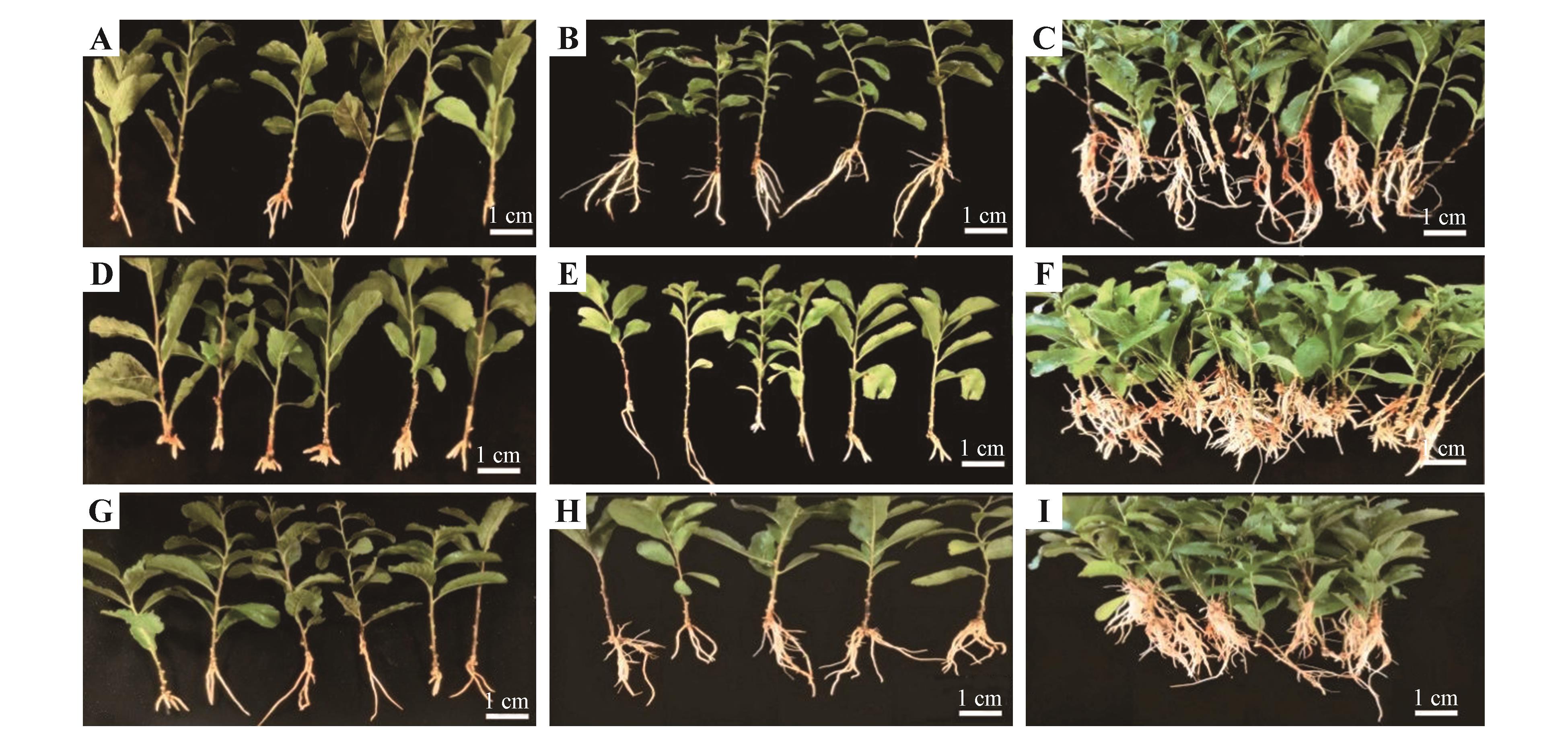
Table 4
Comprehensive evaluation of RSR for rooting and root system indicators under different cuttings treatments
处理 Treatment | 生根率 Rooting rate/% | 腐烂率 Rotting rate/% | 愈伤率 Callus rate/% | 总根长 Total root length/cm | 根表面积 Root surface area/cm2 | 根体积 Root volume/ cm3 | 分支数量 Branch number | 秩和 Sum of ranks | 秩和比 RSR | 评价等级 Rating level |
|---|---|---|---|---|---|---|---|---|---|---|
| CK | 2.0 | 1.0 | 3.0 | 2.0 | 2.0 | 1.0 | 2.0 | 13.0 | 0.265 3 | 差 |
| P1 | 7.0 | 7.0 | 5.0 | 4.0 | 5.0 | 6.0 | 4.0 | 38.0 | 0.775 5 | 优 |
| P2 | 4.0 | 6.0 | 2.0 | 3.0 | 3.0 | 4.0 | 3.0 | 25.0 | 0.510 2 | 中 |
| P3 | 1.0 | 2.0 | 1.0 | 1.0 | 1.0 | 2.0 | 1.0 | 9.0 | 0.183 7 | 差 |
| S1 | 6.0 | 4.5 | 7.0 | 5.0 | 4.0 | 3.0 | 5.0 | 34.5 | 0.704 1 | 优 |
| S2 | 5.0 | 4.5 | 6.0 | 6.0 | 6.0 | 5.0 | 6.0 | 38.5 | 0.785 7 | 优 |
| S3 | 3.0 | 3.0 | 4.0 | 7.0 | 7.0 | 7.0 | 7.0 | 38.0 | 0.775 5 | 优 |
Table 5
Effects of irrigation period with growth retardant on rooting characteristics of cuttings
处理 Treatment | 生根率 Rooting rate/% | 腐烂率 Rotting rate/% | 总根长 Total root length/cm | 根表面积 Root surface area/cm2 | 根体积 Root volume/cm3 | 分支数量 Branch number |
|---|---|---|---|---|---|---|
| CK | 20.56±4.75c | 77.78±4.94a | 77.82±15.88b | 14.77±3.12b | 0.22±0.05b | 669.33±213.83b |
| S-7 d | 31.67±1.93b | 66.11±3.09ab | 95.54±13.89ab | 20.66±2.16ab | 0.36±0.03ab | 1 251.33±228.12ab |
| S-14 d | 57.22±2.94a | 40.56±3.89c | 136.33±23.63ab | 25.14±3.83ab | 0.37±0.05ab | 1 226.67±218.67ab |
| S-21 d | 41.11±6.41b | 58.33±5.85b | 168.50±39.80a | 33.47±7.82a | 0.53±0.12a | 1 868.67±541.40a |

Fig.2
Effects of irrigation period with S3307 on carbon and nitrogen nutrient mass fractions in cuttings
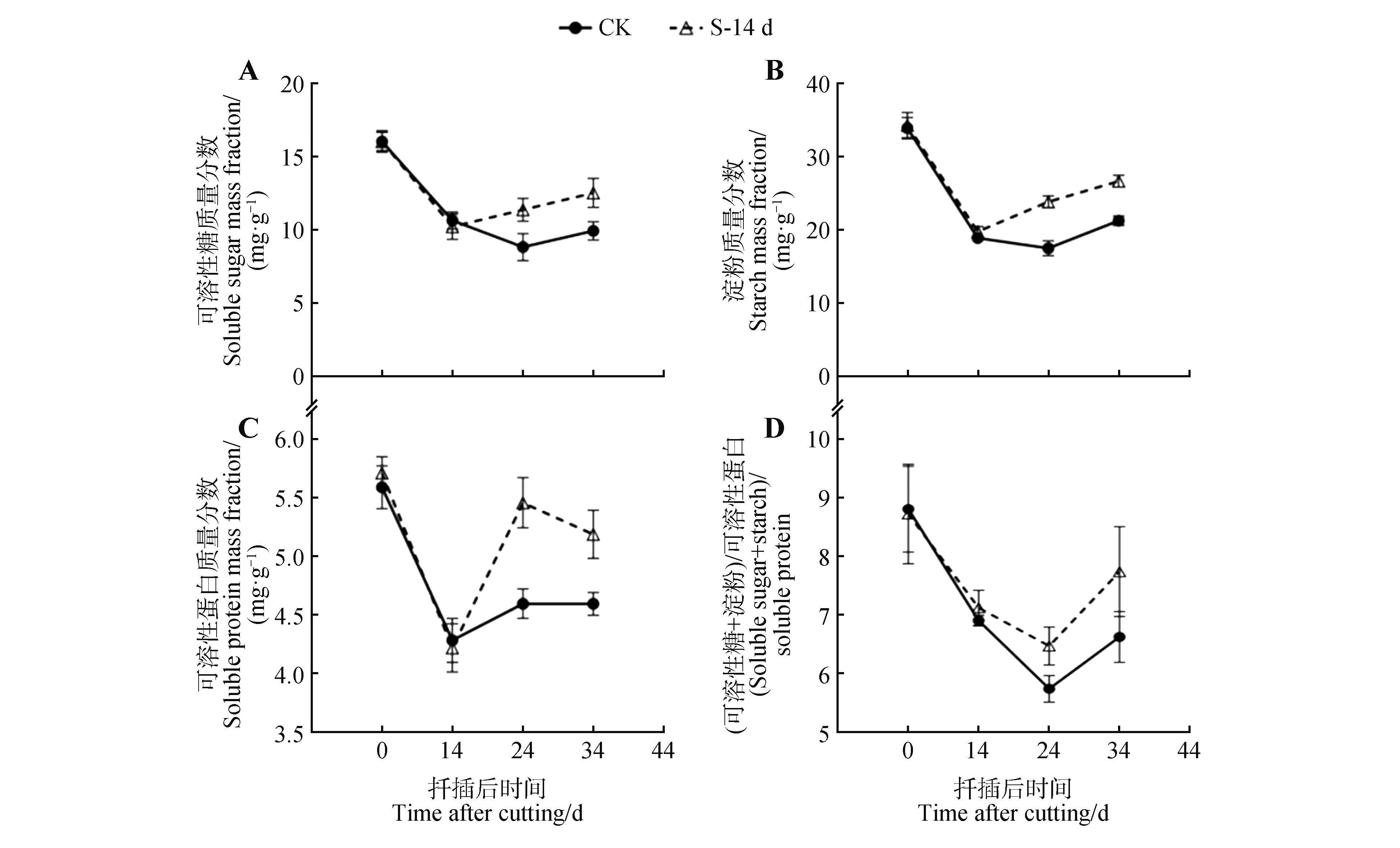
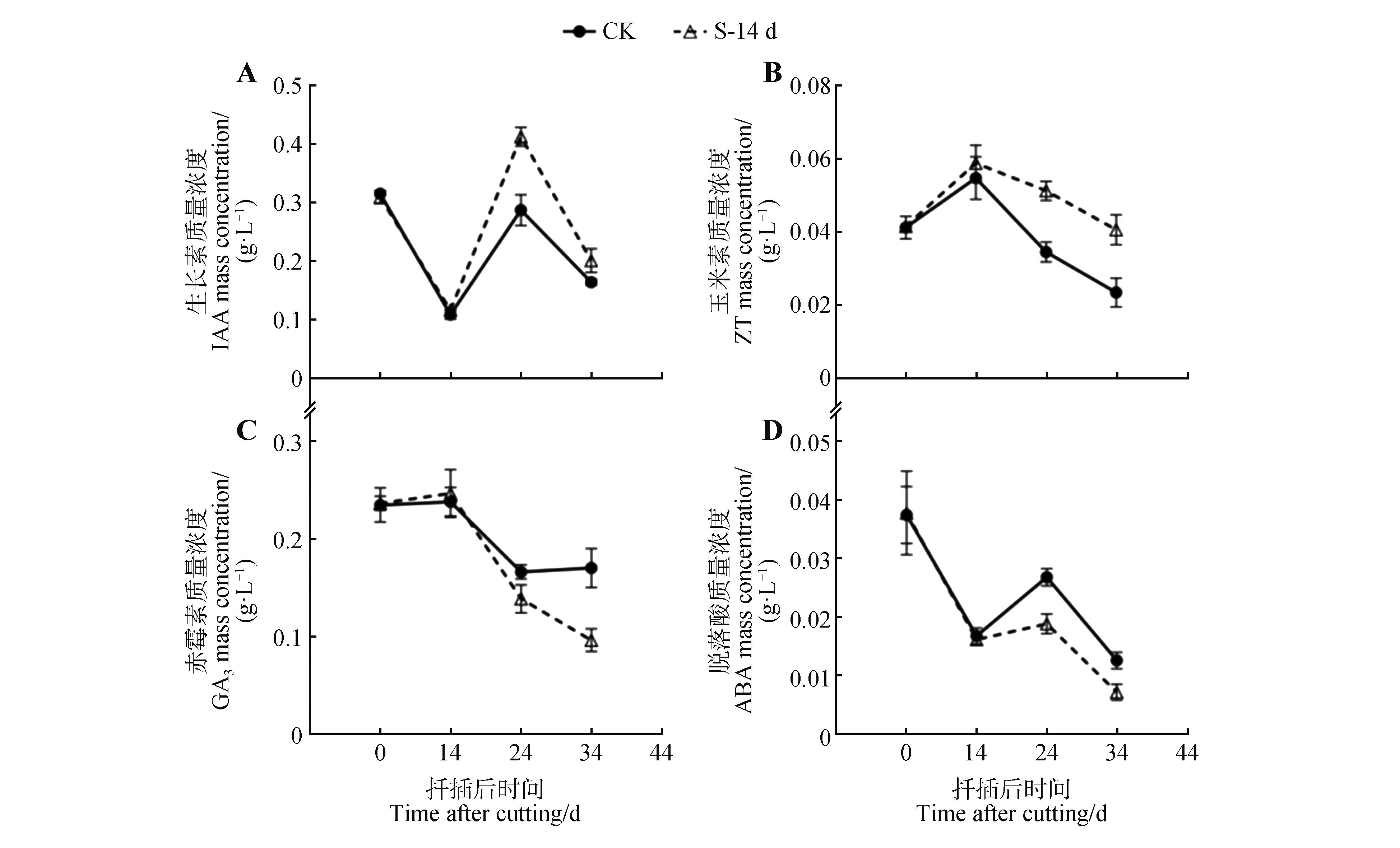
Fig. 3
Effects of irrigation period with S3307 on endogenous hormone mass concentrations in cuttings
| [1] | 吴春燕,韩潇怡,吴俊英,等.欧李营养价值及开发利用研究进展[J].中国果树,2024(2):1-5. |
| Wu Chunyan, Han Xiaoyi, Wu Junying,et al.Research progress on nutritional value and development and utilization of Cerasus humilis(Bge.) Sok[J].China Fruits,2024(2):1-5. | |
| [2] | 姚泽,王祺,王大为.我国特有新型果树—中华钙果的产业发展设想[J].果树资源学报,2026,7(2):106-108. |
| Yao Ze, Wang Qi, Wang Dawei.Prospects for industrial development of Cerasus humilis——a novel endemic fruit tree in China[J].Journal of Fruit Resources,2026,7(2):106-108. | |
| [3] | 叶丙鑫,陈小丽,谢淑琴,等.不同影响因子对干旱半干旱区欧李嫩枝扦插育苗生根的影响[J].林业科技通讯,2024(11):76-79. |
| Ye Bingxin, Chen Xiaoli, Xie Shuqin,et al.Effects of different influencing factors on rooting of Cerasus humilis cuttings in arid and semi-arid areas[J].Forest Science and Technology,2024(11):76-79. | |
| [4] | 覃芳,张俊杰,史艳财,等.叶面喷施多效唑对金槐生长及生理的影响[J].湖北农业科学,2021,60(15):96-100. |
| Qin Fang, Zhang Junjie, Shi Yancai,et al.Effects of paclobutrazol treatment on the growth and physiology of Sophora japonica ‘Jinhuai’[J].Hubei Agricultural Sciences,2021,60(15):96-100. | |
| [5] | Mauriat M, Petterle A, Bellini C,et al.Gibberellins inhibit adventitious rooting in hybrid aspen and Arabidopsis by affecting auxin transport[J].The Plant Journal,2014,78(3):372-384. |
| [6] | 周再知,刘式超,张金浩,等.外源IBA对裸花紫珠扦插生根和内源激素含量变化的影响[J].热带作物学报,2016,37(6):1075-1080. |
| Zhou Zaizhi, Liu Shichao, Zhang Jinhao,et al.Effects of IBA treatments on adventitious rooting and endogenous hormones contents of shoot cuttings of Callicarpa nudiflora [J].Chinese Journal of Tropical Crops,2016,37(6):1075-1080. | |
| [7] | 丛树春.多效唑对桧柏扦插生根效应的试验[J].吉林林业科技,1998,27(4):22. |
| Cong Shuchun.An experiment on the effect of paclobutrazol on the cutting rooting of Sabina chinensis [J].Journal of Jilin Forestry Science and Technology,1998,27(4):22. | |
| [8] | 黄源妹.多效唑对几种乡土树种扦插生根的影响[J].陕西林业科技,2025,53(5):23-28. |
| Huang Yuanmei.Effect of paclobutrazol on the rooting of cuttings from several native tree species[J].Shaanxi Forest Science and Technology,2025,53(5):23-28. | |
| [9] | 杜俊杰.中国特有林果——欧李[M].北京:中国农业科学技术出版社,2023. |
| Du Junjie. Prunus humilis,a unique fruit in China[M].China Agricultural Science and Technology Press,2023. | |
| [10] | 何倩倩,张婕,穆霄鹏,等.叶面喷施植物生长调节剂对欧李嫩枝扦插生根与生理变化的影响[J].植物生理学报,2024,60(1):108-116. |
| He Qianqian, Zhang Jie, Mu Xiaopeng,et al.Effects of foliar spraying plant growth regulator on rooting and physiological changes of Cerasus humilis softwood cuttings[J].Plant Physiology Journal,2024,60(1):108-116. | |
| [11] | 穆霄鹏,牟小燕,亓新亮,等.不同生长延缓剂处理对欧李根状茎扦插生根的影响[J].植物研究,2025,45(1):88-97. |
| Mu Xiaopeng, Mou Xiaoyan, Qi Xinliang,et al.Effects of different growth retardant treatments on rooting of Prunus humilis rhizome cuttings[J].Bulletin of Botanical Research,2025,45(1):88-97. | |
| [12] | 闫松涛.欧李根状茎扦插繁殖及生根的生理机制研究[D].太谷:山西农业大学,2024. |
| Yan Songtao.Research on the propagation and rooting of Cerasus humilis rhizome cuttings[D].Taigu:Shanxi Agricultural University,2024. | |
| [13] | 王齐,张玉雯,白静怡,等.基于秩和比法的滇东南石漠化草原区植被恢复模式筛选[J].云南农业大学学报(自然科学),2025,40(5):170-177. |
| Wang Qi, Zhang Yuwen, Bai Jingyi,et al.Screen of vegetation restoration patterns in rocky desertification grasslands of southeast Yunnan based on rank-sum ratio method[J].Journal of Yunnan Agricultural University (Natural Science),2025, 40(5):170-177. | |
| [14] | 季琳琳,孙维敏, 陈素传,等.配比施肥对山核桃幼树生长生理特性的影响[J/OL].扬州大学学报(农业与生命科学版),2026-03-18.. |
| Ji Linlin, Sun Weimin, Chen Suchuan,et al.Effects of fertilization on growth and physiological characteristics for young stand of Carya cathayensis [J].Journal of Yangzhou University(Agricultural and Life Science Edition),2026-03-18.. | |
| [15] | 刘玉玲,张红岩,滕长才,等.蚕豆SSR标记遗传多样性及与淀粉含量的关联分析[J].作物学报,2022,48(11):2786-2796. |
| Liu Yuling, Zhang Hongyan, Teng Changcai,et al.Genetic diversity and its association analysis of SSR markers with starch content in faba bean (Vicia faba L.)[J].Acta Agronomica Sinica,2022,48(11):2786-2796. | |
| [16] | 庄红梅, YUNUSOV Salohiddinjon Adhamovich, KAISAER Rehemu,等.外源γ-氨基丁酸对乌兹别克斯坦芜菁农艺性状及生理特性的影响[J].园艺学报,2026,53(3):791-801. |
| Zhuang Hongmei,Yunusov Salohiddinjon Adhamovich, Rehemu Kaisaer,et al.Effects of exogenous γ-aminobutyric acid on agronomic traits and physiological characteristics of Uzbekistani turnip[J].Acta Horticulturae Sinica,2026,53(3):791-801. | |
| [17] | Lykokanellos G, Lagogiannis I, Liopa-Tsakalidi A,et al.Optimizing rooting and growth of Salvia rosmarinus cuttings in soilless systems affected by growth regulators[J].Plants,2025,14(14):2210. |
| [18] | Lee S, Moon B, Kim S,et al.Effects of rooting substrates and plant growth regulators on rooting performance,photosynthetic characteristics,and soil properties of Broussonetia×kazinoki sieb. cuttings[J].Forests,2025,16(11):1752. |
| [19] | 代丽华,段九东,邵齐飞,等.不同植物生长调节剂及浓度对猴欢喜嫩枝扦插生根的影响[J].温带林业研究,2025,8(6):26-30. |
| Dai Lihua, Duan Jiudong, Shao Qifei,et al.The effects of different plant growth regulators and their concentrations on the rooting of softwood cuttings in Sloanea sinensis [J].Journal of Temperate Forestry Research,2025,8(6):26-30. | |
| [20] | Yu W W, Li Y H, Zhang Y T,et al.Integrated physiological and transcriptomic analyses reveal mechanisms regulating endogenous phytohormones in adventitious root formation during Cinnamomum bodinieri cutting propagation[J].Forests,2025,16(3):509. |
| [21] | Xiong Y P, Chen X H, Liu J Y,et al.Comparative transcriptomic and hormonal analyses reveal potential regulation networks of adventitious root formation in Metasequoia glyptostroboides Hu et Cheng[J].BMC Genomics,2024,25(1):1098. |
| [22] | 苏彩风,段国珍,樊光辉.枸杞扦插生根及相关生理生化分析[J].北方园艺,2023(1):90-97. |
| Su Caifeng, Duan Guozhen, Fan Guanghui.Cutting rooting and related physiological and biochemical analysis of Lycium barbarum [J].Northern Horticulture,2023(1):90-97. | |
| [23] | Shao F X, Wang S, Huang W,et al.Effects of IBA on the rooting of branch cuttings of Chinese jujube (Zizyphus jujuba Mill.) and changes to nutrients and endogenous hormones[J].Journal of Forestry Research,2018,29(6):1557-1567. |
| [24] | 庞艳萍.植物生长调节剂对江南油杉嫩枝扦插生根变化的影响研究[D].南宁:广西大学,2024. |
| Pang Yanping.Studies on the effects of plant growth regulators on the changes of rooting in shoot cuttings of Keteleeria fortune var. cyclolepis[D].Nanning:Guangxi University,2024. | |
| [25] | 岳艳玲,史佳,荆蓉.不同生长调节剂对互叶醉鱼木嫩枝扦插的影响[J].寒旱农业科学,2025,4(11):1052-1058. |
| Yue Yanling, Shi Jia, Jing Rong.Effect of different growth regulators on the cuttings of tender branches of Buddleja aalternifolia [J].Journal of Cold-Arid Agricultural Sciences,2025,4(11):1052-1058. | |
| [26] | 刘冉,赵盼,周心怡,等.生长素诱导调节PagHAM4a和PagHAM4b的表达及对杨树次生木质部发育的影响[J/OL].生物技术通报,2026-03-10.. |
| Liu Ran, Zhao Pan, Zhou Xinyi,et al.Auxin induces and regulates the expressions of PagHAM4a/PagHAM4b and affects the secondary xylem development in poplar [J].Biotechnology Bulletin,2026-03-10.. | |
| [27] | 邵华正,叶水英.生长素类物质对东云叶插生根的影响[J].安徽农学通报,2025,31(23):41-45. |
| Shao Huazheng, Ye Shuiying.Effects of auxins on the rooting of Echeveria agavoides leaf cuttings[J].Anhui Agricultural Science Bulletin,2025,31(23):41-45. | |
| [28] | 史锋厚,赵瑞,罗帅,等.南京椴嫩枝扦插生根过程中植物激素的变化[J].中南林业科技大学学报,2019,39(2):21-26. |
| Shi Fenghou, Zhao Rui, Luo Shuai,et al.Study on plant hormone changes in soft cuttings of Tilia miqueliana during rooting[J].Journal of Central South University of Forestry & Technology,2019,39(2):21-26. | |
| [29] | 王乔春.植物激素与插条不定根的形成(综述)[J].四川农业大学学报,1992(1):33-39. |
| Wang Qiaochun.Plant hormones and the formation of adventitious roots in cuttings(Review)[J].Journal of Sichuan Agricultural University,1992(1):33-39. | |
| [30] | 周洁,张立军.沙棘组培苗生根过程中内源激素含量的变化[J].安徽农业科学,2010,38(17):8917-8918. |
| Zhou Jie, Zhang Lijun.Research of changes of endogenous phytohormones during the course of cuttings rooting of Hippophae rhamnoides L.[J].Journal of Anhui Agricultural Sciences,2010,38(17):8917-8918. | |
| [31] | Khatri S, Shylla B, Sharma D P,et al.Enhancing seed germination and growth of date-plum(Diospyros Lotus L.) for robust graftable rootstock seedlings using organic growing media and gibberellic acid[J].Applied Fruit Science,2025,67(3):93. |
| [32] | Kawai Y.Effects of exogenous BAP,GA3,and ABA on endogenous auxin and rooting of grapevine hardwood cuttings[J].Journal of the Japanese Society for Horticultural Science,1997,66(1):93-98. |
| [33] | 刘桂丰,杨传平,曲冠证,等.落叶松杂种插穗生根过程中4种内源激素的动态变化[J].东北林业大学学报,2001,29(6):1-3. |
| Liu Guifeng, Yang Chuanping, Qu Guanzheng,et al.Dynamic changes of four endogenous hormones in the larch hybrid during cuttings rooting[J].Journal of Northeast Forestry University,2001,29(6):1-3. | |
| [34] | 敖红,王崑,冯玉龙.长白落叶松插穗的内源激素水平及其与扦插生根的关系[J].植物研究,2002,22(2):190-195. |
| Ao Hong, Wang Kun, Feng Yulong.Endogenous hormones levels in cuttings of Larix olgensis and their relations to rooting[J].Bulletin of Botanical Research,2002,22(2):190-195. | |
| [35] | 郑均宝,刘玉军,裴保华,等.几种木本植物插穗生根与内源IAA,ABA的关系[J].植物生理学报,1991,17(3):313-316. |
| Zheng Junbao, Liu Yujun, Pei Baohua,et al.Relationship between adventitious root formation and endogenous IAA and ABA of several tree species[J].Acta Phytophysiologica Sinica,1991,17(3):313-316. | |
| [36] | 胡虹,季本仁,段金玉,等.云南山楂中吲哚乙酸、脱落酸、玉米素和玉米素核苷的内源水平及其生根率[J].云南植物研究,1993(3):278-284. |
| Hu Hong, Ji Benren, Duan Jinyu,et al.The endogenous levels of indole-3-acetic acid,abscisic acid,and zeatin plus zeatin-riboside in cultural shoots of Crategus scabrifolia and their rooting ratio[J].Acta Botanica Yunnanica,1993(3):278-284. |
| [1] | Weiqian WU, Zijian HU, Shiya SHEN, Guifang ZHANG, Jinxing LIN, Xi ZHANG. Research Progress on the Hormonal Regulation Related to Adventitious Root Regeneration and Cuttings Rooting in Plants [J]. Bulletin of Botanical Research, 2026, 46(1): 13-24. |
| [2] | Xiaopeng MU, Xiaoyan MOU, Xinliang QI, Jing WANG, Yu YANG, Jiancheng ZHANG, Pengfei WANG. Effects of Different Growth Retardant Treatments on Rooting of Prunus humilis Rhizome Cuttings [J]. Bulletin of Botanical Research, 2025, 45(1): 88-97. |
| [3] | Guoshi SU, Li ZHANG, Suotong LIU, Xiaoyan LI, Zhimao QIN, Jinli GUO. Effect of 2,4-D Treatment on Calcium Uptake and the Relationship with IAA and Organic Acid Metabolism in Cerasus humilis Fruit [J]. Bulletin of Botanical Research, 2024, 44(6): 832-842. |
| [4] | Xuping TIAN, Jiali WANG, Ke QIAO, Huixin LIU, Kangjie YUE. Methods for Reducing the Vitrification Rate and Promoting Rooting Formation of Dianthus plumarius [J]. Bulletin of Botanical Research, 2024, 44(6): 954-962. |
| [5] | Galip NARGIZA, Yuxin XIAO, Boyi SONG, Weiwei ZHUANG. Effects of “Fertilizer Island” Effect of Desert Plants on Spatial Distribution of Soil Nutrients [J]. Bulletin of Botanical Research, 2023, 43(6): 868-880. |
| [6] | Ermei CHANG, Yao DONG, Jianfeng LIU, Zirui JIA, Xiang LI, Xiulian ZHAO, Wei GUO. Physiological Response of Ancient Platycladus orientalis with Different Ages During Cutting Rooting Process [J]. Bulletin of Botanical Research, 2023, 43(4): 582-590. |
| [7] | Liben PAN, Xue YAN, Jia LIU, Kexin WU, Yang LIU, Shaochong LIU. Physiological Characteristics of Early Spring Flowering Plants under Northeast Forest [J]. Bulletin of Botanical Research, 2022, 42(4): 657-666. |
| [8] | Guobin Liu, Ting Liao, Ye Wang, Liqin Guo, Jinzhe Zhao, Yanwu Yao, Jun Cao. Regulation Mechanism of Endogenous Hormones in Adventitious Roots Formation of Platycladus orientalis ‘Beverleyensis’ [J]. Bulletin of Botanical Research, 2022, 42(2): 278-288. |
| [9] | Yang-Jing ZHAO, Nan TANG, Dao-Cheng TANG, Jing ZHANG. An Optimized HPLC Procedure for Analyzing Three Endogenous Hormones in Tulip Bulbs [J]. Bulletin of Botanical Research, 2021, 41(1): 130-137. |
| [10] | WANG Ning, DONG Ying-Ying, YUAN Mei-Li, WANG Ya-Nan, ZENG Sheng-Yun. Effect of Warm Water Soaking on Protective Enzyme Activity and Endogenous Hormones Content of Eucommia ulmoides Seed During Different Stages of Germination [J]. Bulletin of Botanical Research, 2020, 40(4): 523-529. |
| [11] | ZHENG Ya-Qiong, ZHAI Jun-Tuan, CHEN Jia-Li, HAN Zhan-Jiang, JIAO Pei-Pei, LI Zhi-Jun. Seasonal Variations of Clonal Propagation Characteristics of Populus pruinosa Schrenk,Organ Nutrient and Soil Fertility, and Their Coupling Associations in the Forest and Forest Edges [J]. Bulletin of Botanical Research, 2019, 39(3): 347-357. |
| [12] | ZHOU Peng, ZHANG Min, WU Shuang-Zhu, HUANG Jing. Effect of Different LEDs Light Qualities on Vaccinium bracteatum Stem Multiplication and Rooting [J]. Bulletin of Botanical Research, 2018, 38(5): 697-703. |
| [13] | CHEN Guo-Ping, ZU Li-Hong, GAO Zhang-Ying, ZHOU Mei-Li, QIAO Yan-Yun, ZHAO Tie-Jian, FENG Xiao-Mei, SHI Fu-Chen. The Characteristics of Forest Floor Nutrients and Soil Fertility Assessment for Deciduous Broad-Leaved Forest with Different Site Conditions [J]. Bulletin of Botanical Research, 2016, 36(6): 878-885. |
| [14] | LIU Shi-Chao, ZHOU Zai-Zhi, ZHANG Jin-Hao, LIANG Kun-Nan, MA Hua-Ming, HUANG Gui-Hua. Rooting Impact Factors of Callicarpa nudiflora Softwood Cuttings [J]. Bulletin of Botanical Research, 2016, 36(5): 739-746. |
| [15] | YANG Liu, WANG Le, XIE Zhong-Kui, GUO Zhi-Hong, ZHANG Yu-Bao. Influence of Endogenous IAA and GA3 on in vitro Lily Seedling Growth [J]. Bulletin of Botanical Research, 2016, 36(5): 760-767. |
| Viewed | ||||||
|
Full text |
|
|||||
|
Abstract |
|
|||||