Bulletin of Botanical Research ›› 2026, Vol. 46 ›› Issue (5): 927-937.doi: 10.7525/j.issn.1673-5102.2026.05.013
• Original Paper • Previous Articles Next Articles
Weina GUO1,2( ), Gang LI1,3, Xiaoli XU1, Li ZHAO1, Lei CHENG1
Received:2026-03-06
Online:2026-08-28
Published:2026-10-10
Contact:
Weina GUO
E-mail:guoweina0201@163.com
CLC Number:
Weina GUO, Gang LI, Xiaoli XU, Li ZHAO, Lei CHENG. Structural Analysis of Nectar-Secreting Sites in the Bracts of Paeonia lactiflora[J]. Bulletin of Botanical Research, 2026, 46(5): 927-937.
Add to citation manager EndNote|Ris|BibTeX
URL: https://bbr.nefu.edu.cn/EN/10.7525/j.issn.1673-5102.2026.05.013
Fig.1
The nectar secretion process of P. lactiflora bractsA. Bud-initiation stage; B. Young-bud stage; C. Leaf-expansion stage (the arrow showed the nectar); D. Firm stage (arrows showed the nectar); E. Color-showing stage.
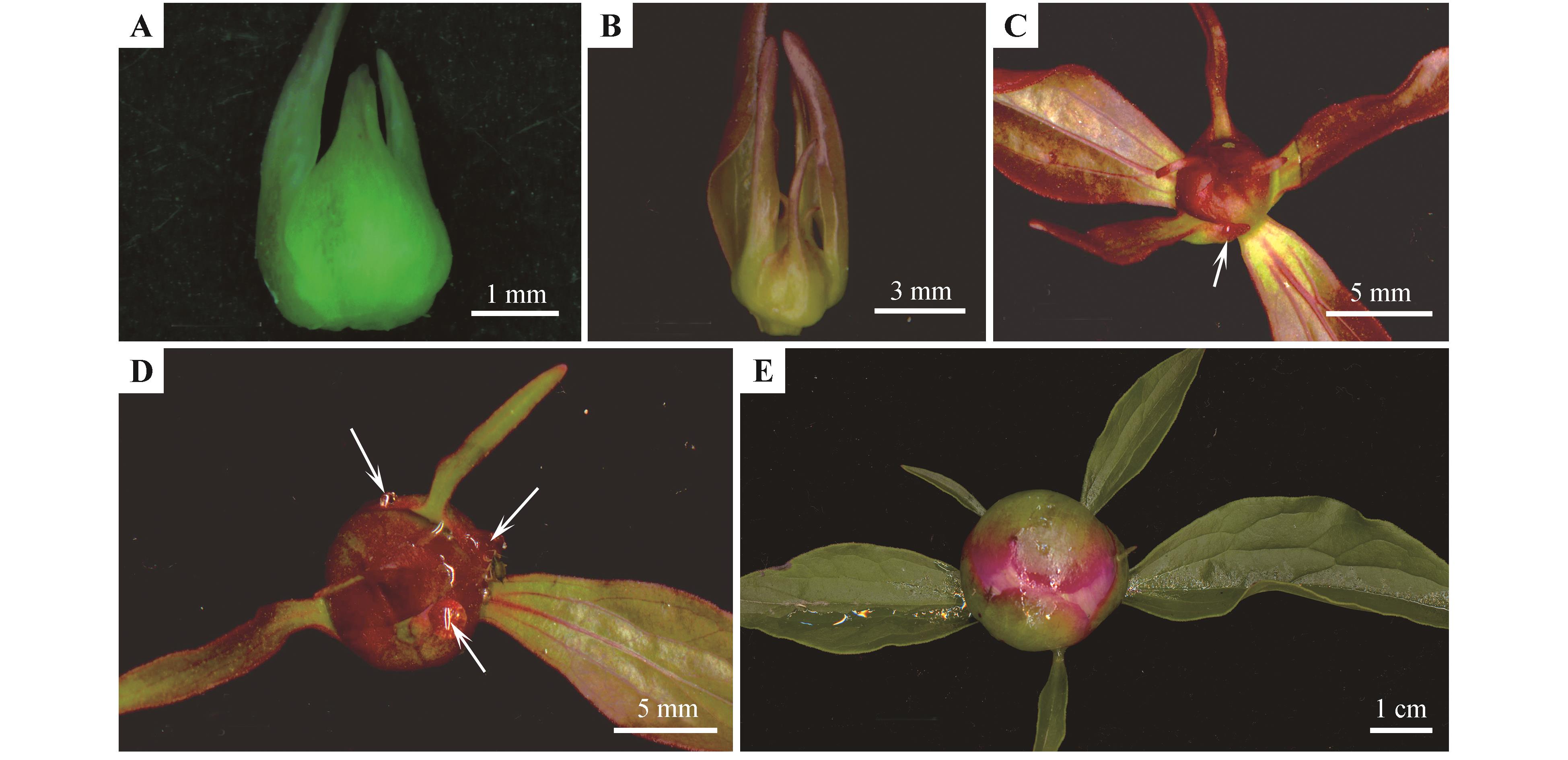
Fig.2
Microstructure of P. lactiflora bracts at different developmental stagesA. Cross-section at the bud-initiation stage; B. Cross-section at the young-bud stage; C. Lower epidermis and hypodermis at the young-bud stage; D. Cross-section at the leaf-expansion stage; E. Stomata at the leaf-expansion stage; F-G. Stomata and secretions; H. Cross-section at the firm stage; I. Partial enlargement of Fig.2H; J. Cross-section at the color-showing stage. UE. Upper epidermis; LE. Lower epidermis; H. Hypodermis; GT. Ground tissue; VB. Vascular bundle; GC. Guard cells; Sc. Substomatal chamber; Cod. Calcium oxalate druse.
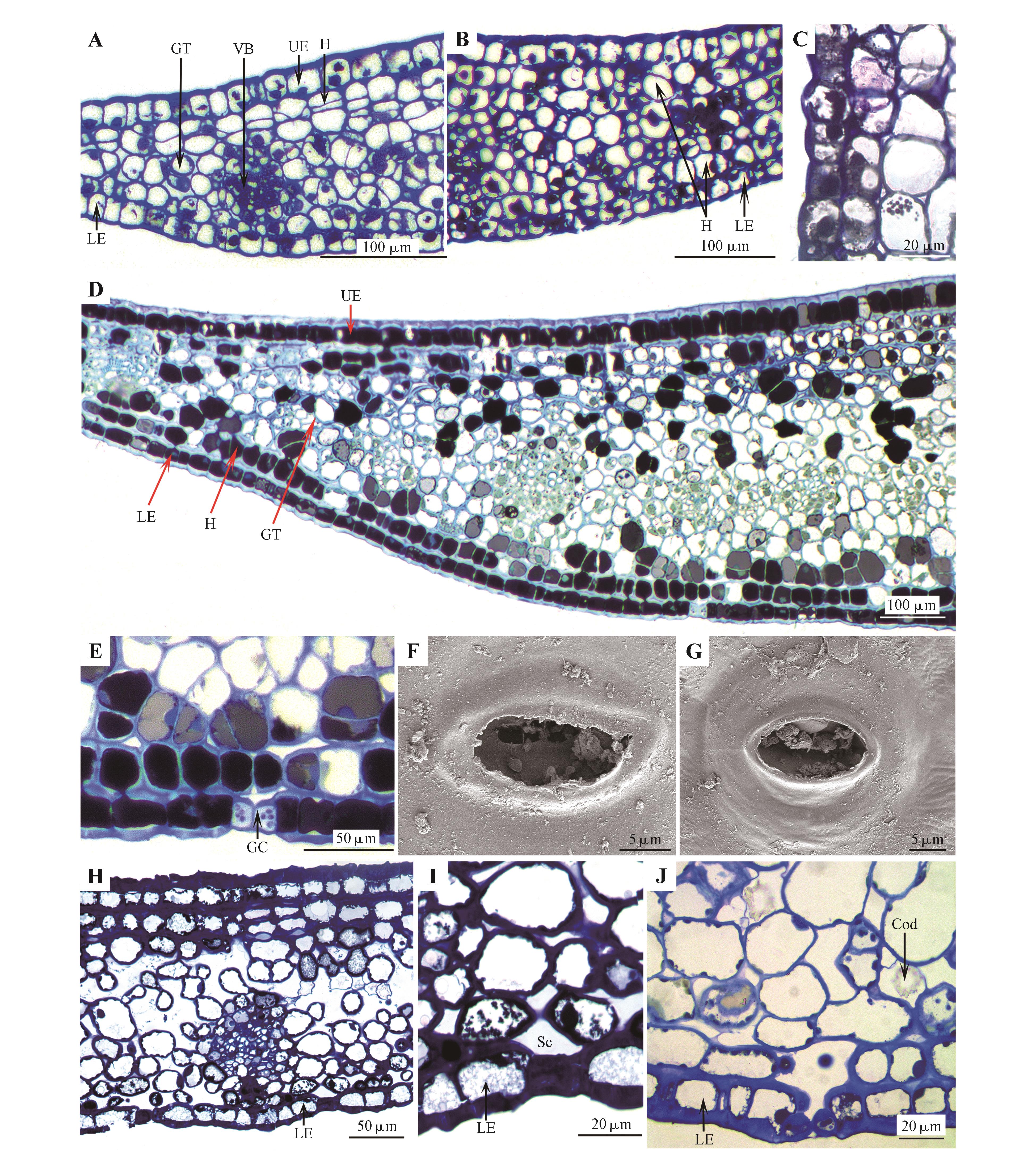
Fig.3
Ultrastructure of P. lactiflora bracts at the bud-initiation stageA. Lower epidermis and hypodermis; B. Hypodermal cells adjacent to the lower epidermis; C-D. Enlarged views of the area within black outlines in Fig.3B, C showing plastids, D showing mitochondria and endoplasmic reticulum; E. Upper epidermis and hypodermis; F. Enlarged view of the area within black outlines in Fig.3E, showing cellular organelles. P. Plastid; V. Vacuole; ER. Endoplasmic reticulum; M. Mitochondrion; CW. Cell wall.
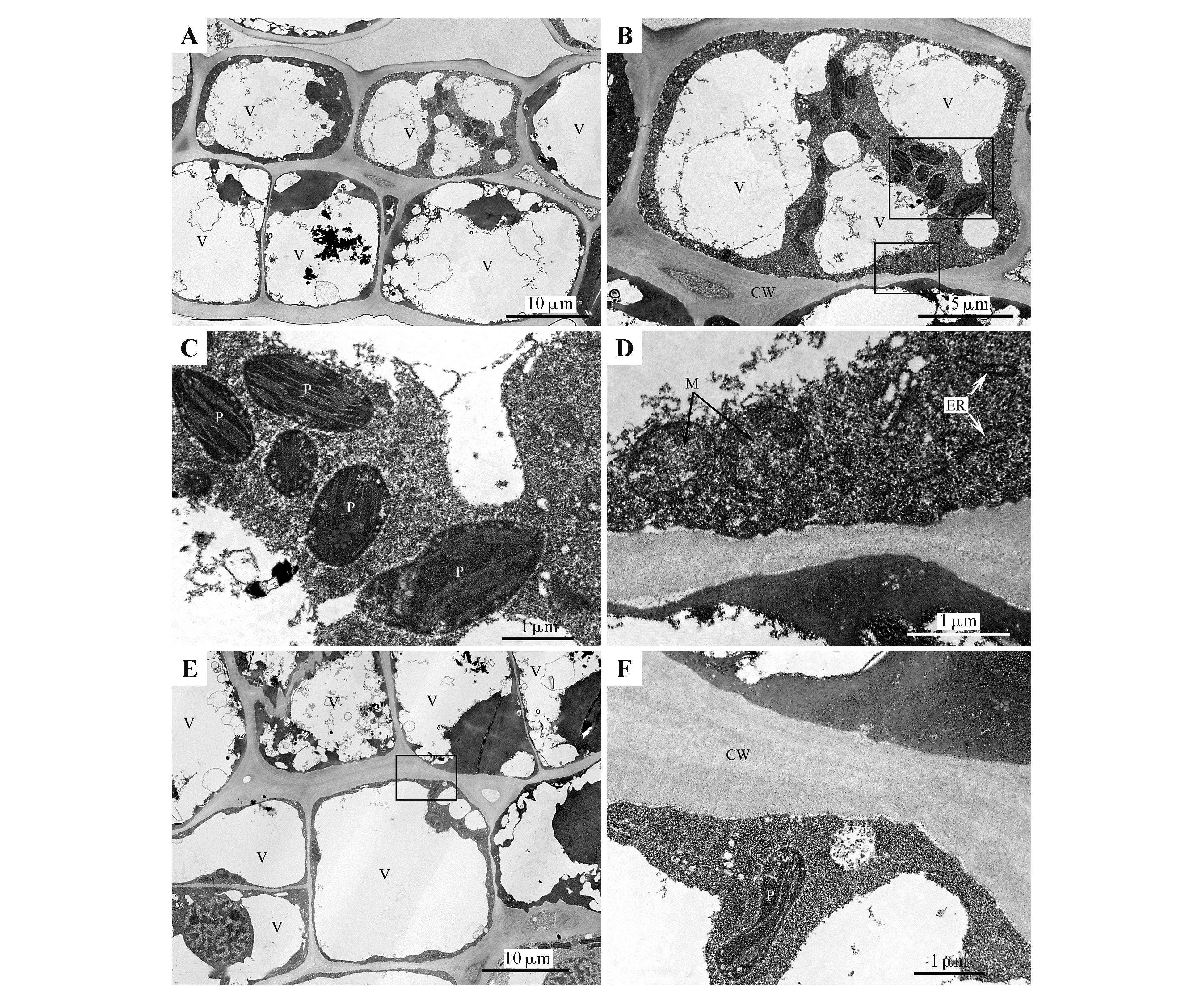
Fig.4
Ultrastructure of P. lactiflora bracts at the young-bud stageA.Lower epidermis and hypodermis; B.Organelles in the lower epidermal cells; C.Hypodermal cells on the inner side of the upper epidermis; D.Enlarged view of the area within black outlines in Fig.4C. P. Plastid; V. Vacuole; ER. Endoplasmic reticulum; M. Mitochondrion; CW. Cell wall; S. Starch grains; R. Ribosomes; G. Golgi apparatus; PM. Plasma membrane; SV. Secretory vesicle.
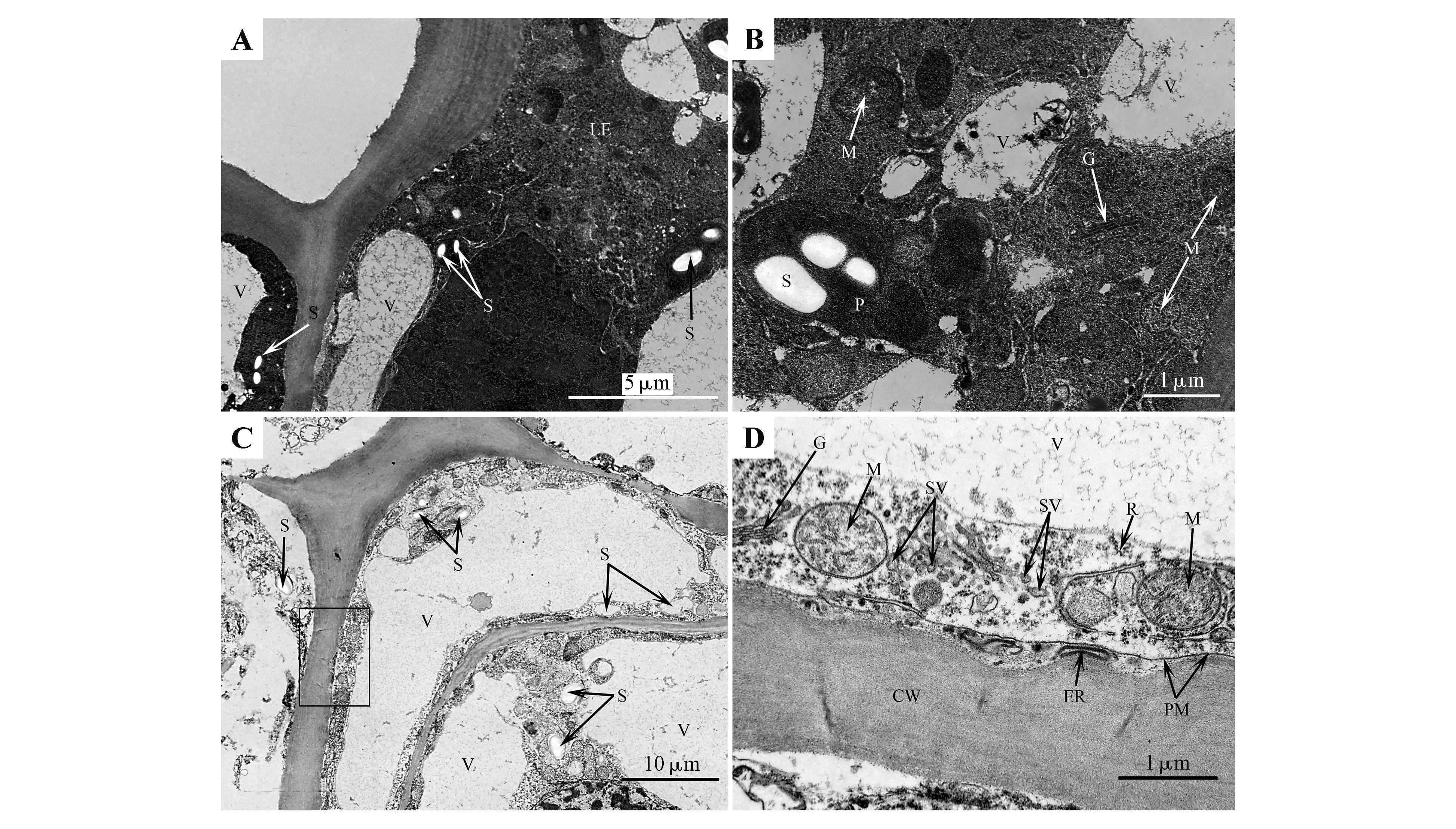
Fig.5
Ultrastructure of the epidermis and hypodermis of P. lactiflora bracts at the leaf-expansion stageA.Lower epidermis and hypodermis; B.Adjacent lower epidermal cells; C.Lower epidermal cells and adjacent hypodermal cells; D-E.Upper epidermal cells and adjacent hypodermal cells; F.Hypodermal cells close to the upper epidermis. LE. Lower epidermis; H. Hypodermis; UE. Upper epidermis; P. Plastid; V. Vacuole; M. Mitochondrion; CW. Cell wall; SV. Secretory vesicle; PL. Plasmodesma.
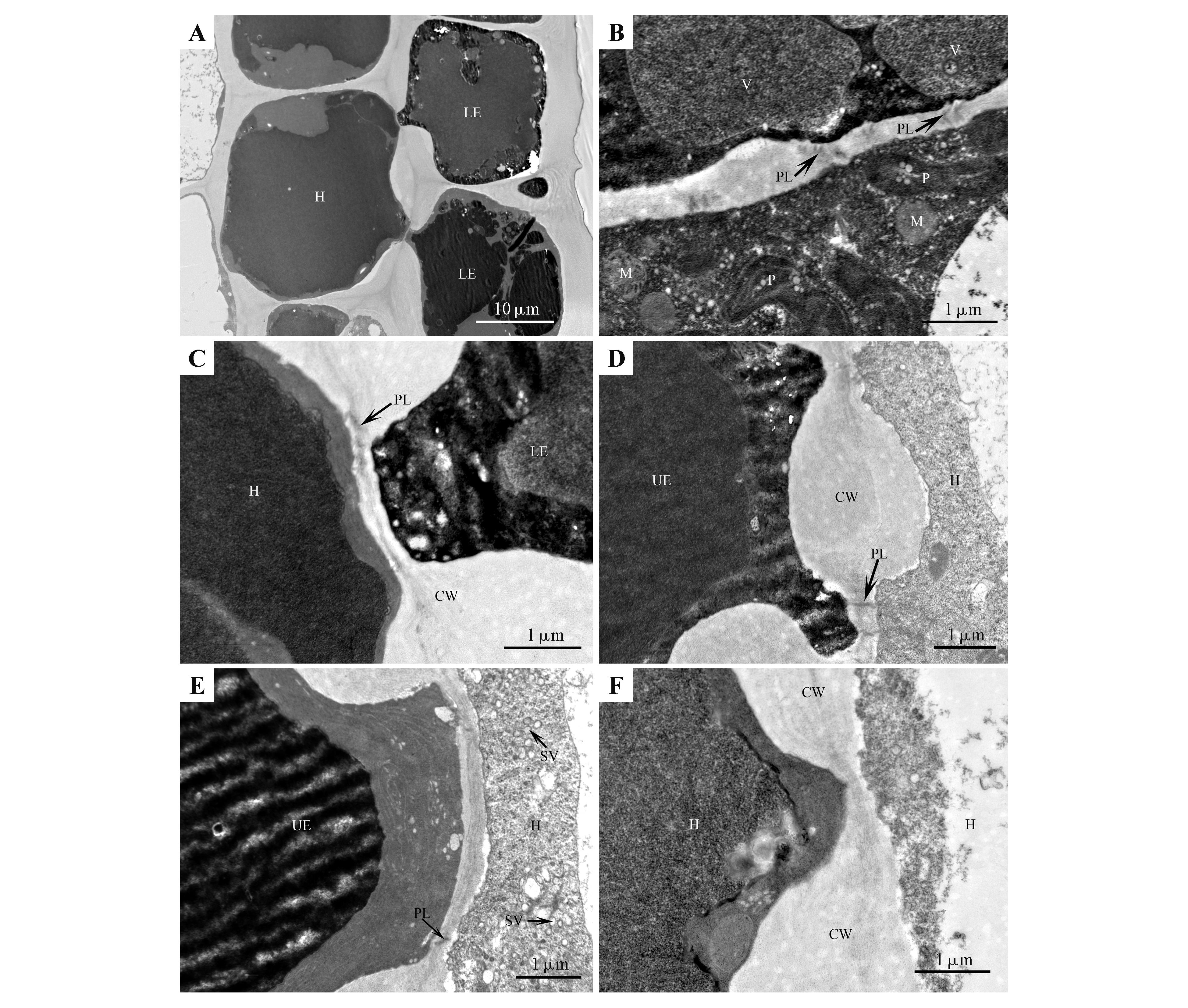
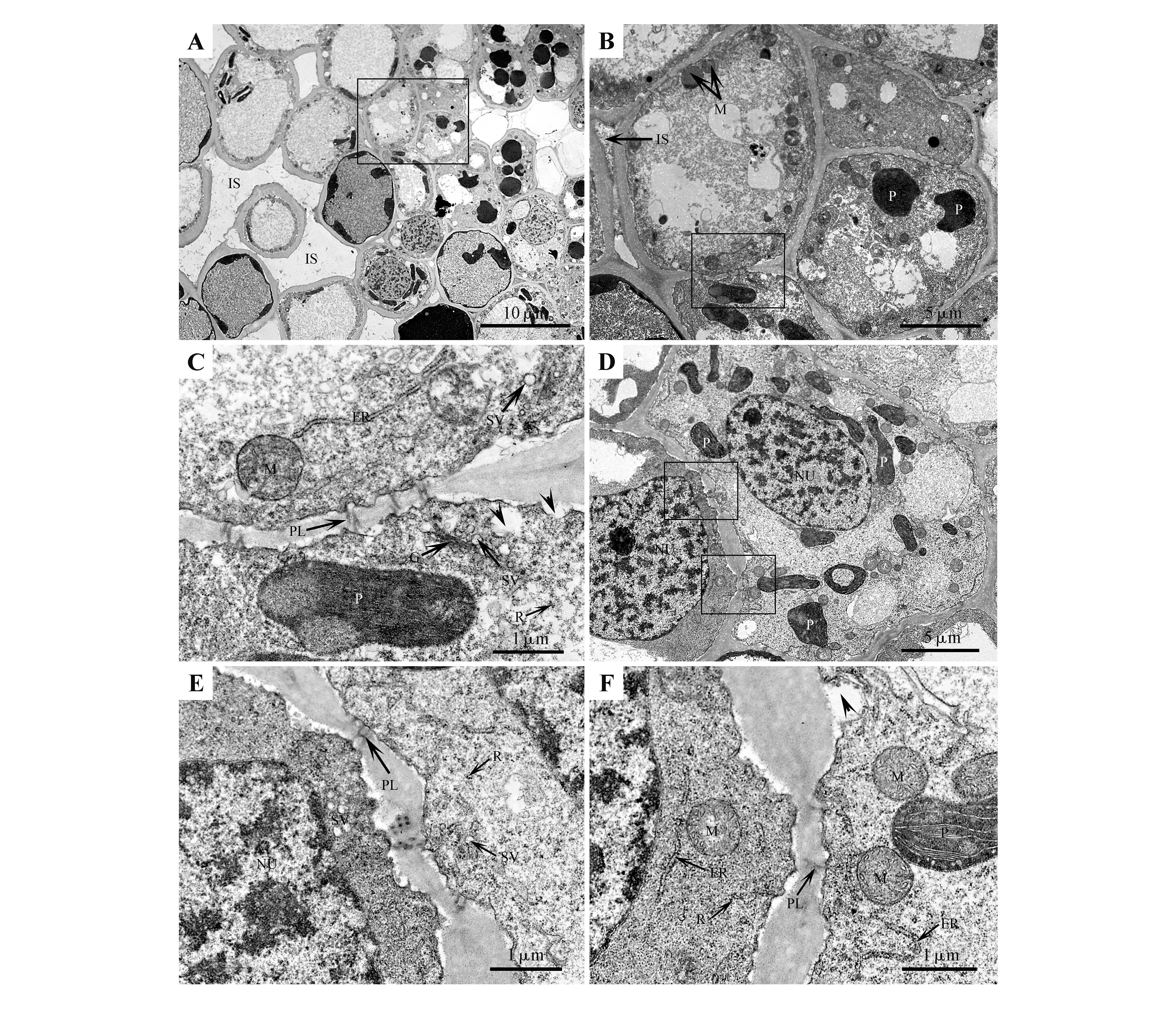
Fig.6
Ultrastructure of the ground tissue of P. lactiflora bracts at the leaf-expansion stageA.Intercellular space in the ground tissue; B. Enlarged view of the area within black outlines in Fig. 6A; C. Enlarged view of the area within black outlines in Fig. 6B; D. Parenchyma cells containing a nucleus; E-F. Enlarged view of the area within black outlines in Fig. 6D. IS. Intercellular space; P. Plastid; M. Mitochondrion; ER. Endoplasmic reticulum; SV. Secretory vesicle; G. Golgi apparatus; PL. Plasmodesma; R. Ribosomes; NU. Nucleus.
| [1] | 胡正海.植物分泌结构解剖学[M].上海:上海科学技术出版社,2012. |
| Hu Zhenghai.Anatomy of plant secretory structure[M].Shanghai:Shanghai Scientific & Technical Publishers,2012. | |
| [2] | Sandoval-Molina M A, González-Camarena E, Rosas-Sánchez J,et al.The distraction function of extrafloral nectaries:keeping ants away from flowers and preventing interaction with pollinators[J].Arthropod-Plant Interactions,2025,19(5):67. |
| [3] | Almeida O J G, Cota-Sánchez J H, Paoli A A S.The systematic significance of floral morphology,nectaries,and nectar concentration in epiphytic cacti of tribes Hylocereeae and Rhipsalideae (Cactaceae)[J].Perspectives in Plant Ecology,Evolution and Systematics,2013,15(5):255-268. |
| [4] | Liu M L, Yu W B, Kuss P,et al.Floral nectary morphology and evolution in Pedicularis (Orobanchaceae):floral nectaries in Pedicularis [J].Botanical Journal of the Linnean Society,2015,178(4):592-607. |
| [5] | Chen C L, Ruhfel B R, Li J L,et al.Phylotranscriptomics of Swertiinae (Gentianaceae) reveals that key floral traits are not phylogenetically correlated[J].Journal of Integrative Plant Biology,2023,65(6):1490-1504. |
| [6] | 王雯婧,陈虹帆,邵国峻,等.自交与异交象牙参属植物的蜜腺结构及其生物学意义[J].植物研究,2022,42(3):364-372. |
| Wang Wenjing, Chen Hongfan, Shao Guojun,et al.Nectary structure of selfing and outcrossing species in Roscoea [J].Bulletin of Botanical Research,2022,42(3):364-372. | |
| [7] | 舒金帅,刘玉梅,李占省,等.植物蜜腺研究进展及展望[J].园艺学报,2014,41(9):1846-1860. |
| Shu Jinshuai, Liu Yumei, Li Zhansheng,et al.Advances and perspectives in plant nectaries studies[J].Acta Horticulturae Sinica,2014,41(9):1846-1860. | |
| [8] | Morel P, Heijmans K, Ament K,et al.The floral C-lineage genes trigger nectary development in Petunia and Arabidopsis [J].The Plant Cell,2018,30(9):2020-2037. |
| [9] | Blüthgen N, Verhaagh M, Goitía W,et al.How plants shape the ant community in the Amazonian rainforest canopy:the key role of extrafloral nectaries and homopteran honeydew[J].Oecologia,2000,125(2):229-240. |
| [10] | 徐芳芳,陈进.本地种西番莲与外引种西番莲的花外蜜腺-蚂蚁-植食昆虫相互作用系统的比较[J].云南植物研究,2009,31(6):543-550. |
| Xu Fangfang, Chen Jin,et al.Comparison of the differences in response to the change of the extrafloral nectar-ant-herbivore interaction system between a native and an introduced Passiflora species[J].Acta Botanica Yunnanica,2009,31(6):543-550. | |
| [11] | Heil M.Extrafloral nectar at the plant-insect interface:a spotlight on chemical ecology,phenotypic plasticity,and food webs[J].Annual Review of Entomology,2015,60:213-232. |
| [12] | Camarota F, Powell S, Vasconcelos H L,et al.Extrafloral nectaries have a limited effect on the structure of arboreal ant communities in a Neotropical savanna[J].Ecology,2015,96(1):231-240. |
| [13] | Díaz-Castelazo C, Rico-Gray V, Ortega F,et al.Morphological and secretory characterization of extrafloral nectaries in plants of coastal Veracruz,Mexico[J].Annals of Botany,2005,96(7):1175-1189. |
| [14] | Weber M G, Keeler K H.The phylogenetic distribution of extrafloral nectaries in plants[J].Annals of Botany,2013,111(6):1251-1261. |
| [15] | da Costa Barbosa V D, Bächtold A, Del-Claro K,et al.Extrafloral nectary plants in Brazilian biomes:dominance of Cerrado and Fabaceae[J].Flora,2025,323:152668. |
| [16] | 潘开玉.中国植物志:第27卷[M].北京:科学出版社,1979:51-52. |
| Pan Kaiyu.Flora Reipublicae Popularis Sinicae:Vol. 27[M].Beijing:Science Press,1979:51-52. | |
| [17] | 王康才,张荣荣,卢秋文,等.芍药蜜腺及泌蜜规律研究[J].江苏农业科学,2008,36(3):142-146. |
| Wang Kangcai, Zhang Rongrong, Lu Qiuwen,et al.Study on nectary and nectar secretion regularity of Paeonia lactiflora [J].Jiangsu Agricultural Sciences,2008,36(3):142-146. | |
| [18] | 黄东旭.芍药花萼蜜露分泌特性及清除方法研究[D].扬州:扬州大学,2025. |
| Huang Dongxu.Study on secretion characteristics and removal methods of Paeonia lactiflora sepal’s nectar [D].Yangzhou:Yangzhou University,2025. | |
| [19] | 宋焕芝,郝丽红,于晓南.芍药蜜腺与蜜露分泌的观察研究[C]//中国观赏园艺研究进展.北京:中国林业出版社,2014:241-245. |
| Song Huanzhi, Hao Lihong, Yu Xiaonan.Observational study on nectary and nectar secretion of Paeonia lactiflora [C]//Advances in Ornamental Horticulture of China.Beijing:China Forestry Publishing House,2014:241-245. | |
| [20] | 张荣荣.芍药生长发育及芍药苷和苯甲酸累积规律研究[D].南京:南京农业大学,2009. |
| Zhang Rongrong.Studies on rhythm of development and accumulation regularity of paeoniflorin and benzoic acid of Paeonia lactiflora Pall.[D].Nanjing:Nanjing Agricultural University,2009. | |
| [21] | 孙苗,赵家庚.芍药花蕾泌蜜的秘密[J].生命世界,2025(2):40-41. |
| Sun Miao, Zhao Jiageng.The secret of nectar secretion in Paeonia lactiflora buds [J].Life World,2025(2):40-41. | |
| [22] | Hu W, Qin W Q, Jin Y Y,et al.Genetic and evolution analysis of extrafloral nectary in cotton[J].Plant Biotechnology Journal,2020,18(10):2081-2095. |
| [23] | Macêdo L P M, Silva E O, de Aguiar-Dias A C A.Morphoanatomy and ecology of the extrafloral nectaries in two species of Passiflora L.(Passifloraceae)[J].South African Journal of Botany,2021,143:248-255. |
| [24] | Maximo D, Ferreira M J P, Demarco D.Inaugural description of extrafloral nectaries in Sapindaceae:structure,diversity and nectar composition[J].Plants,2023,12(19):3411. |
| [25] | Delgado M N, da Silva L C, Báo S N,et al.Distribution,structural and ecological aspects of the unusual leaf nectaries of Calolisianthus species(Gentianaceae)[J].Flora,2011,206(7):676-683. |
| [26] | Eleftheriou E P, Hall J L.The extrafloral nectaries of cotton:Ⅱ.cytochemical localization of atpase activity and Ca2+-binding sites,and selective osmium impregnation[J].Journal of Experimental Botany,1983,34(8):1066-1079. |
| [27] | Mohan J S S, Inamdar J A.Ultrastructure and secretion of extrafloral nectaries of Plumeria rubra L.[J].Annals of Botany,1986,57(3):389-401. |
| [28] | Power M S, Skog J E.Ultrastructure of the extrafloral nectaries of Pteridium aquilinum [J].American Fern Journal,1987,77(1):1-15. |
| [29] | Balduino H, Tunes P, Nepi M,et al.Structure and ultrastructure of nuptial and extranuptial nectaries explain secretion changes throughout flower lifetime and allow for multiple ecological interactions[J].AoB Plants,2025,17(4):plaf037. |
| [30] | 祝建,胡正海.拟南芥花蜜腺筛分子及蜜腺组织发育过程中的细胞学研究[J].植物学报,2002,44(1):9-14. |
| Zhu Jian, Hu Zhenghai.Cytological study on the sieve elements in floral nectary and the development of nectary tissue in Arabidopsis thaliana [J].Acta Botanica Sinica,2002,44(1):9-14. | |
| [31] | 祝建,胡正海,马丁∙米勒.高压冷冻及低温替代技术制备的拟南芥花蜜腺超微结构的研究[J].植物学报,1997,39(4):289-295. |
| Zhu Jian, Hu Zhenghai, Müller Martin.Ultrastructure of floral nectary of Arabidopsis thaliana prepared by high pressure freezing and freeze substitution[J].Acta Botanica Sinica,1997,39(4):289-295. | |
| [32] | 黄子璇.莬葵属(Eranthis)花形态的变异式样及蜜腺的发育解剖学研究[D].西安:陕西师范大学,2021. |
| Huang Zixuan.Variation patterns of floral morphology and developmental anatomy of nectaries in the genus Eranthis [D].Xi’an:Shaanxi Normal University,2021. | |
| [33] | 沈燕,唐晓宇,唐秀俊,等.川莓花蜜腺泌蜜节律及发育形态特征[J].植物研究,2025,45(4):636-647. |
| Shen Yan, Tang Xiaoyu, Tang Xiujun,et al.Rhythms of nectar secretion,morphological characteristics of developmental floral nectary in Rubus setchuenensis [J].Bulletin of Botanical Research,2025,45(4):636-647. | |
| [34] | Amarilla L D, Tello N R, Cavalcante M C,et al.Floral structure and nectary anatomy of Bertholletia excelsa (Lecythidaceae)[J].Botany Letters,2024,171(4):424-432.[LinkOut] |
| [35] | Gaffal K P, Friedrichs G J, El-Gammal S.Ultrastructural evidence for a dual function of the phloem and programmed cell death in the floral nectary of Digitalis purpurea [J].Annals of Botany,2007,99(4):593-607. |
| [36] | Gui M Y, Liu W Z.Programmed cell death during floral nectary senescence in Ipomoea purpurea [J].Protoplasma,2014,251(3):677-685. |
| [1] | Yan SHEN, Xiaoyu TANG, Xiujun TANG, Lilin LUO, Zhenxing HUANG, Man LIU. Rhythms of Nectar Secretion, Morphological Characteristics of Developmental Floral Nectary in Rubus setchuenensis [J]. Bulletin of Botanical Research, 2025, 45(4): 636-647. |
| [2] | Jiaying TANG, Jinkun ZHANG, Jiwen HU, Fude WANG, Peiyao XIN, Wenjun MA. Phenotypic Diversity Analysis of Natural Herbaceous Peony Populations in Great Khingan Mountains [J]. Bulletin of Botanical Research, 2025, 45(2): 299-314. |
| [3] | Wenjing WANG, Hongfan CHEN, Guojun SHAO, Hong LIAO, Jianli ZHAO, Qingjun LI. Nectary Structure of Selfing and Outcrossing Speciesin Roscoea [J]. Bulletin of Botanical Research, 2022, 42(3): 364-372. |
| [4] | GOU Jun;WANG Hong*;ZHANG Wei-Hong;WANG Jiang. Developmental Anatomy of the Floral Nectaries in Salvia deserta Schang [J]. Bulletin of Botanical Research, 2012, 32(6): 641-645. |
| [5] | WANG Hong;ZOU Ling*;ZHANG Wei-Hong;YANG Jie;FU Qiang. Developmental Anatomy of Floral Nectary in Thymus marschallianus Willd [J]. Bulletin of Botanical Research, 2012, 32(5): 544-548. |
| [6] | GENG Hua-Mei;FU Qiang;GUO Jun;WANG Hong*. Developmental Anatomy of the Floral Nectaries in Dracocephalum nutans Linn. [J]. Bulletin of Botanical Research, 2012, 32(1): 22-27. |
| [7] | WANG Hong;KUANG Dai-Liang;SUO Fei-Ya;DU Hong-Wei;WANG Yong-Xin*. Developmental Anatomy of the Floral Nectaries in Nitraria tangutorum Bobrov [J]. Bulletin of Botanical Research, 2011, 31(1): 24-28. |
| [8] | WANG Hong;WANG Xin;WANG Yong-Xing;YANG Bin-Yin;JIANG Yan-Cheng*. Developmental Anatomy of the Floral Nectaries in Calligonum ebi-nuricum [J]. Bulletin of Botanical Research, 2010, 30(3): 262-266. |
| [9] | FENG Ying;WU Yu-Hu;SHEN Guan-Mian. Bracts and bracteoles Morphology of Pleurospermum Hoffm. in Kun-Lun Mountains and Its Taxonomic Significance [J]. Bulletin of Botanical Research, 2009, 29(6): 674-680. |
| [10] | WANG Hong, ZHANG Fu-Chun. Developmental and anatomical studies on the floral nectaries in Ferula sinkiangensts K.M.Shen [J]. Bulletin of Botanical Research, 2004, 24(4): 406-409. |
| [11] | WANG Hong, WU Jing, DENG Yan-bin. THE DEVELOPMENTAL AND ANATOMICAL STUDIES ON THE FLORAL NECTARY IN ARMENIACA VULGARIS LAM [J]. Bulletin of Botanical Research, 2002, 22(4): 456-458. |
| [12] | Deng Yan-bin, Liu Zhong-yuan, Jiang Yan-cheng, Wang Hong. DEVELOPMENTAL AND ANATOMICAL STUDIES ON THE FLORAL NECTARIES IN ELAEAGNUS ANGUSTIFOLIA [J]. Bulletin of Botanical Research, 1998, 18(1): 34-37. |
| Viewed | ||||||
|
Full text |
|
|||||
|
Abstract |
|
|||||