植物研究 ›› 2026, Vol. 46 ›› Issue (5): 938-947.doi: 10.7525/j.issn.1673-5102.2026.05.014
王晓燕, 王浩男, 何倩倩, 贾璐婷, 张帅, 王鹏飞( )
收稿日期:2026-04-17
出版日期:2026-08-28
发布日期:2026-10-10
通讯作者:
王鹏飞
E-mail:pengfeiwang2004@163.com
作者简介:王晓燕(2001—),女,硕士研究生,主要从事果树种质资源开发与利用研究。
基金资助:
Xiaoyan WANG, Haonan WANG, Qianqian HE, Luting JIA, Shuai ZHANG, Pengfei WANG()
Received:2026-04-17
Online:2026-08-28
Published:2026-10-10
Contact:
Pengfei WANG
E-mail:pengfeiwang2004@163.com
摘要:
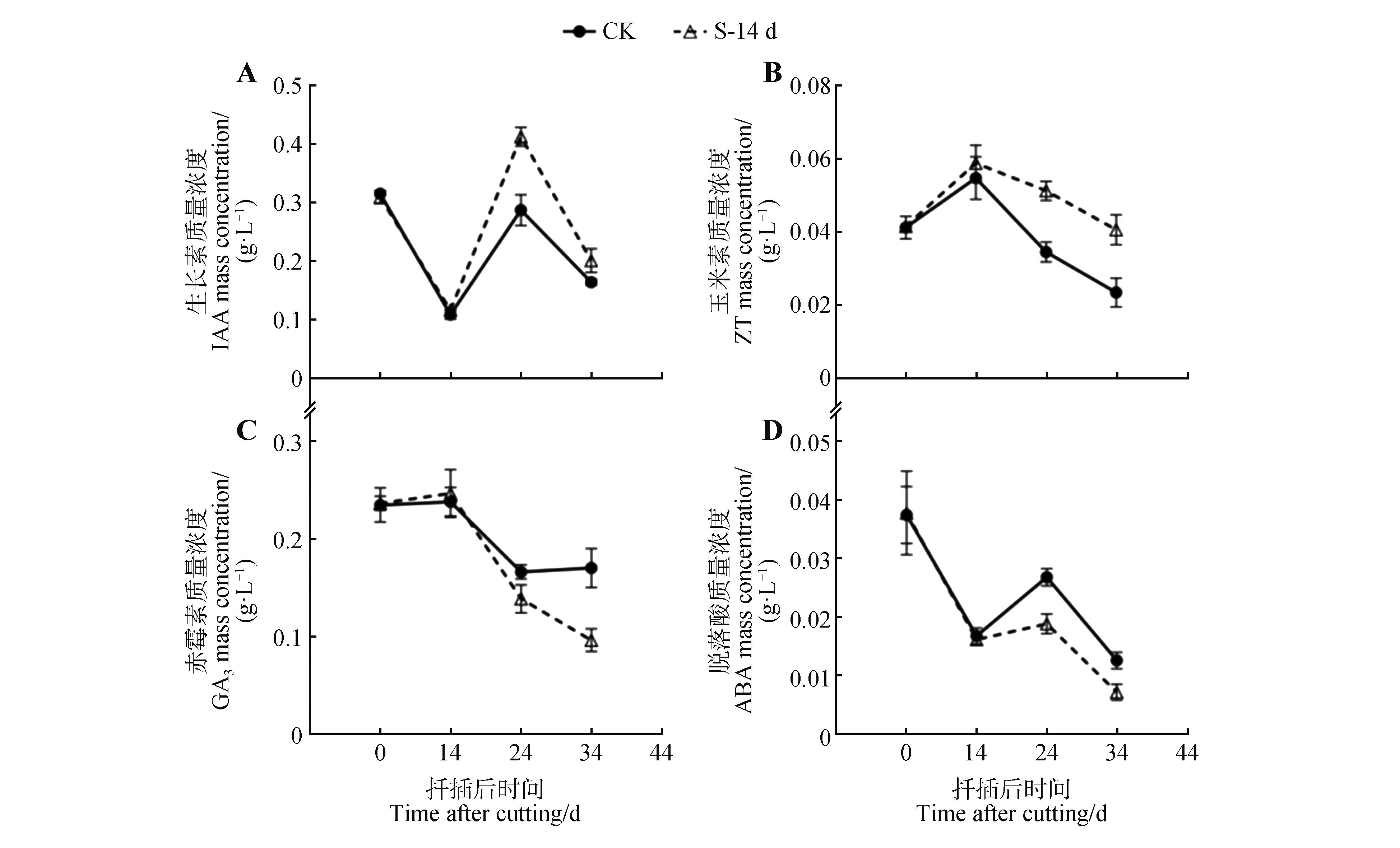
为了探究基质浇灌不同生长延缓剂调控欧李(Cerasus humilis)嫩枝扦插生根的机制,本研究以‘农大6号’(‘Nongda No.6’)欧李半木质化新梢制作插穗,筛选适宜的调节剂浓度和浇灌时期,并分析最优处理插穗生根过程中营养物质和内源激素动态变化特征。结果表明:基质浇灌不同浓度的多效唑(paclobutrazol,PP333)和烯效唑(uniconazole,S3307)均能够提高生根率,其中100 mg⋅L-1多效唑处理生根率最高,达60.83%,显著高于对照;50 mg⋅L-1烯效唑处理的生根率、插穗存活率与根系发育等综合表现最优,适宜在欧李嫩枝扦插中应用。扦插后7 d、14 d与21 d分别浇灌50 mg⋅L-1 S3307,发现14 d浇灌处理(S-14 d)的生根率最高(57.22%)。S-14 d处理插穗茎段中可溶性糖、淀粉与可溶性蛋白含量在生根过程中积累量显著高于对照,形成了较高的碳氮比,提升了生根速度和根系质量;同时,S-14 d处理提高插穗中生长素(indole-3-acetic acid,IAA)和玉米素(zeatin,ZT)含量,抑制赤霉素(gibberellic acid,GA3)和脱落酸(abscisic acid,ABA)的积累,优化激素平衡,有利于插穗生根。综上,扦插后14 d基质浇灌50 mg⋅L-1 S3307可通过调控营养物质代谢和内源激素水平,有效促进欧李嫩枝扦插生根。
中图分类号:
王晓燕, 王浩男, 何倩倩, 贾璐婷, 张帅, 王鹏飞. 基质浇灌生长延缓剂对欧李嫩枝扦插生根的影响[J]. 植物研究, 2026, 46(5): 938-947.
Xiaoyan WANG, Haonan WANG, Qianqian HE, Luting JIA, Shuai ZHANG, Pengfei WANG. Effects of Substrate Irrigation with Growth Retardants on Rooting of Cerasus humilis Softwood Cuttings[J]. Bulletin of Botanical Research, 2026, 46(5): 938-947.
表1
不同生长延缓剂质量浓度处理
处理 Treatment | 生长延缓剂 Growth retardant | 质量浓度 Mass concentration/(mg·L-1) |
|---|---|---|
| CK | 清水 | — |
| P1 | PP333 | 100 |
| P2 | PP333 | 200 |
| P3 | PP333 | 300 |
| S1 | S3307 | 25 |
| S2 | S3307 | 50 |
| S3 | S3307 | 100 |
表2
50 mg·L-1 S3307不同浇灌时期处理
处理 Treatment | 生长延缓剂 Growth retardant | 质量浓度 Mass concentration/ (mg·L-1) | 浇灌时期 Irrigation period |
|---|---|---|---|
| CK | 清水 | — | — |
| S-7 d | S3307 | 50 | 扦插后7 d |
| S-14 d | S3307 | 50 | 扦插后14 d |
| S-21 d | S3307 | 50 | 扦插后21 d |
表3
基质浇灌不同生长延缓剂下插穗生根及生长情况
处理 Treatment | 生根率 Rooting rate/% | 腐烂率 Rotting rate/% | 愈伤率 Callus rate/% | 总根长 Total root length/cm | 根表面积 Root surface area/cm2 | 根体积 Root volume/cm3 | 分支数量 Branch number |
|---|---|---|---|---|---|---|---|
| CK | 37.09±2.29c | 58.33±1.80a | 4.17±1.59ab | 79.79±10.32bc | 10.91±1.21b | 0.12±0.01a | 601.33±38.96bc |
| P1 | 60.83±2.59a | 36.25±2.75c | 2.92±1.72b | 109.58±13.85abc | 21.15±3.27ab | 0.37±0.15a | 951.67±50.85abc |
| P2 | 51.25±2.19ab | 42.92±2.29bc | 5.42±1.25ab | 83.32±29.36bc | 17.68±5.26ab | 0.31±0.08a | 928.00±317.43abc |
| P3 | 34.17±3.23c | 55.00±4.14ab | 9.58±3.22a | 38.66±4.13c | 9.44±1.07b | 0.18±0.02a | 347.00±62.35c |
| S1 | 54.58±6.06ab | 43.75±5.95bc | 1.25±0.42b | 111.90±34.70ab | 18.80±5.87ab | 0.25±0.08a | 1 053.67±406.11abc |
| S2 | 52.92±3.43ab | 43.75±4.22bc | 2.50±1.44b | 140.76±7.11ab | 24.30±3.32ab | 0.34±0.08a | 1 402.00±229.38ab |
| S3 | 43.33±4.91bc | 51.25±5.24ab | 3.34±2.26b | 176.28±30.73a | 35.90±13.01a | 0.62±0.33a | 1 620.00±406.70a |
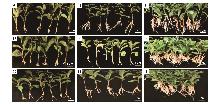
图1
不同处理对欧李插穗生根进程的影响对照处理扦插后20 d(A)、30 d(B)、40 d(C)的插穗生根情况;100 mg⋅L-1 PP333处理扦插后20 d(D)、30 d(E)、40 d(F)的插穗生根情况; 50 mg⋅L-1 S3307处理扦插后20 d(G)、30 d(H)、40 d(I)的插穗生根情况。
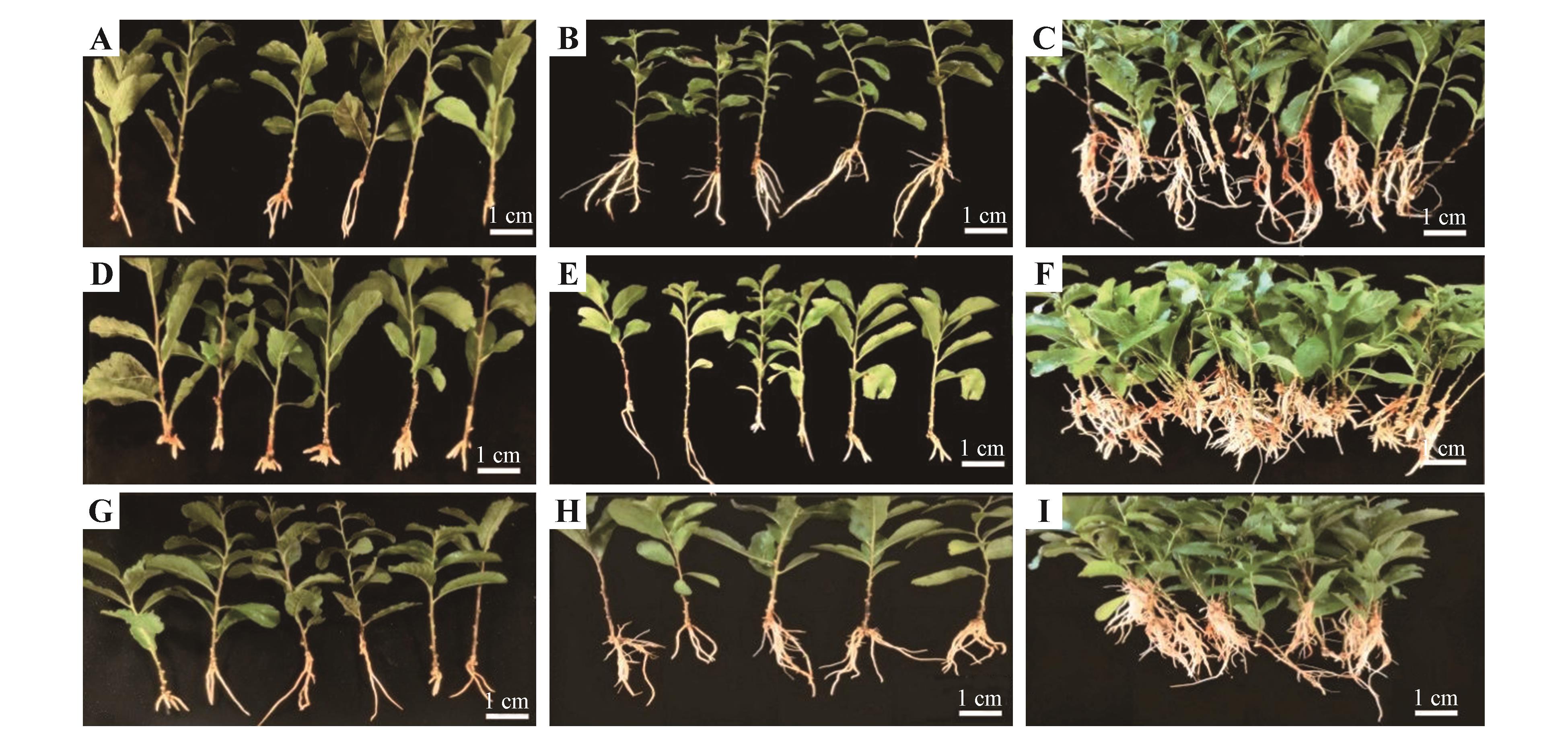
表4
不同扦插处理生根及根系指标的秩和比综合评价
处理 Treatment | 生根率 Rooting rate/% | 腐烂率 Rotting rate/% | 愈伤率 Callus rate/% | 总根长 Total root length/cm | 根表面积 Root surface area/cm2 | 根体积 Root volume/ cm3 | 分支数量 Branch number | 秩和 Sum of ranks | 秩和比 RSR | 评价等级 Rating level |
|---|---|---|---|---|---|---|---|---|---|---|
| CK | 2.0 | 1.0 | 3.0 | 2.0 | 2.0 | 1.0 | 2.0 | 13.0 | 0.265 3 | 差 |
| P1 | 7.0 | 7.0 | 5.0 | 4.0 | 5.0 | 6.0 | 4.0 | 38.0 | 0.775 5 | 优 |
| P2 | 4.0 | 6.0 | 2.0 | 3.0 | 3.0 | 4.0 | 3.0 | 25.0 | 0.510 2 | 中 |
| P3 | 1.0 | 2.0 | 1.0 | 1.0 | 1.0 | 2.0 | 1.0 | 9.0 | 0.183 7 | 差 |
| S1 | 6.0 | 4.5 | 7.0 | 5.0 | 4.0 | 3.0 | 5.0 | 34.5 | 0.704 1 | 优 |
| S2 | 5.0 | 4.5 | 6.0 | 6.0 | 6.0 | 5.0 | 6.0 | 38.5 | 0.785 7 | 优 |
| S3 | 3.0 | 3.0 | 4.0 | 7.0 | 7.0 | 7.0 | 7.0 | 38.0 | 0.775 5 | 优 |
表5
不同时期浇灌生长延缓剂对插穗生根性状的影响
处理 Treatment | 生根率 Rooting rate/% | 腐烂率 Rotting rate/% | 总根长 Total root length/cm | 根表面积 Root surface area/cm2 | 根体积 Root volume/cm3 | 分支数量 Branch number |
|---|---|---|---|---|---|---|
| CK | 20.56±4.75c | 77.78±4.94a | 77.82±15.88b | 14.77±3.12b | 0.22±0.05b | 669.33±213.83b |
| S-7 d | 31.67±1.93b | 66.11±3.09ab | 95.54±13.89ab | 20.66±2.16ab | 0.36±0.03ab | 1 251.33±228.12ab |
| S-14 d | 57.22±2.94a | 40.56±3.89c | 136.33±23.63ab | 25.14±3.83ab | 0.37±0.05ab | 1 226.67±218.67ab |
| S-21 d | 41.11±6.41b | 58.33±5.85b | 168.50±39.80a | 33.47±7.82a | 0.53±0.12a | 1 868.67±541.40a |

图2
不同时期浇灌S3307对插穗碳氮营养物质质量分数的影响
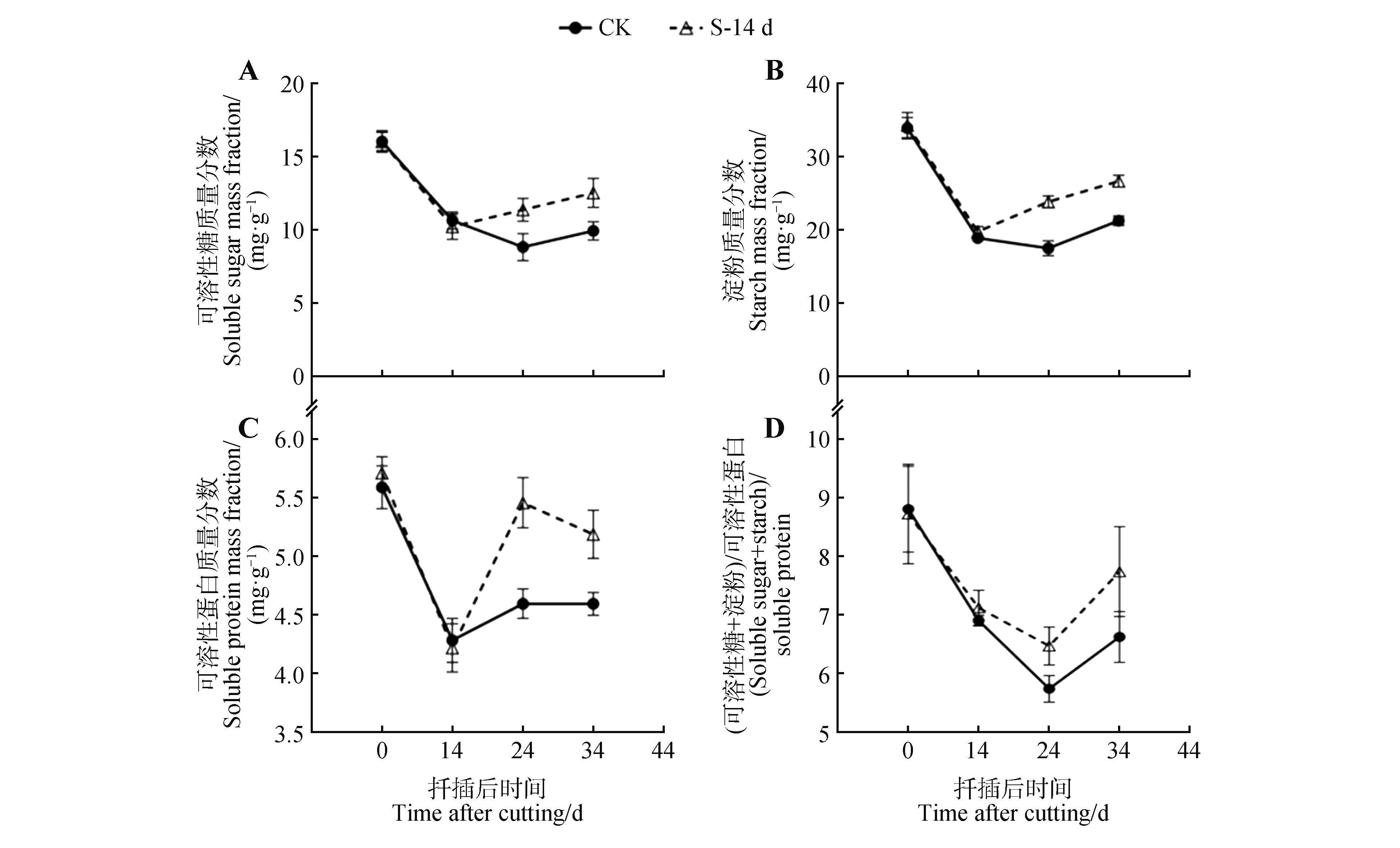
图3
不同时期浇灌S3307对插穗内源激素质量浓度的影响
| [1] | 吴春燕,韩潇怡,吴俊英,等.欧李营养价值及开发利用研究进展[J].中国果树,2024(2):1-5. |
| Wu Chunyan, Han Xiaoyi, Wu Junying,et al.Research progress on nutritional value and development and utilization of Cerasus humilis(Bge.) Sok[J].China Fruits,2024(2):1-5. | |
| [2] | 姚泽,王祺,王大为.我国特有新型果树—中华钙果的产业发展设想[J].果树资源学报,2026,7(2):106-108. |
| Yao Ze, Wang Qi, Wang Dawei.Prospects for industrial development of Cerasus humilis——a novel endemic fruit tree in China[J].Journal of Fruit Resources,2026,7(2):106-108. | |
| [3] | 叶丙鑫,陈小丽,谢淑琴,等.不同影响因子对干旱半干旱区欧李嫩枝扦插育苗生根的影响[J].林业科技通讯,2024(11):76-79. |
| Ye Bingxin, Chen Xiaoli, Xie Shuqin,et al.Effects of different influencing factors on rooting of Cerasus humilis cuttings in arid and semi-arid areas[J].Forest Science and Technology,2024(11):76-79. | |
| [4] | 覃芳,张俊杰,史艳财,等.叶面喷施多效唑对金槐生长及生理的影响[J].湖北农业科学,2021,60(15):96-100. |
| Qin Fang, Zhang Junjie, Shi Yancai,et al.Effects of paclobutrazol treatment on the growth and physiology of Sophora japonica ‘Jinhuai’[J].Hubei Agricultural Sciences,2021,60(15):96-100. | |
| [5] | Mauriat M, Petterle A, Bellini C,et al.Gibberellins inhibit adventitious rooting in hybrid aspen and Arabidopsis by affecting auxin transport[J].The Plant Journal,2014,78(3):372-384. |
| [6] | 周再知,刘式超,张金浩,等.外源IBA对裸花紫珠扦插生根和内源激素含量变化的影响[J].热带作物学报,2016,37(6):1075-1080. |
| Zhou Zaizhi, Liu Shichao, Zhang Jinhao,et al.Effects of IBA treatments on adventitious rooting and endogenous hormones contents of shoot cuttings of Callicarpa nudiflora [J].Chinese Journal of Tropical Crops,2016,37(6):1075-1080. | |
| [7] | 丛树春.多效唑对桧柏扦插生根效应的试验[J].吉林林业科技,1998,27(4):22. |
| Cong Shuchun.An experiment on the effect of paclobutrazol on the cutting rooting of Sabina chinensis [J].Journal of Jilin Forestry Science and Technology,1998,27(4):22. | |
| [8] | 黄源妹.多效唑对几种乡土树种扦插生根的影响[J].陕西林业科技,2025,53(5):23-28. |
| Huang Yuanmei.Effect of paclobutrazol on the rooting of cuttings from several native tree species[J].Shaanxi Forest Science and Technology,2025,53(5):23-28. | |
| [9] | 杜俊杰.中国特有林果——欧李[M].北京:中国农业科学技术出版社,2023. |
| Du Junjie. Prunus humilis,a unique fruit in China[M].China Agricultural Science and Technology Press,2023. | |
| [10] | 何倩倩,张婕,穆霄鹏,等.叶面喷施植物生长调节剂对欧李嫩枝扦插生根与生理变化的影响[J].植物生理学报,2024,60(1):108-116. |
| He Qianqian, Zhang Jie, Mu Xiaopeng,et al.Effects of foliar spraying plant growth regulator on rooting and physiological changes of Cerasus humilis softwood cuttings[J].Plant Physiology Journal,2024,60(1):108-116. | |
| [11] | 穆霄鹏,牟小燕,亓新亮,等.不同生长延缓剂处理对欧李根状茎扦插生根的影响[J].植物研究,2025,45(1):88-97. |
| Mu Xiaopeng, Mou Xiaoyan, Qi Xinliang,et al.Effects of different growth retardant treatments on rooting of Prunus humilis rhizome cuttings[J].Bulletin of Botanical Research,2025,45(1):88-97. | |
| [12] | 闫松涛.欧李根状茎扦插繁殖及生根的生理机制研究[D].太谷:山西农业大学,2024. |
| Yan Songtao.Research on the propagation and rooting of Cerasus humilis rhizome cuttings[D].Taigu:Shanxi Agricultural University,2024. | |
| [13] | 王齐,张玉雯,白静怡,等.基于秩和比法的滇东南石漠化草原区植被恢复模式筛选[J].云南农业大学学报(自然科学),2025,40(5):170-177. |
| Wang Qi, Zhang Yuwen, Bai Jingyi,et al.Screen of vegetation restoration patterns in rocky desertification grasslands of southeast Yunnan based on rank-sum ratio method[J].Journal of Yunnan Agricultural University (Natural Science),2025, 40(5):170-177. | |
| [14] | 季琳琳,孙维敏, 陈素传,等.配比施肥对山核桃幼树生长生理特性的影响[J/OL].扬州大学学报(农业与生命科学版),2026-03-18.. |
| Ji Linlin, Sun Weimin, Chen Suchuan,et al.Effects of fertilization on growth and physiological characteristics for young stand of Carya cathayensis [J].Journal of Yangzhou University(Agricultural and Life Science Edition),2026-03-18.. | |
| [15] | 刘玉玲,张红岩,滕长才,等.蚕豆SSR标记遗传多样性及与淀粉含量的关联分析[J].作物学报,2022,48(11):2786-2796. |
| Liu Yuling, Zhang Hongyan, Teng Changcai,et al.Genetic diversity and its association analysis of SSR markers with starch content in faba bean (Vicia faba L.)[J].Acta Agronomica Sinica,2022,48(11):2786-2796. | |
| [16] | 庄红梅, YUNUSOV Salohiddinjon Adhamovich, KAISAER Rehemu,等.外源γ-氨基丁酸对乌兹别克斯坦芜菁农艺性状及生理特性的影响[J].园艺学报,2026,53(3):791-801. |
| Zhuang Hongmei,Yunusov Salohiddinjon Adhamovich, Rehemu Kaisaer,et al.Effects of exogenous γ-aminobutyric acid on agronomic traits and physiological characteristics of Uzbekistani turnip[J].Acta Horticulturae Sinica,2026,53(3):791-801. | |
| [17] | Lykokanellos G, Lagogiannis I, Liopa-Tsakalidi A,et al.Optimizing rooting and growth of Salvia rosmarinus cuttings in soilless systems affected by growth regulators[J].Plants,2025,14(14):2210. |
| [18] | Lee S, Moon B, Kim S,et al.Effects of rooting substrates and plant growth regulators on rooting performance,photosynthetic characteristics,and soil properties of Broussonetia×kazinoki sieb. cuttings[J].Forests,2025,16(11):1752. |
| [19] | 代丽华,段九东,邵齐飞,等.不同植物生长调节剂及浓度对猴欢喜嫩枝扦插生根的影响[J].温带林业研究,2025,8(6):26-30. |
| Dai Lihua, Duan Jiudong, Shao Qifei,et al.The effects of different plant growth regulators and their concentrations on the rooting of softwood cuttings in Sloanea sinensis [J].Journal of Temperate Forestry Research,2025,8(6):26-30. | |
| [20] | Yu W W, Li Y H, Zhang Y T,et al.Integrated physiological and transcriptomic analyses reveal mechanisms regulating endogenous phytohormones in adventitious root formation during Cinnamomum bodinieri cutting propagation[J].Forests,2025,16(3):509. |
| [21] | Xiong Y P, Chen X H, Liu J Y,et al.Comparative transcriptomic and hormonal analyses reveal potential regulation networks of adventitious root formation in Metasequoia glyptostroboides Hu et Cheng[J].BMC Genomics,2024,25(1):1098. |
| [22] | 苏彩风,段国珍,樊光辉.枸杞扦插生根及相关生理生化分析[J].北方园艺,2023(1):90-97. |
| Su Caifeng, Duan Guozhen, Fan Guanghui.Cutting rooting and related physiological and biochemical analysis of Lycium barbarum [J].Northern Horticulture,2023(1):90-97. | |
| [23] | Shao F X, Wang S, Huang W,et al.Effects of IBA on the rooting of branch cuttings of Chinese jujube (Zizyphus jujuba Mill.) and changes to nutrients and endogenous hormones[J].Journal of Forestry Research,2018,29(6):1557-1567. |
| [24] | 庞艳萍.植物生长调节剂对江南油杉嫩枝扦插生根变化的影响研究[D].南宁:广西大学,2024. |
| Pang Yanping.Studies on the effects of plant growth regulators on the changes of rooting in shoot cuttings of Keteleeria fortune var. cyclolepis[D].Nanning:Guangxi University,2024. | |
| [25] | 岳艳玲,史佳,荆蓉.不同生长调节剂对互叶醉鱼木嫩枝扦插的影响[J].寒旱农业科学,2025,4(11):1052-1058. |
| Yue Yanling, Shi Jia, Jing Rong.Effect of different growth regulators on the cuttings of tender branches of Buddleja aalternifolia [J].Journal of Cold-Arid Agricultural Sciences,2025,4(11):1052-1058. | |
| [26] | 刘冉,赵盼,周心怡,等.生长素诱导调节PagHAM4a和PagHAM4b的表达及对杨树次生木质部发育的影响[J/OL].生物技术通报,2026-03-10.. |
| Liu Ran, Zhao Pan, Zhou Xinyi,et al.Auxin induces and regulates the expressions of PagHAM4a/PagHAM4b and affects the secondary xylem development in poplar [J].Biotechnology Bulletin,2026-03-10.. | |
| [27] | 邵华正,叶水英.生长素类物质对东云叶插生根的影响[J].安徽农学通报,2025,31(23):41-45. |
| Shao Huazheng, Ye Shuiying.Effects of auxins on the rooting of Echeveria agavoides leaf cuttings[J].Anhui Agricultural Science Bulletin,2025,31(23):41-45. | |
| [28] | 史锋厚,赵瑞,罗帅,等.南京椴嫩枝扦插生根过程中植物激素的变化[J].中南林业科技大学学报,2019,39(2):21-26. |
| Shi Fenghou, Zhao Rui, Luo Shuai,et al.Study on plant hormone changes in soft cuttings of Tilia miqueliana during rooting[J].Journal of Central South University of Forestry & Technology,2019,39(2):21-26. | |
| [29] | 王乔春.植物激素与插条不定根的形成(综述)[J].四川农业大学学报,1992(1):33-39. |
| Wang Qiaochun.Plant hormones and the formation of adventitious roots in cuttings(Review)[J].Journal of Sichuan Agricultural University,1992(1):33-39. | |
| [30] | 周洁,张立军.沙棘组培苗生根过程中内源激素含量的变化[J].安徽农业科学,2010,38(17):8917-8918. |
| Zhou Jie, Zhang Lijun.Research of changes of endogenous phytohormones during the course of cuttings rooting of Hippophae rhamnoides L.[J].Journal of Anhui Agricultural Sciences,2010,38(17):8917-8918. | |
| [31] | Khatri S, Shylla B, Sharma D P,et al.Enhancing seed germination and growth of date-plum(Diospyros Lotus L.) for robust graftable rootstock seedlings using organic growing media and gibberellic acid[J].Applied Fruit Science,2025,67(3):93. |
| [32] | Kawai Y.Effects of exogenous BAP,GA3,and ABA on endogenous auxin and rooting of grapevine hardwood cuttings[J].Journal of the Japanese Society for Horticultural Science,1997,66(1):93-98. |
| [33] | 刘桂丰,杨传平,曲冠证,等.落叶松杂种插穗生根过程中4种内源激素的动态变化[J].东北林业大学学报,2001,29(6):1-3. |
| Liu Guifeng, Yang Chuanping, Qu Guanzheng,et al.Dynamic changes of four endogenous hormones in the larch hybrid during cuttings rooting[J].Journal of Northeast Forestry University,2001,29(6):1-3. | |
| [34] | 敖红,王崑,冯玉龙.长白落叶松插穗的内源激素水平及其与扦插生根的关系[J].植物研究,2002,22(2):190-195. |
| Ao Hong, Wang Kun, Feng Yulong.Endogenous hormones levels in cuttings of Larix olgensis and their relations to rooting[J].Bulletin of Botanical Research,2002,22(2):190-195. | |
| [35] | 郑均宝,刘玉军,裴保华,等.几种木本植物插穗生根与内源IAA,ABA的关系[J].植物生理学报,1991,17(3):313-316. |
| Zheng Junbao, Liu Yujun, Pei Baohua,et al.Relationship between adventitious root formation and endogenous IAA and ABA of several tree species[J].Acta Phytophysiologica Sinica,1991,17(3):313-316. | |
| [36] | 胡虹,季本仁,段金玉,等.云南山楂中吲哚乙酸、脱落酸、玉米素和玉米素核苷的内源水平及其生根率[J].云南植物研究,1993(3):278-284. |
| Hu Hong, Ji Benren, Duan Jinyu,et al.The endogenous levels of indole-3-acetic acid,abscisic acid,and zeatin plus zeatin-riboside in cultural shoots of Crategus scabrifolia and their rooting ratio[J].Acta Botanica Yunnanica,1993(3):278-284. |
| [1] | 易辉, 姚子于, 黄皓, 孙胜, 姜雪茹, 蔡军火, 涂淑萍. 圆齿野鸦椿种子发育过程中综合休眠特征的建立[J]. 植物研究, 2026, 46(3): 471-480. |
| [2] | 吴卫倩, 胡子建, 沈诗雅, 张贵芳, 林金星, 张曦. 植物不定根再生与扦插生根相关激素调控研究进展[J]. 植物研究, 2026, 46(1): 13-24. |
| [3] | 任隐, 王文娜. 3种附生兰气生根初生结构的种间差异比较[J]. 植物研究, 2025, 45(4): 648-658. |
| [4] | 穆霄鹏, 牟小燕, 亓新亮, 王晶, 杨钰, 张建成, 王鹏飞. 不同生长延缓剂处理对欧李根状茎扦插生根的影响[J]. 植物研究, 2025, 45(1): 88-97. |
| [5] | 苏国是, 张莉, 刘锁仝, 李晓艳, 覃志茂, 郭金丽. 2,4-D处理对欧李果实钙摄取的影响及与有机酸代谢和IAA的关系[J]. 植物研究, 2024, 44(6): 832-842. |
| [6] | 田旭平, 王佳丽, 乔珂, 刘慧欣, 岳康杰. 降低常夏石竹玻璃化率及促进生根的方法[J]. 植物研究, 2024, 44(6): 954-962. |
| [7] | 任艳君, 郭晓瑞, 于子煊, 吴可心, 孙宇, 陈宁, 油乔木, 邢凯鑫. 变温层积不同阶段刺五加种子萌发生理及代谢特点[J]. 植物研究, 2024, 44(4): 576-589. |
| [8] | 常二梅, 董遥, 刘建锋, 贾子瑞, 李香, 赵秀莲, 郭伟. 不同树龄侧柏古树扦插生根过程中的生理响应[J]. 植物研究, 2023, 43(4): 582-590. |
| [9] | 矫春晶, 李明月, 张鹏. 外源激素浸种与渗透处理对水曲柳种子热休眠的作用[J]. 植物研究, 2023, 43(3): 370-378. |
| [10] | 潘立本, 闫雪, 刘佳, 吴可心, 刘洋, 刘少冲. 东北林下早春植物开花的生理特征研究[J]. 植物研究, 2022, 42(4): 657-666. |
| [11] | 刘国彬, 廖婷, 王烨, 郭丽琴, 赵今哲, 姚砚武, 曹均. 金塔柏扦插不定根形成与内源激素的调控研究[J]. 植物研究, 2022, 42(2): 278-288. |
| [12] | 龙伟, 姚小华, 吕乐燕. 基于芽苗砧嫁接油茶砧穗创伤后内源激素动态变化分析[J]. 植物研究, 2021, 41(2): 232-242. |
| [13] | 赵杨静, 唐楠, 唐道城, 张静. 高效液相色谱法测定郁金香鳞茎中3种内源激素[J]. 植物研究, 2021, 41(1): 130-137. |
| [14] | 刘智媛, 曾丽, 杜习武, 彭勇政, 陶懿伟, 李雨清, 秦俊. 藤本月季“安吉拉”花芽分化形态结构及内源激素变化研究[J]. 植物研究, 2021, 41(1): 37-43. |
| [15] | 王宁, 董莹莹, 袁美丽, 王亚楠, 曾胜蕴. 温水浸种对杜仲种子萌发过程中保护酶活性及内源激素含量变化的影响[J]. 植物研究, 2020, 40(4): 523-529. |
| 阅读次数 | ||||||
|
全文 |
|
|||||
|
摘要 |
|
|||||