Bulletin of Botanical Research ›› 2026, Vol. 46 ›› Issue (3): 570-578.doi: 10.7525/j.issn.1673-5102.2026.03.016
• Original Paper • Previous Articles
Haoxiang GUO, Binhui LIU( )
)
Received:2026-01-21
Online:2026-05-20
Published:2026-06-01
Contact:
Binhui LIU
E-mail:lbinhui@yahoo.com
CLC Number:
Haoxiang GUO, Binhui LIU. Relationship between Radial Growth of Pinus koraiensis and Larix gmelinii and NDVI and Environmental Factors[J]. Bulletin of Botanical Research, 2026, 46(3): 570-578.
Add to citation manager EndNote|Ris|BibTeX
URL: https://bbr.nefu.edu.cn/EN/10.7525/j.issn.1673-5102.2026.03.016
Fig.1
Comparison plot of tree growth periods of Pinus koraiensis
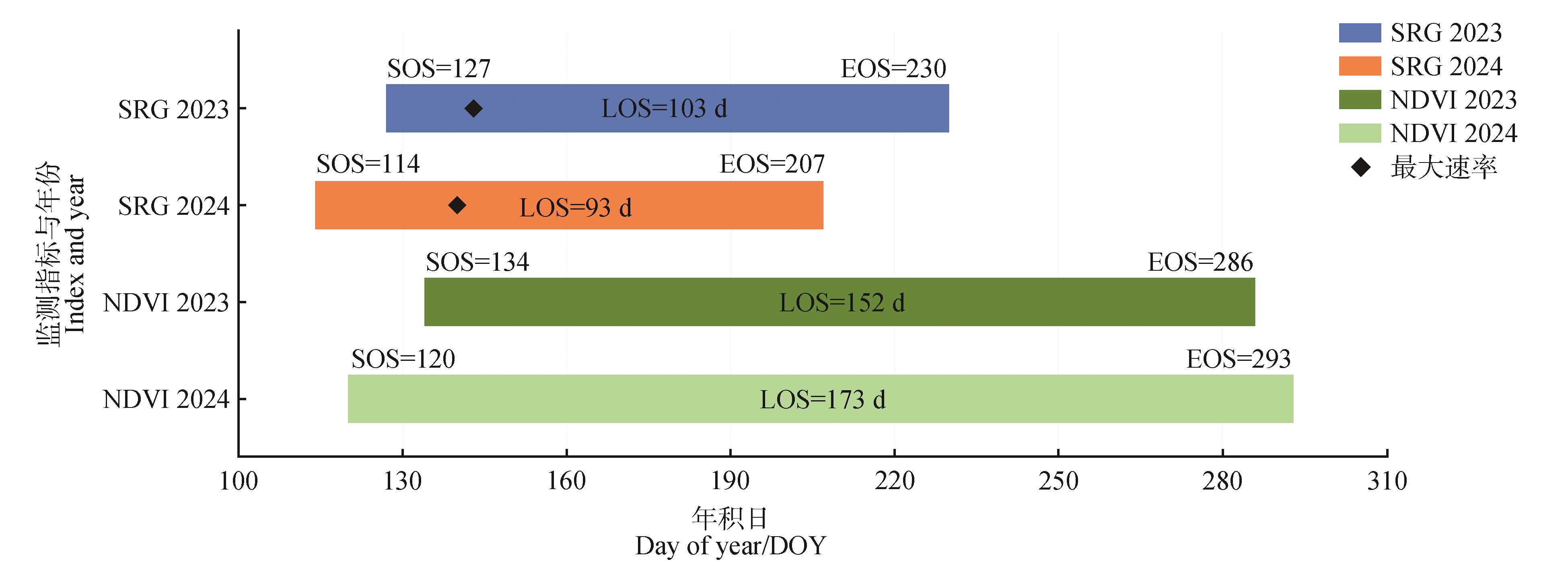
Fig.2
Comparison plot of tree growth periods of Larix gmelinii
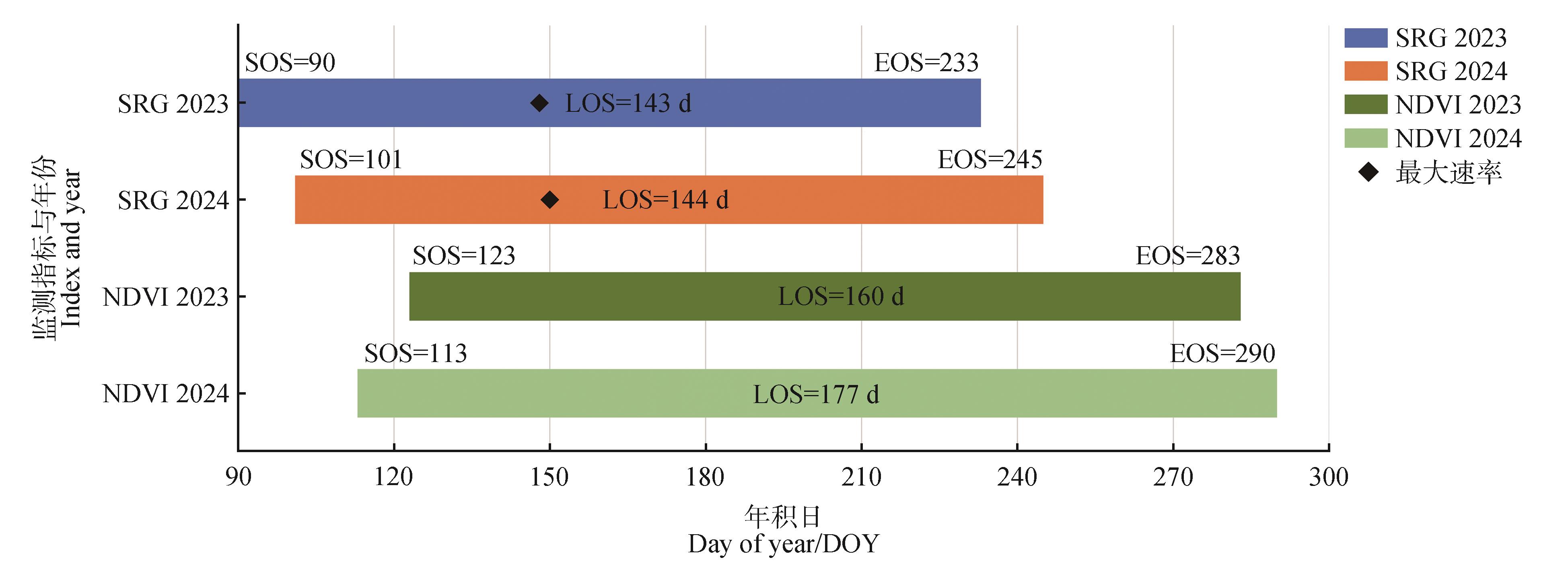

Fig.3
Correlation between radial growth and NDVI in the two tree species**.P<0.01.
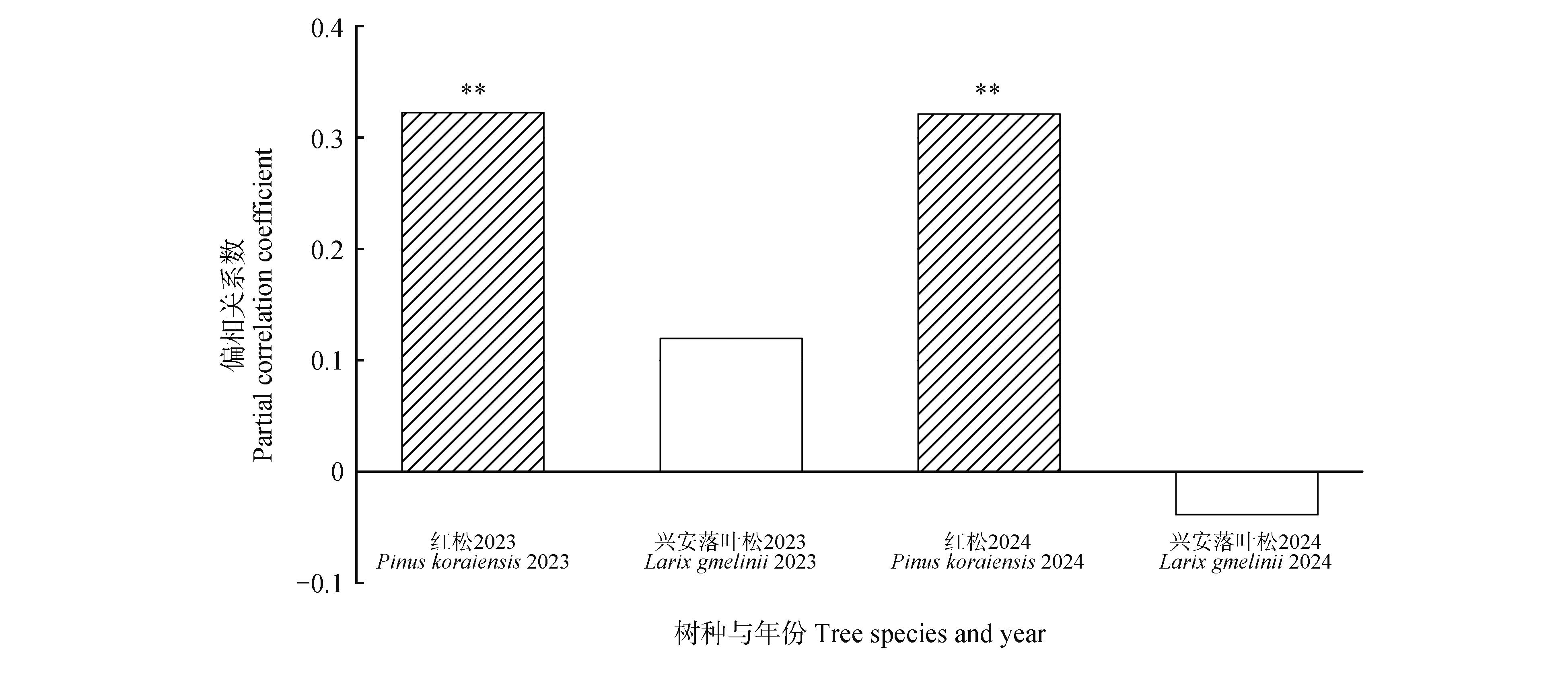
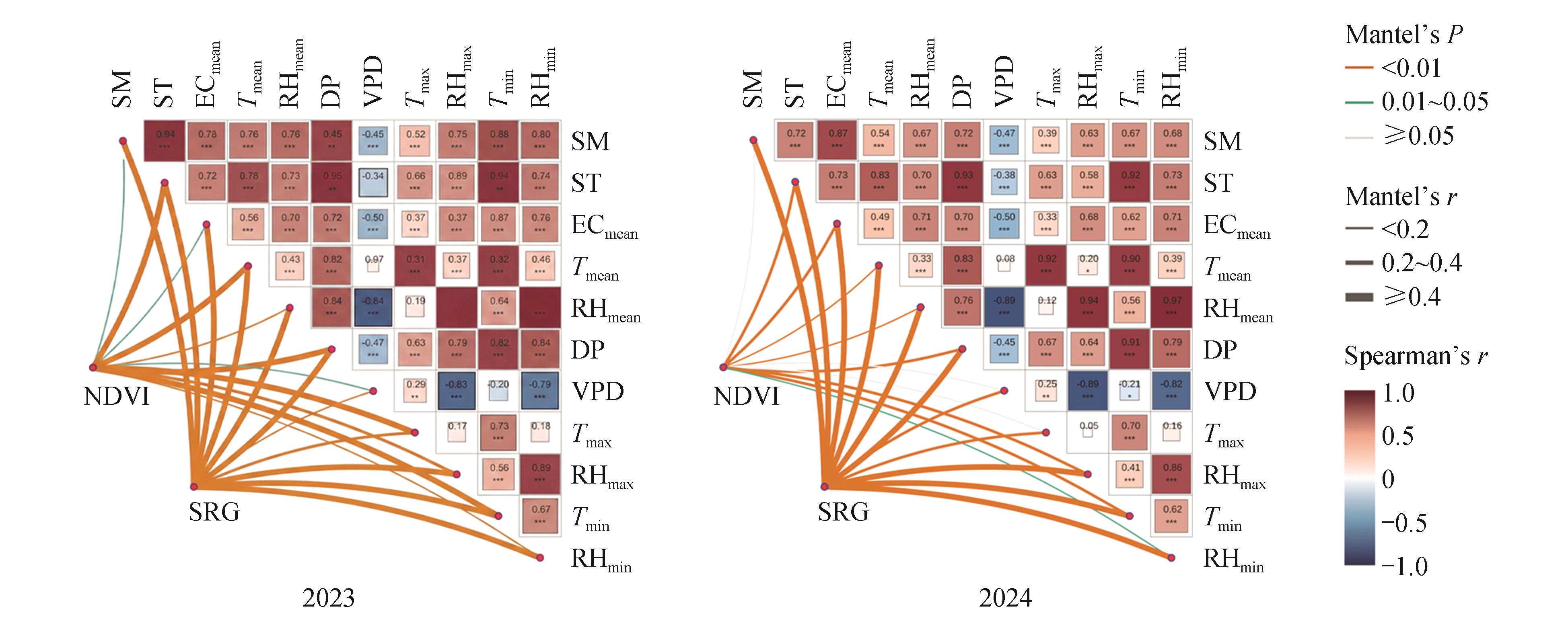
Fig.4
Heat map of Mantel test correlation between SRG,NDVI and climate factors for Pinus koraiensis in 2023 and 2024SM. Soil moisture; ST. Soil temperature; ECmean. Soil electrical conductivity; Tmean. Mean air temperature; RHmean. Mean relative humidity; DP. Dew point temperature; VPD. Saturated water vapor pressure difference; Tmax. Maximum air temperature; RHmax. Maximum relative humidity; Tmin. Minimum air temperature; RHmin. Minimum relative humidity. Mantel’s P represented the significance level of the Mantel test; edge color indicated significance (orange, P<0.01; green, 0.01≤P<0.05; gray, P≥0.05). Mantel’s r represented the Mantel correlation coefficient; edge width indicated the strength of correlation (thin, r<0.2; medium, 0.2≤r< 0.4; thick, r≥0.4). Spearman’s r represented the Spearman correlation coefficient between pairwise environmental variables in the matrix; red indicated positive correlations and blue indicated negative correlations, with color intensity reflecting the strength of the correlation. *. P<0.05; **. P<0.01; ***. P<0.001.
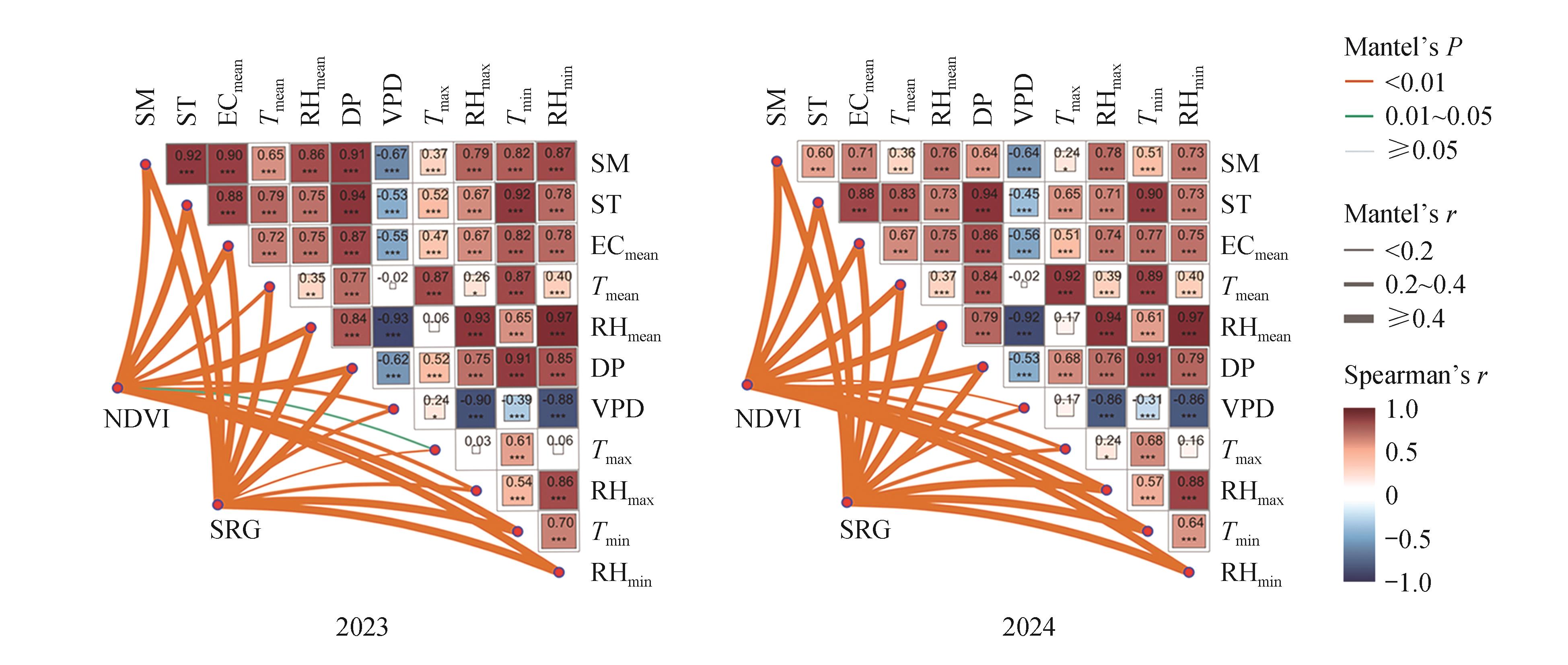
Fig.5
Heat map of Mantel test correlation between SRG,NDVI and climate factors for Larix gmelinii in 2023 and 2024Mantel’s P represented the significance level of the Mantel test; edge color indicated significance (orange, P<0.01; green, 0.01≤P<0.05; gray, P≥0.05). Mantel’s r represented the Mantel correlation coefficient; edge width indicated the strength of correlation (thin, r<0.2; medium, 0.2≤r< 0.4; thick, r≥0.4). Spearman’s r represented the Spearman correlation coefficient between pairwise environmental variables in the matrix; red indicated positive correlations and blue indicated negative correlations, with color intensity reflecting the strength of the correlation. *. P<0.05; **. P<0.01; ***. P<0.001.
| [1] | BONAN G B.Forests and climate change:forcings,feedbacks,and the climate benefits of forests[J].Science,2008,320(5882):1444-1449. |
| [2] | GREEN J K, KEENAN T F.The limits of forest carbon sequestration[J].Science,2022,376(6594):692-693. |
| [3] | DE MIL T, HUBAU W, ANGOBOY ILONDEA B,et al.Asynchronous leaf and cambial phenology in a tree species of the Congo Basin requires space-time conversion of wood traits[J].Annals of Botany,2019,124(2):245-253. |
| [4] | ZHANG T W, SONG J H, FAN Y T,et al.Vegetation index research on the basis of tree-ring data:current status and prospects[J].Forests,2023,14(10):2016. |
| [5] | CHENG C H, LEE P C, LEE H R,et al.Using homemade stainless steel dendrometer band for long term tree growth measurements[J].Botanical Studies,2023,64(1):22. |
| [6] | DREW D M, DOWNES G M.The use of precision dendrometers in research on daily stem size and wood property variation:a review[J].Dendrochronologia,2009,27(2):159-172. |
| [7] | WANG S H, ZHANG L F, HUANG C P,et al.An NDVI-based vegetation phenology is improved to be more consistent with photosynthesis dynamics through applying a light use efficiency model over boreal high-latitude forests[J].Remote Sensing,2017,9(7):695. |
| [8] | FAWCETT D, BENNIE J, ANDERSON K.Monitoring spring phenology of individual tree crowns using drone-acquired NDVI data[J].Remote Sensing in Ecology and Conservation,2021,7(2):227-244. |
| [9] | XU P P, FANG W, ZHOU T,et al.Spatial upscaling of tree-ring-based forest response to drought with satellite data[J].Remote Sensing,2019,11(20):2344. |
| [10] | BUNN A G, HUGHES M K, KIRDYANOV A V,et al.Comparing forest measurements from tree rings and a space-based index of vegetation activity in Siberia[J].Environmental Research Letters,2013,8(3):035034. |
| [11] | ANDREU-HAYLES L, D’ARRIGO R, ANCHUKAITIS K J,et al.Varying boreal forest response to Arctic environmental change at the Firth River,Alaska[J].Environmental Research Letters,2011,6(4):045503. |
| [12] | BREHAUT L, DANBY R K.Inconsistent relationships between annual tree ring-widths and satellite-measured NDVI in a mountainous subarctic environment[J].Ecological Indicators,2018,91:698-711. |
| [13] | D’ANDREA G, ŠIMŮNEK V, CASTELLANETA M,et al.Mismatch between annual tree-ring width growth and NDVI index in Norway spruce stands of Central Europe[J].Forests,2022,13(9):1417. |
| [14] | BECK P S A, ANDREU-HAYLES L, D’ARRIGO R,et al.A large-scale coherent signal of canopy status in maximum latewood density of tree rings at Arctic treeline in North America[J].Global and Planetary Change,2013,100:109-118. |
| [15] | VICENTE-SERRANO S M, CAMARERO J J, OLANO J M,et al.Diverse relationships between forest growth and the normalized difference vegetation index at a global scale[J].Remote Sensing of Environment,2016,187:14-29. |
| [16] | VICENTE-SERRANO S M, MARTÍN-HERNÁNDEZ N, CAMARERO J J,et al.Linking tree-ring growth and satellite-derived gross primary growth in multiple forest biomes.Temporal-scale matters[J].Ecological Indicators,2020,108:105753. |
| [17] | PENG D L, ZHANG B, LIU L Y,et al.Characteristics and drivers of global NDVI-based FPAR from 1982 to 2006[J].Global Biogeochemical Cycles,2012,26(3):2011GB004060. |
| [18] | VICENTE-SERRANO S M, GOUVEIA C, CAMARERO J J,et al.Response of vegetation to drought time-scales across global land biomes[J].Proceedings of the National Academy of Sciences of the United States of America,2013,110(1):52-57. |
| [19] | BHUYAN U, ZANG C, VICENTE-SERRANO S M,et al.Exploring relationships among tree-ring growth,climate variability,and seasonal leaf activity on varying timescales and spatial resolutions[J].Remote Sensing,2017,9(6):526. |
| [20] | CORREA-DÍAZ A, GÓMEZ-GUERRERO A, VARGAS-HERNÁNDEZ J J,et al.Long-term wood micro-density variation in Alpine forests at central México and their spatial links with remotely sensed information[J].Forests,2020,11(4):452. |
| [21] | NEZVAL O, KREJZA J, BELLAN M,et al.Asynchrony and time-lag between primary and secondary growth of Norway spruce growing in different elevations[J].Forests,2021,12(5):627. |
| [22] | GRIEBEL A, BENNETT L T, ARNDT S K.Evergreen and ever growing: stem and canopy growth dynamics of a temperate eucalypt forest[J].Forest Ecology and Management,2017,389:417-426. |
| [23] | ZHAO K, YUE Y J, QIN F C,et al.Carbon storage and carbon pool characteristics of Larix gmelinii forest in Daxing’anling,Inner Mongolia,China[J].Frontiers in Forests and Global Change,2024,7:1419023. |
| [24] | CHEN X, XIAO K T, DENG R X,et al.Projecting the future redistribution of Pinus koraiensis (Pinaceae:Pinoideae:Pinus) in China using machine learning[J].Frontiers in Forests and Global Change,2024,7:1326319. |
| [25] | CUI P,XV D, TANG J N,et al.Assessing the effects of urban green spaces metrics and spatial structure on LST and carbon sinks in Harbin,a cold region city in China[J].Sustainable Cities and Society,2024,113:105659. |
| [26] | DOWNES G, BEADLE C, WORLEDGE D.Daily stem growth patterns in irrigated Eucalyptus globulus and E.nitens in relation to climate[J].Trees,1999,14(2):102-111. |
| [27] | ZWEIFEL R, HAENI M, BUCHMANN N,et al.Are trees able to grow in periods of stem shrinkage?[J].New Phytologist,2016,211(3):839-849. |
| [28] | URRUTIA-JALABERT R, ROSSI S, DESLAURIERS A,et al.Environmental correlates of stem radius change in the endangered Fitzroya cupressoides forests of southern Chile[J].Agricultural and Forest Meteorology,2015,200:209-221. |
| [29] | MA J, GUO J B, WANG Y H,et al.Variations in stem radii of Larix principis-rupprechtii to environmental factors at two slope locations in the Liupan Mountains,northwest China[J].Journal of Forestry Research,2021,32(2):513-527. |
| [30] | LIU X S, NIE Y Q, WEN F.Seasonal dynamics of stem radial increment of Pinus taiwanensis Hayata and its response to environmental factors in the Lushan Mountains,southeastern China[J].Forests,2018,9(7):387. |
| [31] | YANG W, ZHANG S W.Monitoring vegetation phenology using MODIS time-series data[C]//2012 2nd International Conference on Remote Sensing,Environment and Transportation Engineering,June 1-3,2012,Nanjing,China.New York:IEEE,2012:1-4. |
| [32] | DOBBERT S, PAPE R, LÖFFLER J.Contrasting growth response of evergreen and deciduous Arctic-Alpine shrub species to climate variability[J].Ecosphere,2021,12(8):e03688. |
| [33] | KAGAWA A, SUGIMOTO A, MAXIMOV T C.Seasonal course of translocation,storage and remobilization of 13C pulse-labeled photoassimilate in naturally growing Larix gmelinii saplings[J].New Phytologist,2006,171(4):793-804. |
| [34] | KROMER B, WACKER L, FRIEDRICH M,et al.Origin and age of carbon in the cellulose of mid-latitude tree rings[J].Radiocarbon,2024,66(6):1898-1913. |
| [35] | ROSSI S, ANFODILLO T, ČUFAR K,et al.Pattern of xylem phenology in conifers of cold ecosystems at the Northern Hemisphere[J].Global Change Biology,2016,22(11):3804-3813. |
| [36] | QIAN N P, XU Z Z, SONG C J,et al.Comparing the intra-annual radial growth of three temperate species as related to leaf phenology[J].European Journal of Forest Research,2024,143(6):1657-1666. |
| [37] | RATHGEBER C B K, CUNY H E, FONTI P.Biological basis of tree-ring formation:a crash course[J].Frontiers in Plant Science,2016,7:734. |
| [38] | LIU N, WU Z T, DU Z Q,et al.Relationship between the radial growth of two dominant coniferous species and GPP in the arid region of northwest China[J].Forests,2023,14(7):1336. |
| [39] | ROSSI S, RATHGEBER C B K, DESLAURIERS A.Comparing needle and shoot phenology with xylem development on three conifer species in Italy[J].Annals of Forest Science,2009,66(2):206. |
| [40] | GALLARDO V B, HADAD M A, ROIG F A,et al.Spatio-temporal linkage variations between NDVI and tree rings on the leeward side of the northern Patagonian Andes[J].Forest Ecology and Management,2024,553:121593. |
| [41] | LANG W G, QIAN S W, CHEN X Q.Daylength predominates the bud growth initiation of winter deciduous forest trees in the monsoon region of China[J].Frontiers in Plant Science,2024,14:1327509. |
| [1] | Hairui WEN, Yuchun YANG, Yue LIU, Chunjing JIAO, Jun WANG, Fang WANG, Yelei YANG, Yitong LI, Jie WANG. Responses of Non-structural Carbohydrates and Stoichiometric Characteristics of Pinus koraiensis to Thinning [J]. Bulletin of Botanical Research, 2026, 46(2): 348-360. |
| [2] | Qingbin JIA, Xudong YAO, Guixiang JIN, Hongying YU, Yanxia LI. Genetic Variation Analysis of Radial Growth and Superior Family Selection in Korean Pine Half-Sib Families [J]. Bulletin of Botanical Research, 2026, 46(1): 158-166. |
| [3] | Nan WANG, Jingjing WANG, Chuankuan WANG, Xiankui QUAN. Responses of Water Use Efficiency in Larix gmelinii to Simulated Climate Warming [J]. Bulletin of Botanical Research, 2025, 45(5): 686-694. |
| [4] | Fang WANG, Yelei YANG, Changhua YUAN, Jun WANG, Wei WEI, Lin WU, Kuiyou LI, Kuiquan LI, Zhimin LU, Yuanxing WANG, Yuchun YANG. Variation Analysis of Growth Traits of Offspring and Superior Materials Selection of Pinus koraiensis [J]. Bulletin of Botanical Research, 2025, 45(5): 816-826. |
| [5] | Min ZHAO, Feng WANG, Jianan WANG, Qi YU, Hanguo ZHANG, Lei ZHANG. Selection of Superior Families of Larch Resistant to Pine Wood Nematode Disease [J]. Bulletin of Botanical Research, 2025, 45(5): 827-836. |
| [6] | Yanyan PAN, Xiaoguang LI, Lijun LIU, Hong LI, Xin ZHONG, Yifei ZHANG. Response of Pinus Koraiensis Growth and Rhizosphere Soil Enzyme Activity to Lepista nuda Inoculation [J]. Bulletin of Botanical Research, 2025, 45(3): 460-470. |
| [7] | Wenhui GUO, Yue WANG, Lin WU, Jianfei YANG, Ling YANG, Peng ZHANG, Haibo WU, Hailong SHEN. Effects of Exogenous Flavonoids on Embryogenic Callus Proliferation and Somatic Embryogenesis of Korean Pine [J]. Bulletin of Botanical Research, 2025, 45(1): 130-138. |
| [8] | Yitong LUAN, Niansen LI, Lujing QIAO, Cunyong JU, Tijiu CAI, Peili SUN. Niches, Interspecific Associations and Community Stability of Dominant Tree Species of Piceakoraiensis-Abies nephrolepis-Pinus koraiensis Forest [J]. Bulletin of Botanical Research, 2024, 44(5): 753-762. |
| [9] | Xuelai WANG, Xiaoting LIU, Liran WANG, Shitong LI, Taijin ZHANG, Jiafeng ZHANG, Jinghua XU, Guanzheng QU, Xiyang ZHAO. Coupling Evaluation of Growth and Wood Properties of Pinus koraiensis Half-sib Families [J]. Bulletin of Botanical Research, 2024, 44(4): 554-564. |
| [10] | Xi ZHEN, Xuyang LIU, Wenjie LI, Feng ZHANG, Yue SU, Yao XIAO, Jie ZHANG, Tao WAN. Characteristics of Apocynum venetum Community and Its Relationship to Climatic Factors [J]. Bulletin of Botanical Research, 2024, 44(3): 448-458. |
| [11] | Yuhui REN, Shuai NIE, Chunxue PENG, Ling YANG, Hailong SHEN. Effects of Hormone Combinations, Carbon Source Type and Proliferation Cycle on Embryogenic Callus Proliferation of Pinus koraiensis [J]. Bulletin of Botanical Research, 2022, 42(4): 704-712. |
| [12] | Zhi-Gang WEI, De-An XIA, Rui-Qi Wang, Yang ZHANG, Ying-Ying Liu, Ruo-Lin LI, Chuan-Ping YANG. Provenance Test of Pinus koraiensis in Different Types of Natural Secondary Forests in Xiaoxing’an Mountains [J]. Bulletin of Botanical Research, 2021, 41(5): 807-815. |
| [13] | Fang WANG, Zhi-Min LU, Jun WANG, Shi-Kai ZHANG, Yu-Xi LI, Shao-Chen LI, Jian-Qiu ZHANG, Yu-Chun YANG. Photosynthetic and Stomatal Characteristics of Pinus koraiensis and P.sibirica under Low Temperature Stress [J]. Bulletin of Botanical Research, 2021, 41(2): 205-212. |
| [14] | LI Xiang, FAN Zuo-Yi, WANG Jing-Yuan, WANG Qi, LI Xi-Peng, WANG De-Qiu, KONG Ling-Yuan, CAO Sen-Lin, MENG Qing-Gang, ZHAO Xi-Yang. Codon Usage Bias of Chalcone Synthase Gene CHS in Pinus koraiensis [J]. Bulletin of Botanical Research, 2020, 40(3): 447-457. |
| [15] | ZHOU Xue-Yan, GAO Hai-Yan, LI Zhao-Min, ZHAO Yin-Kun, GE Li-Li, HOU Qing-Wen, DING Wen-Ya, ZHAO Xi-Yang. Evaluating Parents of Pinus koraiensis Seeds Orchard with Growth and Fruiting [J]. Bulletin of Botanical Research, 2020, 40(3): 376-385. |
| Viewed | ||||||
|
Full text |
|
|||||
|
Abstract |
|
|||||