Bulletin of Botanical Research ›› 2025, Vol. 45 ›› Issue (6): 873-887.doi: 10.7525/j.issn.1673-5102.2025.06.005
• Original Paper • Previous Articles
Jiahuan LI1, Qingqing ZHENG2, Rongrong GUAN2, Yuping LIU1, Xu SU1, Faqi ZHANG2,3( )
)
Received:2025-03-28
Online:2025-11-20
Published:2025-11-27
Contact:
Faqi ZHANG
E-mail:fqzhang@nwipb.cas.cn
CLC Number:
Jiahuan LI, Qingqing ZHENG, Rongrong GUAN, Yuping LIU, Xu SU, Faqi ZHANG. Structure Characterization and Phylogeny of Chloroplast Genomes in Tamaricaceae[J]. Bulletin of Botanical Research, 2025, 45(6): 873-887.
Add to citation manager EndNote|Ris|BibTeX
URL: https://bbr.nefu.edu.cn/EN/10.7525/j.issn.1673-5102.2025.06.005
Table 1
Species collection information
物种 Species | 属 Genus | 采集地 Locality | 地理坐标 Geographical coordinates | 凭证标本 Voucher |
|---|---|---|---|---|
甘蒙柽柳 Tamarix austromongolica | 柽柳属 Tamarix | 青海德令哈 Delingha,Qinghai | 37°37′N,96°58′E | QXA0075 |
多枝柽柳 Tamarix ramosissima | 柽柳属 Tamarix | 青海德令哈 Delingha,Qinghai | 37°37′N,96°58′E | QXA0176 |
密花柽柳 Tamarix arceuthoides | 柽柳属 Tamarix | 青海都兰 Dulan,Qinghai | 35°53′N,98°7′E | QXA0191 |
沙生柽柳* Tamarix taklamakanensis | 柽柳属 Tamarix | 新疆塔克拉玛干沙漠 Taklimakan Desert,Xinjiang | 38°12′N,80°45′E | TD-04001 |
匍匐水柏枝 Myricaria prostrata | 水柏枝属 Myricaria | 青海都兰 Dulan,Qinghai | 35°53′N,98°7′E | QXA0269 |
宽苞水柏枝 Myricaria bracteata | 水柏枝属 Myricaria | 青海乌兰 Wulan,Qinghai | 36°45′N,98°11′E | QXA0346 |
红砂 Reaumuria songarica | 红砂属 Reaumuria | 青海都兰 Dulan,Qinghai | 36°33′N,98°40′E | QXA0436 |
五柱红砂 Reaumuria kaschgarica | 红砂属 Reaumuria | 青海格尔木 Geermu,Qinghai | 37°8′N,92°38′E | QXA160727002 |
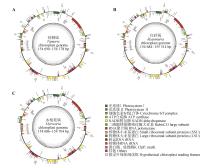
Fig.1
Chloroplast genome ring map of the species in Tamaricaceae
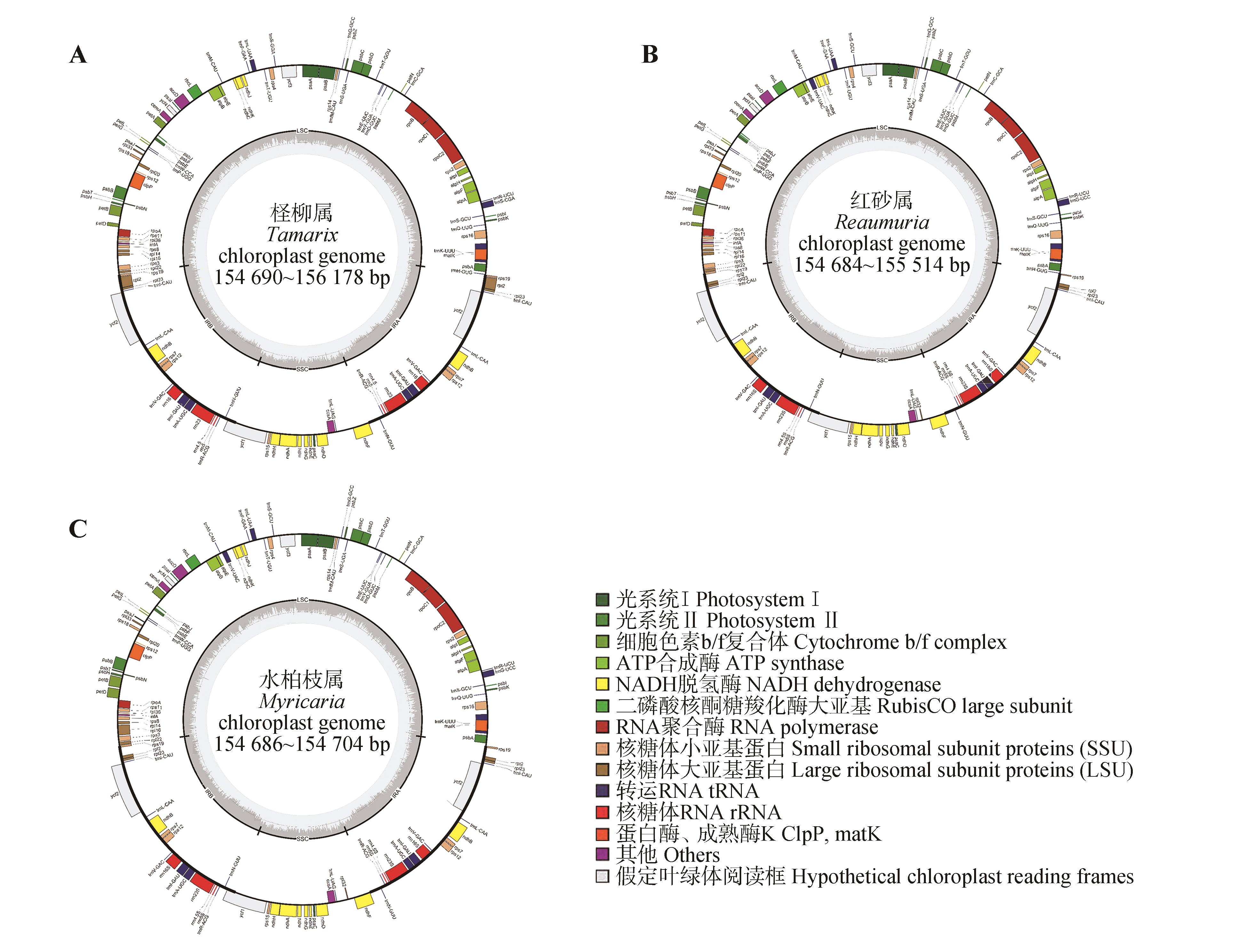
Table 2
Structure information of chloroplast genomes in 10 species of Tamaricaceae
物种 Species | 长度 Length/bp | 基因数量 Number of gene | ||||||
|---|---|---|---|---|---|---|---|---|
长单 拷贝区 LSC | 短单 拷贝区 SSC | 反向 重复区 IR | 叶绿体基因组 Chloroplast genome | 转运RNA tRNA | 核糖体RNA rRNA | 蛋白编码基因 Protein-coding gene | 总数 Total | |
| 盐地柽柳 Tamarix karelinii* | 84 787 | 18 247 | 26 571 | 156 176 | 36(29) | 10(4) | 84(77) | 130(110) |
| 短穗柽柳 Tamarix laxa* | 84 781 | 18 260 | 26 561 | 156 163 | 36(29) | 10(4) | 84(77) | 130(110) |
| 沙生柽柳 Tamarix taklamakanensis* | 84 778 | 18 257 | 26 571 | 156 177 | 36(29) | 10(4) | 81(75) | 127(108) |
| 密花柽柳 Tamarix arceuthoides | 84 766 | 18 247 | 26 575 | 156 163 | 36(28) | 10(4) | 84(77) | 130(109) |
| 甘蒙柽柳 Tamarix austromongolica | 84 379 | 18 303 | 26 004 | 154 690 | 36(28) | 10(4) | 85(78) | 131(110) |
| 多枝柽柳 Tamarix ramosissima | 84 802 | 18 254 | 26 561 | 156 178 | 37(29) | 10(4) | 85(78) | 132(111) |
| 宽苞水柏枝 Myricaria bracteata | 84 374 | 18 304 | 26 004 | 154 686 | 36(28) | 10(4) | 85(78) | 131(110) |
| 匍匐水柏枝 Myricaria prostrata | 84 380 | 18 308 | 26 008 | 154 704 | 36(28) | 10(4) | 85(78) | 131(110) |
| 五柱红砂 Reaumuria kaschgarica | 85 859 | 17 571 | 26 042 | 155 514 | 37(29) | 10(4) | 86(79) | 133(112) |
| 红砂 Reaumuria songarica | 85 046 | 17 540 | 26 031 | 154 684 | 37(29) | 10(4) | 85(78) | 132(111) |
Table 3
Chloroplast genome encoding genes of the species in Tamaricaceae
类别 Category | 分组 Group | 基因名称 Gene name | 总数 Total |
|---|---|---|---|
自我复制相关基因 Self-replication related genes | 转运RNA tRNA | trnA-UGC*、trnC-GCA、trnD-GUC、trnE-UUC、trnF-GAA、trnM-CAU、trnG-GCC、trnG-UCC、trnH-GUG、trnI-CAU*、trnI-GAU*、trnK-UUU、trnL-CAA*、trnL-UAA、trnL-UAG、trnM-CAU、trnN-GUU*、trnP-UGG、trnQ-UUG、trnR-ACG*、trnR-UCU、trnS-CGA、trnS-GCU*、trnS-GGA、trnS-UGA、trnT-GGU、trnT-UGU、trnV-GAC* | 28 |
核糖体RNA rRNA | rrn4.5*、rrn5*、rrn16**、rrn23* | 4 | |
核糖体大亚基 Large ribosomal subunit | rpl32、rpl33、rpl20、rpl16、rpl22、rpl14、rpl2*、rpl23*、rpl36 | 9 | |
核糖体小亚基 Small ribosomal subunit | rps4、rps11、rps12*、rps3、rps15、rps7*、rps14、rps18、rps16、rps2、rps19*、rps8 | 12 | |
DNA依赖性RNA聚合酶 DNA dependent RNA polymerase | rpoA、rpoC2、rpoC1、rpoB | 4 | |
光合相关基因 Photosynthesis related genes | NADH脱氢酶亚基 NADH-dehydrogenase subunit | ndhD、ndhA、ndhI、ndhE、ndhH、ndhF、ndhG、ndhJ、ndhC、ndhK、ndhB* | 11 |
二磷酸核酮糖氧合酶/羧化酶大亚基 RubisCO large subunit | rbcL | 1 | |
ATP合成酶亚基 ATP synthase subunit | atpA、atpE、atpH、atpF、atpI、atpB | 6 | |
光系统Ⅰ亚基 PhotosystemⅠsubunit | psaI、psaJ、psaA、psaC、psaB | 5 | |
光系统Ⅱ亚基 Photosystem Ⅱ subunit | psbB、psbE、psbL、psbC、psbZ、psbF、psbH、psbN、psbK、psbI、psbJ、psbM、psbA、psbT、psbD | 15 | |
细胞色素b/f复合物亚基 Cytochrome b/f complex subunit | petB、petA、petG、petL、petN、petD | 6 | |
其他基因 Other genes | C型细胞色素合成 C-type cytochrome synthesis | ccsA | 1 |
翻译起始因子 Translation initiation factor | infA | 1 | |
乙酰辅酶A羧化酶亚基 Acetyl-CoA carboxylase subunit | accD | 1 | |
成熟酶K Maturase K | matK | 1 | |
蛋白酶 Protease | clpP | 1 | |
包裹膜蛋白 Envelop membrane protein | cemA | 1 | |
未知功能基因 Genes of unknown function | 假定叶绿体阅读框 Hypothetical chloroplast reading frame | ycf3、ycf4、ycf2*、ycf1 | 4 |
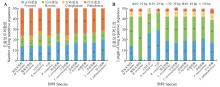
Fig.2
Long repetitive sequences of chloroplast of 10 species in TamaricaceaeA.Number of long repetitive sequences; B.Length of long repetitive sequences.
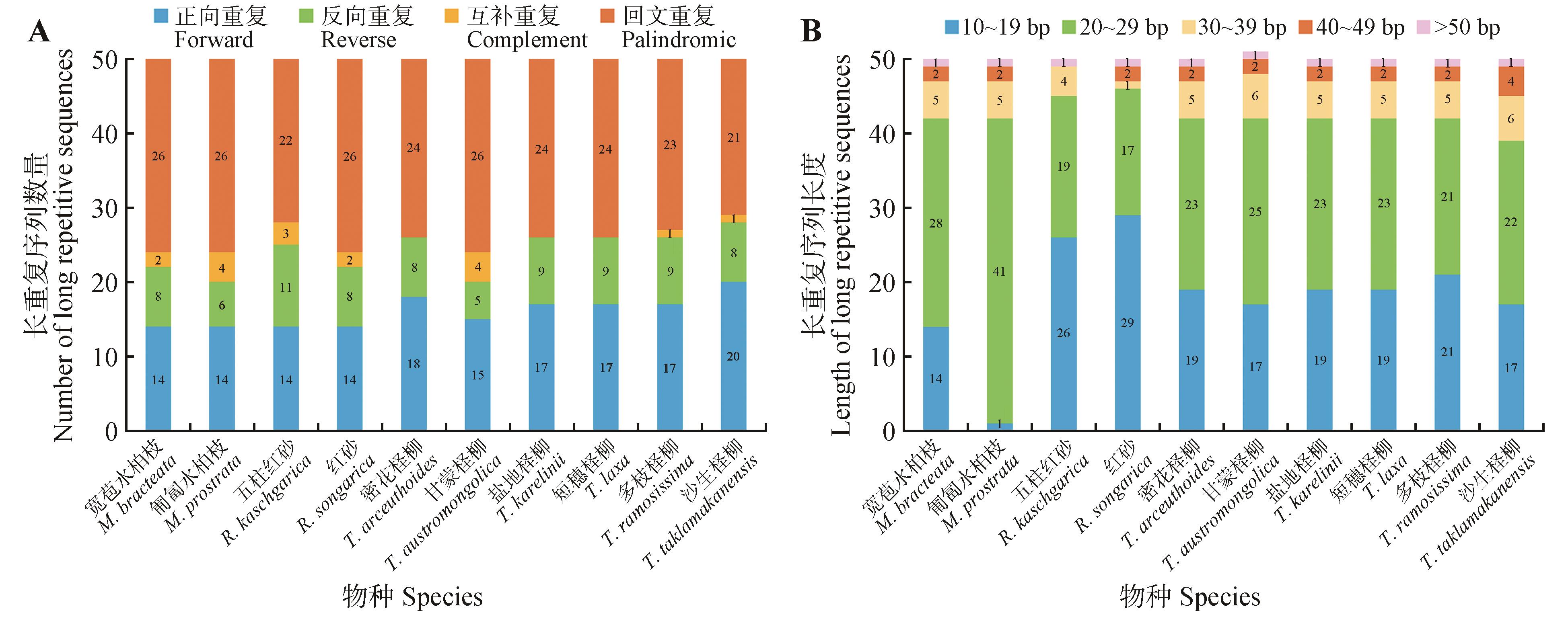
Table 4
Chloroplast genome SSR type in ten species of Tamaricaceae
物种 Species | SSR类型 SSR type | ||
|---|---|---|---|
| A/T | C/G | AT/AT | |
| 盐地柽柳 T. karelinii | 40 | 0 | 3 |
| 短穗柽柳 T. laxa | 44 | 0 | 3 |
| 沙生柽柳 T. taklamakanensis | 40 | 0 | 4 |
| 密花柽柳 T. arceuthoides | 25 | 0 | 2 |
| 甘蒙柽柳 T. austromongolica | 36 | 2 | 2 |
| 多枝柽柳 T. ramosissima | 41 | 0 | 3 |
| 宽苞水柏枝 M. bracteata | 44 | 0 | 6 |
| 匍匐水柏枝 M. prostrata | 36 | 0 | 3 |
| 五柱红砂 R. kaschgarica | 48 | 0 | 6 |
| 红砂 R. songarica | 46 | 0 | 6 |
Fig.3
Comparison of chloroplast genomes of the species in Tamaricaceae
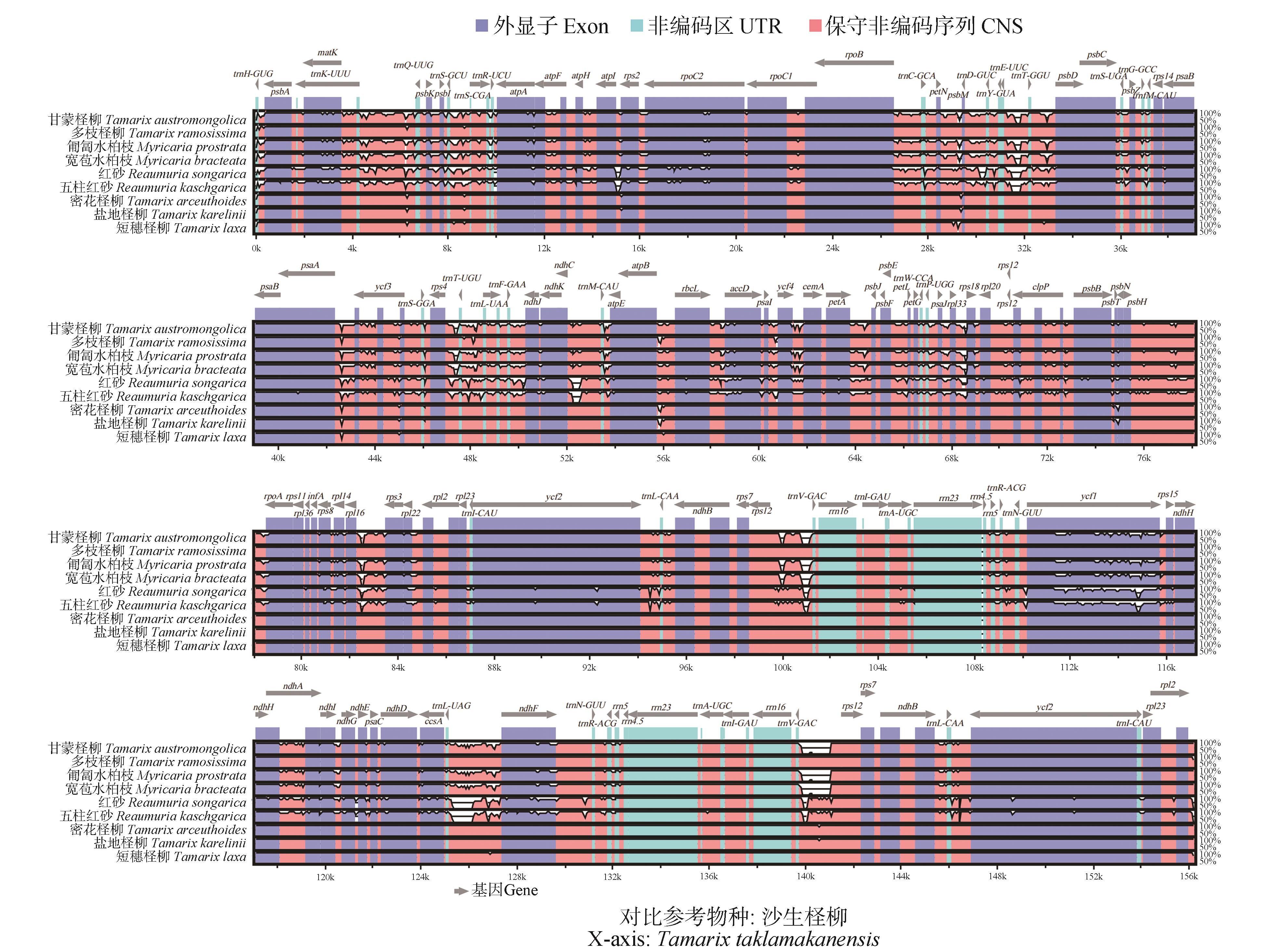
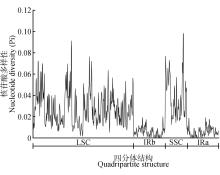
Fig.4
Nucleotide diversity of chloroplast genomes of the species in Tamaricaceae
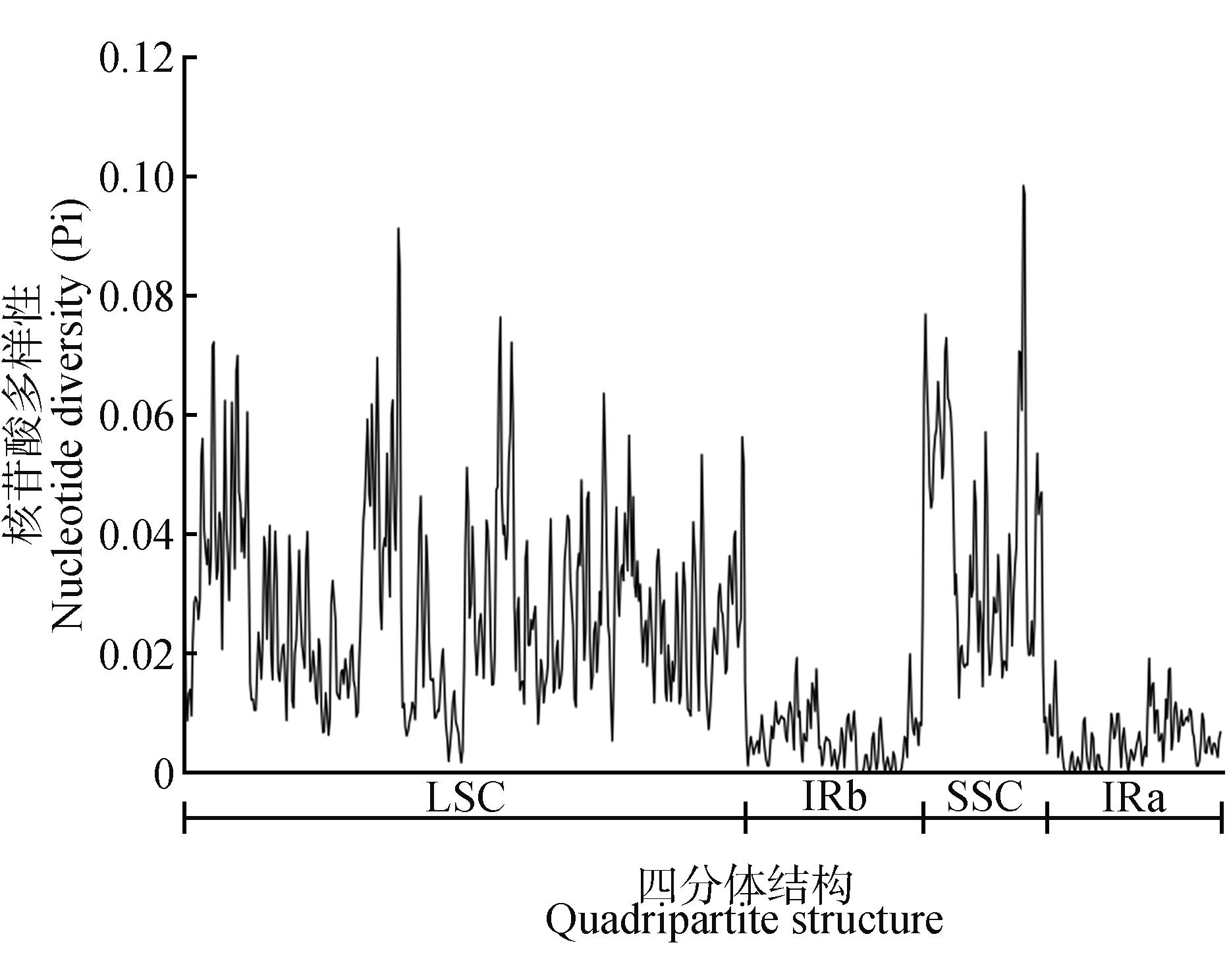
Fig.5
Comparison of chloroplast genome zonal linkages of 10 species in Tamaricaceae
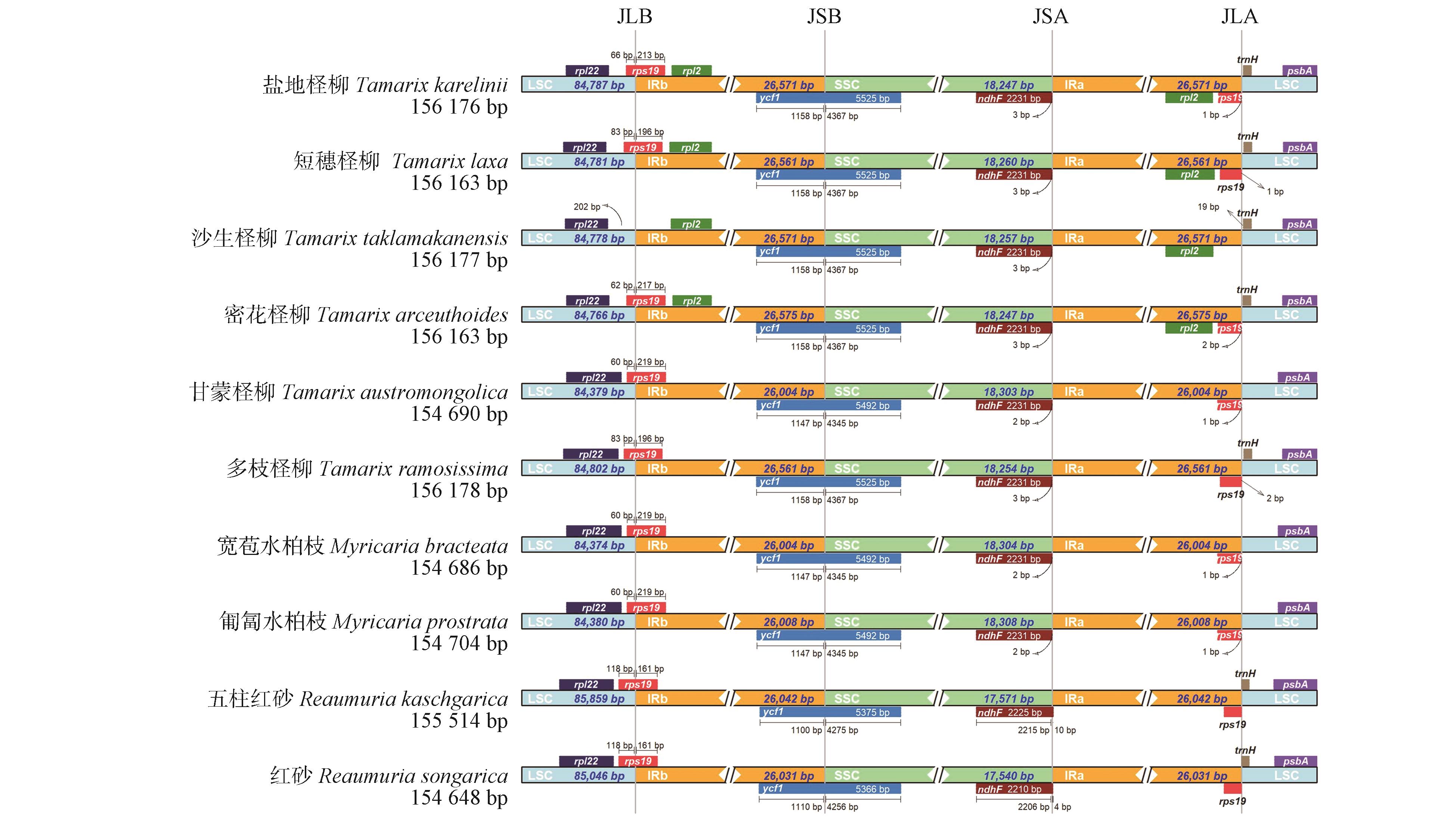
Table 5
Codon preference of chloroplast protein coding genes of 10 species of in Tamaricaceae
物种 Species | 有效密码 子数目 ENc | 密码子 适应指数 CAI | 密码子 偏好指数 CBI | 最优密码子 使用频率 FOP | 同义第三密码子胸腺嘧啶含量 T3s | 同义第三密 码子胞嘧啶 含量 C3s | 同义第三密 码子腺嘌呤 含量 A3s | 同义第三密 码子鸟嘌呤 含量 G3s |
|---|---|---|---|---|---|---|---|---|
| 盐地柽柳 T. karelinii | 54.841 | 0.160 | 0.223 | 0.354 | 0.409 2 | 0.232 6 | 0.414 4 | 0.224 1 |
| 短穗柽柳 T. laxa | 55.359 | 0.158 | 0.200 | 0.358 | 0.404 3 | 0.242 7 | 0.399 4 | 0.232 5 |
| 沙生柽柳 T. taklamakanensis | 55.147 | 0.160 | 0.215 | 0.355 | 0.414 2 | 0.236 3 | 0.401 5 | 0.230 0 |
| 密花柽柳 T. arceuthoides | 55.285 | 0.157 | 0.206 | 0.356 | 0.410 3 | 0.238 5 | 0.400 7 | 0.230 2 |
| 甘蒙柽柳 T. austromongolica | 55.143 | 0.160 | 0.216 | 0.355 | 0.413 2 | 0.230 3 | 0.405 1 | 0.231 3 |
| 多枝柽柳 T. ramosissima | 54.960 | 0.160 | 0.221 | 0.357 | 0.404 5 | 0.240 3 | 0.399 6 | 0.239 5 |
| 宽苞水柏枝 M. bracteata | 55.607 | 0.156 | 0.203 | 0.354 | 0.406 6 | 0.239 0 | 0.399 4 | 0.237 6 |
| 匍匐水柏枝 M. prostrata | 55.432 | 0.158 | 0.204 | 0.354 | 0.407 2 | 0.235 3 | 0.401 6 | 0.235 4 |
| 五柱红砂 R. kaschgarica | 55.361 | 0.161 | 0.204 | 0.355 | 0.409 9 | 0.235 1 | 0.403 0 | 0.235 3 |
| 红砂 R. songarica | 55.644 | 0.162 | 0.193 | 0.359 | 0.405 6 | 0.244 6 | 0.396 6 | 0.238 4 |
Table 6
GC content of chloroplast genomes in 10 species in Tamaricaceae
物种 Species | 第一密码子GC含量 GC1 content/% | 第二密码子GC含量 GC2 content/% | 第三密码子GC含量 GC3 content/% | 总GC含量 GC content/% |
|---|---|---|---|---|
| 盐地柽柳 T. karelinii | 45.17 | 37.85 | 28.41 | 37.15 |
| 短穗柽柳 T. laxa | 45.18 | 37.83 | 28.44 | 37.15 |
| 沙生柽柳 T. taklamakanensis | 45.07 | 37.82 | 28.51 | 37.13 |
| 密花柽柳 T. arceuthoides | 45.18 | 37.85 | 28.41 | 37.15 |
| 甘蒙柽柳 T. austromongolica | 45.05 | 37.62 | 28.22 | 36.96 |
| 多枝柽柳 T. ramosissima | 45.04 | 37.68 | 28.35 | 37.03 |
| 宽苞水柏枝 M. bracteata | 45.03 | 37.62 | 28.23 | 36.96 |
| 匍匐水柏枝 M. prostrata | 45.05 | 37.62 | 28.22 | 36.96 |
| 五柱红砂 R. kaschgarica | 45.21 | 37.70 | 29.11 | 37.34 |
| 红砂 R. songarica | 45.20 | 37.66 | 29.06 | 37.31 |
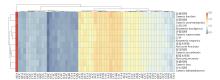
Fig.6
Heat map of relative synonymous codon usage(RSCU)values of chloroplast genome of 10 species in Tamaricaceae
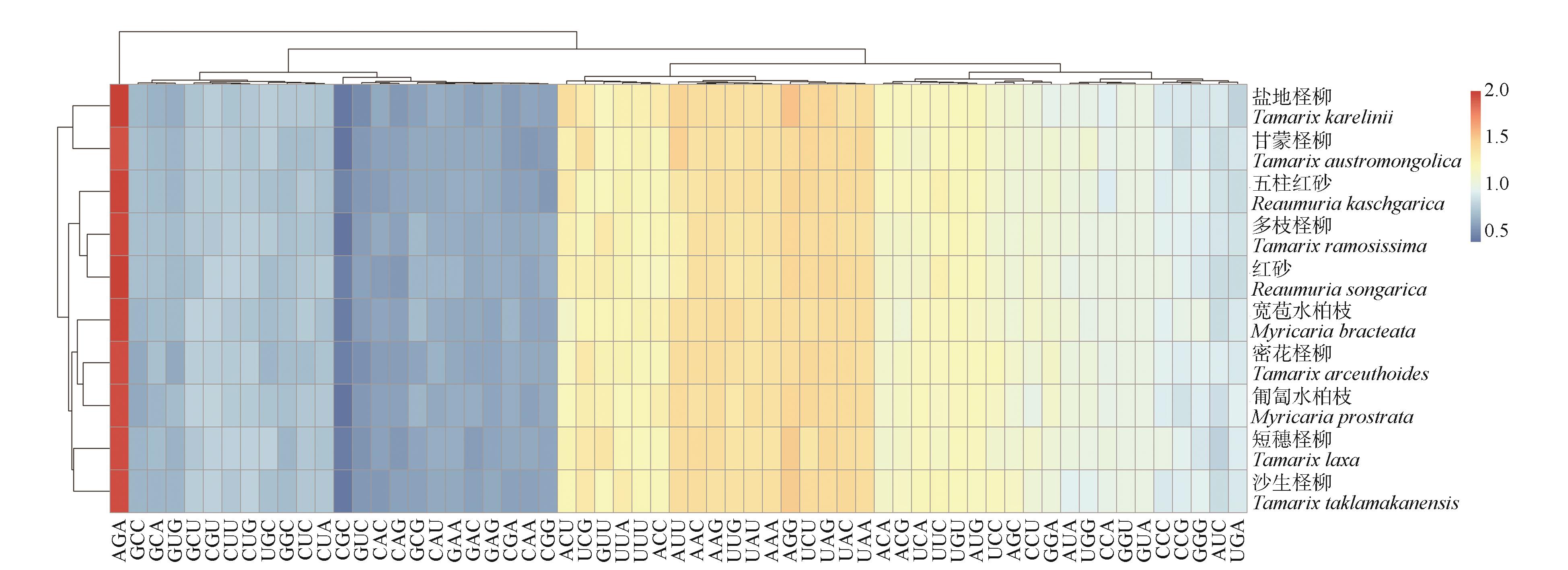
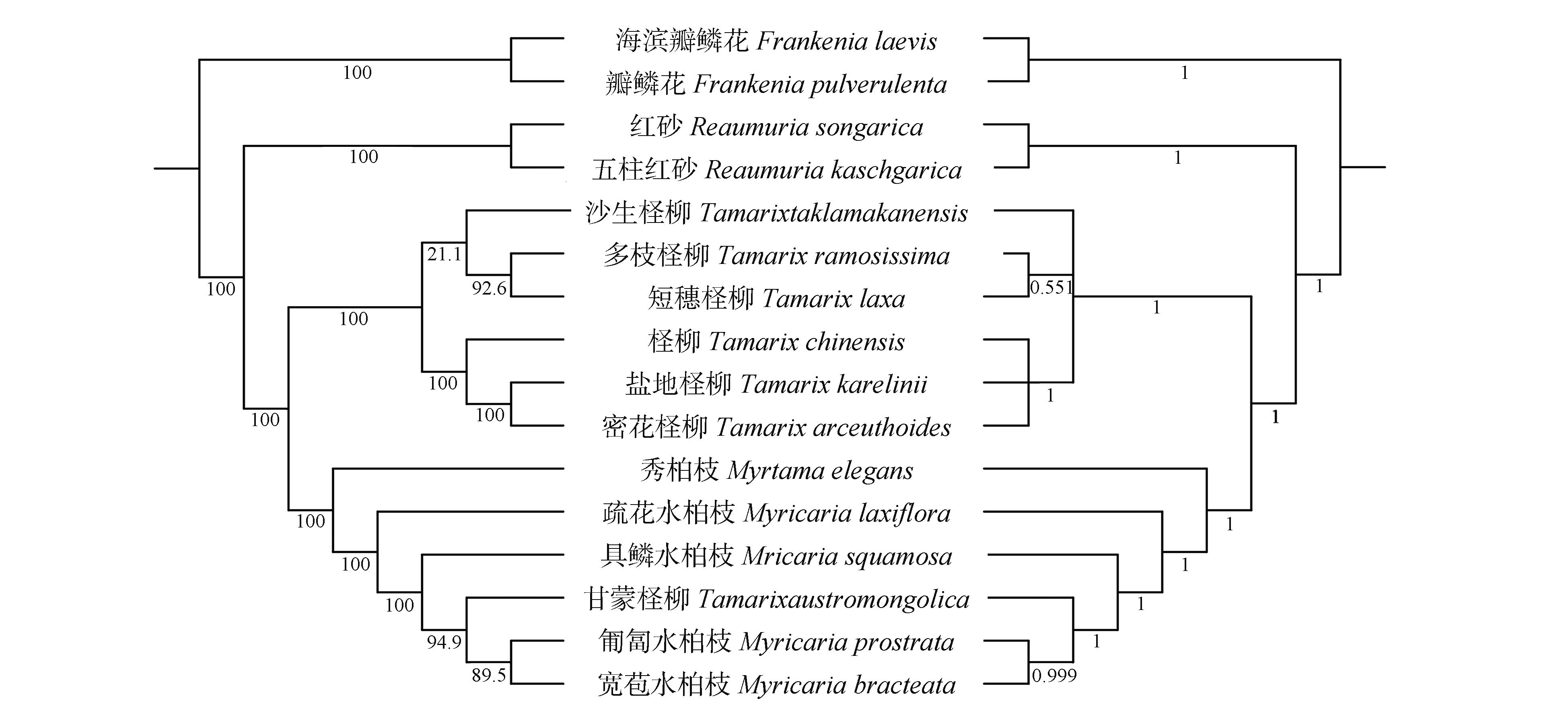
Fig.7
Phylogenetic relationships of Tamaricaceae based on the concatenate sequences of CDS
| [1] | 张韵洁,李德铢.叶绿体系统发育基因组学的研究进展[J].植物分类与资源学报,2011,33(4):365-375. |
| ZHANG Y J, LI D Z.Advances in phylogenomics based on complete chloroplast genomes[J].Plant Diversity and Resources,2011,33(4):365-375. | |
| [2] | O’NEILL S L, GIORDANO R, COLBERT A M,et al.16S rRNA phylogenetic analysis of the bacterial endosymbionts associated with cytoplasmic incompatibility in insects[J].Proceedings of the National Academy of Sciences of the United States of America,1992,89(7):2699-2702. |
| [3] | PURKHOLD U, POMMERENING-RÖSER A, JURETSC-HKO S,et al.Phylogeny of all recognized species of ammonia oxidizers based on comparative 16S rRNA and amoA sequence analysis:implications for molecular diversity surveys[J].Applied and Environmental Microbiology,2000,66(12):5368-5382. |
| [4] | HEDGES S B, MOBERG K D, MAXSON L R.Tetrapod phylogeny inferred from 18S and 28S ribosomal RNA sequences and a review of the evidence for amniote relationships[J].Molecular Biology and Evolution,1990,7(6):607-633. |
| [5] | SNEL B, BORK P, HUYNEN M A.Genome phylogeny based on gene content[J].Nature Genetics,1999,21(1):108-110. |
| [6] | MORET B M E, WANG L S, WARNOW T,et al.New approaches for reconstructing phylogenies from gene order data[J].Bioinformatics,2001,17(Sup.1):S165-S173. |
| [7] | SEMPLE C, STEEL M.A supertree method for rooted trees[J].Discrete Applied Mathematics,2000,105(1/2/3):147-158. |
| [8] | 李建伏,郭茂祖.系统发生树构建技术综述[J].电子学报,2006,34(11):2047-2052. |
| LI J F, GUO M Z.A review of phylogenetic tree reconstruction technology[J].Acta Electronica Sinica,2006,34(11):2047-2052. | |
| [9] | 于黎,张亚平.系统发育基因组学:重建生命之树的一条迷人途径[J].遗传,2006,28(11):1445-1450. |
| YU L, ZHANG Y P.Phylogenomics:an attractive avenue to reconstruct “Tree of Life”[J].Hereditas(Beijing),2006,28(11):1445-1450. | |
| [10] | ZUNTINI A R, CARRUTHERS T, MAURIN O,et al.Phylogenomics and the rise of the angiosperms[J].Nature,2024,629(8013):843-850. |
| [11] | WANG X X, HUANG C H, MORALES-BRIONES D F,et al.Phylotranscriptomics reveals the phylogeny of Asparagales and the evolution of allium flavor biosynthesis[J].Nature Communications,2024,15(1):9663. |
| [12] | ZHOU X K, FAN H Y, FENG X Y,et al.PGCP:a comprehensive database of plant genomes for comparative phylogenomics[J].Plant Biotechnology Journal,2025,23(7):2928-2930. |
| [13] | 邹新慧,葛颂.基因树冲突与系统发育基因组学研究[J].植物分类学报,2008,46(6):795-807. |
| ZOU X H, GE S.Conflicting gene trees and phylogenomics[J].Journal of Systematics and Evolution,2008,46(6):795-807. | |
| [14] | MOORE M J, SOLTIS P S, BELL C D,et al.Phylogenetic analysis of 83 plastid genes further resolves the early diversification of eudicots[J].Proceedings of the National Academy of Sciences of the United States of America,2010,107(10):4623-4628. |
| [15] | LI H T, LUO Y, GAN L,et al.Plastid phylogenomic insights into relationships of all flowering plant families[J].BMC Biology,2021,19(1):232. |
| [16] | LI H T, YI T S, GAO L M,et al.Origin of angiosperms and the puzzle of the Jurassic gap[J].Nature Plants,2019,5(5):461-470. |
| [17] | MA H, LIU Z Q, LAN W X,et al.Complete chloroplast genomes of 9 Impatiens species:genome structure,comparative analysis,and phylogenetic relationships[J].International Journal of Molecular Sciences,2025,26(2): 536. |
| [18] | 王飞,赵文植,董章宏,等.丝兰属6种植物叶绿体基因组特征分析[J].植物研究,2023,43(1):109-119. |
| WANG F, ZHAO W Z, DONG Z H,et al.Analysis of the chloroplast genome characteristics of 6 species of Yucca [J].Bulletin of Botanical Research,2023,43(1):109-119. | |
| [19] | 张妍彤,黄剑,宋菊,等.壳斗科植物叶绿体基因组结构及变异分析[J].植物研究,2018,38(5):757-765. |
| ZHANG Y T, HUANG J, SONG J,et al.Structure and variation analysis of chloroplast genomes in Fagacea[J].Bulletin of Botanical Research,2018,38(5):757-765. | |
| [20] | 苏丹丹,刘玉萍,刘涛,等.苦马豆叶绿体基因组结构及其特征分析[J].植物研究,2022,42(3):446-454. |
| SU D D, LIU Y P, LIU T,et al.Structure of chloroplast genome and its characteristics of Sphaerophysa salsula [J].Bulletin of Botanical Research,2022,42(3):446-454. | |
| [21] | DANIELL H, JIN S X, ZHU X G,et al.Green giant:a tiny chloroplast genome with mighty power to produce high-value proteins:history and phylogeny[J].Plant Biotechnology Journal,2021,19(3):430-447. |
| [22] | 张鹏云,张耀甲.中国植物志[M].北京:科学出版社,1979,50(2):142-143. |
| ZHANG P Y, ZHANG Y J.Flora of China[M].Beijing:Science Press,1979,50(2):142-143. | |
| [23] | 种培芳,苏世平,李毅.4个地理种群红砂的抗旱性综合评价[J].草业学报,2011,20(5):26-33. |
| ZHONG P F, SU S P, LI Y.Comprehensive evaluation of drought resistance of Reaumuria soongorica from four geographical populations[J].Acta Prataculturae Sinica,2011,20(5):26-33. | |
| [24] | 蒋进,高海峰.柽柳属植物抗旱性排序研究[J].干旱区研究,1992(4):41-45. |
| JIANG J, GAO H F.A study on drought resistant ordination of Tamarix L.[J].Arid Zone Research,1992(4):41-45. | |
| [25] | 王雲霞,单立山,解婷婷,等.干旱-复水对红砂幼苗各器官非结构性碳水化合物的影响[J].生态学杂志,2024,43(2):383-394. |
| WANG Y X, SHAN L S, XIE T T,et al.The effects of drought-rehydration on non-structural carbohydrates in Reaumuria soongorica seedlings[J].Chinese Journal of Ecology,2024,43(2):383-394. | |
| [26] | SUN T T, SU Z H, WANG R,et al.Transcriptome and metabolome analysis reveals the molecular mechanisms of Tamarix taklamakanensis under progressive drought and rehydration treatments[J].Environmental and Experimental Botany,2022,195:104766. |
| [27] | 王红宝,郑伶杰,丁丁,等.7种柽柳属植物对NaCl胁迫的生长生理响应与耐盐性差异[J].山东农业科学,2022,54(11):31-38. |
| WANG H B, ZHENG L J, DING D,et al.Growth and physiological response to NaCl stress and salt tolerance differences of seven Tamarix Linn. species[J].Shandong Agricultural Sciences,2022,54(11):31-38. | |
| [28] | 张元明,潘伯荣,尹林克.中国柽柳科(Tamaricaceae)花粉形态研究及其分类意义的探讨[J].西北植物学报,2001,21(5):857-864. |
| ZHANG Y M, PAN B R, YIN L K.Pollen morphology of the Tamaricaceae from China and its taxonomic significance[J].Acta Botanica Boreali-Occidentalia Sinica,2001,21(5):857-864. | |
| [29] | 张元明.中国柽柳科植物花粉形态特征聚类分析[J].西北植物学报,2004,24(9):1702-1707. |
| ZHANG Y M.Cluster analysis on pollen morphology of the Tamaricaceae from China[J].Acta Botanica Boreali-Occidentalia Sinica,2004,24(9):1702-1707. | |
| [30] | 张道远,陈之端,孙海英,等.用核糖体DNA的ITS序列探讨中国柽柳科植物系统分类中的几个问题[J].西北植物学报,2000,20(3):421-431. |
| ZHANG D Y, CHEN Z D, SUN H Y,et al.Systematic studies on some questions of Tamaricaceae based on ITS sequence[J].Acta Botanica Boreali-Occidentalia Sinica,2000,20(3):421-431. | |
| [31] | 魏岩,谭敦炎,尹林克.中国柽柳科植物叶解剖特征与分类关系的探讨[J].西北植物学报,1999,19(1):113-118. |
| WEI Y, TAN D Y, YIN L K.The discussions on the anatomical structure of leaf and ITS taxonomic relationship of Tamaricaceae in China[J].Acta Botanica Boreali-Occidentalia Sinica,1999,19(1):113-118. | |
| [32] | 张鹏云,刘名庭.中国的柽柳属植物研究简史[J].干旱区研究,1988,5(3):20-26. |
| ZHANG P Y, LIU M T.A brief history of research on Tamarix plants in China[J].Arid Zone Research,1988,5(3):20-26. | |
| [33] | 师亚婷,单立山,解婷婷,等.干旱胁迫下红砂幼苗非结构性碳水化合物动态变化特征[J].西北植物学报,2023,43(1):116-126. |
| SHI Y T, SHAN L S, XIE T T,et al.Dynamic changes of non-structural carbohydrate in Reaumuria soongorica seedlings under drought stress[J].Acta Botanica Boreali-Occidentalia Sinica,2023,43(1):116-126. | |
| [34] | WEI X C, YAN X, YANG Z,et al.Salt glands of recretohalophyte Tamarix under salinity:their evolution and adaptation[J].Ecology and Evolution,2020,10(17):9384-9395. |
| [35] | LI F J, XIE W L, DING X R,et al.Phytochemical and pharmacological properties of the genus Tamarix:a comprehensive review[J].Archives of Pharmacal Research,2024,47(5):410-441. |
| [36] | CHEN Y H, WANG G Y, ZHANG H X,et al.Transcriptome analysis of Tamarix ramosissima leaves in response to NaCl stress[J].PLoS One,2022,17(3):e0265653. |
| [37] | DU C, MA B J, WU Z G,et al. Reaumuria trigyna transcription factor RtWRKY23 enhances salt stress tolerance and delays flowering in plants[J].Journal of Plant Physiology,2019,239(8):38-51. |
| [38] | SONG M M, GONG W, TIAN Y Y,et al.Chromosome-level genome assembly and annotation of xerophyte secretohalophyte Reaumuria soongarica [J].Scientific Data,2024,11(1):812. |
| [39] | DOYLE J J, DOYLE J L.A rapid DNA isolation procedure for small quantities of fresh leaf tissue[J].Phytochemical Bulletin,1987,19(1):11-13. |
| [40] | ARIMURA S I, NAKAZATO I.Genome editing of plant mitochondrial and chloroplast genomes[J].Plant and Cell Physiology,2024,65(4):477-483. |
| [41] | ANDROSIUK P, JASTRZEBSKI J P, PAUKSZTO Ł,et al.Evolutionary dynamics of the chloroplast genome sequences of six Colobanthus species[J].Scientific Reports,2020,10(1):11522. |
| [42] | XU L Y, WANG J H, ZHANG T J,et al.Characterizing complete mitochondrial genome of Aquilegia amurensis and its evolutionary implications[J].BMC Plant Biology,2024,24(1):142. |
| [43] | DELSUC F, BRINKMANN H, PHILIPPE H.Phylogenomics and the reconstruction of the tree of life[J].Nature Reviews Genetics,2005,6(5):361-375. |
| [44] | CUI H N, DING Z, ZHU Q L,et al.Population structure and genetic diversity of watermelon (Citrullus lanatus) based on SNP of chloroplast genome[J].3 Biotech,2020,10(8):374. |
| [45] | GUO Y Y, YANG J X, BAI M Z,et al.The chloroplast genome evolution of Venus slipper (Paphiopedilum):IR expansion,SSC contraction,and highly rearranged SSC regions[J].BMC Plant Biology,2021,21(1):248. |
| [46] | LI E Z, LIU K J, DENG R Y,et al.Insights into the phylogeny and chloroplast genome evolution of Eriocaulon (Eriocaulaceae)[J].BMC Plant Biology,2023,23(1):32. |
| [47] | WENG M L, RUHLMAN T A, JANSEN R K.Plastid-nuclear interaction and accelerated coevolution in plastid ribosomal genes in Geraniaceae[J].Genome Biology and Evolution,2016,8(6):1824-1838. |
| [48] | 陈仁芳,张泽,唐洲,等.桑属ITS、trnL-F、rps16序列与进化分析[J].中国农业科学,2011,44(8):1553-1561. |
| CHEN R F, ZHANG Z, TANG Z,et al. Morus ITS,trnL-F,rps16 sequence and phylogenetic analysis of mulberry resources[J].Scientia Agricultura Sinica,2011,44(8):1553-1561. | |
| [49] | 曾建敏,陈学军,吴兴富,等.基于烟草叶绿体基因组和线粒体基因组SSR标记的烟属植物遗传多样性分析[J].中国烟草学报,2016,22(4):89-97. |
| ZENG J M, CHEN X J, WU X F,et al.Genetic diversity analysis of genus Nicotiana based on SSR markers in chloroplast genome and mitochondria genome[J].Acta Tabacaria Sinica,2016,22(4):89-97. | |
| [50] | 刘霞,孙冲,黄勤琴,等.九叶青花椒叶绿体基因组结构及系统进化分析[J].林业科学研究,2023,36(1):100-108. |
| LIU X, SUN C, HUANG Q Q,et al.Analysis of complete chloroplast genome sequences and phylogenetic evolution of Zanthoxylum armatum ‘Jiuyeqing’[J].Forest Research,2023,36(1):100-108. | |
| [51] | CHI X F, ZHANG F Q, DONG Q,et al.Insights into comparative genomics,codon usage bias,and phylogenetic relationship of species from Biebersteiniaceae and Nitrariaceae based on complete chloroplast genomes[J].Plants,2020,9(11):1605. |
| [52] | SALTONSTALL K, LAMBERTINI C.The value of repetitive sequences in chloroplast DNA for phylogeographic inference:a comment on Vachon & Freeland 2011[J].Molecular Ecology Resources,2012,12(4):581-585. |
| [53] | DONG W P, XU C, LI W Q,et al.Phylogenetic resolution in Juglans based on complete chloroplast genomes and nuclear DNA sequences[J].Frontiers in Plant Science,2017,8:1148. |
| [54] | LI L, HU Y F, HE M,et al.Comparative chloroplast genomes:insights into the evolution of the chloroplast genome of Camellia sinensis and the phylogeny of Camellia [J].BMC Genomics,2021,22(1):138. |
| [55] | CHO K S, YUN B K, YOON Y H,et al.Complete chloroplast genome sequence of Tartary Buckwheat (Fagopyrum tataricum) and comparative analysis with Common Buckwheat (F. esculentum)[J].PLoS One,2015,10(5):e0125332. |
| [56] | NICOLAISEN M, BERTACCINI A.An oligonucleotide microarray-based assay for identification of phytoplasma 16S ribosomal groups[J].Plant Pathology,2010,56(2):332-336. |
| [57] | AMAR M H. ycf1-ndhF genes,the most promising plastid genomic barcode,sheds light on phylogeny at low taxonomic levels in Prunus persica [J].Journal of Genetic Engineering and Biotechnology,2020,18(1):42. |
| [58] | ZHANG Y, FAN Y F, LV X T,et al.Deficiency in NDH-cyclic electron transport retards heat acclimation of photosynthesis in tobacco over day and night shift[J].Frontiers in Plant Science,2023,14:1267191. |
| [59] | TANG D F, WEI F, CAI Z Q,et al.Analysis of codon usage bias and evolution in the chloroplast genome of Mesona chinensis Benth[J].Development Genes and Evolution,2021,231(1/2):1-9. |
| [60] | PARVATHY S T, UDAYASURIYAN V, BHADANA V.Codon usage bias[J].Molecular Biology Reports,2022,49(1):539-565. |
| [61] | 唐晓芬,陈莉,马玉韬.密码子使用偏性量化方法研究综述[J].基因组学与应用生物学,2013,32(5):660-666. |
| TANG X F, CHEN L, MA Y T.Review and prospect of the principle and methods quantifying codon usage bias[J].Genomics and Applied Biology,2013,32(5):660-666. | |
| [62] | 夏铭泽,张发起,迟晓峰,等.梅花草属叶绿体基因组进化分析[J].植物研究,2022,42(4):626-636. |
| XIA M Z, ZHANG F Q, CHI X F,et al.Evolutionary analysis of chloroplast genome of Parnassia [J].Bulletin of Botanical Research,2022,42(4):626-636. | |
| [63] | 胡欢,张梅,易凌睿.资源植物水柏枝属的分类与应用研究进展[J].西北植物学报,2023,43(2):351-358. |
| HU H, ZHANG M, YI L R.Advances in research on taxonomy and application of genus Myricaria (Tamaricaceae)[J].Acta Botanica Boreali-Occidentalia Sinica,2023,43(2):351-358. | |
| [64] | 席以珍.中国柽柳科植物花粉形态的研究[J].植物研究,1988,8(3):23-42. |
| XI Y Z.Studies on pollen morphology of Tamaricaceae in China[J].Bulletin of Botanical Research,1988,8(3):23-42. | |
| [65] | 白慧慧,张凯,杜忠毓,等.红砂(Reaumuria songarica)叶绿体基因组解析及系统发育分析[J/OL].分子植物育种,(2022-03-07) [2025-01-22].. |
| BAI H H, ZHANG K, DU Z Y,et al.Chloroplast genome and phylogenetic analysis of Reaumuria songarica [J/OL].Molecular Plant Breeding,(2022-03-07) [2025-01-22].. | |
| [66] | 华丽,张道远,潘伯荣.中国柽柳属和水柏枝属的分子系统学研究[J].云南植物研究,2004,26(3):283-289. |
| HUA L, ZHANG D Y, PAN B R.Molecular systematics of Tamarix and Myricaria in China inferred from ITS sequence data[J].Acta Botanica Yunnanica,2004,26(3):283-289. | |
| [67] | 刘浩宇.具鳞水柏枝叶绿体基因组及谱系地理学研究[D].西宁:青海师范大学,2024. |
| LIU H Y.Chloroplast genome analysis and phylogeography of Myricaria squamosa Desv[D].Xining:Qinghai Normal University,2024. | |
| [68] | LIU Y L, DING K, LIANG L X,et al.Comparative study on chloroplast genome of Tamarix species[J].Ecology and Evolution,2024,14(10):e70353. |
| [1] | Yue YIN, Wenli YANG, Hongyu HU, Gangmin ZHANG. Taxonomic Status of Paragymnopteris in Pteridaceae and Its Relationship with Pellaea [J]. Bulletin of Botanical Research, 2024, 44(4): 491-501. |
| [2] | Yanli WEN, Rong LI. Diversity Pattern and Conservation of Monocotyledon in Yunnan,China [J]. Bulletin of Botanical Research, 2024, 44(2): 200-209. |
| [3] | Xueqin WAN, Yujie SHI, Jinliang HUANG, Jiaxuan MI, Yu ZHONG, Fan ZHANG, Lianghua CHEN. An Overview and Prospect on Taxonomy of the Genus Populus [J]. Bulletin of Botanical Research, 2023, 43(2): 161-168. |
| [4] | Fei WANG, Wenzhi ZHAO, Zhanghong DONG, Luyao MA, Weiying LI, Zongyan LI, Peiyao XIN. Analysis of the Chloroplast Genome Characteristics of 6 Species of Yucca [J]. Bulletin of Botanical Research, 2023, 43(1): 109-119. |
| [5] | Yongchang LU, Xin ZHANG, Luyan ZHANG, Jiuli WANG. Complete Chloroplast Genome Structure and Characterization of Syringa villosa subsp. wolfii [J]. Bulletin of Botanical Research, 2023, 43(1): 120-130. |
| [6] | Yingtong MU, Dongchang FAN, Lijuan LÜ, Xiajie LI, Jingshi LU, Xiaoming ZHANG. Comparison of Codon Characteristics and Phylogeny of Chloroplast Genome between Ranunculaceae and Paeoniaceae [J]. Bulletin of Botanical Research, 2022, 42(6): 964-975. |
| [7] | Yu ZHANG, Xu SU, Yuping LIU, Tao LIU, Changyuan ZHENG, Dandan SU, Yanan WANG, Ting LÜ. Characteristics of Complete Chloroplast Genome and Phylogenetic Analysis of Rhodiola himalensis (Crassulaceae) [J]. Bulletin of Botanical Research, 2022, 42(4): 602-612. |
| [8] | Mingze XIA, Faqi ZHANG, Xiaofeng CHI, Shuang HAN, Shilong CHEN. Evolutionary Analysis of Chloroplast Genome of Parnassia [J]. Bulletin of Botanical Research, 2022, 42(4): 626-636. |
| [9] | Chen YANG, Xueying YAO, Zhixiang CHEN, Qizhi WANG. Chloroplast Genome Structure and Interspecies Relationship of Sanicula rubriflora [J]. Bulletin of Botanical Research, 2022, 42(3): 437-445. |
| [10] | Dandan SU, Yuping LIU, Tao LIU, Changyuan ZHENG, Yu ZHANG, Yanan WANG, Na QIN, Xu SU. Structure of Chloroplast Genome and its Characteristics of Sphaerophysa salsula [J]. Bulletin of Botanical Research, 2022, 42(3): 446-454. |
| [11] | Qian CAO, Long-Hua XU, Jiu-Li WANG, Fa-Qi ZHANG, Shi-Long CHEN. Molecular Phylogeny of Subtribe Swertiinae [J]. Bulletin of Botanical Research, 2021, 41(3): 408-418. |
| [12] | YANG Bin, MENG Qing-Yao, ZHANG Kai, DUAN Yi-Zhong. Chloroplast Genome Characterization and Identification of Genetic Relationship of Relict Endangered Plant Amygdalus nana [J]. Bulletin of Botanical Research, 2020, 40(5): 686-695. |
| [13] | DUAN Yi-Zhong, DU Zhong-Yu, WANG Hai-Tao. Chloroplast Genome Characteristics of Endangered Relict Plant Tetraena mongolica in the Arid Region of Northwest China [J]. Bulletin of Botanical Research, 2019, 39(5): 653-663. |
| [14] | ZHU Hong, YI Xian-Gui, ZHU Shu-Xia, WANG Hua-Chen, DUAN Yi-Fan, WANG Xian-Rong. Analysis on Relationship and Taxonomic Status of Some Species in Subg. Cerasus Koehne with Chloroplast DNA atpB-rbcL Fragment [J]. Bulletin of Botanical Research, 2018, 38(6): 820-827. |
| [15] | ZHANG Yan-Tong, HUANG Jian, SONG Ju, LIN Li-Mei, FENG Ruo-Xuan, XING Zhao-Bin. Structure and Variation Analysis of Chloroplast Genomes in Fagacea [J]. Bulletin of Botanical Research, 2018, 38(5): 757-765. |
| Viewed | ||||||
|
Full text |
|
|||||
|
Abstract |
|
|||||