植物研究 ›› 2025, Vol. 45 ›› Issue (6): 873-887.doi: 10.7525/j.issn.1673-5102.2025.06.005
李佳欢1, 郑清清2, 关蓉蓉2, 刘玉萍1, 苏旭1, 张发起2,3( )
)
收稿日期:2025-03-28
出版日期:2025-11-20
发布日期:2025-11-27
通讯作者:
张发起
E-mail:fqzhang@nwipb.cas.cn
作者简介:李佳欢(2000—),女,硕士研究生,主要从事植物遗传多样性研究。
基金资助:
Jiahuan LI1, Qingqing ZHENG2, Rongrong GUAN2, Yuping LIU1, Xu SU1, Faqi ZHANG2,3()
Received:2025-03-28
Online:2025-11-20
Published:2025-11-27
Contact:
Faqi ZHANG
E-mail:fqzhang@nwipb.cas.cn
摘要:
叶绿体基因组结构特征能够反映植物类群间的系统发育和进化关系。该研究通过Illumina高通量测序平台对7种柽柳科(Tamaricaceae)植物叶绿体基因组进行测序和组装,并与已发表的柽柳科及其近缘种叶绿体基因信息结合,分析其叶绿体基因组序列变异、结构特征、蛋白编码基因密码子偏好性和系统发育。结果显示:10种柽柳科植物叶绿体基因组结构均为四分体结构,全长为154 684~156 178 bp;叶绿体基因组组成相似,约130个基因,非重复基因约111个;GC含量和密码子使用偏好性均与典型的被子植物叶绿体基因组类似,检测到27~54个简单重复序列(SSR)位点,SSR位点偏向于A或T组成;系统发育分析结果支持将甘蒙柽柳(Tamarix austromongolica)、秀柏枝(Myrtama elegans)归入水柏枝属(Myricaria)。以上研究结果表明,10种柽柳科植物叶绿体基因组结构特征相似,部分物种存在差异,这可为分析柽柳科植物系统发育关系和鉴定提供依据。
中图分类号:
李佳欢, 郑清清, 关蓉蓉, 刘玉萍, 苏旭, 张发起. 柽柳科植物叶绿体基因组结构特征和系统发育[J]. 植物研究, 2025, 45(6): 873-887.
Jiahuan LI, Qingqing ZHENG, Rongrong GUAN, Yuping LIU, Xu SU, Faqi ZHANG. Structure Characterization and Phylogeny of Chloroplast Genomes in Tamaricaceae[J]. Bulletin of Botanical Research, 2025, 45(6): 873-887.
表1
物种采集信息
物种 Species | 属 Genus | 采集地 Locality | 地理坐标 Geographical coordinates | 凭证标本 Voucher |
|---|---|---|---|---|
甘蒙柽柳 Tamarix austromongolica | 柽柳属 Tamarix | 青海德令哈 Delingha,Qinghai | 37°37′N,96°58′E | QXA0075 |
多枝柽柳 Tamarix ramosissima | 柽柳属 Tamarix | 青海德令哈 Delingha,Qinghai | 37°37′N,96°58′E | QXA0176 |
密花柽柳 Tamarix arceuthoides | 柽柳属 Tamarix | 青海都兰 Dulan,Qinghai | 35°53′N,98°7′E | QXA0191 |
沙生柽柳* Tamarix taklamakanensis | 柽柳属 Tamarix | 新疆塔克拉玛干沙漠 Taklimakan Desert,Xinjiang | 38°12′N,80°45′E | TD-04001 |
匍匐水柏枝 Myricaria prostrata | 水柏枝属 Myricaria | 青海都兰 Dulan,Qinghai | 35°53′N,98°7′E | QXA0269 |
宽苞水柏枝 Myricaria bracteata | 水柏枝属 Myricaria | 青海乌兰 Wulan,Qinghai | 36°45′N,98°11′E | QXA0346 |
红砂 Reaumuria songarica | 红砂属 Reaumuria | 青海都兰 Dulan,Qinghai | 36°33′N,98°40′E | QXA0436 |
五柱红砂 Reaumuria kaschgarica | 红砂属 Reaumuria | 青海格尔木 Geermu,Qinghai | 37°8′N,92°38′E | QXA160727002 |
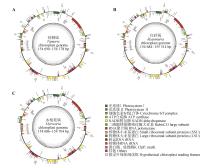
图1
柽柳科植物叶绿体基因组环状图
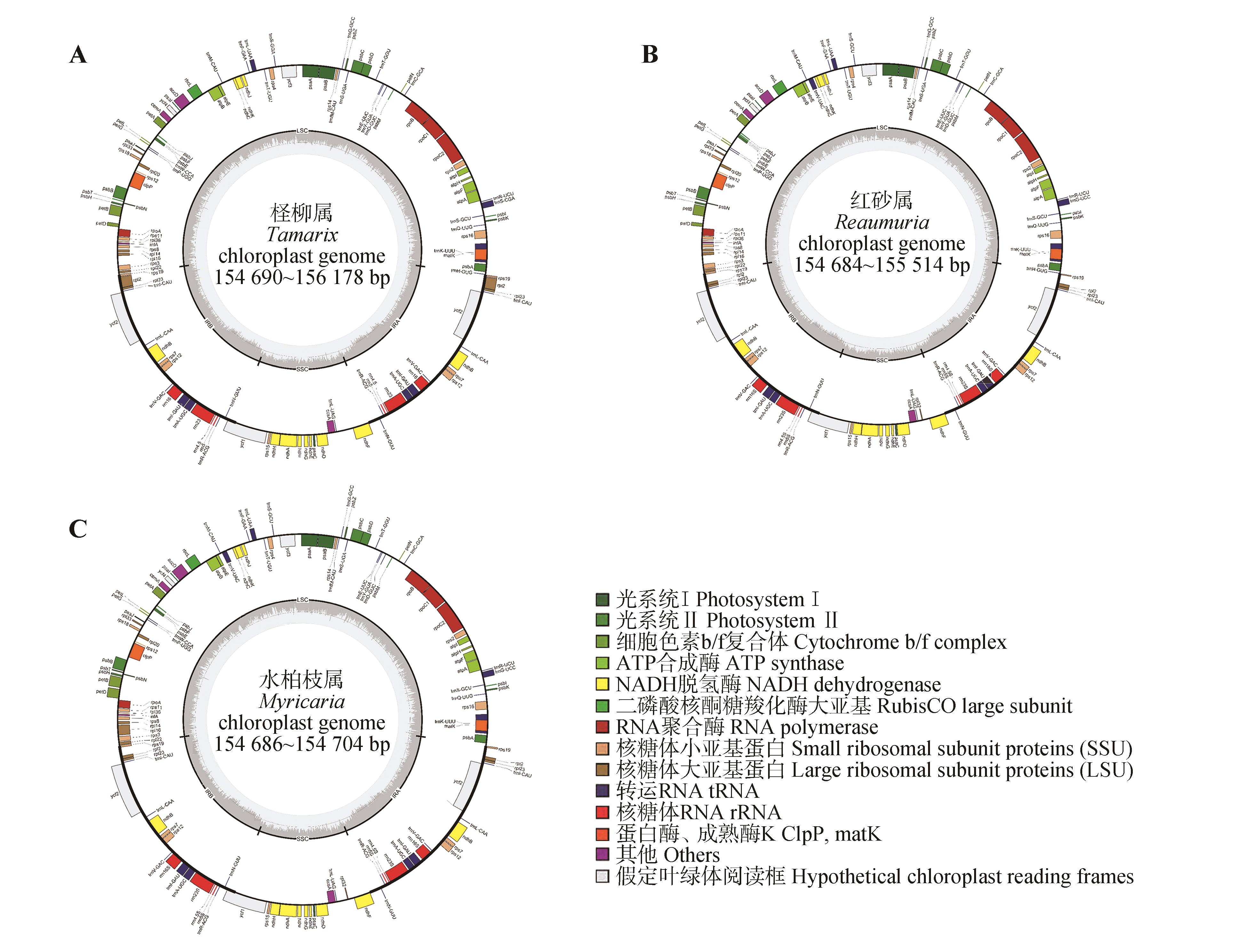
表2
10种柽柳科植物叶绿体基因组结构信息
物种 Species | 长度 Length/bp | 基因数量 Number of gene | ||||||
|---|---|---|---|---|---|---|---|---|
长单 拷贝区 LSC | 短单 拷贝区 SSC | 反向 重复区 IR | 叶绿体基因组 Chloroplast genome | 转运RNA tRNA | 核糖体RNA rRNA | 蛋白编码基因 Protein-coding gene | 总数 Total | |
| 盐地柽柳 Tamarix karelinii* | 84 787 | 18 247 | 26 571 | 156 176 | 36(29) | 10(4) | 84(77) | 130(110) |
| 短穗柽柳 Tamarix laxa* | 84 781 | 18 260 | 26 561 | 156 163 | 36(29) | 10(4) | 84(77) | 130(110) |
| 沙生柽柳 Tamarix taklamakanensis* | 84 778 | 18 257 | 26 571 | 156 177 | 36(29) | 10(4) | 81(75) | 127(108) |
| 密花柽柳 Tamarix arceuthoides | 84 766 | 18 247 | 26 575 | 156 163 | 36(28) | 10(4) | 84(77) | 130(109) |
| 甘蒙柽柳 Tamarix austromongolica | 84 379 | 18 303 | 26 004 | 154 690 | 36(28) | 10(4) | 85(78) | 131(110) |
| 多枝柽柳 Tamarix ramosissima | 84 802 | 18 254 | 26 561 | 156 178 | 37(29) | 10(4) | 85(78) | 132(111) |
| 宽苞水柏枝 Myricaria bracteata | 84 374 | 18 304 | 26 004 | 154 686 | 36(28) | 10(4) | 85(78) | 131(110) |
| 匍匐水柏枝 Myricaria prostrata | 84 380 | 18 308 | 26 008 | 154 704 | 36(28) | 10(4) | 85(78) | 131(110) |
| 五柱红砂 Reaumuria kaschgarica | 85 859 | 17 571 | 26 042 | 155 514 | 37(29) | 10(4) | 86(79) | 133(112) |
| 红砂 Reaumuria songarica | 85 046 | 17 540 | 26 031 | 154 684 | 37(29) | 10(4) | 85(78) | 132(111) |
表3
柽柳科植物叶绿体基因组编码基因
类别 Category | 分组 Group | 基因名称 Gene name | 总数 Total |
|---|---|---|---|
自我复制相关基因 Self-replication related genes | 转运RNA tRNA | trnA-UGC*、trnC-GCA、trnD-GUC、trnE-UUC、trnF-GAA、trnM-CAU、trnG-GCC、trnG-UCC、trnH-GUG、trnI-CAU*、trnI-GAU*、trnK-UUU、trnL-CAA*、trnL-UAA、trnL-UAG、trnM-CAU、trnN-GUU*、trnP-UGG、trnQ-UUG、trnR-ACG*、trnR-UCU、trnS-CGA、trnS-GCU*、trnS-GGA、trnS-UGA、trnT-GGU、trnT-UGU、trnV-GAC* | 28 |
核糖体RNA rRNA | rrn4.5*、rrn5*、rrn16**、rrn23* | 4 | |
核糖体大亚基 Large ribosomal subunit | rpl32、rpl33、rpl20、rpl16、rpl22、rpl14、rpl2*、rpl23*、rpl36 | 9 | |
核糖体小亚基 Small ribosomal subunit | rps4、rps11、rps12*、rps3、rps15、rps7*、rps14、rps18、rps16、rps2、rps19*、rps8 | 12 | |
DNA依赖性RNA聚合酶 DNA dependent RNA polymerase | rpoA、rpoC2、rpoC1、rpoB | 4 | |
光合相关基因 Photosynthesis related genes | NADH脱氢酶亚基 NADH-dehydrogenase subunit | ndhD、ndhA、ndhI、ndhE、ndhH、ndhF、ndhG、ndhJ、ndhC、ndhK、ndhB* | 11 |
二磷酸核酮糖氧合酶/羧化酶大亚基 RubisCO large subunit | rbcL | 1 | |
ATP合成酶亚基 ATP synthase subunit | atpA、atpE、atpH、atpF、atpI、atpB | 6 | |
光系统Ⅰ亚基 PhotosystemⅠsubunit | psaI、psaJ、psaA、psaC、psaB | 5 | |
光系统Ⅱ亚基 Photosystem Ⅱ subunit | psbB、psbE、psbL、psbC、psbZ、psbF、psbH、psbN、psbK、psbI、psbJ、psbM、psbA、psbT、psbD | 15 | |
细胞色素b/f复合物亚基 Cytochrome b/f complex subunit | petB、petA、petG、petL、petN、petD | 6 | |
其他基因 Other genes | C型细胞色素合成 C-type cytochrome synthesis | ccsA | 1 |
翻译起始因子 Translation initiation factor | infA | 1 | |
乙酰辅酶A羧化酶亚基 Acetyl-CoA carboxylase subunit | accD | 1 | |
成熟酶K Maturase K | matK | 1 | |
蛋白酶 Protease | clpP | 1 | |
包裹膜蛋白 Envelop membrane protein | cemA | 1 | |
未知功能基因 Genes of unknown function | 假定叶绿体阅读框 Hypothetical chloroplast reading frame | ycf3、ycf4、ycf2*、ycf1 | 4 |
图2
10种柽柳科植物叶绿体基因组长重复序列A.长重复序列数量;B.长重复序列长度。
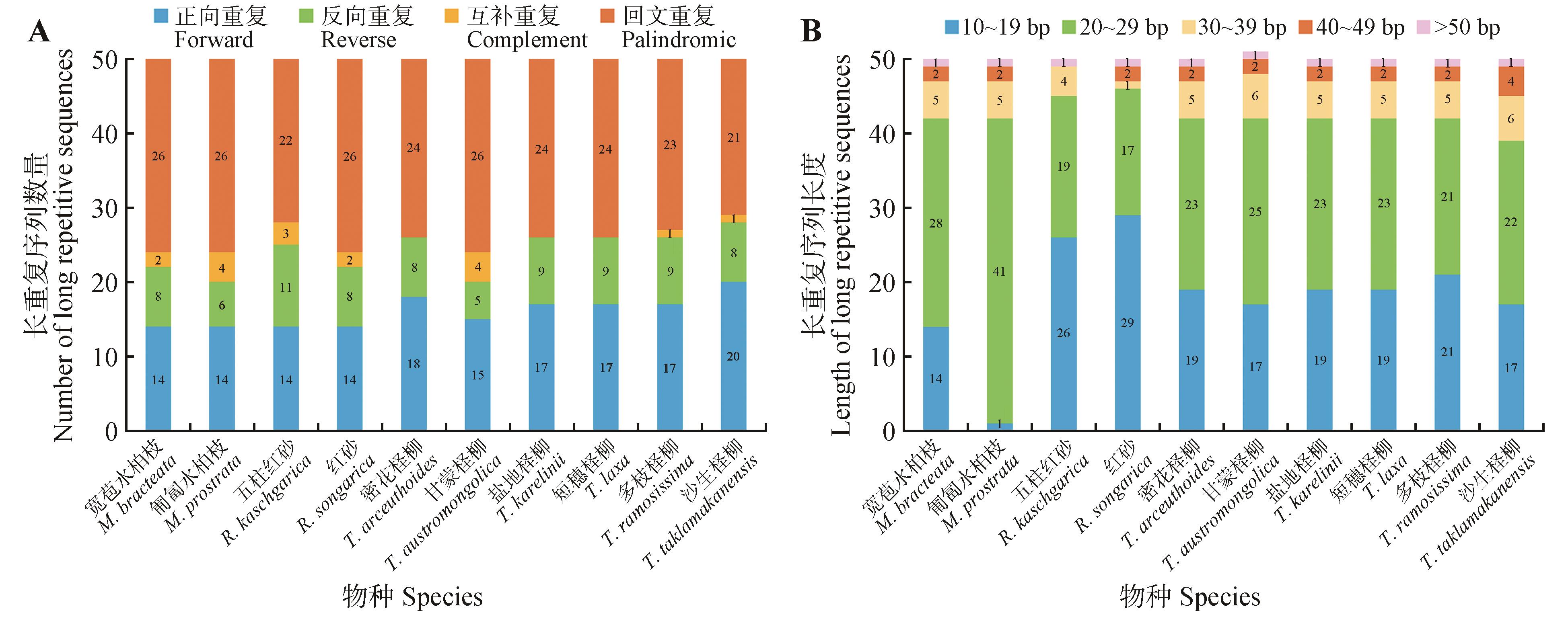
表4
10种柽柳科植物叶绿体基因组SSR类型
物种 Species | SSR类型 SSR type | ||
|---|---|---|---|
| A/T | C/G | AT/AT | |
| 盐地柽柳 T. karelinii | 40 | 0 | 3 |
| 短穗柽柳 T. laxa | 44 | 0 | 3 |
| 沙生柽柳 T. taklamakanensis | 40 | 0 | 4 |
| 密花柽柳 T. arceuthoides | 25 | 0 | 2 |
| 甘蒙柽柳 T. austromongolica | 36 | 2 | 2 |
| 多枝柽柳 T. ramosissima | 41 | 0 | 3 |
| 宽苞水柏枝 M. bracteata | 44 | 0 | 6 |
| 匍匐水柏枝 M. prostrata | 36 | 0 | 3 |
| 五柱红砂 R. kaschgarica | 48 | 0 | 6 |
| 红砂 R. songarica | 46 | 0 | 6 |
图3
柽柳科植物叶绿体基因组比对
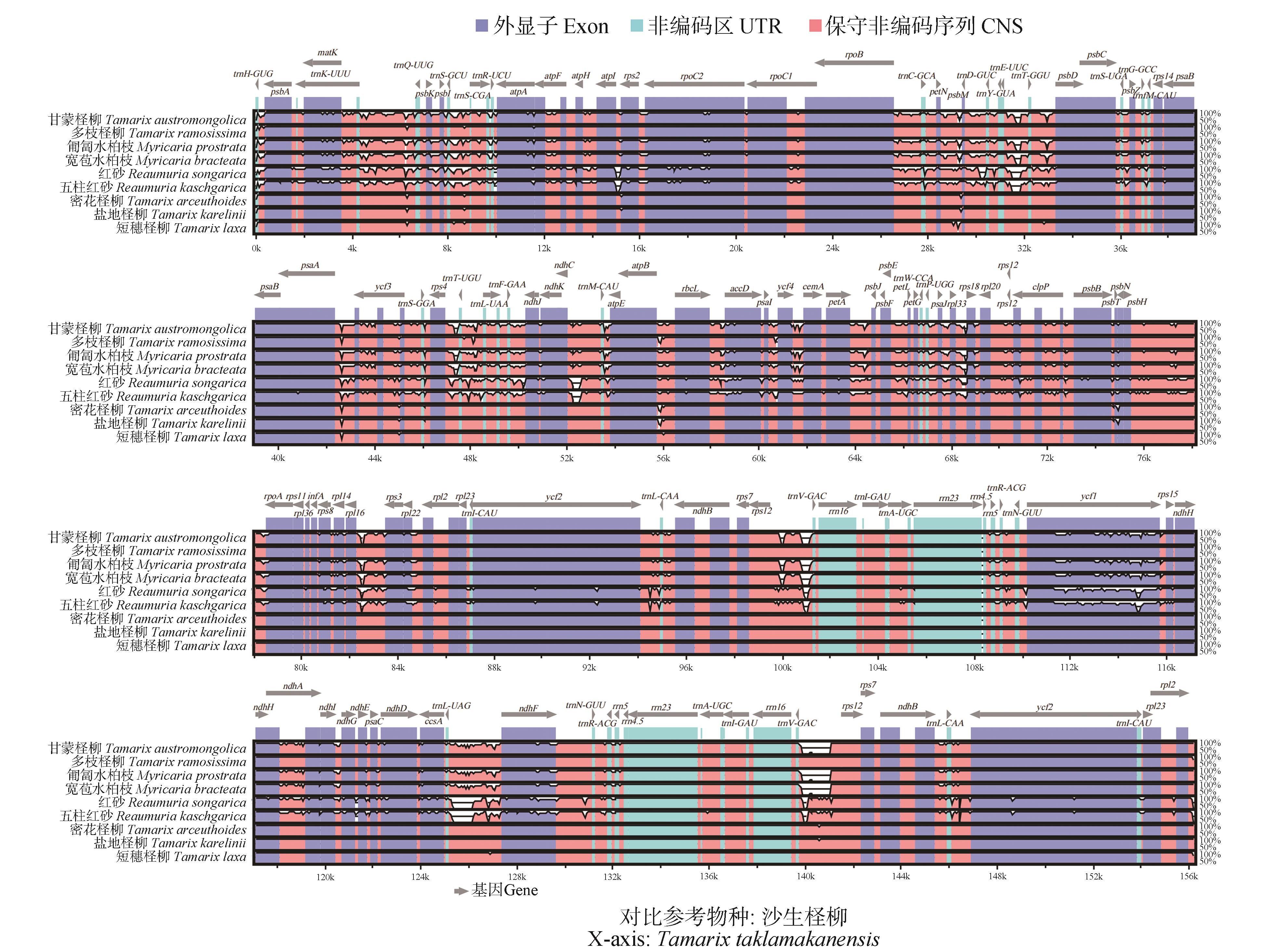
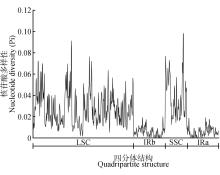
图4
柽柳科植物叶绿体基因组核苷酸多态性
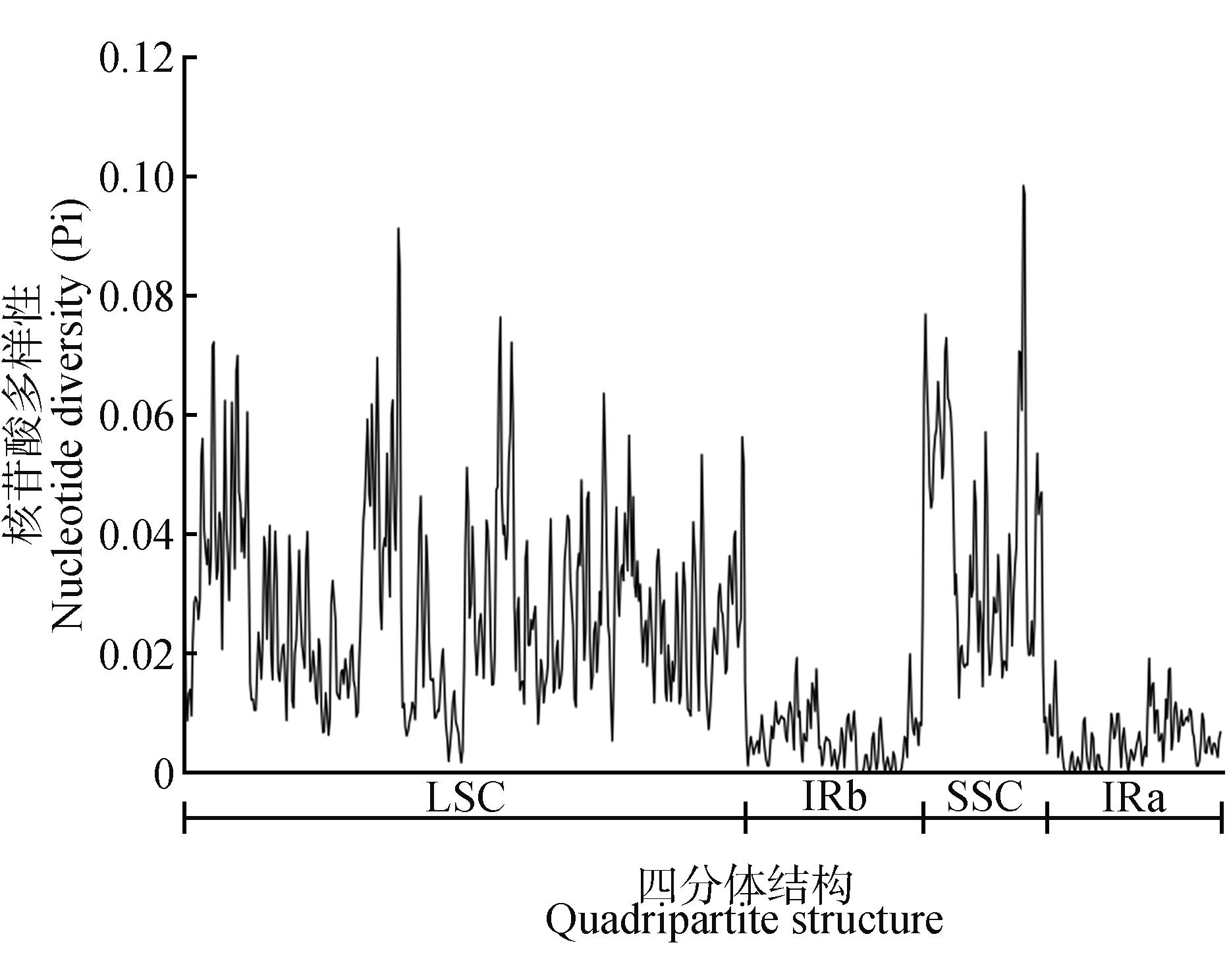
图5
10种柽柳科植物叶绿体基因组分区连接处比较
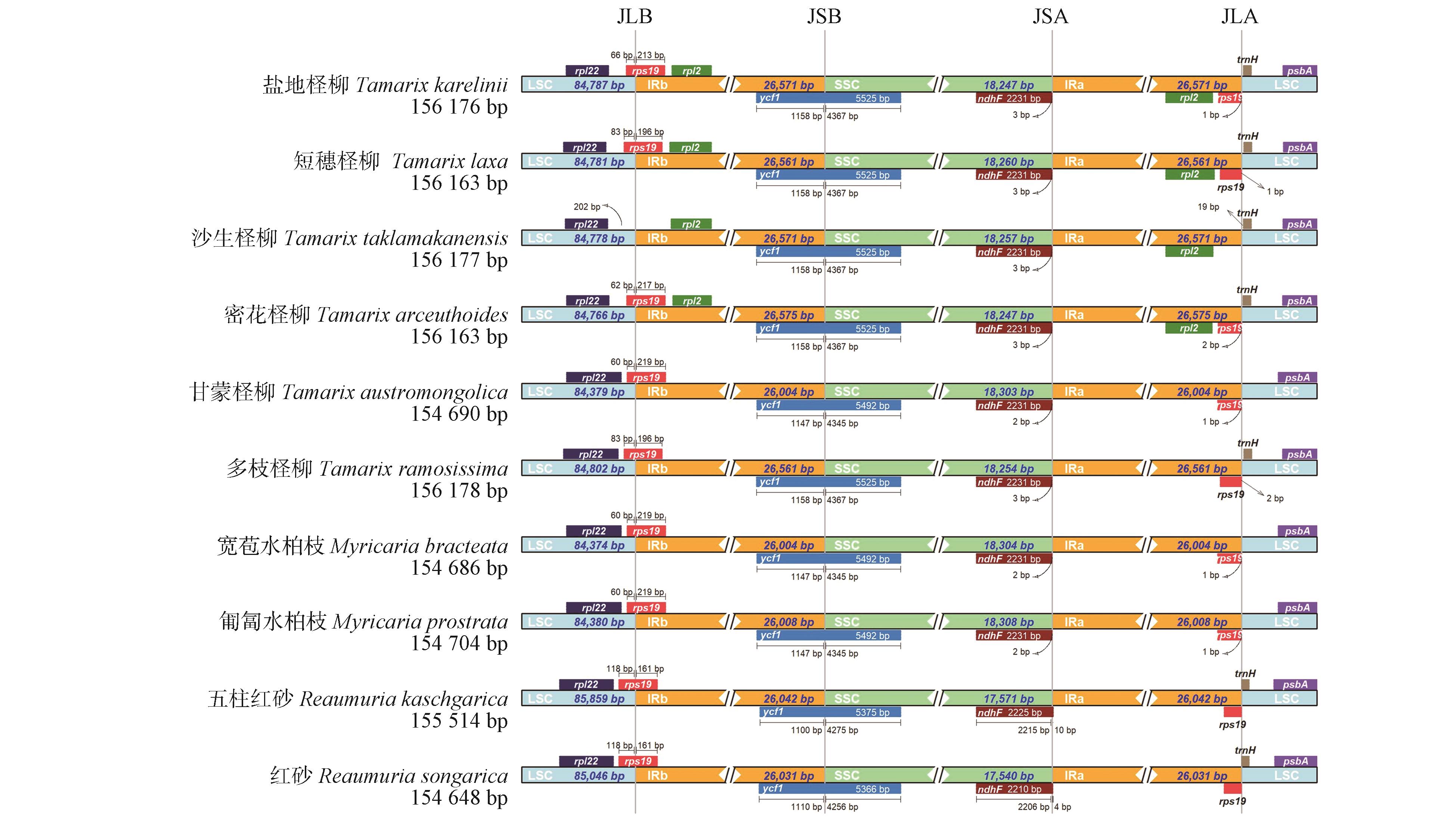
表5
10种柽柳科植物叶绿体蛋白编码基因的密码子偏好性
物种 Species | 有效密码 子数目 ENc | 密码子 适应指数 CAI | 密码子 偏好指数 CBI | 最优密码子 使用频率 FOP | 同义第三密码子胸腺嘧啶含量 T3s | 同义第三密 码子胞嘧啶 含量 C3s | 同义第三密 码子腺嘌呤 含量 A3s | 同义第三密 码子鸟嘌呤 含量 G3s |
|---|---|---|---|---|---|---|---|---|
| 盐地柽柳 T. karelinii | 54.841 | 0.160 | 0.223 | 0.354 | 0.409 2 | 0.232 6 | 0.414 4 | 0.224 1 |
| 短穗柽柳 T. laxa | 55.359 | 0.158 | 0.200 | 0.358 | 0.404 3 | 0.242 7 | 0.399 4 | 0.232 5 |
| 沙生柽柳 T. taklamakanensis | 55.147 | 0.160 | 0.215 | 0.355 | 0.414 2 | 0.236 3 | 0.401 5 | 0.230 0 |
| 密花柽柳 T. arceuthoides | 55.285 | 0.157 | 0.206 | 0.356 | 0.410 3 | 0.238 5 | 0.400 7 | 0.230 2 |
| 甘蒙柽柳 T. austromongolica | 55.143 | 0.160 | 0.216 | 0.355 | 0.413 2 | 0.230 3 | 0.405 1 | 0.231 3 |
| 多枝柽柳 T. ramosissima | 54.960 | 0.160 | 0.221 | 0.357 | 0.404 5 | 0.240 3 | 0.399 6 | 0.239 5 |
| 宽苞水柏枝 M. bracteata | 55.607 | 0.156 | 0.203 | 0.354 | 0.406 6 | 0.239 0 | 0.399 4 | 0.237 6 |
| 匍匐水柏枝 M. prostrata | 55.432 | 0.158 | 0.204 | 0.354 | 0.407 2 | 0.235 3 | 0.401 6 | 0.235 4 |
| 五柱红砂 R. kaschgarica | 55.361 | 0.161 | 0.204 | 0.355 | 0.409 9 | 0.235 1 | 0.403 0 | 0.235 3 |
| 红砂 R. songarica | 55.644 | 0.162 | 0.193 | 0.359 | 0.405 6 | 0.244 6 | 0.396 6 | 0.238 4 |
表6
10种柽柳科植物叶绿体基因组GC含量
物种 Species | 第一密码子GC含量 GC1 content/% | 第二密码子GC含量 GC2 content/% | 第三密码子GC含量 GC3 content/% | 总GC含量 GC content/% |
|---|---|---|---|---|
| 盐地柽柳 T. karelinii | 45.17 | 37.85 | 28.41 | 37.15 |
| 短穗柽柳 T. laxa | 45.18 | 37.83 | 28.44 | 37.15 |
| 沙生柽柳 T. taklamakanensis | 45.07 | 37.82 | 28.51 | 37.13 |
| 密花柽柳 T. arceuthoides | 45.18 | 37.85 | 28.41 | 37.15 |
| 甘蒙柽柳 T. austromongolica | 45.05 | 37.62 | 28.22 | 36.96 |
| 多枝柽柳 T. ramosissima | 45.04 | 37.68 | 28.35 | 37.03 |
| 宽苞水柏枝 M. bracteata | 45.03 | 37.62 | 28.23 | 36.96 |
| 匍匐水柏枝 M. prostrata | 45.05 | 37.62 | 28.22 | 36.96 |
| 五柱红砂 R. kaschgarica | 45.21 | 37.70 | 29.11 | 37.34 |
| 红砂 R. songarica | 45.20 | 37.66 | 29.06 | 37.31 |
图6
10种柽柳科植物叶绿体基因组相对同义密码子使用热图
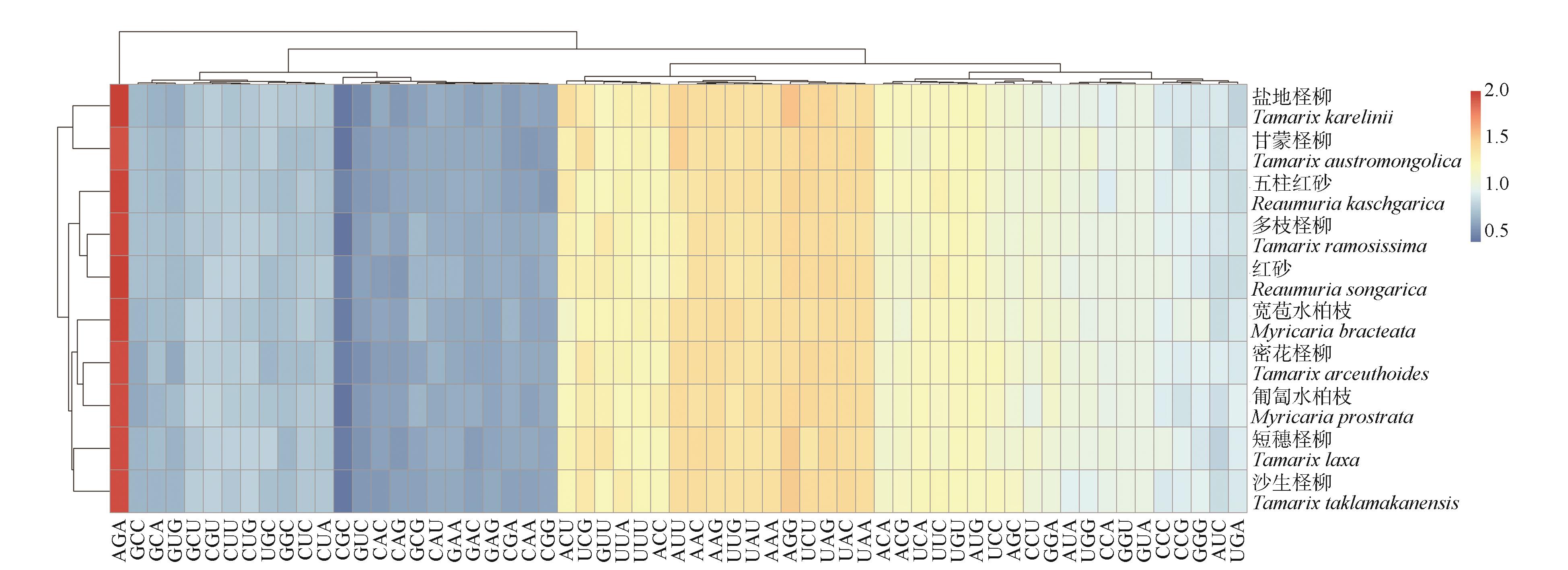
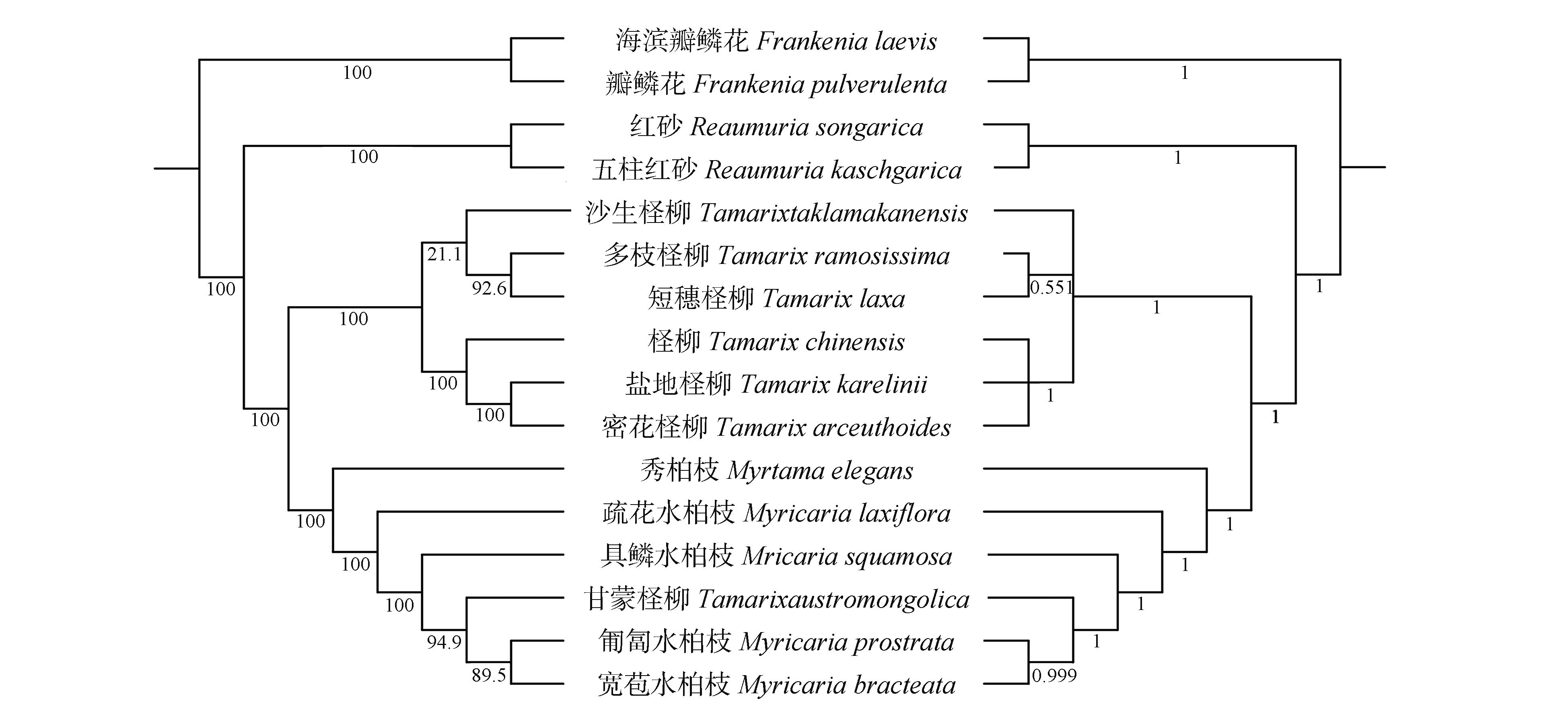
图7
基于叶绿体基因组蛋白编码序列的柽柳科系统发育关系
| [1] | 张韵洁,李德铢.叶绿体系统发育基因组学的研究进展[J].植物分类与资源学报,2011,33(4):365-375. |
| ZHANG Y J, LI D Z.Advances in phylogenomics based on complete chloroplast genomes[J].Plant Diversity and Resources,2011,33(4):365-375. | |
| [2] | O’NEILL S L, GIORDANO R, COLBERT A M,et al.16S rRNA phylogenetic analysis of the bacterial endosymbionts associated with cytoplasmic incompatibility in insects[J].Proceedings of the National Academy of Sciences of the United States of America,1992,89(7):2699-2702. |
| [3] | PURKHOLD U, POMMERENING-RÖSER A, JURETSC-HKO S,et al.Phylogeny of all recognized species of ammonia oxidizers based on comparative 16S rRNA and amoA sequence analysis:implications for molecular diversity surveys[J].Applied and Environmental Microbiology,2000,66(12):5368-5382. |
| [4] | HEDGES S B, MOBERG K D, MAXSON L R.Tetrapod phylogeny inferred from 18S and 28S ribosomal RNA sequences and a review of the evidence for amniote relationships[J].Molecular Biology and Evolution,1990,7(6):607-633. |
| [5] | SNEL B, BORK P, HUYNEN M A.Genome phylogeny based on gene content[J].Nature Genetics,1999,21(1):108-110. |
| [6] | MORET B M E, WANG L S, WARNOW T,et al.New approaches for reconstructing phylogenies from gene order data[J].Bioinformatics,2001,17(Sup.1):S165-S173. |
| [7] | SEMPLE C, STEEL M.A supertree method for rooted trees[J].Discrete Applied Mathematics,2000,105(1/2/3):147-158. |
| [8] | 李建伏,郭茂祖.系统发生树构建技术综述[J].电子学报,2006,34(11):2047-2052. |
| LI J F, GUO M Z.A review of phylogenetic tree reconstruction technology[J].Acta Electronica Sinica,2006,34(11):2047-2052. | |
| [9] | 于黎,张亚平.系统发育基因组学:重建生命之树的一条迷人途径[J].遗传,2006,28(11):1445-1450. |
| YU L, ZHANG Y P.Phylogenomics:an attractive avenue to reconstruct “Tree of Life”[J].Hereditas(Beijing),2006,28(11):1445-1450. | |
| [10] | ZUNTINI A R, CARRUTHERS T, MAURIN O,et al.Phylogenomics and the rise of the angiosperms[J].Nature,2024,629(8013):843-850. |
| [11] | WANG X X, HUANG C H, MORALES-BRIONES D F,et al.Phylotranscriptomics reveals the phylogeny of Asparagales and the evolution of allium flavor biosynthesis[J].Nature Communications,2024,15(1):9663. |
| [12] | ZHOU X K, FAN H Y, FENG X Y,et al.PGCP:a comprehensive database of plant genomes for comparative phylogenomics[J].Plant Biotechnology Journal,2025,23(7):2928-2930. |
| [13] | 邹新慧,葛颂.基因树冲突与系统发育基因组学研究[J].植物分类学报,2008,46(6):795-807. |
| ZOU X H, GE S.Conflicting gene trees and phylogenomics[J].Journal of Systematics and Evolution,2008,46(6):795-807. | |
| [14] | MOORE M J, SOLTIS P S, BELL C D,et al.Phylogenetic analysis of 83 plastid genes further resolves the early diversification of eudicots[J].Proceedings of the National Academy of Sciences of the United States of America,2010,107(10):4623-4628. |
| [15] | LI H T, LUO Y, GAN L,et al.Plastid phylogenomic insights into relationships of all flowering plant families[J].BMC Biology,2021,19(1):232. |
| [16] | LI H T, YI T S, GAO L M,et al.Origin of angiosperms and the puzzle of the Jurassic gap[J].Nature Plants,2019,5(5):461-470. |
| [17] | MA H, LIU Z Q, LAN W X,et al.Complete chloroplast genomes of 9 Impatiens species:genome structure,comparative analysis,and phylogenetic relationships[J].International Journal of Molecular Sciences,2025,26(2): 536. |
| [18] | 王飞,赵文植,董章宏,等.丝兰属6种植物叶绿体基因组特征分析[J].植物研究,2023,43(1):109-119. |
| WANG F, ZHAO W Z, DONG Z H,et al.Analysis of the chloroplast genome characteristics of 6 species of Yucca [J].Bulletin of Botanical Research,2023,43(1):109-119. | |
| [19] | 张妍彤,黄剑,宋菊,等.壳斗科植物叶绿体基因组结构及变异分析[J].植物研究,2018,38(5):757-765. |
| ZHANG Y T, HUANG J, SONG J,et al.Structure and variation analysis of chloroplast genomes in Fagacea[J].Bulletin of Botanical Research,2018,38(5):757-765. | |
| [20] | 苏丹丹,刘玉萍,刘涛,等.苦马豆叶绿体基因组结构及其特征分析[J].植物研究,2022,42(3):446-454. |
| SU D D, LIU Y P, LIU T,et al.Structure of chloroplast genome and its characteristics of Sphaerophysa salsula [J].Bulletin of Botanical Research,2022,42(3):446-454. | |
| [21] | DANIELL H, JIN S X, ZHU X G,et al.Green giant:a tiny chloroplast genome with mighty power to produce high-value proteins:history and phylogeny[J].Plant Biotechnology Journal,2021,19(3):430-447. |
| [22] | 张鹏云,张耀甲.中国植物志[M].北京:科学出版社,1979,50(2):142-143. |
| ZHANG P Y, ZHANG Y J.Flora of China[M].Beijing:Science Press,1979,50(2):142-143. | |
| [23] | 种培芳,苏世平,李毅.4个地理种群红砂的抗旱性综合评价[J].草业学报,2011,20(5):26-33. |
| ZHONG P F, SU S P, LI Y.Comprehensive evaluation of drought resistance of Reaumuria soongorica from four geographical populations[J].Acta Prataculturae Sinica,2011,20(5):26-33. | |
| [24] | 蒋进,高海峰.柽柳属植物抗旱性排序研究[J].干旱区研究,1992(4):41-45. |
| JIANG J, GAO H F.A study on drought resistant ordination of Tamarix L.[J].Arid Zone Research,1992(4):41-45. | |
| [25] | 王雲霞,单立山,解婷婷,等.干旱-复水对红砂幼苗各器官非结构性碳水化合物的影响[J].生态学杂志,2024,43(2):383-394. |
| WANG Y X, SHAN L S, XIE T T,et al.The effects of drought-rehydration on non-structural carbohydrates in Reaumuria soongorica seedlings[J].Chinese Journal of Ecology,2024,43(2):383-394. | |
| [26] | SUN T T, SU Z H, WANG R,et al.Transcriptome and metabolome analysis reveals the molecular mechanisms of Tamarix taklamakanensis under progressive drought and rehydration treatments[J].Environmental and Experimental Botany,2022,195:104766. |
| [27] | 王红宝,郑伶杰,丁丁,等.7种柽柳属植物对NaCl胁迫的生长生理响应与耐盐性差异[J].山东农业科学,2022,54(11):31-38. |
| WANG H B, ZHENG L J, DING D,et al.Growth and physiological response to NaCl stress and salt tolerance differences of seven Tamarix Linn. species[J].Shandong Agricultural Sciences,2022,54(11):31-38. | |
| [28] | 张元明,潘伯荣,尹林克.中国柽柳科(Tamaricaceae)花粉形态研究及其分类意义的探讨[J].西北植物学报,2001,21(5):857-864. |
| ZHANG Y M, PAN B R, YIN L K.Pollen morphology of the Tamaricaceae from China and its taxonomic significance[J].Acta Botanica Boreali-Occidentalia Sinica,2001,21(5):857-864. | |
| [29] | 张元明.中国柽柳科植物花粉形态特征聚类分析[J].西北植物学报,2004,24(9):1702-1707. |
| ZHANG Y M.Cluster analysis on pollen morphology of the Tamaricaceae from China[J].Acta Botanica Boreali-Occidentalia Sinica,2004,24(9):1702-1707. | |
| [30] | 张道远,陈之端,孙海英,等.用核糖体DNA的ITS序列探讨中国柽柳科植物系统分类中的几个问题[J].西北植物学报,2000,20(3):421-431. |
| ZHANG D Y, CHEN Z D, SUN H Y,et al.Systematic studies on some questions of Tamaricaceae based on ITS sequence[J].Acta Botanica Boreali-Occidentalia Sinica,2000,20(3):421-431. | |
| [31] | 魏岩,谭敦炎,尹林克.中国柽柳科植物叶解剖特征与分类关系的探讨[J].西北植物学报,1999,19(1):113-118. |
| WEI Y, TAN D Y, YIN L K.The discussions on the anatomical structure of leaf and ITS taxonomic relationship of Tamaricaceae in China[J].Acta Botanica Boreali-Occidentalia Sinica,1999,19(1):113-118. | |
| [32] | 张鹏云,刘名庭.中国的柽柳属植物研究简史[J].干旱区研究,1988,5(3):20-26. |
| ZHANG P Y, LIU M T.A brief history of research on Tamarix plants in China[J].Arid Zone Research,1988,5(3):20-26. | |
| [33] | 师亚婷,单立山,解婷婷,等.干旱胁迫下红砂幼苗非结构性碳水化合物动态变化特征[J].西北植物学报,2023,43(1):116-126. |
| SHI Y T, SHAN L S, XIE T T,et al.Dynamic changes of non-structural carbohydrate in Reaumuria soongorica seedlings under drought stress[J].Acta Botanica Boreali-Occidentalia Sinica,2023,43(1):116-126. | |
| [34] | WEI X C, YAN X, YANG Z,et al.Salt glands of recretohalophyte Tamarix under salinity:their evolution and adaptation[J].Ecology and Evolution,2020,10(17):9384-9395. |
| [35] | LI F J, XIE W L, DING X R,et al.Phytochemical and pharmacological properties of the genus Tamarix:a comprehensive review[J].Archives of Pharmacal Research,2024,47(5):410-441. |
| [36] | CHEN Y H, WANG G Y, ZHANG H X,et al.Transcriptome analysis of Tamarix ramosissima leaves in response to NaCl stress[J].PLoS One,2022,17(3):e0265653. |
| [37] | DU C, MA B J, WU Z G,et al. Reaumuria trigyna transcription factor RtWRKY23 enhances salt stress tolerance and delays flowering in plants[J].Journal of Plant Physiology,2019,239(8):38-51. |
| [38] | SONG M M, GONG W, TIAN Y Y,et al.Chromosome-level genome assembly and annotation of xerophyte secretohalophyte Reaumuria soongarica [J].Scientific Data,2024,11(1):812. |
| [39] | DOYLE J J, DOYLE J L.A rapid DNA isolation procedure for small quantities of fresh leaf tissue[J].Phytochemical Bulletin,1987,19(1):11-13. |
| [40] | ARIMURA S I, NAKAZATO I.Genome editing of plant mitochondrial and chloroplast genomes[J].Plant and Cell Physiology,2024,65(4):477-483. |
| [41] | ANDROSIUK P, JASTRZEBSKI J P, PAUKSZTO Ł,et al.Evolutionary dynamics of the chloroplast genome sequences of six Colobanthus species[J].Scientific Reports,2020,10(1):11522. |
| [42] | XU L Y, WANG J H, ZHANG T J,et al.Characterizing complete mitochondrial genome of Aquilegia amurensis and its evolutionary implications[J].BMC Plant Biology,2024,24(1):142. |
| [43] | DELSUC F, BRINKMANN H, PHILIPPE H.Phylogenomics and the reconstruction of the tree of life[J].Nature Reviews Genetics,2005,6(5):361-375. |
| [44] | CUI H N, DING Z, ZHU Q L,et al.Population structure and genetic diversity of watermelon (Citrullus lanatus) based on SNP of chloroplast genome[J].3 Biotech,2020,10(8):374. |
| [45] | GUO Y Y, YANG J X, BAI M Z,et al.The chloroplast genome evolution of Venus slipper (Paphiopedilum):IR expansion,SSC contraction,and highly rearranged SSC regions[J].BMC Plant Biology,2021,21(1):248. |
| [46] | LI E Z, LIU K J, DENG R Y,et al.Insights into the phylogeny and chloroplast genome evolution of Eriocaulon (Eriocaulaceae)[J].BMC Plant Biology,2023,23(1):32. |
| [47] | WENG M L, RUHLMAN T A, JANSEN R K.Plastid-nuclear interaction and accelerated coevolution in plastid ribosomal genes in Geraniaceae[J].Genome Biology and Evolution,2016,8(6):1824-1838. |
| [48] | 陈仁芳,张泽,唐洲,等.桑属ITS、trnL-F、rps16序列与进化分析[J].中国农业科学,2011,44(8):1553-1561. |
| CHEN R F, ZHANG Z, TANG Z,et al. Morus ITS,trnL-F,rps16 sequence and phylogenetic analysis of mulberry resources[J].Scientia Agricultura Sinica,2011,44(8):1553-1561. | |
| [49] | 曾建敏,陈学军,吴兴富,等.基于烟草叶绿体基因组和线粒体基因组SSR标记的烟属植物遗传多样性分析[J].中国烟草学报,2016,22(4):89-97. |
| ZENG J M, CHEN X J, WU X F,et al.Genetic diversity analysis of genus Nicotiana based on SSR markers in chloroplast genome and mitochondria genome[J].Acta Tabacaria Sinica,2016,22(4):89-97. | |
| [50] | 刘霞,孙冲,黄勤琴,等.九叶青花椒叶绿体基因组结构及系统进化分析[J].林业科学研究,2023,36(1):100-108. |
| LIU X, SUN C, HUANG Q Q,et al.Analysis of complete chloroplast genome sequences and phylogenetic evolution of Zanthoxylum armatum ‘Jiuyeqing’[J].Forest Research,2023,36(1):100-108. | |
| [51] | CHI X F, ZHANG F Q, DONG Q,et al.Insights into comparative genomics,codon usage bias,and phylogenetic relationship of species from Biebersteiniaceae and Nitrariaceae based on complete chloroplast genomes[J].Plants,2020,9(11):1605. |
| [52] | SALTONSTALL K, LAMBERTINI C.The value of repetitive sequences in chloroplast DNA for phylogeographic inference:a comment on Vachon & Freeland 2011[J].Molecular Ecology Resources,2012,12(4):581-585. |
| [53] | DONG W P, XU C, LI W Q,et al.Phylogenetic resolution in Juglans based on complete chloroplast genomes and nuclear DNA sequences[J].Frontiers in Plant Science,2017,8:1148. |
| [54] | LI L, HU Y F, HE M,et al.Comparative chloroplast genomes:insights into the evolution of the chloroplast genome of Camellia sinensis and the phylogeny of Camellia [J].BMC Genomics,2021,22(1):138. |
| [55] | CHO K S, YUN B K, YOON Y H,et al.Complete chloroplast genome sequence of Tartary Buckwheat (Fagopyrum tataricum) and comparative analysis with Common Buckwheat (F. esculentum)[J].PLoS One,2015,10(5):e0125332. |
| [56] | NICOLAISEN M, BERTACCINI A.An oligonucleotide microarray-based assay for identification of phytoplasma 16S ribosomal groups[J].Plant Pathology,2010,56(2):332-336. |
| [57] | AMAR M H. ycf1-ndhF genes,the most promising plastid genomic barcode,sheds light on phylogeny at low taxonomic levels in Prunus persica [J].Journal of Genetic Engineering and Biotechnology,2020,18(1):42. |
| [58] | ZHANG Y, FAN Y F, LV X T,et al.Deficiency in NDH-cyclic electron transport retards heat acclimation of photosynthesis in tobacco over day and night shift[J].Frontiers in Plant Science,2023,14:1267191. |
| [59] | TANG D F, WEI F, CAI Z Q,et al.Analysis of codon usage bias and evolution in the chloroplast genome of Mesona chinensis Benth[J].Development Genes and Evolution,2021,231(1/2):1-9. |
| [60] | PARVATHY S T, UDAYASURIYAN V, BHADANA V.Codon usage bias[J].Molecular Biology Reports,2022,49(1):539-565. |
| [61] | 唐晓芬,陈莉,马玉韬.密码子使用偏性量化方法研究综述[J].基因组学与应用生物学,2013,32(5):660-666. |
| TANG X F, CHEN L, MA Y T.Review and prospect of the principle and methods quantifying codon usage bias[J].Genomics and Applied Biology,2013,32(5):660-666. | |
| [62] | 夏铭泽,张发起,迟晓峰,等.梅花草属叶绿体基因组进化分析[J].植物研究,2022,42(4):626-636. |
| XIA M Z, ZHANG F Q, CHI X F,et al.Evolutionary analysis of chloroplast genome of Parnassia [J].Bulletin of Botanical Research,2022,42(4):626-636. | |
| [63] | 胡欢,张梅,易凌睿.资源植物水柏枝属的分类与应用研究进展[J].西北植物学报,2023,43(2):351-358. |
| HU H, ZHANG M, YI L R.Advances in research on taxonomy and application of genus Myricaria (Tamaricaceae)[J].Acta Botanica Boreali-Occidentalia Sinica,2023,43(2):351-358. | |
| [64] | 席以珍.中国柽柳科植物花粉形态的研究[J].植物研究,1988,8(3):23-42. |
| XI Y Z.Studies on pollen morphology of Tamaricaceae in China[J].Bulletin of Botanical Research,1988,8(3):23-42. | |
| [65] | 白慧慧,张凯,杜忠毓,等.红砂(Reaumuria songarica)叶绿体基因组解析及系统发育分析[J/OL].分子植物育种,(2022-03-07) [2025-01-22].. |
| BAI H H, ZHANG K, DU Z Y,et al.Chloroplast genome and phylogenetic analysis of Reaumuria songarica [J/OL].Molecular Plant Breeding,(2022-03-07) [2025-01-22].. | |
| [66] | 华丽,张道远,潘伯荣.中国柽柳属和水柏枝属的分子系统学研究[J].云南植物研究,2004,26(3):283-289. |
| HUA L, ZHANG D Y, PAN B R.Molecular systematics of Tamarix and Myricaria in China inferred from ITS sequence data[J].Acta Botanica Yunnanica,2004,26(3):283-289. | |
| [67] | 刘浩宇.具鳞水柏枝叶绿体基因组及谱系地理学研究[D].西宁:青海师范大学,2024. |
| LIU H Y.Chloroplast genome analysis and phylogeography of Myricaria squamosa Desv[D].Xining:Qinghai Normal University,2024. | |
| [68] | LIU Y L, DING K, LIANG L X,et al.Comparative study on chloroplast genome of Tamarix species[J].Ecology and Evolution,2024,14(10):e70353. |
| [1] | 殷玥, 杨文利, 胡虹雨, 张钢民. 凤尾蕨科金毛裸蕨属的分类地位及旱蕨属范围[J]. 植物研究, 2024, 44(4): 491-501. |
| [2] | 文妍莉, 李嵘. 滇产单子叶植物的多样性格局与保护[J]. 植物研究, 2024, 44(2): 200-209. |
| [3] | 万雪琴, 时羽杰, 黄金亮, 糜加轩, 钟宇, 张帆, 陈良华. 杨属植物分类的研究进展和展望[J]. 植物研究, 2023, 43(2): 161-168. |
| [4] | 王飞, 赵文植, 董章宏, 马路遥, 李卫英, 李宗艳, 辛培尧. 丝兰属6种植物叶绿体基因组特征分析[J]. 植物研究, 2023, 43(1): 109-119. |
| [5] | 芦永昌, 张鑫, 张璐燕, 王久利. 辽东丁香完整叶绿体基因组的结构与特征[J]. 植物研究, 2023, 43(1): 120-130. |
| [6] | 穆赢通, 樊东昌, 吕丽娟, 李晓杰, 路景诗, 张晓明. 毛茛科和芍药科叶绿体基因组密码子特征和系统发育比较[J]. 植物研究, 2022, 42(6): 964-975. |
| [7] | 张雨, 苏旭, 刘玉萍, 刘涛, 郑长远, 苏丹丹, 王亚男, 吕婷. 喜马红景天叶绿体基因组特征及其系统发育分析[J]. 植物研究, 2022, 42(4): 602-612. |
| [8] | 夏铭泽, 张发起, 迟晓峰, 韩霜, 陈世龙. 梅花草属叶绿体基因组进化分析[J]. 植物研究, 2022, 42(4): 626-636. |
| [9] | 杨晨, 姚雪莹, 陈志祥, 王奇志. 红花变豆菜叶绿体基因组结构及同属种间关系研究[J]. 植物研究, 2022, 42(3): 437-445. |
| [10] | 苏丹丹, 刘玉萍, 刘涛, 郑长远, 张雨, 王亚男, 秦娜, 苏旭. 苦马豆叶绿体基因组结构及其特征分析[J]. 植物研究, 2022, 42(3): 446-454. |
| [11] | 曹倩, 徐隆华, 王久利, 张发起, 陈世龙. 獐牙菜亚族植物的系统发育分析[J]. 植物研究, 2021, 41(3): 408-418. |
| [12] | 杨晨, 陈志祥, 姚雪莹, 王河山, 王奇志. 中国15种变豆菜属植物的花粉形态及系统学分析[J]. 植物研究, 2020, 40(6): 805-812. |
| [13] | 付涛, 王志龙, 林乐静, 林立, 李文, 袁冬明. 中国主栽樱花的分子系统发育分析[J]. 植物研究, 2020, 40(6): 876-885. |
| [14] | 张衷华, 宋晓倩, 唐中华, 梁正伟. 中国盐生植物系统发育多样性及省域差异性[J]. 植物研究, 2020, 40(3): 330-338. |
| [15] | 段义忠, 杜忠毓, 王海涛. 西北干旱区孑遗濒危植物四合木(Tetraena mongolica)叶绿体基因组特征研究及比较分析[J]. 植物研究, 2019, 39(5): 653-663. |
| 阅读次数 | ||||||
|
全文 |
|
|||||
|
摘要 |
|
|||||