植物研究 ›› 2026, Vol. 46 ›› Issue (2): 209-219.doi: 10.7525/j.issn.1673-5102.2026.02.002
• 研究论文column:Original Paper • 上一篇 下一篇
何咏1, 乌芷静1, 张武凡2, 罗毅波3, 李睿思1, 王秋月1, 禹瑞敏1, 董树斌1( ), 程瑾1()
收稿日期:2026-01-26
出版日期:2026-03-20
发布日期:2026-04-02
通讯作者:
董树斌,程瑾
E-mail:dongshubin@bjfu.edu.cn;chengjin@bjfu.edu.cn
作者简介:何咏(2001—),女,硕士研究生,主要从事植物繁殖生态学研究。同等贡献作者。基金资助:
Yong HE1, Zhijing WU1, Wufan ZHANG2, Yibo LUO3, Ruisi LI1, Qiuyue WANG1, Ruimin YU1, Shubin DONG1(), Jin CHENG1()
Received:2026-01-26
Online:2026-03-20
Published:2026-04-02
Contact:
Shubin DONG, Jin CHENG
E-mail:dongshubin@bjfu.edu.cn;chengjin@bjfu.edu.cn
摘要:
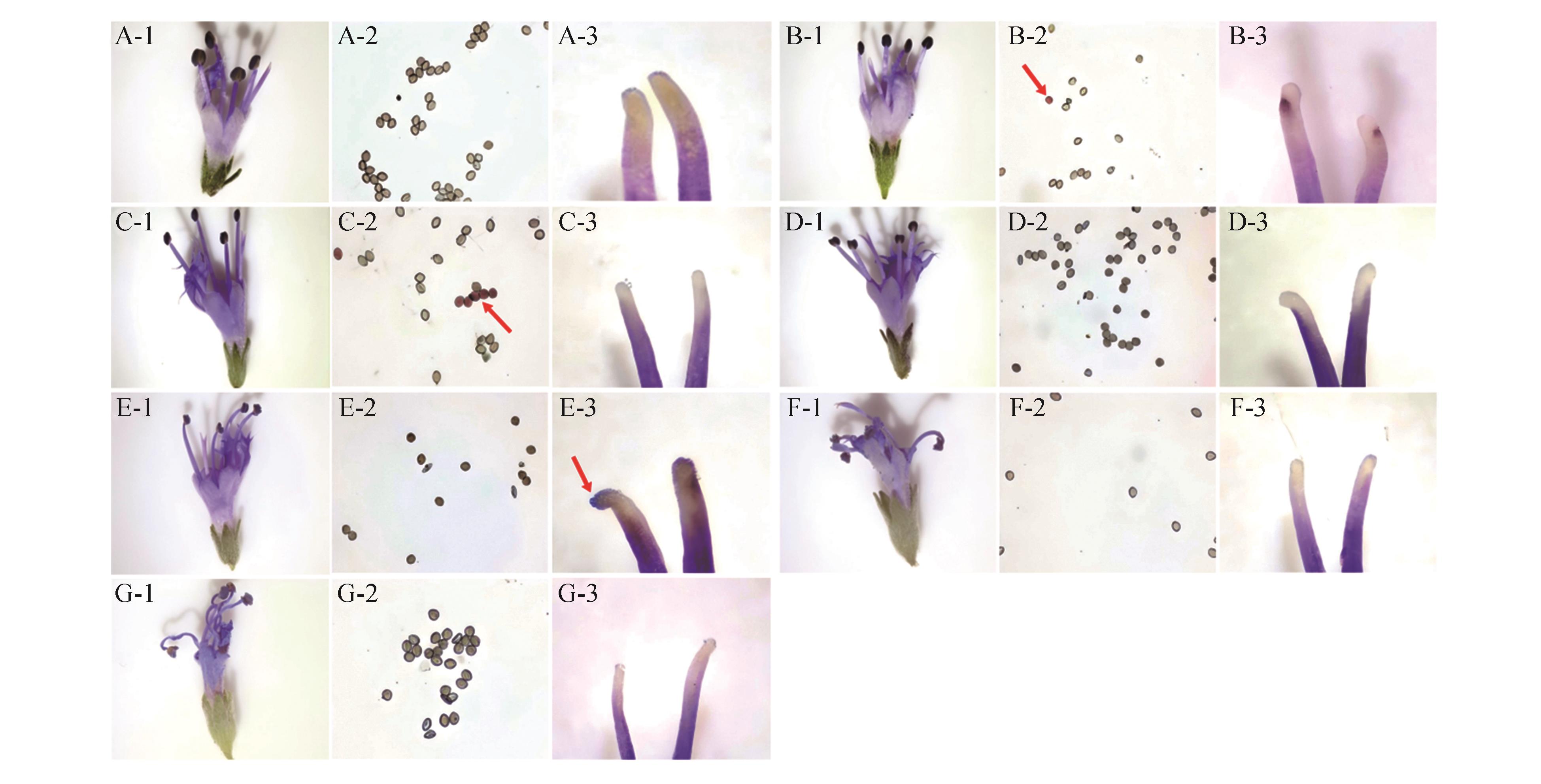
为鉴定兰香草(Caryopteris incana)花挥发性成分,并探讨其对访花昆虫行为的影响,该研究采用英国皇家园艺学会标准比色卡(RHSCC)测定兰香草花色,利用吸附-溶剂洗脱法收集花气味,结合气相色谱-质谱联用技术(GC-MS)鉴定花挥发性成分,通过人工观察统计兰香草的昆虫访花频次,并同步检测花粉活力与柱头可授性的动态变化。结果表明:(1)基于RHSCC的兰香草花色测定确定其色号为N88B深紫色。(2)兰香草花挥发性成分以萜类化合物为主,占77.25%,其次是酯类,占13.00%。相对含量最高的右旋-柠檬烯(36.80%)为兰香草主要特征性挥发物。(3)蜂类是兰香草最主要的访花类群,占比91%以上。其中,意大利蜜蜂(Apis melliferaligustica)是兰香草最主要的访花者,访花频次和其他访花昆虫相比存在极显著差异(P<0.001)。(4)兰香草花期约7 d,花粉在花开放后2 d和3 d具活性,柱头在花开放后5 d具可授性,显示出雌雄蕊异熟中雄蕊先熟的特性,有效减少自交传粉的发生。该研究为兰香草传粉生态学的深入研究提供重要参考。
中图分类号:
何咏, 乌芷静, 张武凡, 罗毅波, 李睿思, 王秋月, 禹瑞敏, 董树斌, 程瑾. 兰香草花挥发性成分鉴定及其对访花昆虫行为的影响[J]. 植物研究, 2026, 46(2): 209-219.
Yong HE, Zhijing WU, Wufan ZHANG, Yibo LUO, Ruisi LI, Qiuyue WANG, Ruimin YU, Shubin DONG, Jin CHENG. Identification of Floral Volatiles from Caryopteris incana and Their Regulatory Effects on Floral Visitors Behavior[J]. Bulletin of Botanical Research, 2026, 46(2): 209-219.

图1
兰香草花色(A)及RHSCC比色结果(B)
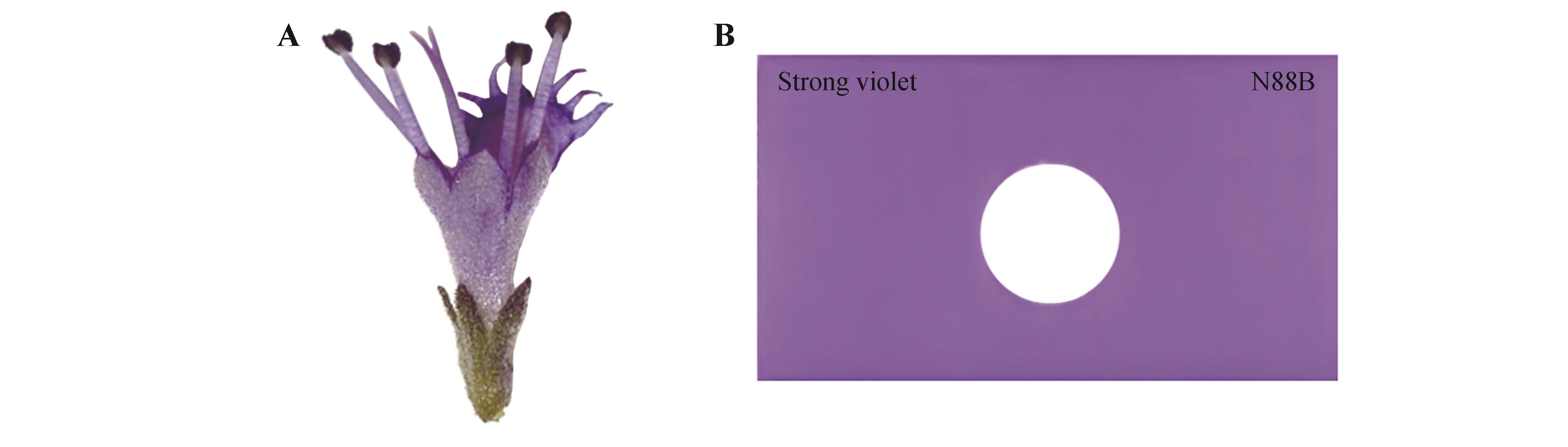
表1
兰香草花挥发性成分组成
序号 No. | 化合物名称 Compound name | 英文名称 English name | 化学式 Molecular formula | 化合物编号 CAS # | 相对含量 Relative content/% |
|---|---|---|---|---|---|
| 1 | 右旋-柠檬烯 | D-Limonene | C10H16 | 5989-27-5 | 36.80 |
| 2 | 顺乙酸-3-己烯酯 | 3-Hexen-1-ol, acetate | C8H14O2 | 1708-82-3 | 10.97 |
| 3 | (烯醇) | (E)-p-2,8-Menthadien-1-ol | C10H16O | 7212-40-0 | 6.64 |
| 4 | 异香芹醇 | Isocarveol | C10H16O | 35907-10-9 | 5.97 |
| 5 | 顺式-异香芹醇 | (Z)-isocarveol | C10H16O | 22626-43-3 | 5.80 |
| 6 | 3-己烯-1-醇 | 3-Hexen-1-ol | C10H16O | 544-12-7 | 5.67 |
| 7 | 雪松醇 | Cedrol | C15H26O | 77-53-2 | 2.29 |
| 8 | (烯) | p-Mentha-1,5,8-triene | C10H14 | 21195-59-5 | 1.42 |
| 9 | 石竹烯 | Caryophyllene | C15H24 | 87-44-5 | 1.38 |
| 10 | β-柏木烯 | β-Cdrene | C15H24 | 546-28-1 | 1.33 |
| 11 | 左旋-香芹酮 | L-Carvone | C10H14O | 6485-40-1 | 1.19 |
| 12 | 桃金娘烯醛 | Myrtenal | C10H14O | 564-94-3 | 1.16 |
| 13 | α-古巴烯 | α-Copaene | C15H24 | 3856-25-5 | 1.06 |
| 14 | 桧烯 | Sabinene | C10H16 | 3387-41-5 | 0.93 |
| 15 | 姥鲛烷 | Norphytane | C19H40 | 1921-70-6 | 0.89 |
| 16 | 顺式-香芹醇 | cis-Carveol | C10H16O | 1197-06-4 | 0.85 |
| 17 | 2-甲基-丙酸3-羟基-2,2,4- 三甲基戊基酯 | Propanoic acid,2-methyl-, 3-hydroxy-2,2,4-trimethylpentyl ester | C12H24O3 | 77-68-9 | 0.79 |
| 18 | 桃金娘烯醇 | Myrtenol | C10H16O | 515-00-4 | 0.77 |
| 19 | 松香芹醇 | Pinocarveol | C10H16O | 5947-36-4 | 0.73 |
| 20 | 乙酸戊酯 | Pentyl acetate | C7H14O2 | 628-63-7 | 0.72 |
| 21 | α-蒎烯 | α-Pinene | C10H16 | 7785-70-8 | 0.72 |
| 22 | 苯乙烯 | Styrene | C8H8 | 100-42-5 | 0.63 |
| 23 | D-樟脑(天然) | d-2-Bornanone | C10H16O | 464-49-3 | 0.60 |
| 24 | 正壬醛 | Nonanal | C9H18O | 124-19-6 | 0.55 |
| 25 | 松香芹酮 | Pinocarvone | C10H14O | 30460-92-5 | 0.53 |
| 26 | 2-甲氧基乙酸乙酯 | β-Methoxyethyl acetate | C5H10O3 | 110-49-6 | 0.52 |
| 27 | 植烷 | Phytane | C20H42 | 638-36-8 | 0.52 |
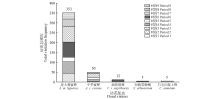
图2
各类访花昆虫对兰香草9个时段内的访花频次统计图中9个时段分别为时段1(07:00—07:15)、时段2(07:30—07:45)、时段3(08:00—08:15)、时段4(11:00—11:15)、时段5(11:30—11:45)、时段6(12:00—12:15)、时段7(15:00—15:15)、时段8(15:30—15:45)、时段9(16:00—16:15)。
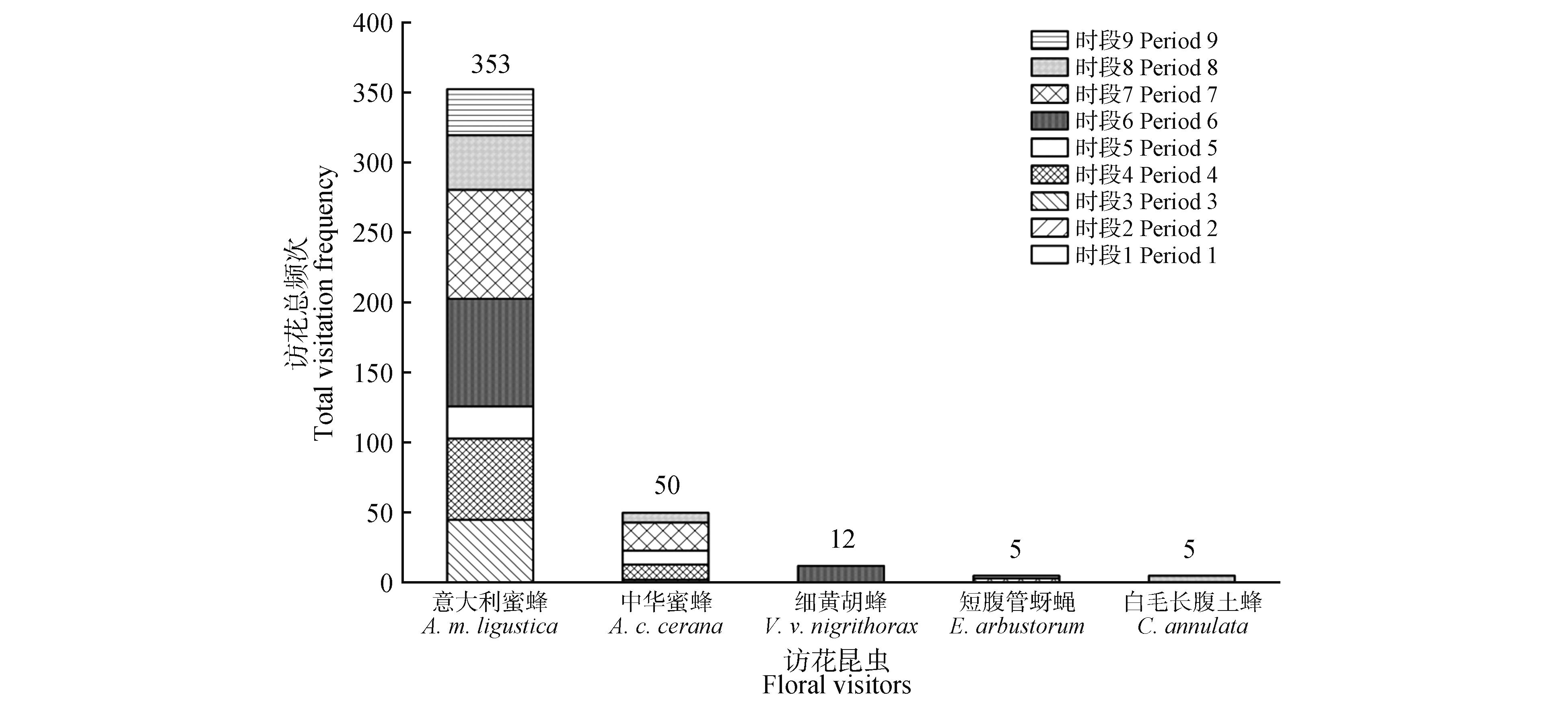
图3
各类访花昆虫对兰香草9个时段内的平均访花频次***.P<0.001,9个时段同图2注释。
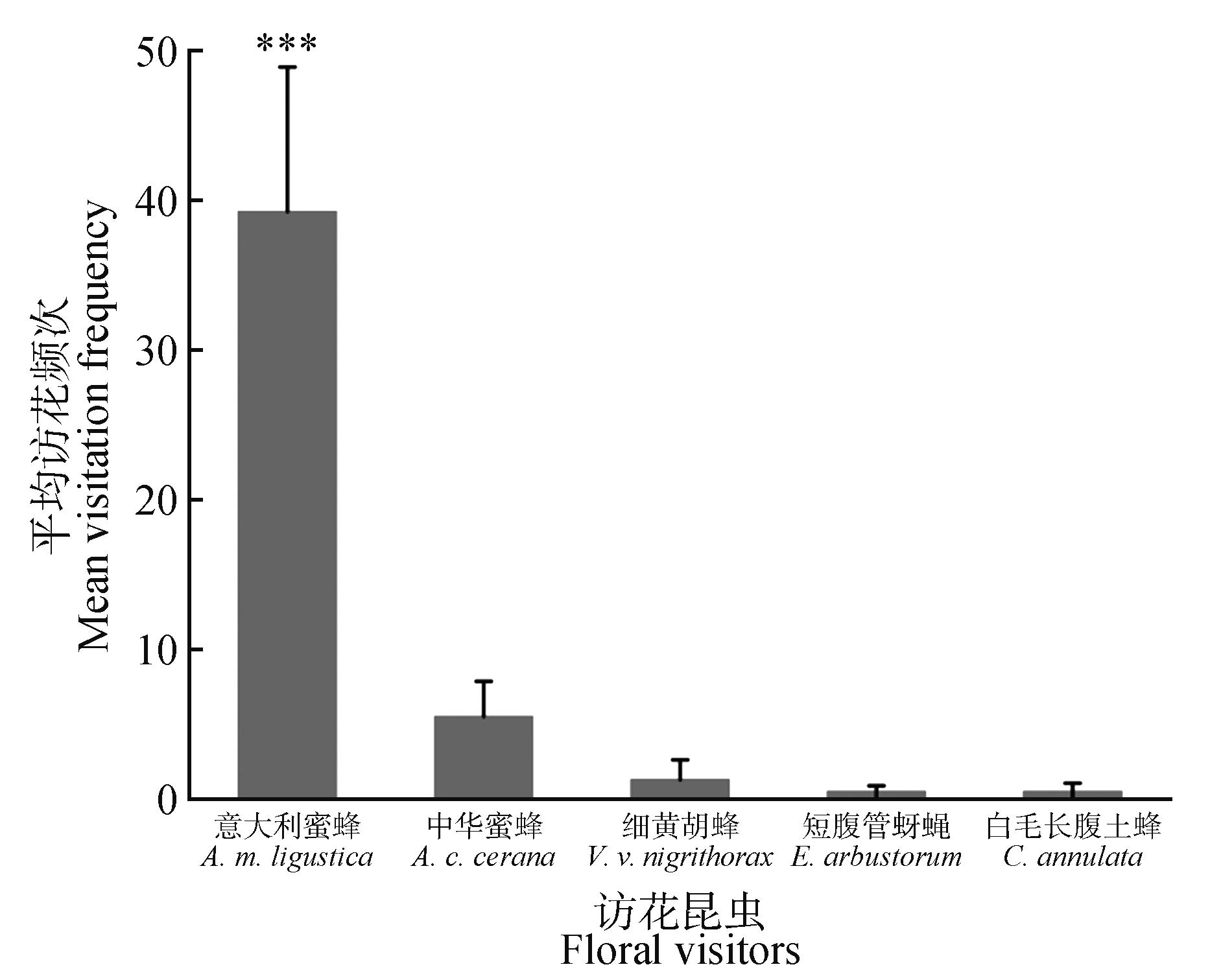
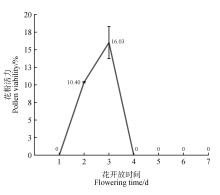
图4
兰香草花粉活力变化
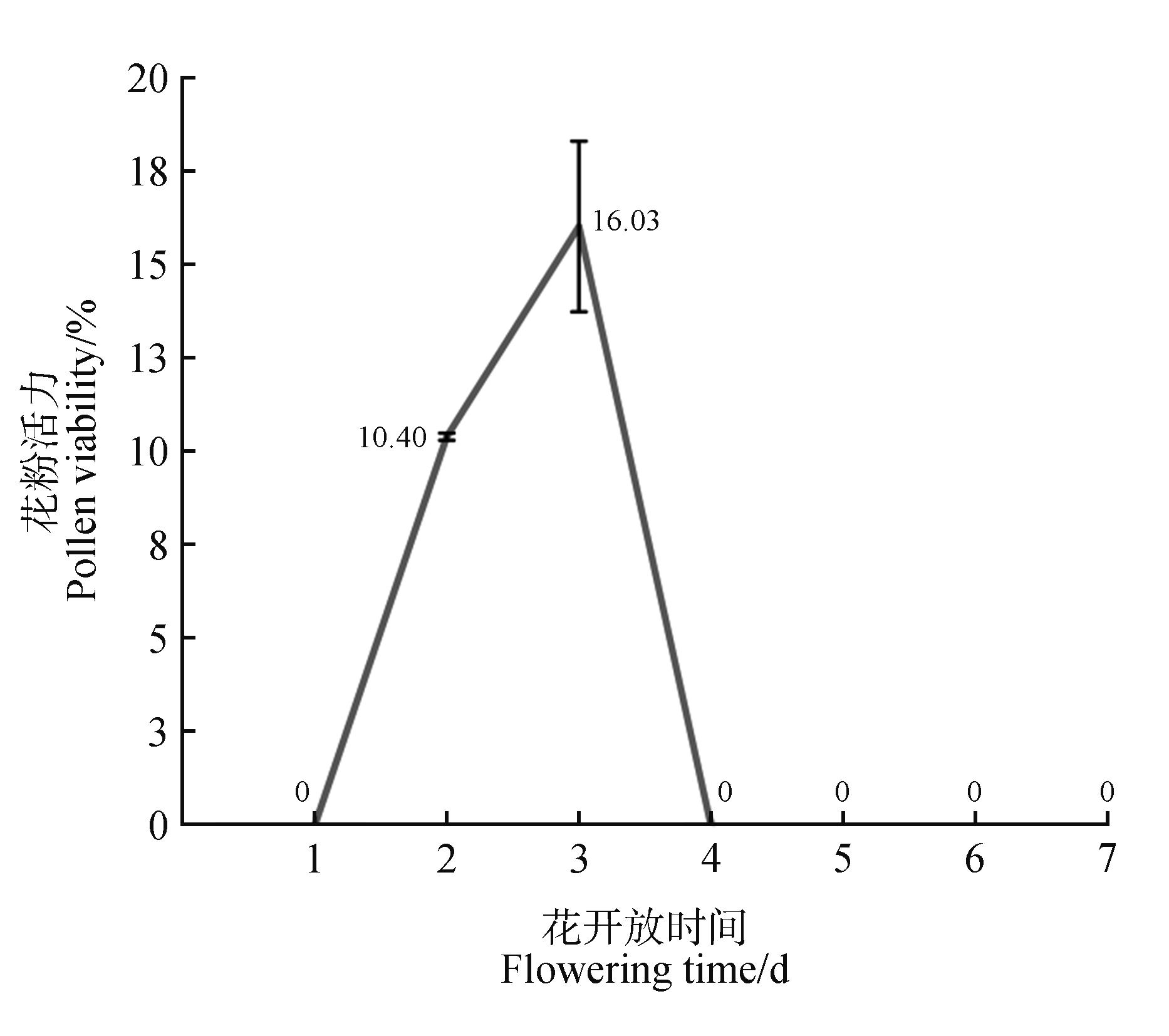
图5
兰香草花展开第1~7天花朵形态变化、花粉活力动态变化、柱头可授性变化情况从左至右依次为兰香草开放后每天的花形态展示、花粉活力检测结果、柱头可授性检测结果;A.花开放1 d;B.花开放2 d;C.花开放3 d; D.花开放4 d;E.花开放5 d;F.花开放6 d;G.花开放7 d。图5B-2、图5C-2红色箭头处指花粉被TTC染液染色为红色;图E-3红色箭头处指兰香草柱头呈现深蓝色。
| [1] | ABROL D P, GORKA A K, ANSARI M J,et al.Impact of insect pollinators on yield and fruit quality of strawberry[J].Saudi Journal of Biological Sciences,2019,26(3):524-530. |
| [2] | 任宗昕,王红,罗毅波.兰科植物欺骗性传粉[J].生物多样性,2012,20(3):270-279. |
| REN Z X, WANG H, LUO Y B.Deceptive pollination of orchids[J].Biodiversity Science,2012,20(3):270-279. | |
| [3] | CAKMAK I, SONG D S, MIXSON T A,et al.Foraging response of Turkish honey bee subspecies to flower color choices and reward consistency[J].Journal of Insect Behavior,2010,23(2):100-116. |
| [4] | LI M T, LIU J, CHEN S N,et al.VOC characterization of Byasa hedistus(Lepidoptera:Papilionidae) and its visual and olfactory responses during foraging and courtship[J].Insects,2024,15(7):548. |
| [5] | ZHANG W F, LUO Y B.Non-associative learning underlies pollination interaction of pollinators and flowering plants[J].National Science Open,2024,3(5):20230031. |
| [6] | 纪霜,杨丽,闫淑君,等.植物花部特征与访花昆虫互作关系研究进展[J].世界林业研究,2023,36(2):26-31. |
| JI S, YANG L, YAN S J,et al.Research advances in the interactions between floral traits and flower-visiting insects[J].World Forestry Research,2023,36(2):26-31. | |
| [7] | 张瑜.薜荔小蜂特异性识别薜荔挥发物的分子机制[D].上海:华东师范大学,2022. |
| ZHANG Y.Molecular mechanisms of Wiebesia pumilae recognizing specific VOCs released by Ficus pumila var.pumila[D].Shanghai:East China Normal University,2022. | |
| [8] | SCHÄFFLER I, STEINER K E, HAID M,et al.Diacetin,a reliable cue and private communication channel in a specialized pollination system[J].Scientific Reports,2015, 5:12779. |
| [9] | 匡泽宇,彭冶,方炎明.铁冬青花挥发性化合物对中华蜜蜂访花的影响[J].南京林业大学学报(自然科学版),2024,48(4):254-260. |
| KUANG Z Y, PENG Y, FANG Y M,et al.Effects of volatile organic components of Ilex rotunda on its insect pollinator,Apis cerana [J].Journal of Nanjing Forestry University (Natural Sciences Edition),2024,48(4):254-260. | |
| [10] | LAHONDÈRE C, VINAUGER C, OKUBO R P,et al.The olfactory basis of orchid pollination by mosquitoes[J].Proceedings of the National Academy of Sciences of the United States of America,2019,117(1):708-716. |
| [11] | 杜家纬.植物-昆虫间的化学通讯及其行为控制[J].植物生理学报,2001,27(3):193-200. |
| DU J W.Plant-insect chemical communication and its behavior control[J].Plant Physiology Journal,2001,27(3):193-200. | |
| [12] | 程玉芬,张志伟,贾永霞,等.对叶榕花序不同发育时期气味成分的变化及其对传粉者的吸引作用[J].热带亚热带植物学报,2019,27(3):299-308. |
| CHENG Y F, ZHANG Z W, JIA Y X,et al.Odour composition variation at different stages of Ficus hispida inflorescence and the attraction to pollinators[J].Journal of Tropical and Subtropical Botany,2019,27(3):299-308. | |
| [13] | ZHU H, QU Y K, YUAN K,et al.Temporal variation in floral scent emission of a woody plant and flower visiting behaviour of male and female flies[J].Oikos,2025(5):e10727. |
| [14] | LI J J, LUO Y Y, LI M Y,et al.Nocturnal burst emissions of germacrene D from the open disk florets of pyrethrum flowers induce moths to oviposit on a nonhost and improve pollination success[J].New Phytologist,2024,244(5):2036-2048. |
| [15] | DE CAUWER I, DELLE-VEDOVE R, BUATOIS B,et al.Striking variation of pollinator attracting scent within a highly specialized pollination system[J].Journal of Ecology,2025,113(4):856-868. |
| [16] | 李庆良,马晓开,程瑾,等.花颜色和花气味的量化研究方法[J].生物多样性,2012,20(3):308-316. |
| LI Q L, MA X K, CHENG J,et al.Quantitative studies of floral color and floral scent[J].Biodiversity Science,2012,20(3):308-316. | |
| [17] | ELIOPOULOS A G, ANGELIS A, LIAKAKOU A,et al. In vitro anti-influenza virus activity of non-polar Primula veris subsp.veris Extract[J].Pharmaceuticals,2022,15(12):1513. |
| [18] | LI M P, ZHAO X Y, XU M J.Chemical composition,antimicrobial and antioxidant activity of essential oil from Allium tenuissimum L.flowers[J].Foods,2022,11(23):3876. |
| [19] | 苏文婷.蜜蜂对梨花的采集行为及嗅觉响应机制研究[D].太谷:山西农业大学,2023. |
| SU W T.Study on foraging behavior and olfactory response mechanism of honey bees to pear flowers[D].Taigu:Shanxi Agricultural University,2023. | |
| [20] | LUKAS K, DÖTTERL S, AYASSE M,et al. Colletes hederae bees are equally attracted by visual and olfactory cues of inconspicuous Hedera helix flowers[J].Chemoecology,2023,33(5):135-143. |
| [21] | ZHANG J C, LIU J J, GAO F,et al.Electrophysiological and behavioral responses of Apis mellifera and Bombusterrestris to melon flower volatiles[J].Insects,2022,13(11):973. |
| [22] | 李欣.水仙花色素成分分析及花色差异的分子机制研究[D].上海:上海交通大学,2016. |
| LI X.Study on flower pigment composition and molecular mechanism of color difference in Narcissus [D].Shanghai:Shanghai Jiao Tong University,2016. | |
| [23] | ZHOU Z L, LING T C, ZHAO J L,et al.Parallel loss of anthocyanins triggers the incipient sympatric speciation in an alpine ginger[J].Plant Diversity,2025,47(3):429-439. |
| [24] | 张佳,李月庆,单晓彤,等.香雪兰花色花香物质合成和调控研究进展[J].植物遗传资源学报,2024,25(5):679-694. |
| ZHANG J, LI Y Q, SHAN X T,et al.The biosynthesis and regulation of floral volatile organic compounds and pigments in Freesia hybrida [J].Journal of Plant Genetic Resources,2024,25(5):679-694. | |
| [25] | 陈翠林.兰香草生物学特性及优良单株的选育研究[D].长沙:湖南农业大学,2009. |
| CHEN C L.Studing on the biology characteristic and selective breeding for the superior individuals of Caryopteris incana [D].Changsha:Hunan Agricultural University,2009. | |
| [26] | DYER A G, JENTSCH A, BURD M,et al.Fragmentary blue:resolving the rarity paradox in flower colors[J].Frontiers in Plant Science,2021,11:618203. |
| [27] | GAO J J, IGALASHI K, NUKINA M.Radical scavenging activity of phenylpropanoid glycosides in Caryopteris incana [J].Bioscience,Biotechnology,and Biochemistry,1999,63(6):983-988. |
| [28] | GAO J J, IGARASHI K, NUKINA M.Three new phenylethanoid glycosides from Caryopteris incana and their antioxidative activity[J].Chemical and Pharmaceutical Bulletin,2000,48(7):1075-1078. |
| [29] | MAO X D, CHOU G X, ZHAO S M,et al.New iridoid glucosides from Caryopteris incana (Thunb.) Miq.and their α-glucosidase inhibitory activities[J].Molecules,2016,21(12):1749. |
| [30] | ZHAO S M, CHOU G X, YANG Q S,et al.Abietane diterpenoids from Caryopteris incana (Thunb.) Miq[J].Organic & Biomolecular Chemistry,2016,14(14):3510-3520. |
| [31] | CHEN D K, ZHANG K, TAN J B,et al.A new stilbenoid from Caryopteris incana [J].Chemistry of Natural Compounds,2022,58(2):199-202. |
| [32] | CHU S S, LIU Q Z, ZHOU L G,et al.Chemical composition and toxic activity of essential oil of Caryopteris incana against Sitophilus zeamais [J].African Journal of Biotechnology,2011,10(42):8476-8480. |
| [33] | GAO G W, YIN Z, HOU Z R,et al.Chemical composition and insecticidal activities of the essential oil from Caryopteris incana(Thunb. ex Hout.) Miq. aerial parts[J].Journal of Essential Oil Bearing Plants,2020,23(3):608-615. |
| [34] | LUCZKIEWICZ M, JESIONEK A, KOKOTKIEWICZ A,et al.Production of essential oils from in vitro cultures of Caryopteris species and comparison of their concentrations with in vivo plants[J].Acta Physiologiae Plantarum,2015,37(3):58. |
| [35] | 郭春燕.蒙古莸生殖生物学研究[D].呼和浩特:内蒙古农业大学,2009. |
| GUO C Y.Study on reproductive biology of Caryopteris mongolica Bunge[D].Hohhot:Inner Mongolia Agricultural University,2009. | |
| [36] | 中国科学院中国植物志编辑委员会.中国植物志[M].北京:科学出版社,1982,65(1):198. |
| Editorial Committee of Flora of China,Chinese Academy of Sciences.Flora of China[M].Beijing:Science Press,1982,65(1):198. | |
| [37] | 梁露,孔德政,刘卓星,等.荷花花粉活力的检测方法比较分析[J].江苏农业科学,2022,50(2):131-136. |
| LIANG L, KONG D Z, LIU Z X,et al.Comparative analysis of detection methods for lotus pollen viability[J].Jiangsu Agricultural Sciences,2022,50(2):131-136. | |
| [38] | 杜学林,刘悦明,黄子锋,等.三角梅属5个品种的花粉活力及柱头可授性比较分析[J].热带作物学报,2022,43(7):1459-1466. |
| DU X L, LIU Y M, HUANG Z F,et al.Comparative analysis of pollen viability and stigma receptivity of five Bougainvillea cultivars[J].Chinese Journal of Tropical Crops,2022,43(7):1459-1466. | |
| [39] | 孙建,魏星,乐美旺,等.芝麻繁育特性研究Ⅴ:花粉活力与柱头可授性[J].西北农业学报,2020,30(10):1537-1546. |
| SUN J, WEI X, LE M W,et al.Study on breeding characteristics of Sesamum indicum L.V:pollen viability and stigma receptivity[J].Acta Agriculturae Boreali-Occidentalis Sinica,2020,30(10):1537-1546. | |
| [40] | WILLMER P.Pollination and floral ecology[M].Princeton,NJ:Princeton University Press,2011. |
| [41] | WANG H, RAN N, JIANG H Q,et al.Complex floral traits shape pollinator attraction to flowering plants in urban greenspaces[J].Urban Forestry & Urban Greening,2024,91:128165. |
| [42] | DE IBARRA N H, VOROBYEV M, MENZEL R.Mechanisms,functions and ecology of colour vision in the honeybee[J].Journal of Comparative Physiology A,2014,200(6):411-433. |
| [43] | VASAS V, PENG F, MABOUDI H,et al.Randomly weighted receptor inputs can explain the large diversity of colour-coding neurons in the bee visual system[J].Scientific Reports,2019,9:8330. |
| [44] | 唐汉青,王晓月,张子楠,等.多星韭(Allium wallichii)的传粉生态学初探[J].广西植物,2020,40(11):1613-1622. |
| TANG H Q, WANG X Y, ZHANG Z N,et al.Pollination biology of Allium wallichii [J].Guihaia,2020,40(11):1613-1622. | |
| [45] | DOBSON H E M.Relationship between floral fragrance composition and type of pollinator[M]//DUDAREVA N,PICHERSKY E.Biology of floral scent.Boca Raton,FL:CRC Press,2006:147-198. |
| [46] | 林涛,何丽云,王帆,等.马家柚花部特征及其访花昆虫种类调查[J].环境昆虫学报,2023,45(1):101-113. |
| LIN T, HE L Y, WANG F,et al.The floral characteristics and its flower-visiting insects’ species investigation of Citrus maxima(L.) Osbeck cv.‘Majiayou’[J].Journal of Environmental Entomology,2023,45(1):101-113. | |
| [47] | 杨尚桦,张猛猛,辛璇,等.柑橘类果实精油的化学成分、生物活性及其安全性的研究进展[J].现代食品科技,2026,42(2):362-374. |
| YANG S H, ZHANG M M, XIN X,et al.Research progress on the chemical constituents,biological activities,and safety of essential oils extracted from citrus fruits[J].Modern Food Science and Technology,2026,42(2):362-374. | |
| [48] | MURSITI S, LESTARI N A, FEBRIANA Z,et al.The activity of D-Limonene from sweet orange peel(Citrus sinensis L.) exctract as a natural insecticide controller of bedbugs (Cimex cimicidae)[J].Oriental Journal of Chemistry,2019,35(4):1420-1425. |
| [49] | MOHAMMED K, AGARWAL M, LI B B,et al.Evaluation of d-limonene and β-ocimene as attractants of Aphytis melinus (Hymenoptera:Aphelinidae),a parasitoid of Aonidiella aurantii (Hemiptera:Diaspididae) on Citrus spp.[J].Insects,2020,11(1):44. |
| [50] | ZIMBA K, HILL M P, MOORE S D,et al. Agathis bishopi (Hymenoptera:Braconidae) as a potential tool for detecting oranges infested with Thaumatotibia leucotreta (Lepidoptera:Tortricidae)[J].Journal of Insect Behavior,2015,28(5):618-633. |
| [51] | LIN Y W, LIN S, AKUTSE K S,et al. Diaphorina citri induces huanglongbing-infected citrus plant volatiles to repel and reduce the performance of Propylaea japonica [J].Frontiers in Plant Science,2016,7:1969. |
| [52] | SONG B Z, LIANG Y P, LIU S Z,et al.Behavioral responses of Aphis citricola (Hemiptera:Aphididae) and its natural enemy Harmonia axyridis (Coleoptera:Coccinellidae) to non-host plant volatiles[J].The Florida Entomologist,2017,100(2):411-421. |
| [53] | DE S FERNANDES N, SILVA F A N, DE ARAGÃO F A S,et al.Volatile organic compounds role in selective pollinator visits to commercial melon types[J].Journal of Agricultural Science,2019,11(3):93-108. |
| [54] | GABEL B, THIÉRY D, SUCHY V,et al.Floral volatiles of Tanacetum vulgare L. attractive to Lobesia botrana den.et schiff. females[J].Journal of Chemical Ecology,1992,18(5):693-701. |
| [55] | 时锦怡.中国几种虾脊兰属和玉凤花属植物的花挥发性成分研究[D].南昌:南昌大学,2022. |
| SHI J Y.Floral volatile compounds of several species of Calanthe and Habenaria (Orchidaceae) from China[D].Nanchang:Nanchang University,2022. | |
| [56] | 刘晋佳.意大利蜜蜂对设施番茄和甜瓜花香气味的行为响应机制研究[D].太谷:山西农业大学,2023. |
| LIU J J.Study on the behavioral response mechanism of Apis mellifera ligustica to the floral scent of tomato and melon in greenhouse[D].Taigu:Shanxi Agricultural University,2023. | |
| [57] | GÖGLER J, TWELE R, FRANCKE W,et al.Two phylogenetically distinct species of sexually deceptive orchids mimic the sex pheromone of their single common pollinator,the cuckoo bumblebee Bombus vestalis [J].Chemoecology,2011,21(4):243-252. |
| [58] | 李慧.薰衣草萜类代谢调控分子机制及对访花昆虫影响[D].北京:北京林业大学,2019. |
| LI H.Molecular mechanism of the terpenoids metabolism regulation of lavender and the influence on the flower-visiting insects[D].Beijing:Beijing Forestry University,2019. | |
| [59] | FARRÉ-ARMENGOL G, FERNÁNDEZ-MARTÍNEZ M, FILELLA I,et al.Deciphering the biotic and climatic factors that influence floral scents:a systematic review of floral volatile emissions[J].Frontiers in Plant Science,2020,11:1154. |
| [60] | OSTERMAN J, AIZEN M A, BIESMEIJER J C,et al.Global trends in the number and diversity of managed pollinator species[J].Agriculture,Ecosystems & Environment,2021,322:107653. |
| [61] | VISICK O D, RATNIEKS F L W.Density of wild honey bee,Apis mellifera,colonies worldwide[J].Ecology and Evolution,2023,13(10):e10609. |
| [62] | WANG L L, HUANG Z Y, DAI W F,et al.Mixed effects of honey bees on pollination function in the Tibetan alpine grasslands[J].Nature Communications,2024,15(1):8164. |
| [63] | DUAN Y W, LIU J Q.Floral syndrome and insect pollination of the Qinghai-Tibet Plateau endemic Swertia przewalskii (Gentianaceae)[J].Journal of Systematics and Evolution,2003,41(5):465-474. |
| [64] | 赵洪,薛勇彪.显花植物自交不亲和性的分子与演化机制[J].遗传,2024,46(1):3-17. |
| ZHAO H, XUE Y B.Molecular and evolutionary mechanisms of self-incompatibility in angiosperms[J].Hereditas(Beijing),2024,46(1):3-17. | |
| [65] | YE Z M, JIN X F, YANG J,et al.Accurate position exchange of stamen and stigma by movement in opposite direction resolves the herkogamy dilemma in a protandrous plant,Ajuga decumbens (Labiatae)[J].AoB Plants,2019,11(5):plz052. |
| [66] | ZHAO J L, DONG Y, HUANG A D,et al.Ginger genome reveals the SMPED1 gene causing sex-phase synchrony and outcrossing in a flowering plant[J].Nature Plants,2025,11:2254-2267. |
| [67] | 帖爽.秦岭地区三花莸和莸的花部特征及其传粉适应性研究[D].武汉:武汉大学,2022. |
| TIE S.Floral traits and pollination adaptation study of Caryopteris terniflora and C . divaricata in Qinling area[D].Wuhan:Wuhan University,2022. | |
| [68] | 白伟宁,张大勇.雌雄同体植物的性别干扰及其进化意义[J].植物生态学报,2005,29(4):672-679. |
| BAI W N, ZHANG D Y.Sexual interference in cosexual plants and its evolutionary implications[J].Chinese Journal of Plant Ecology,2005,29(4):672-679. |
| [1] | 蔡艳清, 陈玉军, 李玫, 邓创发, 黄烈健. 榄李开花生物学和繁育系统[J]. 植物研究, 2024, 44(1): 152-160. |
| [2] | 杨庆华, 葛斌杰, 张大生. 唇形科兰香草蓝色花粉形成观察与成分分析[J]. 植物研究, 2023, 43(5): 794-800. |
| [3] | 台昌锐, 赵凯, 阳艳芳, 吴彦, 翟伟, 童跃伟. 珍稀濒危植物细果秤锤树开花生物学特性和繁育系统[J]. 植物研究, 2023, 43(2): 311-320. |
| [4] | 杨建伟, 李宗艳, 冯尧, 任书娴, 胡梦露, 叶松菩. 束花石斛的繁育生物学特性[J]. 植物研究, 2023, 43(1): 150-160. |
| [5] | 陈兰英, 肖肖, 肖娟. 不同大花类群淫羊藿属植物的花部特征及生殖特征研究[J]. 植物研究, 2019, 39(6): 808-816. |
| [6] | 赵晓依, 王仲科, 李桂芳, 吕新华, 赵文勤, 庄丽. 多伞阿魏的繁育系统及其生态适应性[J]. 植物研究, 2019, 39(3): 321-328. |
| [7] | 李亚兰, 梁凤丽. 线叶忍冬开花动态特征与繁育系统研究[J]. 植物研究, 2016, 36(4): 503-510. |
| [8] | 赵同欣;刘林德*;张莉;王艳杰;贾兴军. 南蛇藤花粉和柱头的生物学特性研究[J]. 植物研究, 2014, 34(3): 309-316. |
| [9] | 王娅丽;王锦秀;常红宇;倪细炉;田英;秦彬彬. 枸杞新品系NQ-2开花生物学研究[J]. 植物研究, 2011, 31(3): 330-335. |
| [10] | 刘林德, 张洪军, 祝宁, 申家恒. 刺五加花粉活力和柱头可授性的研究[J]. 植物研究, 2001, 21(3): 375-379. |
| 阅读次数 | ||||||
|
全文 |
|
|||||
|
摘要 |
|
|||||