Bulletin of Botanical Research ›› 2025, Vol. 45 ›› Issue (6): 928-938.doi: 10.7525/j.issn.1673-5102.2025.06.010
• Original Paper • Previous Articles Next Articles
Jie LI1, Jingli ZHANG1, Timei SUN1, Tian BAI1, Yingmin LÜ2, Fenyong LI3, Yawen WU1( )
)
Received:2024-12-31
Online:2025-11-20
Published:2025-11-27
Contact:
Yawen WU
E-mail:yawenwu@ynau.edu.cn
CLC Number:
Jie LI, Jingli ZHANG, Timei SUN, Tian BAI, Yingmin LÜ, Fenyong LI, Yawen WU. Trait Evaluation and Hybrid Compatibility of Seven Rhododendron Species[J]. Bulletin of Botanical Research, 2025, 45(6): 928-938.
Add to citation manager EndNote|Ris|BibTeX
URL: https://bbr.nefu.edu.cn/EN/10.7525/j.issn.1673-5102.2025.06.010
Table 1
Basic information of seven Rhododendron species
种名 Species | 亚属 Subgenus | 引种来源 Introduction source |
|---|---|---|
| 大白杜鹃R. decorum | 常绿杜鹃亚属 subg. Hymenanthes | 云南普洱 Pu’er, Yunnan |
| 马缨杜鹃R. delavayi | 常绿杜鹃亚属 subg. Hymenanthes | 云南大理 Dali, Yunnan |
| 红马银花R. vialii | 马银花亚属 subg. Azaleastrum | 云南普洱 Pu’er, Yunnan |
| 映山红R. simsii | 映山红亚属 subg. Tsutsusi | 云南普洱 Pu’er, Yunnan |
| 锦绣杜鹃R. × pulchrum | 映山红亚属 subg. Tsutsusi | 江苏宿迁 Suqian, Jiangsu |
| 兴安杜鹃R. dauricum | 杜鹃亚属 subg. Rhododendron | 辽宁凤城 Fengcheng, Liaoning |
| 羊踯躅R. molle | 羊踯躅亚属 subg. Pentanthera | 云南普洱 Pu’er, Yunnan |
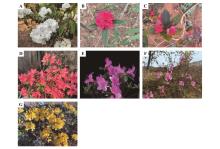
Fig.1
Morphology of seven Rhododendron speciesA. R. decorum;B. R. delavayi;C. R. vialii;D. R. simsii;E. R. × pulchrum;F. R. dauricum;G. R. molle.
Table 2
Structural model of comprehensive evaluation index system
目标层(A) Target layer | 约束层(C) Restraint layer | 标准层(P) Typical floor | 最低层(D) The lowest level |
|---|---|---|---|
7种杜鹃花观赏价值评价 Evaluation of the ornamental value of seven Rhododendron species | C1花观赏性 Floral ornamental value | P1花冠直径 Corolla diameter | D1大白杜鹃 R. decorum D2马缨杜鹃 R. delavayi D3红马银花 R. vialii D4映山红 R. simsii D5锦绣杜鹃 R. × pulchrum D6兴安杜鹃 R. dauricum D7羊踯躅 R. molle |
P2花冠形状 Corolla shape | |||
P3花形 Flower shape | |||
P4花序数量 The number of inflorescences | |||
P5花丰满度 Flowers fullness | |||
P6花期 Flowering period | |||
P7开花时间 Flowering duration | |||
P8花香 Floral fragrance | |||
C2整体观赏性 Overall plant aesthetic merit | P9株形 Plant shape | ||
P10叶形 Leaf morphology | |||
P11叶色 Leaf coloration | |||
P12叶丰满度 Leaf fullness | |||
P13绿期 Foliage retention period | |||
C3园林应用潜力 Landscape application potential | P14资源丰富度* Resource abundance | ||
P15应用现状* Current application status | |||
P16特有性* Rarity of variety |
Table 3
Scoring standards for specific evaluation indicators
标准层(P) Typical floor | 1分 Score 1 | 2分 Score 2 | 3分 Score 3 | 4分 Score 4 | 5分 Score 5 |
|---|---|---|---|---|---|
| P1 | <1 cm | 1~3 cm | 3~5 cm | 5~7 cm | >7 cm |
| P2 | 花小而无特色 Small and unremarkable flowers | 斜漏斗形 Oblique funnel-shaped | 阔漏斗形 Broad funnel-shaped | 管状,钟形 Tubular and campanulate | 花形奇特,如筒状 Unique forms (cylindrical) |
| P3 | 色彩暗淡等不明显的颜色 Dull or inconspicuous colors | 粉、浅粉等较为常见色 Common colors (pink,light pink) | 白色 White | 红、紫红等较为鲜艳色 Vivid colors (red,purple-red) | 绿色、黄色等少见色 Uncommon colors (green,yellow) |
| P4 | 1~2朵 1-2 flowers | 2~5朵 2-5 flowers | 6~10朵 6-10 flowers | 11~15朵 11-15 flowers | 15朵以上 15 flowers or more |
| P5 | <30% | 30%~40% | 50%~60% | 70%~80% | >80% |
| P6 | 春季 Spring | 夏季 Summer | 一年多季或秋季 Multiple seasons per year or autumn | ||
| P7 | 10~20 d | 20~30 d | 30~40 d | 40~50 d | 60~70 d |
| P8 | 异味 Unpleasant odor | 无味 Odorless | 清香 Light fragrance | 香 Fragrance | 浓香 Strong fragrance |
| P9 | 松散 Loose | 较松散 Moderately loose | 一般 Average | 较紧凑 Moderately compact | 紧凑 Compact |
| P10 | 小叶形,叶片长度<3 cm Small leaf shape,blade length <3 cm | 卵形,叶片长度3~5 cm Oval, blade length 3-5 cm | 披针形,叶片 长度6~10 cm Lanceolate, blade length 6-10 cm | 椭圆形,叶片 长度10 cm Elliptical, blade length >10 cm | 叶形奇特, 如基部心形等 Unique leaf shape (cordate base) |
| P11 | 叶色发黄且冬季落叶 Deciduous with yellow leaves in winter | 叶色发黄 Yellowish leaves | 叶色较淡,但常绿 Pale green but evergreen | 叶色浓绿、有光泽 Dark green and glossy | 叶色浓绿有光泽, 冬季有变色 Dark green glossy with color change in winter |
| P12 | <40% | 40%~50% | 50%~60% | 70%~80% | >80% |
| P13 | 落叶 Deciduous | 半常绿 Semi-evergreen | 常绿 Evergreen | ||
| P14 | 稀有 Rare | 少 Scarce | 较少 Moderately abundant | 较丰富 Abundant | 丰富 Very abundant |
| P15 | 无 None | 少 Limited | 较少 Moderate | 广 Wide | 极广 Extensive |
| P16 | 非特有种 Non-endemic | 中国特有 Endemic to China | 云南特有 Endemic to Yunnan |
Table 4
Comprehensive evaluation and ranking of seven Rhododendron species
种名 Species | C1花观赏性 Flower ornamental value | C2整体观赏性 Overall ornamental value | C3园林应用潜力 Landscape application potential | 综合得分 Comprehensive score | 排名 Ranking |
|---|---|---|---|---|---|
| 大白杜鹃R. decorum | 1.803 1 | 0.327 9 | 1.003 6 | 3.134 6 | 5 |
| 马缨杜鹃R. delavayi | 2.303 4 | 0.395 8 | 0.846 1 | 3.545 2 | 3 |
| 红马银花R. vialii | 1.775 8 | 0.313 8 | 0.317 6 | 2.407 2 | 6 |
| 映山红R. simsii | 2.586 2 | 0.252 3 | 0.991 1 | 3.829 6 | 2 |
| 锦绣杜鹃R. × pulchrum | 2.377 1 | 0.350 8 | 1.174 7 | 3.902 7 | 1 |
| 兴安杜鹃R. dauricum | 1.571 5 | 0.180 6 | 0.620 2 | 2.372 3 | 7 |
| 羊踯躅R. molle | 2.508 9 | 0.280 6 | 0.462 7 | 3.252 2 | 4 |
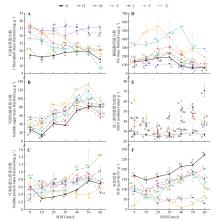
Fig.2
Effects of drought stress on physiological parameters in leaves of seven Rhododendron speciesD. R. decorum; H. R. vialii; M. R. delavayi; S. R. simsii; J. R. × pulchrum; Y. R. molle; X. R. dauricum. Different lowercase letters indicated significant differences in leaf parameter of the same species between different treatment days (P<0.05).
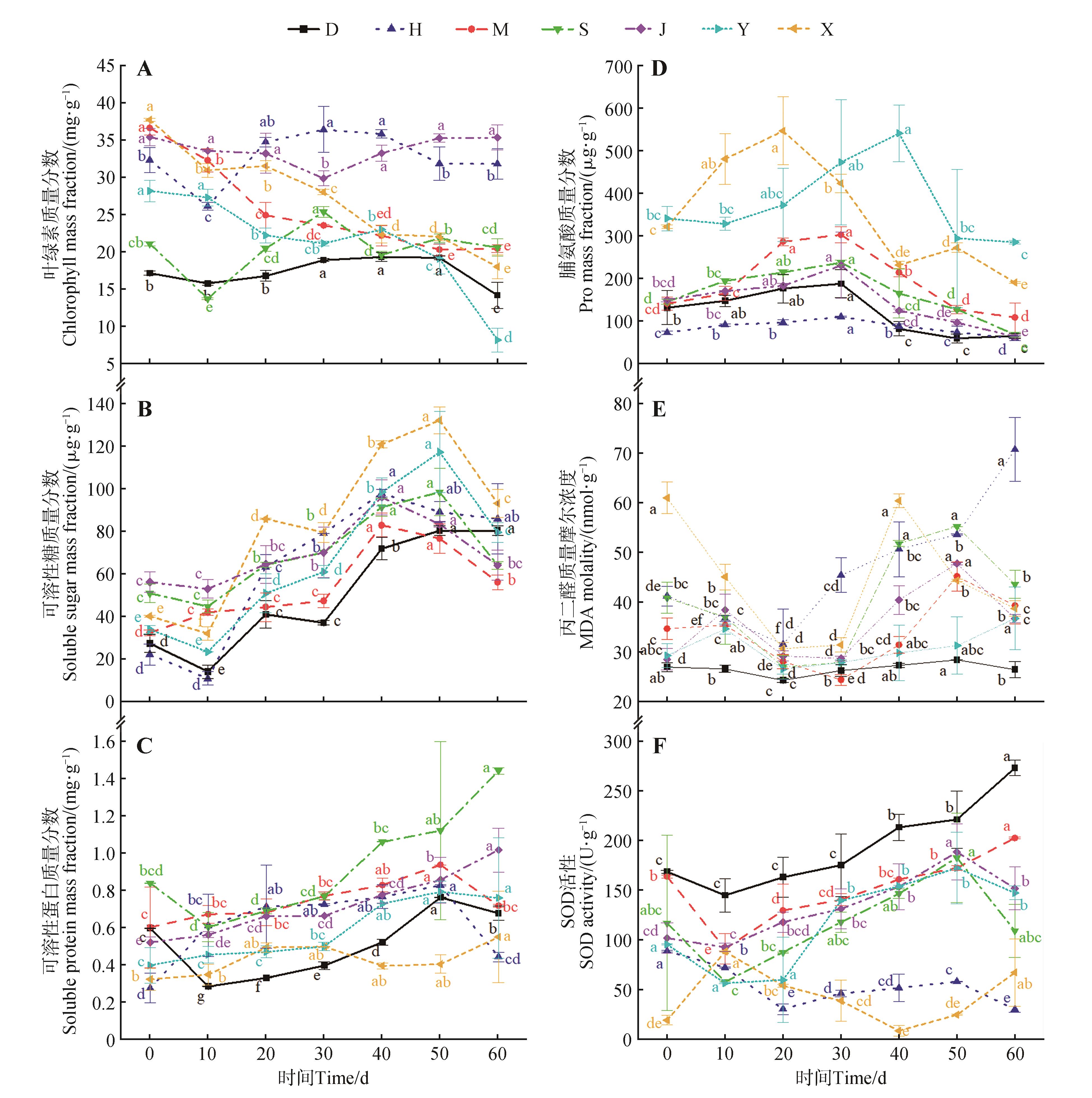
Table 5
The drought resistance membership function values and their rankings of physiological indicators of seven Rhododendron species
种名 Species | 隶属函数值 Membership function values | 排名 Ranking | ||||||
|---|---|---|---|---|---|---|---|---|
叶绿素含量 Chlorophyll content | 可溶性糖含量 Soluble sugar content | 可溶性蛋白含量 Soluble protein content | 脯氨酸含量 Proline content | MDA含量 MDA content | SOD活性 SOD activity | 平均值 Average value | ||
大白杜鹃 R. decorum | 0.032 | 0.016 | 0.345 | 0.047 | 0.123 | 1.000 | 0.260 | 7 |
马缨杜鹃 R. delavayi | 0.576 | 0.221 | 0.643 | 0.261 | 0.423 | 0.701 | 0.471 | 5 |
红马银花 R. Vialii | 0.803 | 0.333 | 0.396 | 0.339 | 1.000 | 0.138 | 0.501 | 4 |
映山红 R. simsii | 0.161 | 0.571 | 0.971 | 0.610 | 0.588 | 0.408 | 0.552 | 2 |
锦绣杜鹃 R. × pulchrum | 0.873 | 0.566 | 0.596 | 0.569 | 0.520 | 0.588 | 0.619 | 1 |
兴安杜鹃 R. dauricum | 0.667 | 0.796 | 0.094 | 0.729 | 0.713 | 0.130 | 0.521 | 3 |
羊踯躅 R. molle | 0.351 | 0.391 | 0.425 | 0.394 | 0.335 | 0.446 | 0.390 | 6 |
Table 6
Fruit setting rate of seven Rhododendron hybrid combinations
亲本(♀×♂) Parents | 授粉花朵数量 Number of pollinated flowers | 坐果数量 Number of fruit setting | 坐果率 Fruit setting rate/% |
|---|---|---|---|
马缨杜鹃×映山红 R. Delavayi × R. simsii | 110 | 30 | 27.27 |
马缨杜鹃×锦绣杜鹃 R. Delavayi × R. × pulchrum | 200 | 10 | 5.00 |
锦绣杜鹃×马缨杜鹃 R. × pulchrum × R. Delavayi | 205 | 0 | 0 |
锦绣杜鹃×映山红 R. × pulchrum × R. simsii | 85 | 0 | 0 |
大白杜鹃×马缨杜鹃 R. Decorum × R. Delavayi | 99 | 18 | 18.18 |
大白杜鹃×映山红 R. Decorum × R. simsii | 100 | 10 | 10.00 |
大白杜鹃×锦绣杜鹃 R. Decorum × R. × pulchrum | 130 | 0 | 0 |
Table 7
Germination of hybrid offspring and parent seeds of Rhododendron species
种(♀×♂) Species | 发芽率 Percentage of germination/% | 萌发高峰期 Germination peak/d | 发芽势 Germinability/% | 萌发时滞 Germination time lag/d | 发芽持续时间 germination duration/d |
|---|---|---|---|---|---|
大白杜鹃 R. decorum | 89.84±8.82ab | 13.00±0d | 34.20±9.69bc | 13.00±0c | 9.00±2.00cd |
马缨杜鹃 R. delavayi | 89.50±12.00ab | 13.00±0d | 50.30±15.05ab | 13.00±0c | 7.00±1.15d |
映山红 R. simsii | 68.04±15.14b | 19.00±1.15b | 66.65±14.18a | 15.00±0.58b | 10.00±1.73bc |
马缨杜鹃×映山红 R. delavayi × R. simsii | 100.00±0a | 14.00±0.58cd | 34.95±4.97bc | 13.00±0c | 12.00±0ab |
大白杜鹃×马缨杜鹃 R. decorum ×R. delavayi | 81.73±13.91ab | 16.00±1.15c | 59.19±13.03a | 14.00±0.58b | 12.00±1.15ab |
大白杜鹃×映山红 R. decorum × R. simsii | 39.47±0c | 22.00±2.08a | 26.32±0c | 16.00±0a | 13.00±1.00a |
| [1] | 刘德团,常宇航,马永鹏.本底资源不清严重制约我国杜鹃花属植物的生物多样性保护[J].植物科学学报,2020,38(4):517-524. |
| LIU D T, CHANG Y H, MA Y P.Unclear resource background seriously restricts biodiversity conservation of Rhododendron in China[J].Plant Science Journal,2020,38(4):517-524. | |
| [2] | 李婧,汤升虎,童琪,等.杜鹃属植物及在园林景观中的应用[J].现代园艺,2020,43(15):66-68. |
| LI J, TANG S H, TONG Q,et al. Rhododendron species and its application in garden landscape[J].Contemporary Horticulture,2020,43(15):66-68. | |
| [3] | 李婧,童琪,汤升虎,等.贵州省植物园杜鹃属植物引种初报[J].农业与技术,2021,41(11):5-7. |
| LI J, TONG Q, TANG S H,et al.Preliminary introduction of Rhododendron in the Botanical Garden of Guizhou Province[J].Agriculture and Technology,2021,41(11):5-7. | |
| [4] | POPESCU R, KOPP B.The genus Rhododendron:an ethnopharmacological and toxicological review[J].Journal of Ethnopharmacology,2013,147(1):42-62. |
| [5] | KREBS S L.Rhododendron[J].Ornamental Crops,2018:673-718. |
| [6] | ZHAO Y, HUO B J, LIN S S,et al.Germplasm innovation and establishment of comprehensive evaluation system for hedgerow garden chrysanthemum[J].Agronomy,2022,12(8):1736. |
| [7] | 李丹丹,李晓花,张乐华.杜鹃花属植物干旱胁迫研究进展[J].广西植物,2022,42(4):700-713. |
| LI D D, LI X H, ZHANG L H.Research progress of drought stress on Rhododendron [J].Guihaia,2022,42(4):700-713. | |
| [8] | 齐鸣,王俊,张明,等.5种杜鹃对干旱胁迫的生理响应及抗旱性评价[J].江西农业学报,2022,34(10):52-58. |
| QI M,W J, ZHANG M,et al.Physiological response to drought stress and drought resistance evaluation of five azalea varieties[J].Acta Agriculturae Jiangxi,2022,34(10):52-58. | |
| [9] | ANISKO T, LINDSTROM O M.Cold hardiness and water relations parameters in Rhododendron cv.catawbiense Boursault subjected to drought episodes[J].Physiologia Plantarum,1996,98(1):147-155. |
| [10] | 郑硕理,易陈燃,刘巧,等.云南几种杜鹃杂交育种初探[J].云南农业大学学报(自然科学),2016,31(6):1052-1057. |
| ZHENG S L, YI C R, LIU Q,et al.Primary study on hybridization breeding among several Rhododendron species in Yunnan Province[J].Journal of Yunnan Agricultural University (Natural Science),2016,31(6):1052-1057. | |
| [11] | 庄平.32种杜鹃花属植物亚属间杂交的可育性研究[J].广西植物,2018,38(12):1566-1580. |
| ZHUANG P.Cross fertility of inter-subgen.Rhododendron of 32 Rhododendron species[J].Guihaia,2018,38(12):1566-1580. | |
| [12] | GENG X M, YANG Q Y, YUE Y,et al.Effects of high temperature on photosynthesis,membrane lipid peroxidation and osmotic adjustment in four Rhododendron species[J].Journal of the Faculty of Agriculture,Kyushu University,2019,64(1):33-38. |
| [13] | 周丹丹.神农架杜鹃花属种质资源收集与评价[D].武汉:华中农业大学,2022. |
| ZHOU D D.Collection and evaluation of Rhododendron germplasm resources in Shennongjia[D].Wuhan:Huazhong Agricultural University,2022. | |
| [14] | 耿玉英.中国杜鹃花解读[M].北京:中国林业出版社,2008. |
| GENG Y Y.Interpretation of Chinese Rhododendron [M].Beijing:China Forestry Publishing House,2008. | |
| [15] | 夏红霞,刘李岚,周徐平,等.基于层次分析法的九寨沟震后裸岩边坡覆绿适用苔藓筛选[J].植物研究,2023,43(4):540-549. |
| XIA H X, LIU L L, ZHOU X P,et al.Selection of suitable mosses for bare rock and steep slope greening after Jiuzhaigou earthquake based on the analytic hierarchy process[J].Bulletin of Botanical Research,2023,43(4):540-549. | |
| [16] | 张平,张慧,刘俊娜,等.干旱及复水处理对抗旱性不同小麦品种/系苗期生理生化指标的影响[J].西北农业学报,2020,30(12):1795-1802. |
| ZHANG P, ZHANG H, LIU J N,et al.Effects of drought and re-watering treatment on physiological and biochemical indexes of different drought-resistant wheat varieties/lines at seedling stage[J].Acta Agriculturae Boreali-occidentalis Sinica,2020,30(12):1795-1802. | |
| [17] | 熊文艳,吴雅文,白天,等.露珠杜鹃繁育系统及杂交亲和性[J].植物研究,2024,44(3):370-379. |
| XIONG W Y, WU Y W, BAI T,et al.Breeding system and hybridization affinity of Rhododendron irroratum [J].Bulletin of Botanical Research,2024,44(3):370-379. | |
| [18] | 袁一波.藏东南杜鹃花属植物种质资源评价[D].武汉:华中农业大学,2022. |
| YUAN Y B.Evaluation of Rhododendron germplasm resources in southeast Tibet[D].Wuhan:Huazhong Agricultural University,2022. | |
| [19] | ZULINI L, RUBINIGG M, ZORER R,et al.Effects of drought stress on chlorophyll fluorescence and photosynthetic pigments in grapevine leaves (Vitis vinifera cv.‘White Riesling’)[J].Acta Horticulturae,2007,754:289-294. |
| [20] | HAZRATI S, TAHMASEBI-SARVESTANI Z, MODA-RRES-SANAVY S A M,et al.Effects of water stress and light intensity on chlorophyll fluorescence parameters and pigments of Aloe vera L.[J].Plant Physiology and Biochemistry,2016,106:141-148. |
| [21] | 高晓宁,赵冰,刘旭梅,等.4个杜鹃花品种对干旱胁迫的生理响应及抗旱性评价[J].浙江农林大学学报,2017,34(4):597-607. |
| GAO X N, ZHAO B, LIU X M,et al.Physiological response to drought stress and drought resistance evaluation of four Rhododendron cultivars[J].Journal of Zhejiang A & F University,2017,34(4):597-607. | |
| [22] | 孟盼盼,何海燕,曹钰昕,等.5个栽培类型药菊分枝期抗旱性综合评价[J].中国农业科技导报,2024,26(2):90-99. |
| MENG P P, HE H Y, CAO Y X,et al.Comprehensive evaluation of 5 cultivation types of medicinal Chrysanthemum morifolium Ramat. at branching stage[J].Journal of Agricultural Science and Technology,2024,26(2):90-99. | |
| [23] | 李畅,苏家乐,刘晓青,等.旱涝交替胁迫对杜鹃花生理特性的影响[J].江苏农业学报,2019,35(2):412-419. |
| LI C, SU J L, LIU X Q,et al.Effects of alternate flooding and drought stress on physiological characteristics in azalea[J].Jiangsu Journal of Agricultural Sciences,2019,35(2):412-419. | |
| [24] | DHINDSA R S, PLUMB-DHINDSA P, THORPE T A.Leaf senescence:correlated with increased levels of membrane permeability and lipid peroxidation,and decreased levels of superoxide dismutase and catalase[J].Journal of Experimental Botany,1981,32(1):93-101. |
| [25] | 鱼泳.干旱胁迫对七种柳树生长及生理的影响[D].呼和浩特:内蒙古农业大学,2019. |
| YU Y.Effects of drought stress on growth and physiology of seven willow species[D].Hohhot:Inner Mongolia Agricultural University,2019. | |
| [26] | 马进艳.西南特有植物大王杜鹃对干旱胁迫的响应机制研究[D].昆明:云南大学,2021. |
| MA J Y.Research on the response mechanism of Rhododendron rex,an endemic plant in southwest China,to drought stress[D].Kunming:Yunnan University,2021. | |
| [27] | 郑颖.6个新引进杜鹃品种的抗旱性评价[D].福州:福建农林大学,2018. |
| ZHENG Y.Drought resistance evaluation of six newly introduced Rhododendron varieties[D].Fuzhou:Fujian Agriculture and Forestry University,2018. | |
| [28] | 杜少波,毛晓宁,鄂崇毅,等.两种柳属植物在干旱胁迫下的生理响应研究[J].内蒙古农业大学学报(自然科学版),2025,46(2):29-37. |
| DU S B, MAO X N, E C Y,et al.Physiological respponses of two salix species to drought stress[J].Journal of Inner Mongolia Agricultural University (Natural Science Edition),2025,46(2):29-37. | |
| [29] | 赵金花,高佳荷,伊如,等.3种葱属植物野生成年植株耐旱生理响应及综合性评价[J].草地学报,2025,33(2):507-515. |
| ZHAO J H, GAO J H, YI R,et al.Comprehensive evaluation and physiological response to drought stress in three wild adult Allium L.species[J].Acta Agrestia Sinica,2025,33(2):507-515. | |
| [30] | 邹卉.高温干旱协同胁迫对杜鹃幼苗生长及生理特性的影响[D].长沙:中南林业科技大学,2021. |
| ZOU H.Effects of high temperature and drought stress on physiological characteristics of Rhododendron seedling growth[D].Changsha:Central South University of Forestry and Technology,2021. |
| [1] | Chu HUANG, Mingyue HE, Meile SUN, Yanhong CHEN, Huizhen WANG. Silicon-mediated Regulation on Polysaccharides Synthesis of Codonopsis pilosula under Drought Stress Based on EMP and TCA cycle Pathways [J]. Bulletin of Botanical Research, 2025, 45(1): 98-110. |
| [2] | Yuping LIU, Mingjun YU, Yu ZHANG, Xu SU, Xiaoli LI, Qian YANG, Xueli LIU. Cloning and Drought Tolerance Functional Validation of PvAQP Gene in Psammochloa villosa (Poaceae) [J]. Bulletin of Botanical Research, 2024, 44(6): 914-925. |
| [3] | Xinyi YU, Huiyue JI, Pingping LU, Jiayu ZHOU, Hai LIAO. The Bioinformatic Analysis on the Plant Isopentenyl Pyrophosphate Isomerase [J]. Bulletin of Botanical Research, 2024, 44(5): 774-782. |
| [4] | Xiaoqian WU, Xu HE, Jinghui GAO, Shuang LI. Germplasm Innovation and Characteristic Analysis of Transgenic PsnNAC007Populus simonii×P. nigra with High Drought Tolerance [J]. Bulletin of Botanical Research, 2024, 44(3): 349-360. |
| [5] | Fazhi FANG, Huiying GUI, Zhaojia LI, Xiaofeng ZHANG. Physiological Adaptation of Six Mangrove Seedlings to Different Salinity [J]. Bulletin of Botanical Research, 2023, 43(6): 881-889. |
| [6] | Hongxia XIA, Lilan LIU, Xuping ZHOU, Ke CHEN, Ying LI, Peigang KUANG, Geng SUN, Yanbao LEI. Selection of Suitable Mosses for Bare Rock and Steep Slope Greening after Jiuzhaigou Earthquake Based on the Analytic Hierarchy Process [J]. Bulletin of Botanical Research, 2023, 43(4): 540-549. |
| [7] | Bing GAO, Pengfei GAO, Weifang FAN, Zhenghong FENG, Jianhui WU. Effects of Cadmium Stress on the Root Structure and Physiology of Symbiont of Potentilla sericea and Arbuscular Mycorrhizal fungi [J]. Bulletin of Botanical Research, 2022, 42(4): 647-656. |
| [8] | Bin WEI, Yi LI, Shiping SU. The Effect of Exogenous Proline on the Stomata of Nitraria tangutorum Leaves under Natural Drought [J]. Bulletin of Botanical Research, 2022, 42(3): 492-501. |
| [9] | Jin-Yu LIU, Sheng-Wei LIN, Jing-Yu PAN, Qin ZHANG. Different Improved Soil Substrates on the Growth and Physiological Characters of Seedlingsfrom Trollius chinensis Bunge [J]. Bulletin of Botanical Research, 2021, 41(6): 928-937. |
| [10] | Feng HE, Hong-Yan DU, Pan-Feng LIU, Lu WANG, Jun QING, Lan-Ying DU. Effects of Drought Stress on Leaf Structure of Eucommia ulmoides [J]. Bulletin of Botanical Research, 2021, 41(6): 947-956. |
| [11] | Shuang-Hui TIAN, He CHENG, Yang ZHANG, Cong LIU, De-An XIA, Zhi-Gang WEI. Genome-wide Identification and Expressional Analysis of Carotenoid Cleavage Dioxygenases(CCD) Gene Family in Populus trichocarpa under Drought and Salt Stress [J]. Bulletin of Botanical Research, 2021, 41(6): 993-1005. |
| [12] | Yu-Qing TANG, Fei SUN, Hai-Long LIU, Sai GAO, Hong-Na LI, Jie ZHANG. Plant Screening in Dumping Site of Duobaoshan Copper Mine in Heilongjiang Based on AHP Method [J]. Bulletin of Botanical Research, 2021, 41(5): 700-711. |
| [13] | Dong ZHANG, Yan LIU, Han ZHANG, Zi-Jian ZHANG, Yang WANG, Mei-Cen LIU. Response of Photosynthesis and Leaf Morphological Characteristics to Drought Stress in Glycyrrhiza uralensis [J]. Bulletin of Botanical Research, 2021, 41(3): 449-457. |
| [14] | Xiao-Chi YU, Gui-Juan YANG, Ju-Lan DONG, Jun-Hui WANG, Wen-Jun MA, Peng ZHANG. Physiological Responses to Drought Stress of Five Speciesfrom Catalpa Scop [J]. Bulletin of Botanical Research, 2021, 41(1): 44-52. |
| [15] | Wen-Hai HU, Xiao-Hong YAN, Xiao-Hong LI, Zao-Gui CAO. Effects of 24-Epibrassinolide on the Chlorophyll Fluorescence Transient in Leaves of Pepper under Drought Stress [J]. Bulletin of Botanical Research, 2021, 41(1): 53-59. |
| Viewed | ||||||
|
Full text |
|
|||||
|
Abstract |
|
|||||