Bulletin of Botanical Research ›› 2025, Vol. 45 ›› Issue (6): 909-918.doi: 10.7525/j.issn.1673-5102.2025.06.008
• Original Paper • Previous Articles Next Articles
Shanshan ZHANG1,2,3, Sunmei RUAN1,2,3, Wenzhong YANG1,2,3( )
)
Received:2025-05-08
Online:2025-11-20
Published:2025-11-27
Contact:
Wenzhong YANG
E-mail:wzyang2004@126.com
CLC Number:
Shanshan ZHANG, Sunmei RUAN, Wenzhong YANG. Genetic Diversity Evaluation and Core Germplasm Construction of Camellia fascicularis[J]. Bulletin of Botanical Research, 2025, 45(6): 909-918.
Add to citation manager EndNote|Ris|BibTeX
URL: https://bbr.nefu.edu.cn/EN/10.7525/j.issn.1673-5102.2025.06.008
Table 1
Sampling information and genetic diversity analysis
种群 Population | 类型 Type | 样本量 Sample size | 期望杂合度 HE | 观测杂合度 HO | 核苷酸多样性 Pi | 近交系数 Fis |
|---|---|---|---|---|---|---|
| MG | 野生种群 Wild population | 46 | 0.292 5 | 0.406 7 | 0.449 8 | 0.090 1 |
| HK | 2 | 0.142 3 | 0.273 4 | 0.270 5 | -0.004 3 | |
| MZ | 5 | 0.206 7 | 0.349 1 | 0.352 6 | 0.006 1 | |
| KMSMY | 迁地保护种群 Ex situ population | 50 | 0.292 4 | 0.443 1 | 0.437 5 | 0.005 5 |
| WSSMY | 30 | 0.229 4 | 0.357 4 | 0.352 0 | 0 | |
物种水平 Species level | 133 | 0.397 3 | 0.502 2 | 0.559 5 | 0.143 8 | |
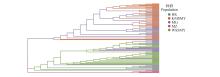
Fig.1
Phylogenetic tree of C. fascicularis individuals
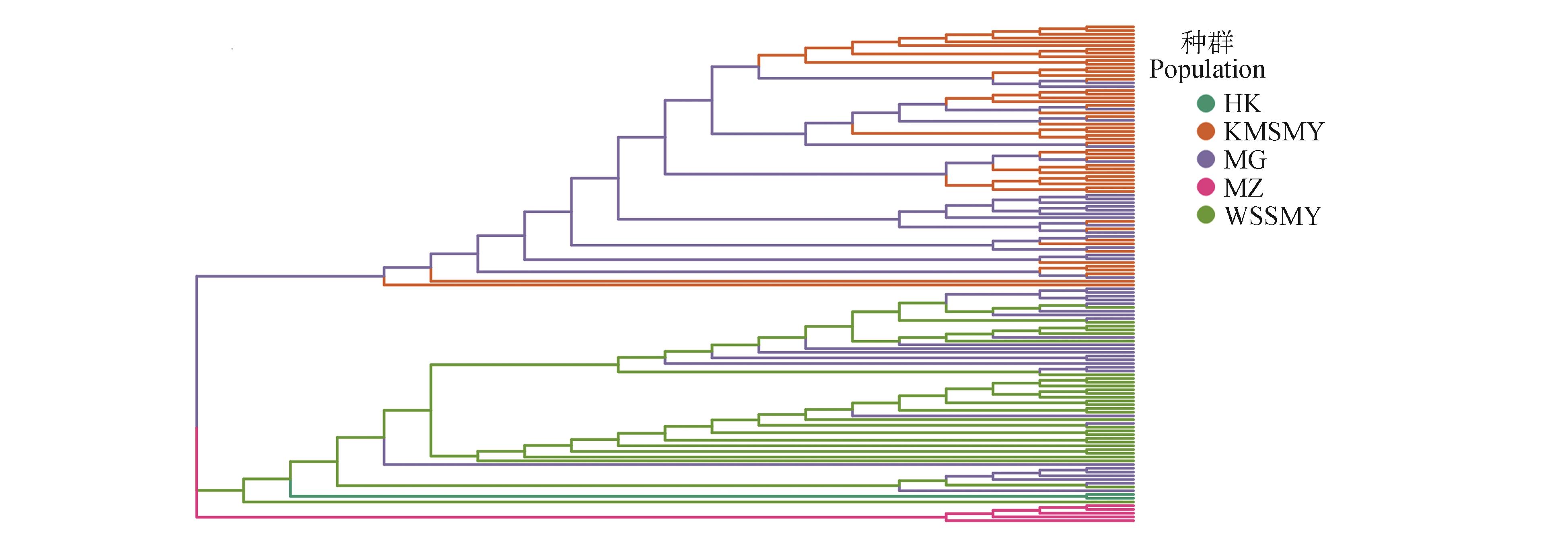
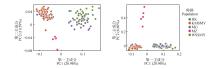
Fig.2
Principal component analysis (PCA) of C. fascicularis individuals
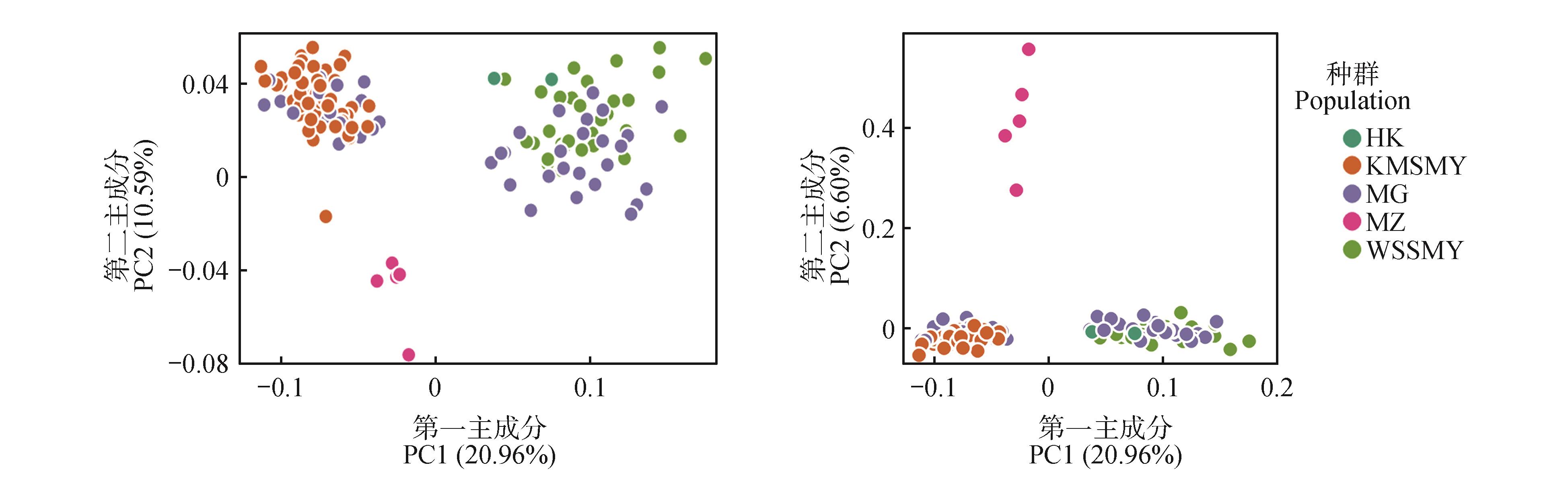
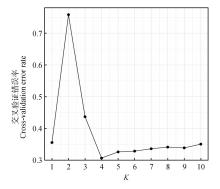
Fig.3
The cross-validation error rate corresponding to the different K values of C. fascicularis populations
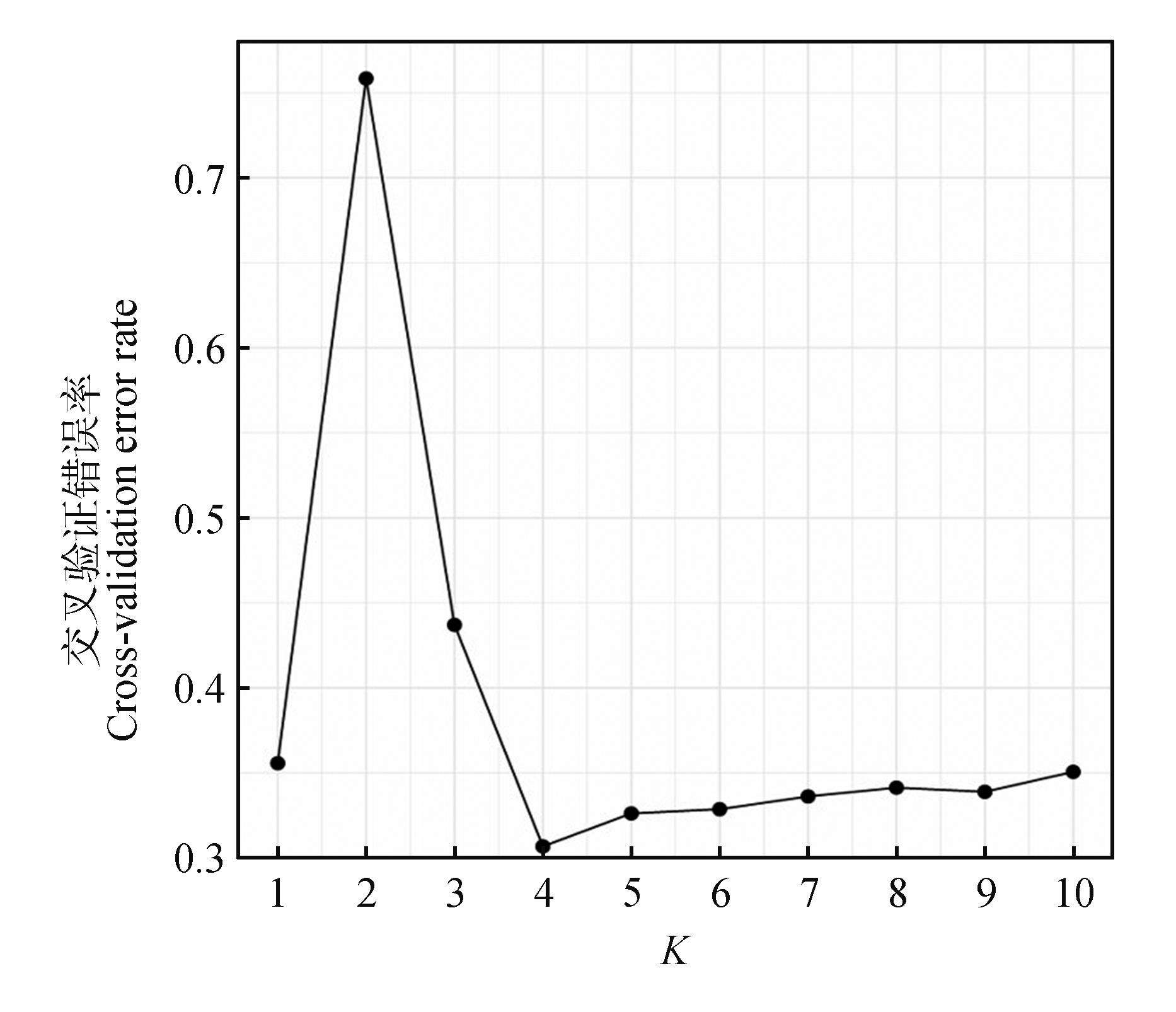
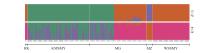
Fig.4
Cluster analysis of ex-situ conservation and wild populations of C. fascicularisEach color represented a population, and each vertical bar represented an individual; the width of each vertical bar indicated its proportion within the ancestral population.
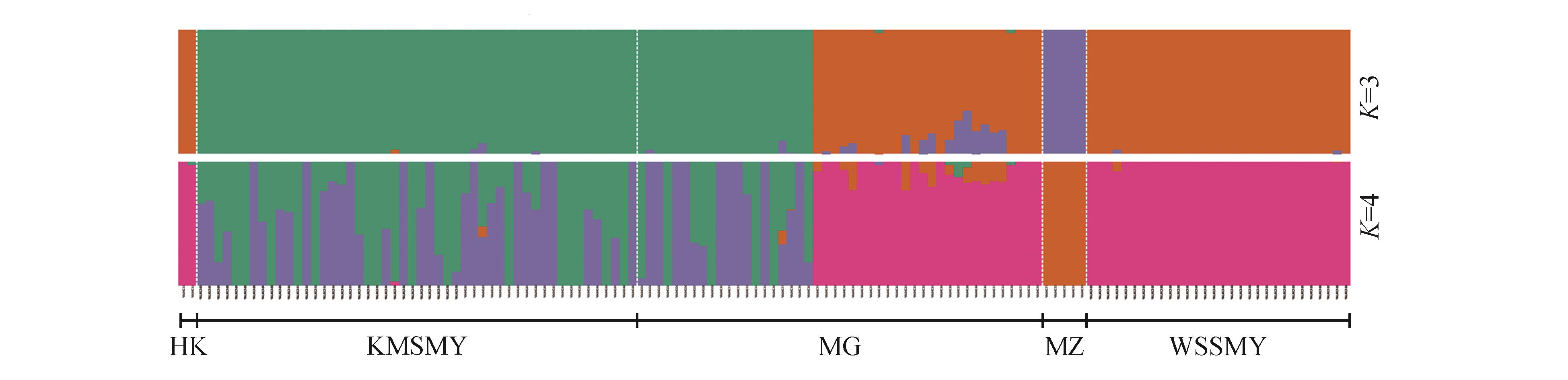
Fig.5
Genetic differentiation coefficients of five C. fasci-cularis populations
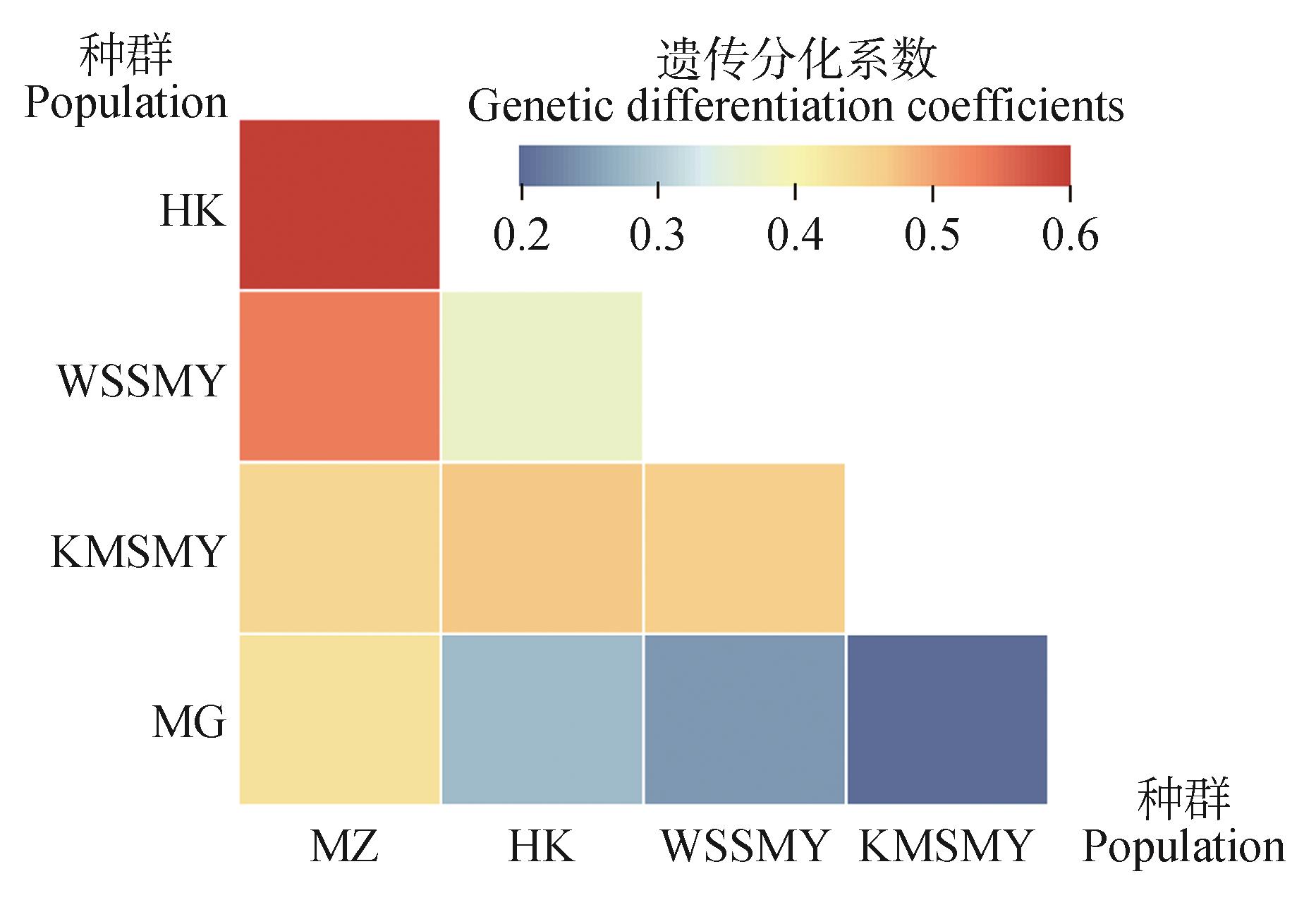
Fig.6
Core germplasm resources extraction of C. fascicularis
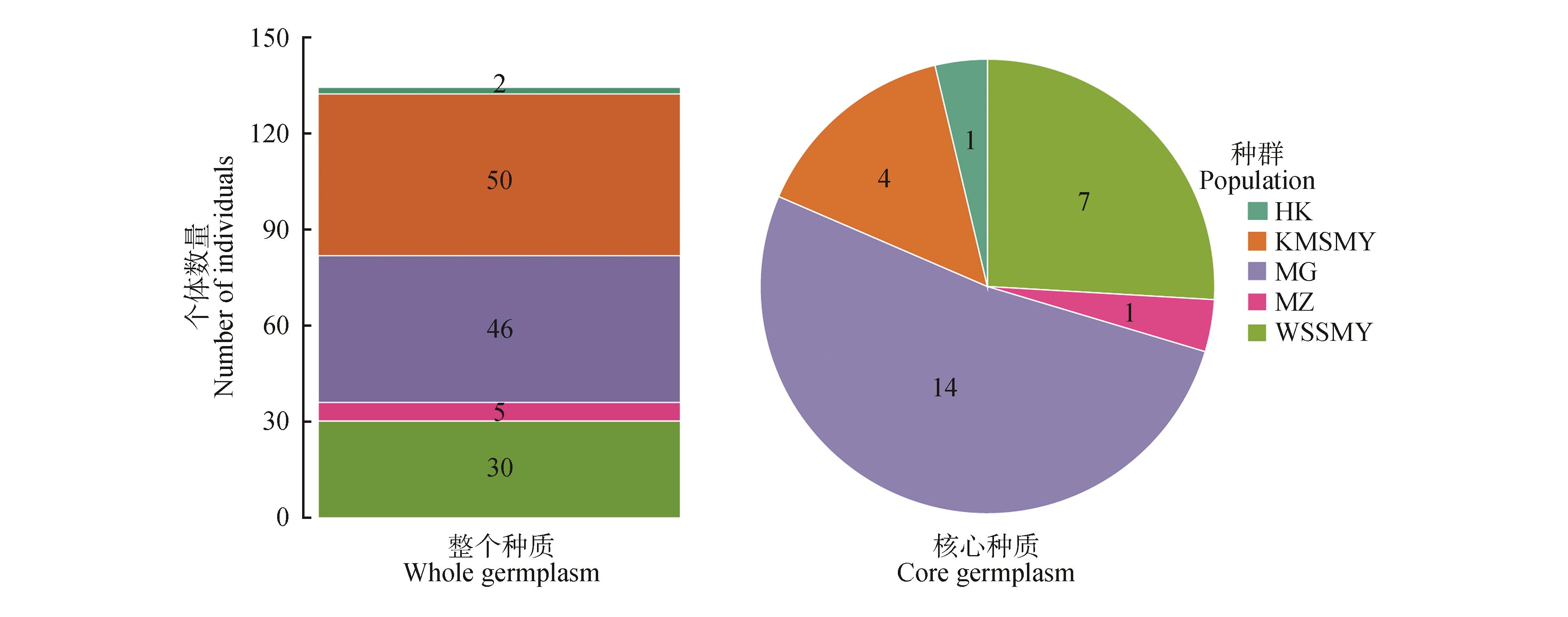
Table 2
Comparative analysis of genetic diversity of 133 germplasm and 27 core germplasm resources
类型 Type | 样本量 Sample size | 遗传相似系数 Genetic similarity coefficient | 遗传距离 Genetic distance | ||||
|---|---|---|---|---|---|---|---|
最小值 Min. | 最大值 Max. | 平均值 Average | 最小值 Min. | 最大值 Max. | 平均值 Average | ||
整个种质 Whole germplasm | 133 | 0.202 6 | 0.995 8 | 0.750 6 | 0.004 2 | 0.797 4 | 0.249 4 |
核心种质 Core germplasm | 27 | 0.392 4 | 0.934 4 | 0.732 0 | 0.065 6 | 0.607 6 | 0.268 0 |
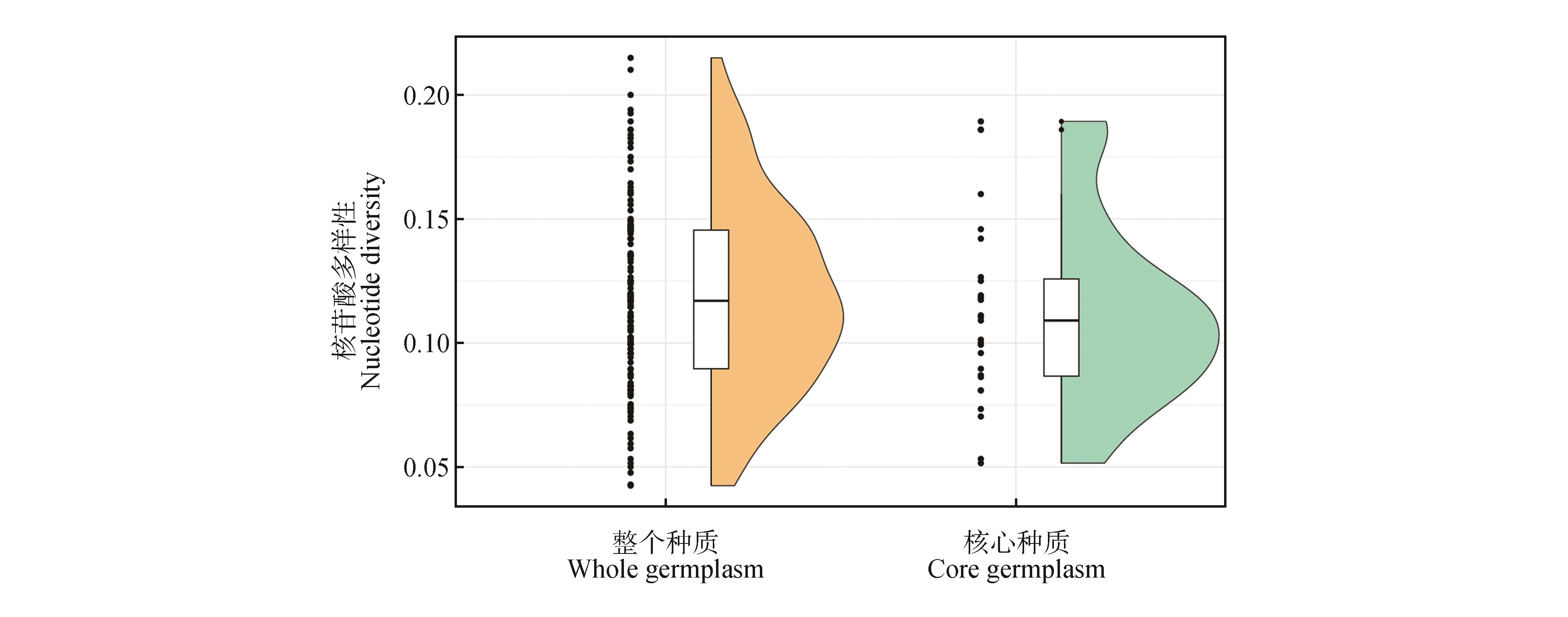
Fig.7
Nucleotide diversity of the whole and core germplasm resources of C. fascicularis
| [1] | 郑进烜,蔡文婧,郑静楠,等.云南省极小种群野生植物拯救保护规划研究[J].林业调查规划,2024,49(1):151-155. |
| ZHENG J X, CAI W J, ZHENG J N,et al.Rescue and conservation planning of wild plant species with extremely small populations in Yunnan Province[J].Forest Inventory and Planning,2024,49(1):151-155. | |
| [2] | 贾淇宇,刘雄盛,廖南燕,等.极小种群野生植物狭叶坡垒种群结构与动态特征[J].西南农业学报,2024,37(5):1078-1086. |
| JIA Q Y, LIU X S, LIAO N Y,et al.Population structure and dynamics characteristics of an extremely small population plant Hopea chinensis(Merr.) Hand.-Mazz.[J].Southwest China Journal of Agricultural Sciences,2024,37(5):1078-1086. | |
| [3] | 王欢利,严灵君,黄犀,等.南京椴群体遗传多样性和遗传结构分析[J].南京林业大学学报(自然科学版),2023,47(1):145-153. |
| WANG H L, YAN L J, HUANG X,et al.Genetic diversity and genetic structure of Tilia miqueliana population[J].Journal of Nanjing Forestry University(Natural Sciences Edition),2023,47(1):145-153. | |
| [4] | 张珊珊,陈剑,杨文忠.应用简化基因组技术对富民枳遗传多样性检测[J].东北林业大学学报,2020,48(4):36-41. |
| ZHANG S S, CHEN J, YANG W Z.Genetic diversity analysis of Poncirus polyandra by reduced-representation sequencing technique[J].Journal of Northeast Forestry University,2020,48(4):36-41. | |
| [5] | CIBRIAN-JARAMILLO A, HIRD A, OLEAS N,et al.What is the conservation value of a plant in a botanic garden? Using indicators to improve management of ex situ collections[J].The Botanical Review,2013,79(4):559-577. |
| [6] | ZHU X L, ZOU R, QIN H Z,et al.Genome-wide diversity evaluation and core germplasm extraction in ex situ conservation:a case of golden Camellia tunghinensis [J].Evolutionary Applications,2023,16(9):1519-1530. |
| [7] | WEI X Z, JIANG M X.Meta-analysis of genetic representativeness of plant populations under ex situ conservation in contrast to wild source populations[J].Conservation Biology,2021,35(1):12-23. |
| [8] | 赵锶琪,李斌,张贵良,等.提高云南金花茶组培苗移栽成活率的方法[J].中国林副特产,2017(4):57-58. |
| ZHAO S Q, LI B, ZHANG G L,et al.Methods for improving transplanting survival rate of tissue-cultured seedlings of Camellia fascicularis [J].Forest By-Product and Speciality in China,2017(4):57-58. | |
| [9] | 刘云,付羚,张颖君,等.金花茶组植物的化学成分及保健功效研究进展[J].食品工业科技,2019,40(3):321-326. |
| LIU Y, FU L, ZHANG Y J,et al.Research progress in chemical compositions and healthy functions of genus Camellia sect.Chrysantha [J].Science and Technology of Food Industry,2019,40(3):321-326. | |
| [10] | 李斌.云南金花茶遗传多样性分析及其离体快繁研究[D].昆明:西南林业大学,2019. |
| LI B.Study on genetic diversity analysis and rapid propagation in vitro of Camellia fascicularis [D].Kunming:Southwest Forestry University,2019. | |
| [11] | ZOU M L, XIA Z Q.Hyper-seq:a novel,effective,and flexible marker-assisted selection and genotyping approach[J].The Innovation,2022,3(4):100254. |
| [12] | 方萍萍,张婷,韦静,等.64份白辣椒种质资源的遗传多样性分析[J].浙江农业科学,2024,65(5):1056-1063. |
| FANG P P, ZHANG T, WEI J,et al.Genetic diversity analysis of 64 white-fruited pepper germplasm resources[J].Journal of Zhejiang Agricultural Sciences,2024,65(5):1056-1063. | |
| [13] | MCKENNA A, HANNA M, BANKS E,et al.The Genome Analysis Toolkit:a MapReduce framework for analyzing next-generation DNA sequencing data[J].Genome Research,2010,20(9):1297-1303. |
| [14] | DANECEK P, AUTON A, ABECASIS G,et al.The variant call format and VCFtools[J].Bioinformatics,2011,27(15):2156-2158. |
| [15] | ROCHETTE N C, RIVERA-COLÓN A G, CATCHEN J M.Stacks 2:analytical methods for paired-end sequencing improve RADseq-based population genomics[J].Molecular Ecology,2019,28(21):4737-4754. |
| [16] | PRICE M N, DEHAL P S, ARKIN A P.FastTree 2-approximately maximum-likelihood trees for large alignments[J].PLoS One,2010,5(3):e9490. |
| [17] | CHANG C C, CHOW C C, TELLIER L C,et al.Second-generation PLINK:rising to the challenge of larger and richer datasets[J].GigaScience,2015,4(1):7. |
| [18] | ALEXANDER D H, NOVEMBRE J, LANGE K.Fast model-based estimation of ancestry in unrelated individuals[J].Genome Research,2009,19(9):1655-1664. |
| [19] | De BEUKELAER H, DAVENPORT G F, FACK V.Core Hunter 3:flexible core subset selection[J].BMC Bioinformatics,2018,19:203. |
| [20] | 田星,李中霁,刘小莉,等.基于SSR分子标记的灯盏花遗传多样性分析[J].中国实验方剂学杂志,2021,27(18):136-143. |
| TIAN X, LI Z J, LIU X L,et al.Genetic diversity analysis of erigeron breviscapus based on SSR markers[J].Chinese Journal of Experimental Traditional Medical Formulae,2021,27(18):136-143. | |
| [21] | 秦斗文,刘伟强,田吉婷,等.基于SRAP分子标记的郁金香遗传多样性分析[J].植物研究,2024,44(5):783-792. |
| QIN D W, LIU W Q, TIAN J T,et al.Genetic diversity analysis of tulip based on SRAP markers[J].Bulletin of Botanical Research,2024,44(5):783-792. | |
| [22] | ZIMMERMAN S J, ALDRIDGE C L, OYLER-MCCANCE S J.An empirical comparison of population genetic analyses using microsatellite and SNP data for a species of conservation concern[J].BMC Genomics,2020,21:382. |
| [23] | CLUGSTON J A R, RUHSAM M, KENICER G J,et al.Conservation genomics of an Australian cycad Cycas calcicola,and the absence of key genotypes in botanic gardens[J].Conservation Genetics,2022,23(3):449-465. |
| [24] | ZHANG X J, LIU X F, LIU D T,et al.Genetic diversity and structure of Rhododendron meddianum,a plant species with extremely small populations[J].Plant Diversity,2021,43(6):472-479. |
| [25] | WU Q, DONG S, ZHAO Y X,et al.Genetic diversity,population genetic structure and gene flow in the rare and endangered wild plant Cypripedium macranthos revealed by genotyping-by-sequencing[J].BMC Plant Biology,2023,23(1):254. |
| [26] | 陈进,杨玺.关于植物迁地保护若干问题的讨论[J].生物多样性,2024,32(2):24064. |
| CHEN J, YANG X.Discussion on the plant ex situ conservation[J].Biodiversity Science,2024,32(2):24064. | |
| [27] | SU Z H, RICHARDSON B A, ZHUO L,et al.Divergent population genetic structure of the endangered Helianthemum (Cistaceae) and its implication to conservation in northwestern China[J].Frontiers in Plant Science,2017,7:2010. |
| [28] | WEI X, CAO H L, JIANG Y S,et al.Population genetic structure of Camellia nitidissima (Theaceae) and conservation implications[J].Botanical Studies,2008,49:147-153. |
| [29] | 常二梅,刘建锋,黄跃宁,等.岷江柏野生居群和迁地保护居群的遗传多样性比较[J].植物研究,2022, 42(5):772-779. |
| CHANG E M, LIU J F, HUANG Y N,et al.Comparison of genetic diversity between wild and ex-situ conservation populations of Cupressus chengiana [J].Bulletin of Botanical Research,2022,42(5):772-779. | |
| [30] | ACHREM M, STĘPIEŃ E, KALINKA A.Epigenetic changes occurring in plant inbreeding[J].International Journal of Molecular Sciences,2023,24(6):5407. |
| [31] | 潘文婷,孙建军,原勤勤,等.RAD-seq技术研究鹅掌楸属种源遗传多样性和遗传结构[J].林业科学,2022,58(4):74-81. |
| PAN W T, SUN J J, YUAN Q Q,et al.Analysis of genetic diversity and structure in different provenances of Liriodendron by RAD-seq technique[J].Scientia Silvae Sinicae,2022,58(4):74-81. | |
| [32] | LOVELESS M D, HAMRICK J L.Ecological determinants of genetic structure in plant populations[J].Annual Review of Ecology,Evolution,and Systematics,1984,15:65-95. |
| [33] | 张笑,郑骑坚,李忠虎,等.绞股蓝的遗传多样性和群体结构研究[J].中草药,2015,46(13):1958-1965. |
| ZHANG X, ZHENG Q J, LI Z H,et al.Genetic diversity and population structure of Gynostemma pentaphyllun [J].Chinese Traditional and Herbal Drugs,2015,46(13):1958-1965. | |
| [34] | WRIGHT S.The interpretation of population structure by F-statistics with special regard to systems of mating[J].Evolution,1965,19(3):395-420. |
| [35] | PÉREZ-ALQUICIRA J, WEHNCKE E V, GARCÍA-LOZA G A,et al.Geographic isolation and long-distance gene flow influence the genetic structure of the blue fan palm Brahea armata (Arecaceae)[J].Journal of Plant Research,2023,136(3):277-290. |
| [36] | ENßLIN A, SANDNER T M, MATTHIES D.Consequences of ex situ cultivation of plants:genetic diversity,fitness and adaptation of the monocarpic Cynoglossum officinale L.in botanic gardens[J].Biological Conservation,2011,144(1):272-278. |
| [37] | FRANKEL O H, BROWN A H D.Current plant genetic resources:a critical appraisal[C]//Genetics:new frontiers:proceedings of the XV International Congress of Genetics.New Delhi:Oxford and IBH Publishing,1984:1-11. |
| [38] | 缪黎明,王神云,邹明华,等.园艺作物核心种质构建的研究进展[J].植物遗传资源学报,2016,17(5):791-800. |
| MIAO L M, WANG S Y, ZOU M H,et al.Review of the studies on core collection for horticultural crops[J].Journal of Plant Genetic Resources,2016,17(5):791-800. |
| [1] | Douwen QIN, Weiqiang LIU, Jiting TIAN, Nan TANG, Xiuting JU. Genetic Diversity Analysis of Tulip Based on SRAP Markers [J]. Bulletin of Botanical Research, 2024, 44(5): 783-792. |
| [2] | Lei YANG, Qiumei CAO, Ying FENG, Wenjun LI. Genetic Diversity and Genetic Structure of the Rare and Endangered Plant Ferula fukanensis [J]. Bulletin of Botanical Research, 2023, 43(1): 51-58. |
| [3] | Ermei CHANG, Jianfeng LIU, Yuening HUANG, Hongli LI, Bingyan SHAN, Zeping JIANG, Xiulian ZHAO. Comparison of Genetic Diversity Between Wild and ex-situ Conservation Populations of Cupressus chengiana [J]. Bulletin of Botanical Research, 2022, 42(5): 772-779. |
| [4] | Yujie ZHANG, Pengxia SHI, Fan ZHAO, Xiaodan CHEN, Kun SUN, Hui ZHANG. Genetic Diversity Analysis from Different Geographic Populations of Linaria vulgaris var. sinensis by rpl32-trnL Fragment [J]. Bulletin of Botanical Research, 2022, 42(5): 780-789. |
| [5] | Yi-Zhong DUAN, Hai-Tao WANG, Ge-Ge ZHANG, Wei-Na YAN. Genetic Diversity of Plant Tetraenamongolica by ISSR Markers [J]. Bulletin of Botanical Research, 2021, 41(3): 466-473. |
| [6] | Dong-Xue LÜ, Xue-Jie ZHANG, Luo-Yan ZHANG, Shou-Jin FAN. Analysis of Limonium bicolor by SSRMolecular Markers in the Yellow River Delta Region [J]. Bulletin of Botanical Research, 2020, 40(6): 923-931. |
| [7] | NING Xin, JIANG Xiao-Long, DENG Min, XU Gang-Biao. Development of Microsatellite Primers of Quercus championii with RAD-seq Data [J]. Bulletin of Botanical Research, 2020, 40(4): 629-634. |
| [8] | ZHANG Zhong-Hua, SONG Xiao-Qian, TANG Zhong-Hua, LIANG Zheng-Wei. An Assessment of Phylogenetic Diversity and Dissimilarity of Halophytes Across Different Provincial Region,China [J]. Bulletin of Botanical Research, 2020, 40(3): 330-338. |
| [9] | GUAN Rui-Ting, LIU Ji-Ming, WANG Min, CHEN Jing-Zhong, WU Meng-Yao, TONG Bing-Li. Genetic Diversity of Critically Endangered Plants Petrocalamus luodianensis from Different Natural Populations [J]. Bulletin of Botanical Research, 2019, 39(5): 740-751. |
| [10] | GUO Wen-Li, LI Yi-Liang, ZHAO Fen-Cheng, TIE Jun, LIAO Fang-Yan, ZHONG Sui-Ying, LIN Chang-Ming, YE Wei-Fang. Phenotypic Genetic Diversity of Pinus elliottii×P.caribaea Morelet var. hondurensis Clones [J]. Bulletin of Botanical Research, 2019, 39(2): 259-266. |
| [11] | LIU Ji-Ming, GUAN Rui-Ting, WANG Min, CHEN Jing-Zhong, TONG Bing-Li, WU Meng-Yao. Genetic Diversity of Ampelocalamus luodianensis in Different Microhabitats [J]. Bulletin of Botanical Research, 2019, 39(1): 69-77. |
| [12] | CAI Nian-Hui, XU Yu-Lan, WANG Ya-Nan, CHEN Shi, WANG Meng-Ting, LI Gen-Qian. Genetic Diversity Characteristics in Different Dominance Hierarchies of Pinus yunnanensis Franch. Trees [J]. Bulletin of Botanical Research, 2019, 39(1): 87-95. |
| [13] | XIAO Yao, MA Wen-Jun, YI Fei, YANG Gui-Juan, WANG Qiu-Xia, WANG Ping, WANG Jun-Hui. Genetic Variation of Growth Traits and Genetic Diversity of Phenotypic Traits in Catalpa fargesii f. duclouxii Germplasm [J]. Bulletin of Botanical Research, 2018, 38(6): 843-851. |
| [14] | DI Lin-Nan, LI Xin-Rong, SONG Nan. Genetic Diversity of Gymnocarpos przewalskii Based on SCoT Markers [J]. Bulletin of Botanical Research, 2018, 38(5): 725-732. |
| [15] | HAO Jiu-Cheng, JIA Xin, MU Xiao-Hong, ZHANG Heng-Qing. Genetic Diversity between Island and Mainland Natural Populations of Polygonatum odoratum in Dalian Area by ISSR [J]. Bulletin of Botanical Research, 2017, 37(5): 709-714. |
| Viewed | ||||||
|
Full text |
|
|||||
|
Abstract |
|
|||||