Bulletin of Botanical Research ›› 2026, Vol. 46 ›› Issue (5): 948-959.doi: 10.7525/j.issn.1673-5102.2026.05.015
• Original Paper • Previous Articles Next Articles
Yongxin DAI, Chenkai NING, Peng TIAN, Zeqi LI, Xinli YANG, Lin WANG( )
Received:2026-02-05
Online:2026-08-28
Published:2026-10-10
Contact:
Lin WANG
E-mail:lwanger@163.com
CLC Number:
Yongxin DAI, Chenkai NING, Peng TIAN, Zeqi LI, Xinli YANG, Lin WANG. Water-carbon Physiological Mechanism of Alternate Fruiting of Chinese Sea Buckthorn[J]. Bulletin of Botanical Research, 2026, 46(5): 948-959.
Add to citation manager EndNote|Ris|BibTeX
URL: https://bbr.nefu.edu.cn/EN/10.7525/j.issn.1673-5102.2026.05.015
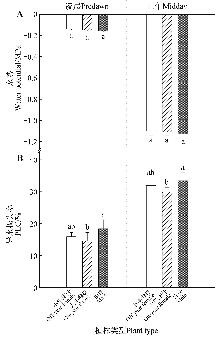
Fig.1
Branch water potential and PLC of different types of sea buckthorn plantsDifferent lowercase letters indicated significant differences in the same index among the three types of plants at the P<0.05 level.
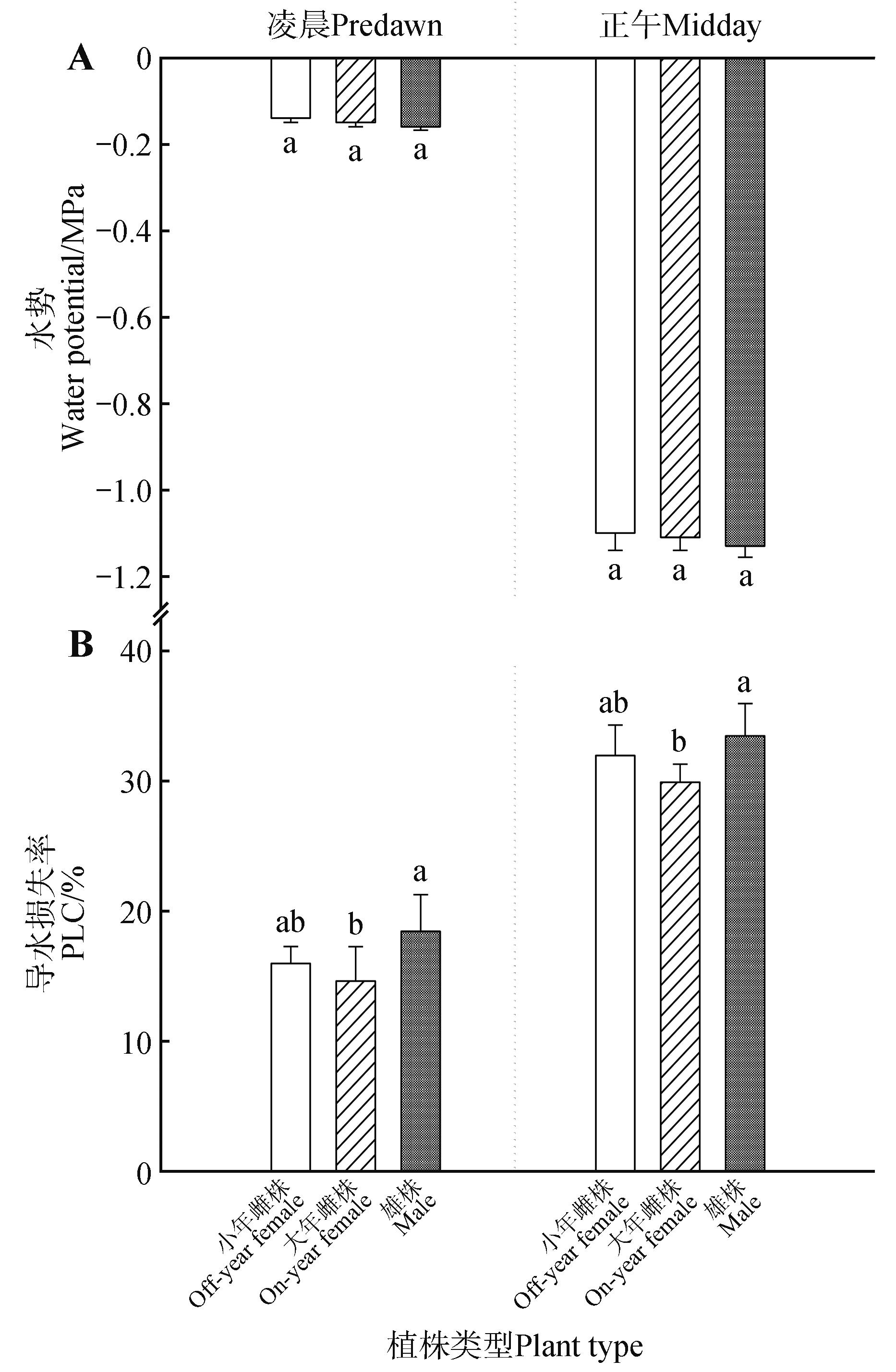
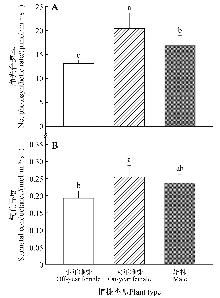
Fig.2
Leaf net photosynthetic rate and stomatal condu-ctance of different types of sea buckthorn plantsDifferent lowercase letters indicated significant differences in the same index among the three types of plants at P<0.05 level.
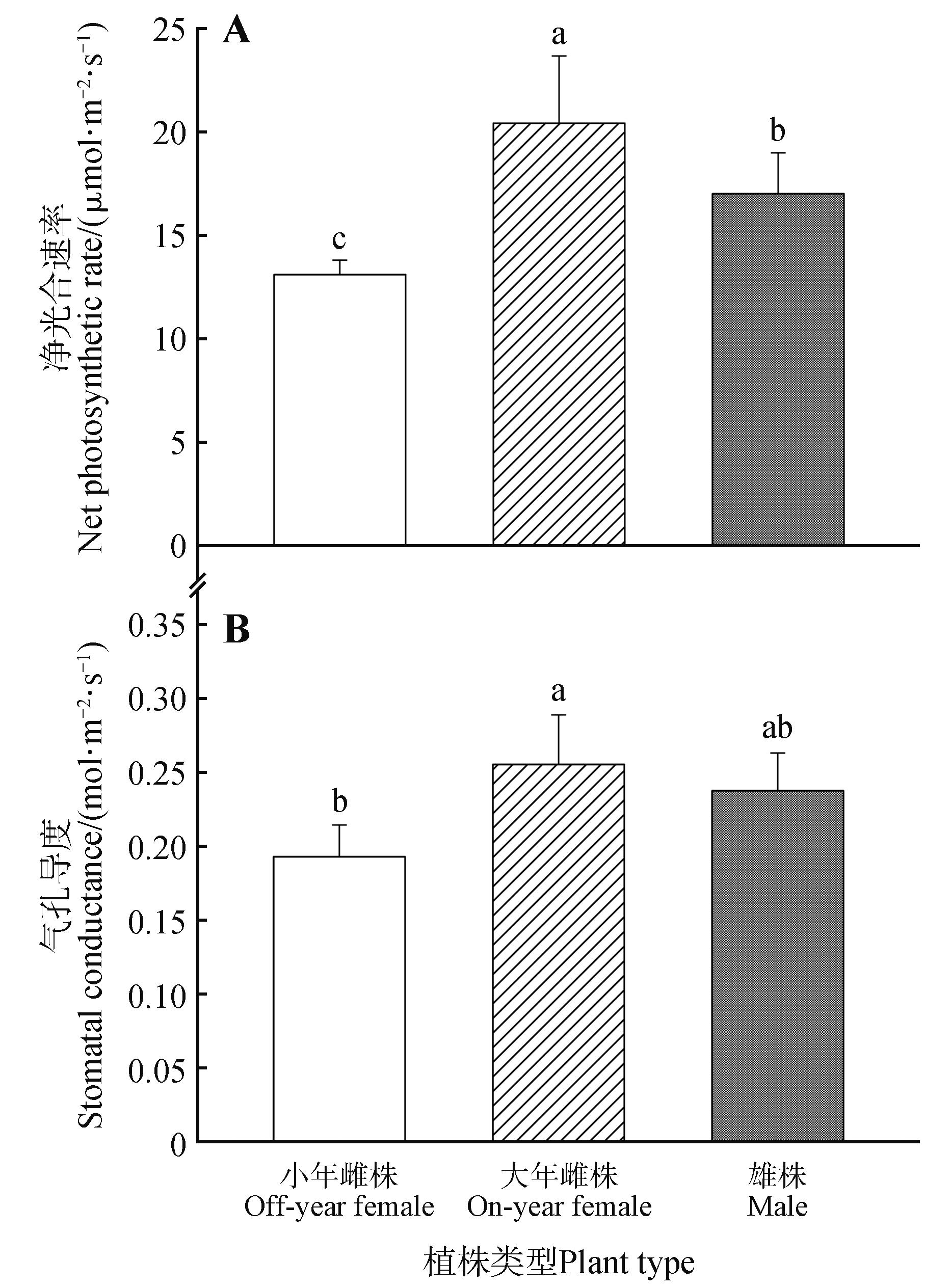
Table 1
Effects of plant type, time and interaction on morhpological and physiological indices of sea buckthorn plants
指标 Index | 植株类型 Plant type | 时间 Time | 植株类型×时间 Plant type×Time | |||
|---|---|---|---|---|---|---|
| F | P | F | P | F | P | |
| 枝韧皮部可溶性糖含量 Soluble sugar content in branch phloem | 233.257 | <0.001** | 10.350 | 0.007** | 163.805 | <0.001** |
| 枝木质部可溶性糖含量 Soluble sugar content in branch xylem | 6.051 | 0.015* | 63.852 | <0.001** | 25.029 | <0.001** |
| 叶片可溶性糖含量 Leaf soluble sugar content | 15.296 | 0.001** | 122.625 | <0.001** | 19.678 | <0.001** |
| 枝韧皮部淀粉含量 Starch content in branch phloem | 21.217 | <0.001** | 13.988 | 0.003** | 24.224 | <0.001** |
| 枝木质部淀粉含量 Starch content in branch xylem | 15.494 | <0.001** | 46.932 | <0.001** | 4.504 | 0.035* |
| 叶片淀粉含量 Leaf starch content | 24.409 | <0.001** | 131.817 | <0.001** | 40.056 | <0.001** |
| 枝韧皮部NSC含量 NSC content in branch phloem | 139.224 | <0.001** | 0.058 | 0.814 | 108.640 | <0.001** |
| 枝木质部NSC含量 NSC content in branch xylem | 17.401 | <0.001** | 100.708 | <0.001** | 18.684 | <0.001** |
| 叶片NSC含量 Leaf NSC content | 18.617 | <0.001** | 283.196 | <0.001** | 61.697 | <0.001** |
| 叶面积 Leaf area | 155.566 | <0.001** | 103.242 | <0.001** | 31.974 | <0.001** |
| 比叶质量 Leaf mass per area | 1.765 | 0.179 | 0.428 | 0.515 | 2.080 | 0.133 |
| 最大新梢长度 Maximum new shoot length | 27.119 | <0.001** | 308.375 | <0.001** | 44.419 | <0.001** |
| 新梢总数 Number of new shoots | 9.963 | 0.001** | 32.420 | <0.001** | 4.154 | 0.030* |
| >10 cm新梢总数 Number of new shoots with length >10 cm | 1.685 | 0.210 | 8.296 | 0.009** | 42.821 | <0.001** |
| >10 cm新梢基径 Base diameter of new shoots with length >10 cm | 23.529 | <0.001** | 162.697 | <0.001** | 27.396 | <0.001** |
| 芽间距 Bud spacing | 15.783 | <0.001** | 547.366 | <0.001** | 40.125 | <0.001** |
| 10 cm枝芽数量 Buds number per 10 cm branch | 5.320 | 0.008** | 51.313 | <0.001** | 11.365 | <0.001** |
| 花芽比例 Flower-to-bud ratio | 0.277 | 0.759 | 31.956 | <0.001** | 5.738 | 0.006** |
| 花芽纵径 Longitudinal diameter of flower bud | 110.105 | <0.001** | 0.632 | 0.428 | 37.054 | <0.001** |
| 花芽横径 Transverse diameter of flower bud | 105.347 | <0.001** | 12.143 | 0.001** | 26.591 | <0.001** |
| 10 cm枝结果数量 Fruits number per 10 cm branch | 99.489 | <0.001** | 24.480 | <0.001** | 12.328 | 0.002** |
| 果实纵径 Fruit longitudinal diameter | 249.038 | <0.001** | 3.646 | 0.062 | 9.996 | 0.003** |
| 果实横径 Fruit transverse diameter | 287.495 | <0.001** | 70.296 | <0.001** | 8.195 | 0.006** |
| 百果质量 Mass per 100 fruits | 904.923 | <0.001** | 631.621 | <0.001** | 183.837 | <0.001** |
| 可溶性固形物含量 Soluble solids content | 18.836 | <0.001** | 11.165 | 0.004** | 29.823 | <0.001** |
| 可滴定酸水平 Titratable acid level | 8.969 | 0.010** | 0.768 | 0.395 | 0.524 | 0.481 |
| 维生素C含量 Vitamin C content | 5.410 | 0.038* | 11.972 | 0.005** | 25.262 | <0.001** |
| 总黄酮含量 Total flavonoids content | 18.581 | 0.001** | 24.182 | <0.001** | 1.376 | 0.264 |
Fig.3
NSC contents of different types of sea buckthorn plantsA-C represented the measurements taken in September of the current year, while D-F represented those taken in April of the subsequent year. Different lowercase letters indicated significant differences in the same index among the three plant types within the same period and organ, whereas different uppercase letters indicated significant differences in the same index for the same plant type and organ between different periods(P<0.05).
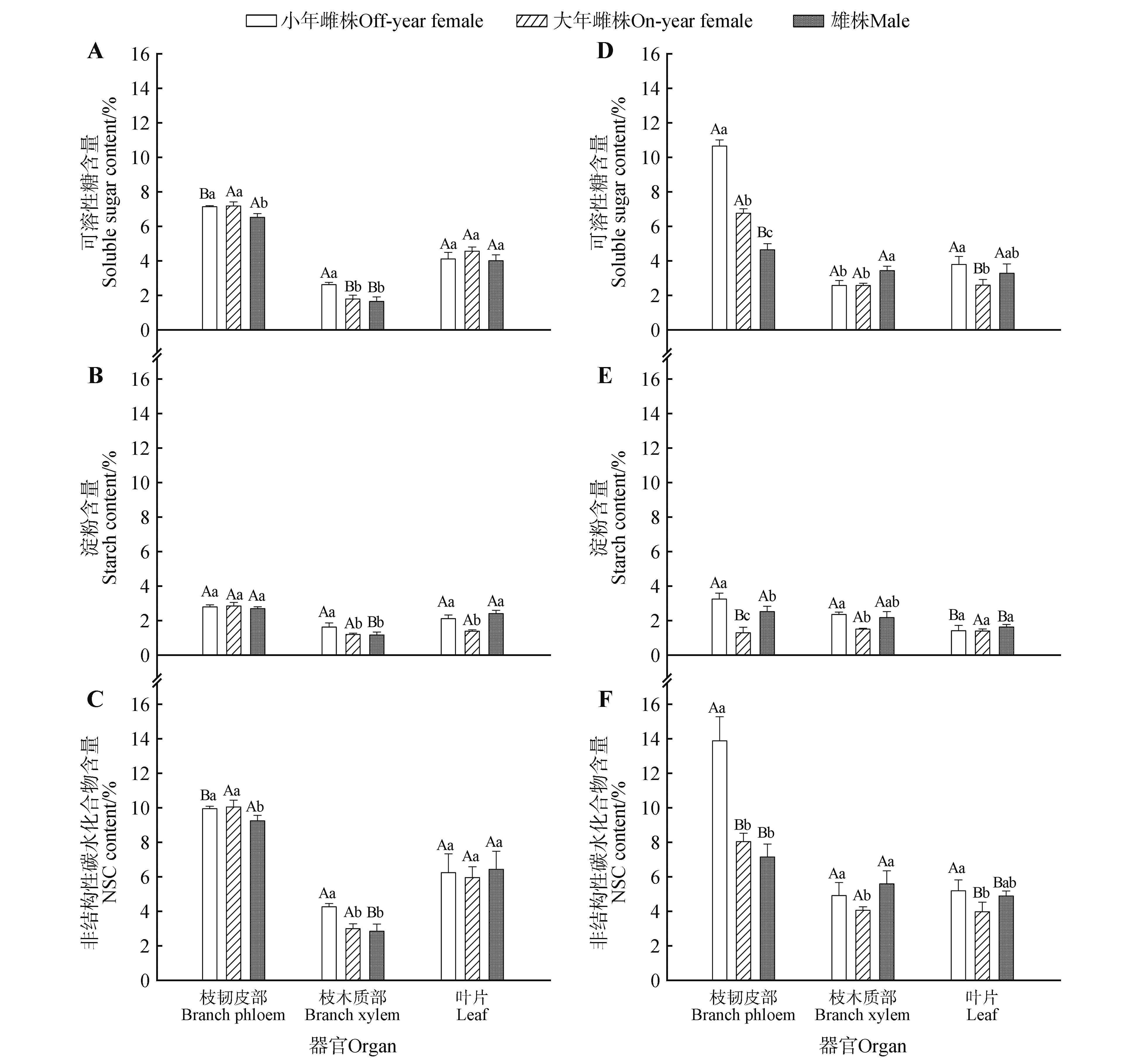
Table 2
Growth indices of leaves,branches and buds of different types of sea buckthorn
年 Year | 植株类型 Plant type | 生长指标 Growth index | |||||
|---|---|---|---|---|---|---|---|
| 叶Leaf | 枝Branch | ||||||
叶面积 Leaf area/ mm2 | 比叶质量 Leaf mass per area/ (mg·cm-2) | 新梢总数 Total number of new shoots | >10 cm新梢长度 Length of new shoots with length >10 cm/mm | >10 cm新梢总数 Number of new shoots with length >10 cm | >10 cm新梢基径 Base diameter of new shoots with length >10 cm/mm | ||
当年 Current year | 小年雌株 Off-year female | 281.51±25.38Aa | 10.29±1.42Aa | 27.83±3.76Aa | 40.83±3.96Aa | 13.17±1.17Aa | 4.08±0.46Aa |
| 大年雌株 On-year female | 149.06±20.99Bc | 10.99±1.23Aa | 26.50±1.64Aa | 31.55±4.82Bb | 8.50±1.05Ab | 3.05±0.29Ab | |
| 雄株 Male | 201.16±24.56Ab | 10.84±1.38Aa | 21.83±1.94Ab | 32.74±2.75Ab | 7.33±1.03Bb | 3.29±0.23Ab | |
次年 The next year | 小年雌株 Off-year female | 151.74±18.52Bb | 11.19±0.97Aa | 17.33±2.52Bb | 31.68±3.81Bb | 6.00±2.00Bb | 2.39±0.22Bb |
| 大年雌株 On-year female | 201.72±28.76Aa | 10.54±1.10Aa | 23.67±2.08Aa | 42.66±3.34Aa | 8.67±0.58Aa | 2.20±0.27Bb | |
| 雄株 Male | 142.74±17.42Bb | 10.06±1.50Aa | 16.33±3.79Bb | 27.12±5.89Bb | 10.33±0.58Aa | 2.97±0.19Aa | |
| 年Year | 植株类型 Plant type | 芽Bud | |||||
芽间距 Bud spacing/ cm | 10 cm枝芽数量 Buds number of 10 cm-length branch | 花芽比例 Flower-to-bud ratio/% | 花芽纵径 Longitudinal diameter of flower bud/ mm | 花芽横径 Transverse diameter of flower bud/ mm | |||
当年 Current year | 小年雌株 Off-year female | 1.30±0.11Ab | 14.00±0.86Bc | 69.08±7.00Bb | 1.80±0.10Bb | 1.65±0.12Bb | |
| 大年雌株 On-year female | 1.19±0.21Ac | 16.58±2.08Aa | 73.21±5.12Bab | 1.65±0.12Ac | 1.54±0.11Ac | ||
| 雄株 Male | 1.49±0.07Aa | 15.11±1.41Bb | 76.19±4.29Aa | 2.26±0.08Aa | 2.06±0.19Aa | ||
次年 The next year | 小年雌株 Off-year female | 0.58±0.04Bb | 17.78±3.70Aab | 84.15±3.60Aa | 2.10±0.20Ab | 2.04±0.24Ab | |
| 大年雌株 On-year female | 0.67±0.08Ba | 16.67±1.12Ab | 80.42±3.03Ab | 1.41±0.19Bc | 1.34±0.20Bc | ||
| 雄株 Male | 0.53±0.02Bb | 19.89±2.89Aa | 79.55±4.62Ab | 2.29±0.24Aa | 2.25±0.23Aa | ||
Table 3
Fruiting traits and fruit nutrient contents of different types of sea buckthorn plants
年 Year | 植株类型 Plant type | 结实性状 Fruiting traits | 果实营养成分 Fruit nutrients | ||||||
|---|---|---|---|---|---|---|---|---|---|
10 cm枝结果数量 Fruits number per 10 cm branch | 果实纵径 Fruit longitudinal diameter/mm | 果实横径 Fruit transverse diameter/mm | 百果质量 Mass per 100 fruits/g | 可溶性固形物含量 Soluble solids content/% | 可滴定酸含量 Titratable acid content/% | 维生素C质量分数 Vitamin C mass fraction/ (mg·g-1) | 总黄酮质量分数 Total flavonoid mass fraction/ (mg·g-1) | ||
当年 Current year | 小年雌株 Off-year female | 21.00±6.08Bb | 5.62±0.21Aa | 6.11±0.41Aa | 11.25±0.52Aa | 12.90±1.84Aa | 2.82±0.68Aa | 7.16±0.81Aa | 8.51±0.83Ba |
大年雌株 On-year female | 44.50±7.19Aa | 4.44±0.34Bb | 4.65±0.33Bb | 8.70±0.28Bb | 7.96±0.97Bb | 3.36±0.54Aa | 4.78±0.61Bb | 6.37±0.77Bb | |
次年 The next year | 小年雌株 Off-year female | 27.25±5.19Aa | 3.97±0.31Bb | 4.33±0.29Bb | 7.96±0.31Bb | 8.40±0.42Ba | 2.87±0.39Ab | 6.64±0.52Aa | 9.98±0.58Aa |
大年雌株 On-year female | 20.50±5.45Bb | 5.73±0.26Aa | 6.20±0.39Aa | 9.54±0.36Aa | 9.04±0.49Aa | 3.73±0.50Aa | 7.52±0.68Aa | 8.74±0.94Aa | |
| [1] | 郭学斌.山西省沙棘产业发展对策研究[J].山西林业,2020(2):4-5. |
| Guo Xuebin.Research on countermeasures for the development of sea buckthorn industry in Shanxi province [J].Forestry of Shanxi,2020(2):4-5. | |
| [2] | Šne E, Segliņa D, Galoburda R,et al.Content of phenolic compounds in various sea buckthorn parts[J].Proceedings of the Latvian Academy of Sciences,2013,67(4/5):411-415. |
| [3] | 武志博.生态经济型杂交沙棘优良单株选择研究[D].呼和浩特:内蒙古农业大学,2008. |
| Wu Zhibo.Select study on excellent individual plant of hybrid Hippophae rhamnoides of ecological and economic type[D].Hohhot:Inner Mongolia Agricultural University,2008. | |
| [4] | Adouli B, Zamani Z, Fattahi-Mohgadam M R,et al.Effects of alternate bearing and 2,4-D application on fruit growth pattern,abscission enzymes activity,ACC content of calyx and carbohydrates partitioning of fruits in Satsuma mandarin(Citrus unshiu Marc.) cv. Miyagawa[J].Scientia Horticulturae,2018,238:58-65. |
| [5] | Goldschmidt E E.Carbohydrate supply as a critical factor for Citrus fruit development and productivity[J].HortScience,1999,34(6):1020-1024. |
| [6] | Sharma N, Singh S K, Mahato A K,et al.Physiological and molecular basis of alternate bearing in perennial fruit crops[J].Scientia Horticulturae,2019,243:214-225. |
| [7] | Yanik H, Turktas M, Dundar E,et al.Genome-wide identification of alternate bearing-associated microRNAs (miRNAs) in olive (Olea europaea L.)[J].BMC Plant Biology,2013,13(1):10. |
| [8] | 张松文.富士响应外源GA3和“大小年结果信号”花芽孕育的生理分子机制[D].杨凌:西北农林科技大学,2016. |
| Zhang Songwen.Physiological and molecular responses of “fuji” apple (Malus domestica borkh.) to GA3 application and alternate bearing signal during floral bud differentiation[D].Yangling:Northwest A & F University,2016. | |
| [9] | Garcia G M, Orians C M.Reproductive tradeoffs in a perennial crop:exploring the mechanisms of coffee alternate bearing in relation to farm management[J].Agriculture,Ecosystems & Environment,2022,340:108151. |
| [10] | Monerri C, Fortunato-Almeida A, Molina R V,et al.Relation of carbohydrate reserves with the forthcoming crop,flower formation and photosynthetic rate,in the alternate bearing ‘Salustiana’ sweet orange(Citrus sinensis L.)[J].Scientia Horticulturae,2011,129(1):71-78. |
| [11] | Ruehr N K, Grote R, Mayr S,et al.Beyond the extreme:recovery of carbon and water relations in woody plants following heat and drought stress[J].Tree Physiology,2019,39(8):1285-1299. |
| [12] | 王俪玢,黄云浩,张新娜,等.雌雄异株树种簇毛槭的生殖成功影响因子研究[J].林业科学研究,2020,33(6):114-120. |
| Wang Lifen, Huang Yunhao, Zhang Xinna,et al.Factors affecting reproductive success in dioecious tree,Acer barbinerve [J].Forest Research,2020,33(6):114-120. | |
| [13] | 沙波.内源激素、水分和氮磷钾含量与银杏大小年结实的关系[D].南宁:广西大学,2006. |
| Sha Bo.The relationship between biennial fruiting and contents of endogenous hormones,moisture,nitrogen,phosphorus and potassium of Ginkgo biloba [D].Nanning:Guangxi University,2006. | |
| [14] | Mantova M, Herbette S, Cochard H,et al.Hydraulic failure and tree mortality:from correlation to causation[J].Trends in Plant Science,2022,27(4):335-345. |
| [15] | Martin-StPaul N, Delzon S, Cochard H.Plant resistance to drought depends on timely stomatal closure[J].Ecology Letters,2017,20(11):1437-1447. |
| [16] | 邓楠,刘心亮,朱丽薇,等.植物气孔调节行为特征及对环境响应的碳水性状综述[J].热带亚热带植物学报,2026,34(2):235-244. |
| Deng Nan, Liu Xinliang, Zhu Liwei,et al.A review of characteristics of plant stomatal regulation behavior and its carbon-water traits in response to environment[J].Journal of Tropical and Subtropical Botany,2026,34(2):235-244. | |
| [17] | 董诗婷,陈云,高群玉.沙棘果生物活性成分及其功能的研究进展[J].中国酿造,2020,39(2):26-32. |
| Dong Shiting, Chen Yun, Gao Qunyu.Research progress on bioactive compounds and function of sea buckthorn berry[J].China Brewing,2020,39(2):26-32. | |
| [18] | Dai Y X, Wang L, Wan X C.Frost fatigue and its spring recovery of xylem conduits in ring-porous,diffuse-porous,and coniferous species in situ [J].Plant Physiology and Biochemistry,2020,146:177-186. |
| [19] | Wang A Y, Han S J, Zhang J H,et al.The interaction between nonstructural carbohydrate reserves and xylem hydraulics in Korean pine trees across an altitudinal gradient[J].Tree Physiology,2018,38(12):1792-1804. |
| [20] | 张瑜瑜,宋怀飞,刘佳妮,等.云南主栽蓝莓果实可滴定酸及抗氧化活性评价研究[J].东北农业科学,2023,48(1):124-128. |
| Zhang Yuyu, Song Huaifei, Liu Jiani,et al.Evaluation of titratable acid and antioxidant activity of blueberry fruits grown in Yunnan[J].Journal of Northeast Agricultural Sciences,2023,48(1):124-128. | |
| [21] | 陈光,孙妍.2,6-二氯靛酚滴定法测定蜂胶中维生素C[J].理化检验:化学分册,2014,50(8):1041-1042. |
| Chen Guang, Sun Yan.Determination of vitamin C in propolis by 2,6-dichlorophenol titration method[J].Physical Testing and Chemical Analysis Part B:Chemical Analysis,2014,50(8):1041-1042. | |
| [22] | 郑瑞霞,杨峻山.中国沙棘果实化学成分的研究[J].中草药,2006,37(8):1154-1155. |
| Zheng Ruixia, Yang Junshan.Research on the chemical composition of Chinese sea buckthorn fruits[J].Chinese Traditional and Herbal Drugs,2006,37(8):1154-1155. | |
| [23] | Choat B, Brodribb T J, Brodersen C R,et al.Triggers of tree mortality under drought[J].Nature,2018,558(7711):531-539. |
| [24] | Rehschuh R, Cecilia A, Zuber M,et al.Drought-induced xylem embolism limits the recovery of leaf gas exchange in Scots pine[J].Plant Physiology,2020,184(2):852-864. |
| [25] | 刘存海.黄土丘陵区典型落叶树种的水力学特性研究[D].杨凌:中国科学院大学, 2014. |
| Liu Cunhai.Study on hydraulic traits of typical deciduous trees and shrubs in loess hilly region[D].Yangling:University of Chinese Academy of Sciences,2014. | |
| [26] | Silber A, Israeli Y, Levi M,et al.The roles of fruit sink in the regulation of gas exchange and water uptake:a case study for avocado[J].Agricultural Water Management,2013,116:21-28. |
| [27] | Nebauer S G, Renau-Morata B, Lluch Y,et al.Influence of crop load on the expression patterns of starch metabolism genes in alternate-bearing Citrus trees[J].Plant Physiology and Biochemistry,2014,80:105-113. |
| [28] | 张述斌.叶果比对核桃碳水化合物同化、转运和果实生长影响的关联分析[D].乌鲁木齐:新疆农业大学,2023. |
| Zhang Shubin.Association analysis of effects of leaf-to-fruit ratio on carbohydrate assimilation,transport,and fruit growth of common walnut[D].Urumqi:Xinjiang Agricultural University,2023. | |
| [29] | Wibbe M L, Blanke M M.Effects of defruiting on source-sink relationship,carbon budget,leaf carbohydrate content and water use efficiency of apple trees[J].Physiologia Plantarum,1995,94(3):529-533. |
| [30] | Wünsche J N, Greer D H, Laing W A,et al.Physiological and biochemical leaf and tree responses to crop load in apple[J].Tree Physiology,2005,25(10):1253-1263. |
| [31] | 何诚诚,木合塔尔·扎热,艾合买提·阿布都热依木,等.不同负载量对库尔勒香梨光合效率和叶绿体超微结构的影响[J].新疆农业大学学报,2012,35(5):368-372. |
| He Chengcheng, Zhare Muhetar, Abudureyimu Aihemaiti,et al.Effects of different loading capacity on photosynthetic efficiency and chloroplasts ultra-structure in Korla fragrant pear[J].Journal of Xinjiang Agricultural University,2012,35(5):368-372. | |
| [32] | 于岩,孙秀波,车远远,等.去果、枝条环剥和新梢套袋后桃树叶片可溶性糖含量的变化对光合作用的影响[J].西北农业学报,2011,20(3):168-174. |
| Yu Yan, Sun Xiubo, Che Yuanyuan,et al.Effects of fruit removal,shoot girdling and new shoot bagging on leaf soluble sugar content and photosynthesis of peach leaves[J].Acta Agriculturae Boreali-Occidentalis Sinica,2011,20(3):168-174. | |
| [33] | Iglesias D J, Lliso I, Tadeo F R,et al.Regulation of photosynthesis through source:sink imbalance in Citrus is mediated by carbohydrate content in leaves[J].Physiologia Plantarum,2002,116(4):563-572. |
| [34] | Syvertsen J P, Goñi C, Otero A.Fruit load and canopy shading affect leaf characteristics and net gas exchange of ‘Spring’ navel orange trees[J].Tree Physiology,2003,23(13):899-906. |
| [35] | 卢敏敏,张国安,宋雯,等.沙棘雌雄株的水力结构和光合特性研究[J].天津农业科学,2024,30(12):1-5. |
| Lu Minmin, Zhang Guo’an, Song Wen,et al.Study on the hydraulic structure and photosynthetic characteristics of male and female Hippophae rhamnoides L.[J].Tianjin Agricultural Sciences,2024,30(12):1-5. | |
| [36] | Piper F I, Paula S.The role of nonstructural carbohydrates storage in forest resilience under climate change[J].Current Forestry Reports,2020,6(1):1-13. |
| [37] | Breen K, Tustin S, Palmer J,et al.Revisiting the role of carbohydrate reserves in fruit set and early-season growth of apple[J].Scientia Horticulturae,2020,261:109034. |
| [38] | Milyaev A, Frolov A, Lempe J,et al.Carbohydrate analyses indicate that fruit-bud competition for assimilates is not the primary trigger of biennial bearing in apple[J].Journal of Plant Physiology,2026,316:154666. |
| [39] | 何有耕,樊运利,王冬梅,等.矮化密植红富士果园大小年结果原因分析及改善措施[J].果树资源学报,2025,6(1):71-73. |
| He Yougeng, Fan Yunli, Wang Dongmei,et al.Cause analysis and countermeasures of alternate bearing of dwarf and dense planting in red fuji orchards[J].Journal of Fruit Resources,2025,6(1):71-73. | |
| [40] | Martínez-Alcántara B, Iglesias D J, Reig C,et al.Carbon utilization by fruit limits shoot growth in alternate-bearing Citrus trees[J].Journal of Plant Physiology,2015,176:108-117. |
| [41] | Stander O P J, Barry G H, Cronjé P J R.Fruit load limits root growth,summer vegetative shoot development,and flowering in alternate-bearing ‘nadorcott’ mandarin trees[J].Journal of the American Society for Horticultural Science,2018,143(3):213-225. |
| [42] | 孟海凤,黄剑,聂佩显,等.硫代硫酸铵对苹果边果营养及激素含量的影响[J].北方园艺,2024(4):8-13. |
| Meng Haifeng, Huang Jian, Nie Peixian,et al.Effects of flower thinning agent ammonium thoisulfate on nutrition and hormone content of apple lateral fruit[J].Northern Horticulture,2024(4):8-13. | |
| [43] | Shaban A E, El-Banna M I, Rashedy A A.Potassium and methionine mitigate the alternate bearing of Balady Mandarin via reducing gibberellins and increasing salicylic acid and auxins[J].Scientific Reports,2025,15:20141. |
| [44] | 周围,陈建华,王晓明,等.结实与不结实紫薇花芽发育形态及生理特性[J].中南林业科技大学学报,2023,43(10):148-157. |
| Zhou Wei, Chen Jianhua, Wang Xiaoming,et al.Developmental morphology and physiological characteristics of the flower buds of fruiting and unfruiting Lagerstroemia indica [J].Journal of Central South University of Forestry & Technology,2023,43(10):148-157. | |
| [45] | 魏钰,董知洋,张蕾,等.大百合花序分化及生理生化特征[J].中国农业大学学报,2023,28(8):108-118. |
| Wei Yu, Dong Zhiyang, Zhang Lei,et al.Inflorescence differentiation of Cardiocrinum giganteum and its morphological and physiological-biochemical characteristics[J].Journal of China Agricultural University,2023,28(8):108-118. | |
| [46] | 苏强,陈闯,曹飞,等.板栗花芽分化生理及分子机理研究进展[J].河北果树,2023(2):1-3. |
| Su Qiang, Chen Chuang, Cao Fei,et al.Research progress on the physiology and molecular mechanism of chestnut flower bud differentiation[J].Hebei Fruits,2023(2):1-3. | |
| [47] | 李晓燕,王林和,李连国,等.沙棘的花芽分化及花器发育进程研究[J].华北农学报,2006,21():5-8. |
| Li Xiaoyan, Wang Linhe, Li Lianguo,et al.Study of flower bud differentiation and sexual cells development on sea buckthorn[J].Acta Agriculturae Boreali-Sinica,2006, 21(S3):5-8. |
| [1] | Xiaotong LIU, Huiting ZHANG, Shilong LIU, Rui GUO, Zheng SHI, Zongqi YANG, Zheyong XUE, Xin HUA. Molecular Mechanisms of Hormone Regulatory Networks and Biosynthesis of Triterpene Saponins in Araliaceae Plants [J]. Bulletin of Botanical Research, 2026, 46(5): 777-790. |
| [2] | Chuxing DONG, Mengyuan ZHANG, Xinbo SHI, Gang ZHANG, Zhongxing SONG, Nan WANG, Honghong JIAO. Genome-wide Identification of WRKY Transcription Factors and Key Genes for Abscisic Acid-mediated Flavonoid Synthesis in Sour Jujube (Ziziphus jujuba var. spinosa) [J]. Bulletin of Botanical Research, 2026, 46(5): 851-865. |
| [3] | Wenguang FAN, Hengyu XIAN, Peng BAI, Bolu SUN, Haiwei REN, Yaqin TIAN. High-concentration CO2 Treatment Inhibits the Accumulation of Anthocyanins in the Bulbs of Lilium davidii var. unicolor [J]. Bulletin of Botanical Research, 2026, 46(5): 866-879. |
| [4] | Yongqi HU, Rui ZHANG, Yisen ZHANG, Yuepeng SONG. PagTIP1;3 Regulates Photosynthetic Physiological Characteristics of 84K Poplar in Response to Salt Stress [J]. Bulletin of Botanical Research, 2026, 46(4): 666-676. |
| [5] | Wosen LI, Rui ZHAI, Qing ZHAO, Jinfeng ZHAO, Dekai MENG, Yanjie CHEN, Shuang LI, Chenguang ZHOU. The Role of the Poplar C2H2 Zinc Finger Transcription Factor PtrZAT11 in Wood Formation [J]. Bulletin of Botanical Research, 2026, 46(4): 677-687. |
| [6] | Siqi WANG, Yunjie BI, Huixian LI, Zhengbao SONG, Runke LIU, Ruixin GAO. Effect of Exogenous Gibberellin on Seed Germination of Agastache rugosa under Salt Stress [J]. Bulletin of Botanical Research, 2026, 46(3): 481-492. |
| [7] | Banghuan WANG, Jiaxin LI, Qi PAN, Yueqin LIANG, Aiping WU, Shuangjiao FENG, Ju GU, Zixiang YANG, Ping LIU, Chao WANG. Tissue Structure, Hormone Levels, and Molecular Changes in Horned Galls Before and After Dehiscence [J]. Bulletin of Botanical Research, 2026, 46(3): 493-504. |
| [8] | Yijiao LIU, Jiqing ZHAO, Jinhuan CHEN. Cloning and Functional Study of the LrMYB64 Gene in Lyciumruthenicum [J]. Bulletin of Botanical Research, 2026, 46(2): 231-245. |
| [9] | Lipeng ZHANG, Mei WU, Hongpeng WANG, Tianyu LI. Salt Stress-related RcNAC22 Gene Cloning and Function Analysis in Rhodiolacrenulata [J]. Bulletin of Botanical Research, 2026, 46(2): 246-258. |
| [10] | Xinyu CHENG, Mengqiao GUO, Haiyun GUAN, Jian RU, Yan BAI, Lianjin GUO. Light Requirements for Germination of Emmenopterys henryi Oliv. Seeds and Transcriptome Response Analysis [J]. Bulletin of Botanical Research, 2025, 45(4): 546-557. |
| [11] | Man MEI, Chencan WANG, Hongxia LIN, Yuqian ZHANG, Wenjing DING, Yuanyuan ZHAO. Application and Prospect of Spatial Transcriptome Technology in Plant Research [J]. Bulletin of Botanical Research, 2025, 45(1): 3-14. |
| [12] | Qingqing XU, Dehui SUN, Wenmeng WANG, Dangdang LI, Xingguo LAN, Guangchao SUI. Research Progress of Plant Growth, Development and Stress Resistance Traits Regulated by Liquid-liquid Phase Separation-mediated Gene Expression [J]. Bulletin of Botanical Research, 2024, 44(6): 805-811. |
| [13] | Xiaoqian WU, Xu HE, Jinghui GAO, Shuang LI. Germplasm Innovation and Characteristic Analysis of Transgenic PsnNAC007Populus simonii×P. nigra with High Drought Tolerance [J]. Bulletin of Botanical Research, 2024, 44(3): 349-360. |
| [14] | Lingtong MENG, Liwei SU, Xiangxin LI, Tiansheng XIONG, Panpeng CHANG, Mengzhuo LIU, Chenguang ZHOU. Functional Analysis of ANT Transcription Factor of Populus trichocarpa Based on CRISPR-dCas9 Transcription Activation System [J]. Bulletin of Botanical Research, 2024, 44(3): 431-440. |
| [15] | Yu SUN, Yiteng ZHANG, Huihui CHENG. The Function of Salt and Alkaline Tolerance of WRKY42 Gene in Amorpha fruticosa [J]. Bulletin of Botanical Research, 2023, 43(4): 612-621. |
| Viewed | ||||||
|
Full text |
|
|||||
|
Abstract |
|
|||||