Bulletin of Botanical Research ›› 2026, Vol. 46 ›› Issue (3): 505-516.doi: 10.7525/j.issn.1673-5102.2026.03.011
• Original Paper • Previous Articles Next Articles
Tinglei GUAN1,2, Zeng CHEN1,2, Chu HUANG1,2, Meile SUN1,2, Honggang CHEN1,2, Tao DU1,2, Huizhen WANG1,2( )
)
Received:2025-11-18
Online:2026-05-20
Published:2026-06-01
Contact:
Huizhen WANG
E-mail:whz1974828@163.com
CLC Number:
Tinglei GUAN, Zeng CHEN, Chu HUANG, Meile SUN, Honggang CHEN, Tao DU, Huizhen WANG. Differential Regulation of Polysaccharide Synthesis in Leaves and Roots of Codonopsis pilosula under Moderate Drought Stress[J]. Bulletin of Botanical Research, 2026, 46(3): 505-516.
Add to citation manager EndNote|Ris|BibTeX
URL: https://bbr.nefu.edu.cn/EN/10.7525/j.issn.1673-5102.2026.03.011
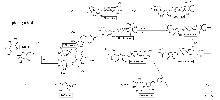
Fig.1
Schematic diagram of CPPs synthesis pathway
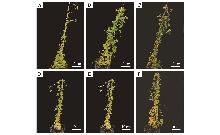
Fig.2
Effects of moderate drought on growth and development of Codonopsis pilosulaA-C represented the plants on the 7th,14th,and 21st day of CK;D-F represented the plants on the 7th,14th,and 21st day of DH.
Table 1
Mobile phase elution program
时间 Time/min | A/% | B/% |
|---|---|---|
| 0 | 82 | 18 |
| 5 | 82 | 18 |
| 22 | 75 | 25 |
| 30 | 60 | 40 |
| 32 | 60 | 40 |
| 33 | 82 | 18 |
Fig.3
Regulatory effects of moderate drought on CPPs and upstream substrates in the polysaccharide synthesis pathway* indicated significant differences between control and drought groups(P<0.05);** indicated highly significant differences(P<0.01).
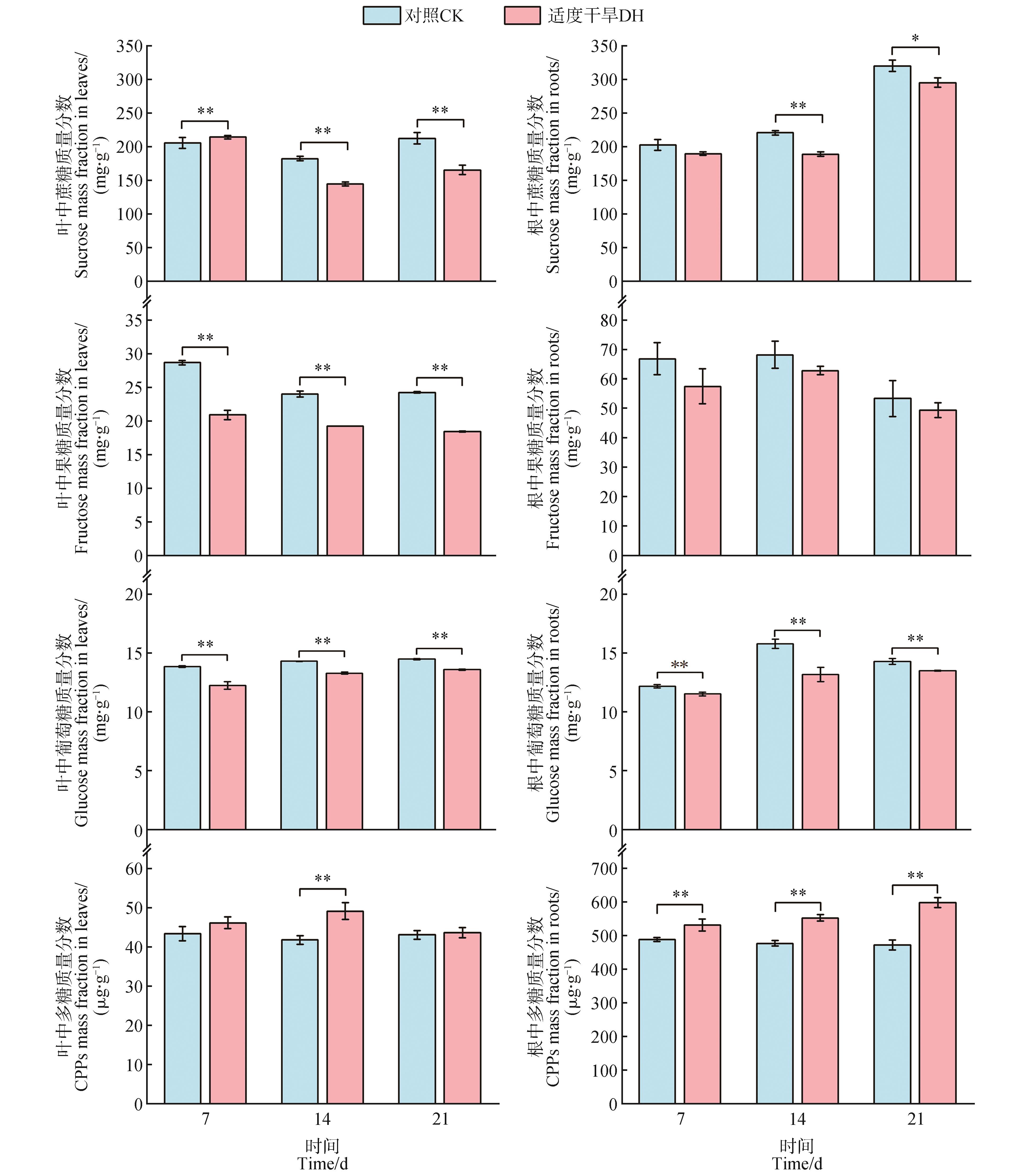
Fig.4
Chromatograms of mixed standard of seven monosaccharides and Codonopsis pilosula sample by highperfor-mance liquid chromatographyA. Monosaccharides standard; B. C. pilosula sample. 1.Mannose(Man);2.Rhamnose(Rha);3.Glucuronic acid(GlcA);4.Galacturonic acid(GalA);5.Glucose(Glc);6.Galactose(Gal);7.Arabinose(Ara).
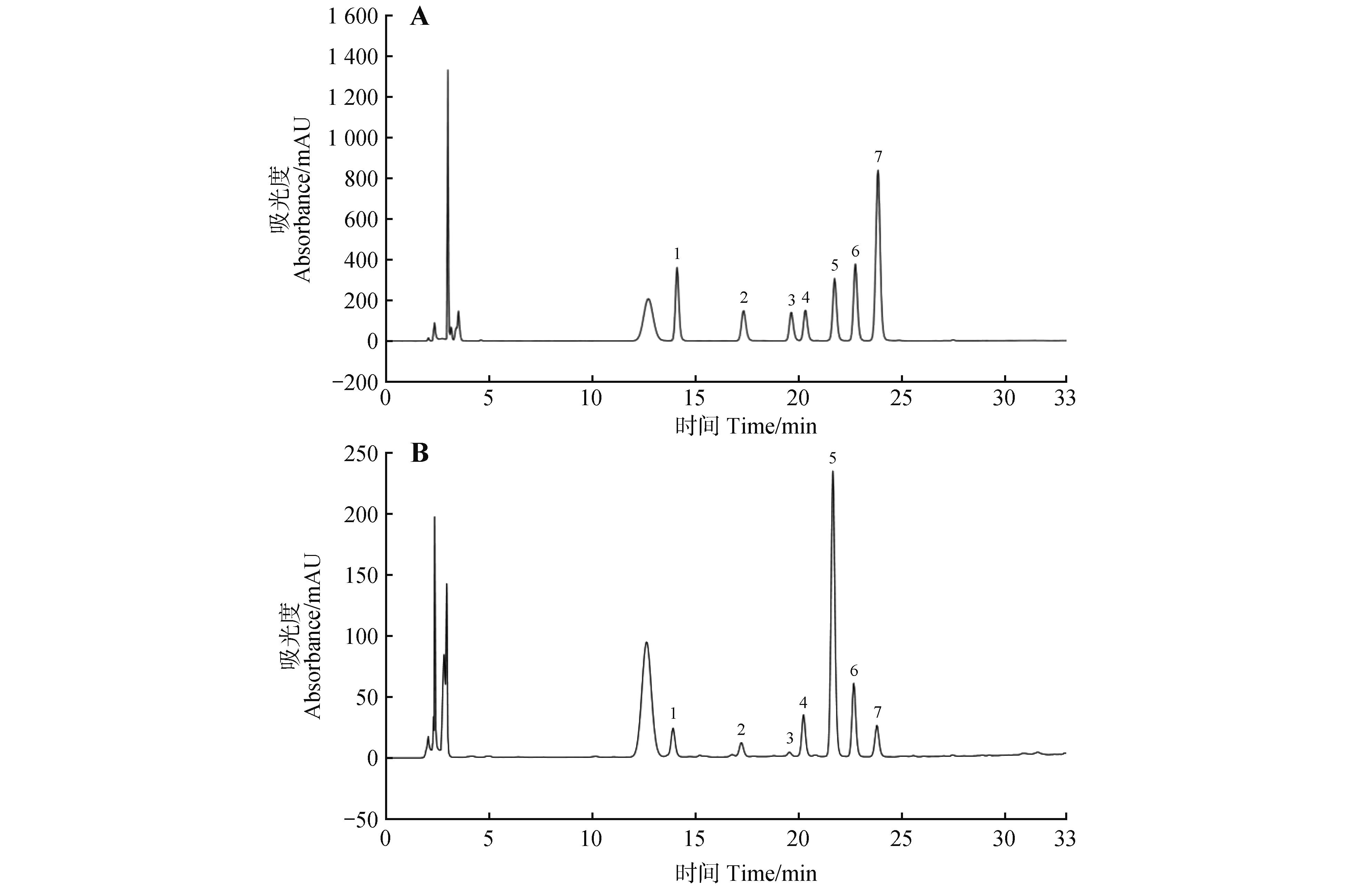

Fig.5
Regulatory effect of moderate drought on the content of monosaccharide component in CPPsMan. Mannose; Rha. Rhamnose; GlcA. Glucuronic acid; GalA. Galacturonic acid; Ara. Arabinose; Gal. Galactose; Glc. Glucose.LC,RC.Leaf and root of the control, respectively;LD,RD.Leaf and root of the drought treatment, respectively.
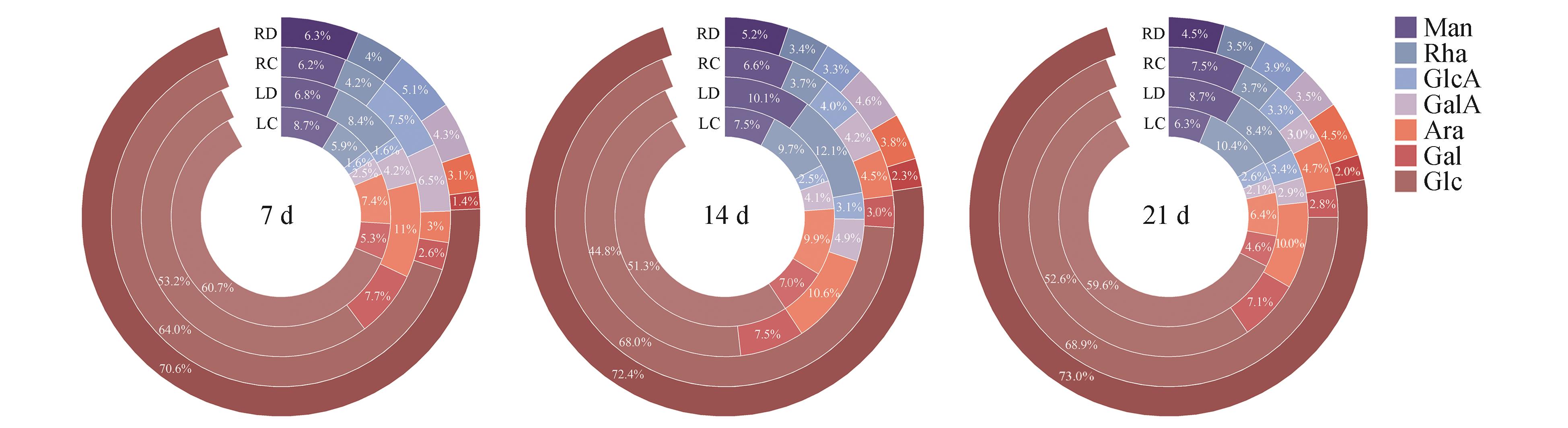
Table 2
Regulatory effect of moderate drought on sucrose related enzyme activity in the CPPs synthesis pathway
酶 Enzyme | 胁迫时间 Stress time/d | 不同处理下各部位酶活性 Enzyme activity of different parts under different treatments/(U·g-1) | |||
|---|---|---|---|---|---|
| CK | DH | ||||
| 叶Leaves | 根Roots | 叶Leaves | 根Roots | ||
蔗糖磷酸合成酶 SPS | 7 | 638.7±16.8 | 584.4±23.8 | 733.5±6.9** | 569.1±17.9 |
| 14 | 649.9±30.8 | 721.6±11.8 | 645.2±9.3 | 714.2±12.5 | |
| 21 | 596.3±10.1 | 609.5±31.6 | 596.3±17.2 | 602.5±6.0 | |
蔗糖合成酶 SS | 7 | 624.0±4.5 | 596.1±8.9 | 691.8±12.9** | 582.9±11.9 |
| 14 | 696.6±17.6 | 802.5±13.8 | 685.4±2.8 | 807.6±3.3 | |
| 21 | 609.4±11.7 | 784.2±5.2** | 688.0±1.8** | 741.8±3.5 | |
β-呋喃果糖苷酶 sacA | 7 | 538.2±12.9 | 576.0±12.1* | 634.3±8.8** | 550.5±17.0 |
| 14 | 567.2±18.5 | 575.9±7.7 | 526.5±4.0 | 608.7±9.6* | |
| 21 | 575.0±30.7 | 613.5±8.7 | 613.8±14.1* | 649.4±23.4 | |
酸性转化酶 AI | 7 | 6 667.5±139.6 | 5 934.1±125.2* | 6 301.8±64.7 | 5 324.3±67.7 |
| 14 | 5 571.4±239.9 | 6 252.7±278.9** | 5 285.1±202.6 | 5 414.5±180.9 | |
| 21 | 6 380.2±171.6* | 5 754.7±165.3 | 5 861.6±137.3 | 5 668.4±229.2 | |
中性转化酶 NI | 7 | 4 043.9±65.5 | 4 111.8±149.8 | 4 160.0±142.1 | 3 923.7±173.2 |
| 14 | 3 951.4±52.6 | 3 986.2±83.2* | 3 954.0±123.6 | 3 580.2±202.2 | |
| 21 | 4 254.6±42.7 | 3 894.5±19.6 | 4 051.1±64.5 | 4 013.6±134.3 | |
Table 3
Regulatory effect of moderate drought on activities of monosaccharide-converting enzymes in the CPPs synthesis pathway
酶 Enzyme | 胁迫时间 Stress time/d | 不同处理下各部位酶活性 Enzyme activity of different parts under different treatments/(U·g-1) | |||
|---|---|---|---|---|---|
| CK | DH | ||||
| 叶Leaves | 根Roots | 叶Leaves | 根Roots | ||
尿苷-葡萄糖4-差向异构酶 galE | 7 | 1.15±0.04 | 1.28±0.06* | 1.19±0.03 | 1.12±0.06 |
| 14 | 1.12±0.04 | 1.16±0.04 | 1.16±0.01 | 1.18±0.04 | |
| 21 | 1.12±0.03 | 1.19±0.03* | 1.13±0.05 | 1.11±0.03 | |
尿苷-葡萄糖醛酸-4-差向异构酶 GAE | 7 | 3 689.86±23.41 | 3 810.1±120.04* | 4 035.81±47.36* | 3 413.70±15.55 |
| 14 | 3 906.98±200.01 | 4 010.6±101.09 | 3 691.22±61.25 | 4 020.50±65.04 | |
| 21 | 3 455.63±140.76 | 3 963.7±199.21** | 4 230.41±152.07** | 3 464.20±37.91 | |
尿苷-葡萄糖6-脱氢酶 UGDH | 7 | 63.92±2.42 | 59.95±0.58** | 64.20±0.53 | 51.80±0.57 |
| 14 | 57.06±2.29 | 60.84±1.64 | 58.16±1.35 | 61.49±1.95 | |
| 21 | 53.67±1.84 | 57.89±1.06 | 58.64±0.53** | 59.89±1.24 | |
尿苷-芹菜糖/木糖合酶 AXS | 7 | 0.73±0.03 | 0.73±0.01 | 0.89±0.01** | 0.72±0.02 |
| 14 | 0.75±0.02 | 0.70±0.01 | 0.71±0.02 | 0.81±0.02* | |
| 21 | 0.76±0.03 | 0.78±0.06 | 1.05±0.04** | 1.13±0.06** | |
尿苷二磷酸葡糖醛酸脱羧酶 UXS1 | 7 | 1.41±0.01 | 1.39±0.05 | 1.51±0.02* | 1.50±0.05* |
| 14 | 1.55±0.04 | 1.69±0.03 | 1.49±0.04 | 1.66±0.01 | |
| 21 | 1.46±0.05 | 1.70±0.14 | 2.00±0.03** | 1.66±0.06 | |
尿苷二磷酸葡萄糖焦磷酸化酶 UGP2 | 7 | 0.76±0.02 | 0.74±0.02 | 0.75±0.01 | 0.70±0.00 |
| 14 | 0.72±0.02 | 0.79±0.02 | 0.75±0.01 | 0.78±0.02 | |
| 21 | 0.68±0.02 | 0.71±0.02 | 0.76±0.01** | 0.76±0.03 | |
3,5-差向异构酶/4-还原酶 UER1 | 7 | 3.12±0.15 | 3.36±0.12 | 3.43±0.16* | 3.12±0.03 |
| 14 | 3.24±0.07 | 3.44±0.18** | 3.31±0.08 | 3.21±0.04 | |
| 21 | 2.91±0.09 | 3.33±0.05 | 3.32±0.16* | 3.26±0.16 | |
尿苷-阿拉伯糖-4-差向异构酶 UXE | 7 | 0.95±0.03 | 1.26±0.05** | 1.13±0.13* | 1.07±0.18 |
| 14 | 0.93±0.07 | 0.97±0.01 | 1.74±0.05** | 1.67±0.04** | |
| 21 | 1.19±0.04 | 1.10±0.08 | 1.70±0.22* | 1.50±0.04** | |
甘露糖-1-磷酸-鸟苷转移酶 GMPP | 7 | 3 414.13±87.78 | 3 382.57±109.75** | 3 346.17±58.57 | 2 874.81±122.82 |
| 14 | 3 181.12±112.84** | 3 501.02±77.56** | 2 885.49±147.49 | 2 768.50±65.67 | |
| 21 | 2 579.17±51.00* | 2 767.04±127.83 | 2 190.88±24.43 | 2 733.54±75.70 | |
糖基转移酶 GTs | 7 | 2 807.46±18.28 | 3 035.13±41.98** | 3 075.76±48.96** | 2 765.51±20.85 |
| 14 | 2 799.42±48.24 | 3 025.76±36.11** | 2 965.49±12.92* | 2 743.62±40.60 | |
| 21 | 2 738.71±44.51 | 2 789.60±76.82 | 2 790.94±27.09* | 2 723.08±10.74 | |
Table 4
Number of differentially expressed genes in leaves and roots of Codonopsis pilosula under moderate drought stress
分组 Group | 上调 Up | 下调 Down |
|---|---|---|
| LC vs LD | 1 039 | 492 |
| RC vs RD | 340 | 330 |
Fig.6
Regulatory effect of moderate drought on expr-ession of CPPs synthesis-associated enzyme genes in leaves and roots of Codonopsis pilosula
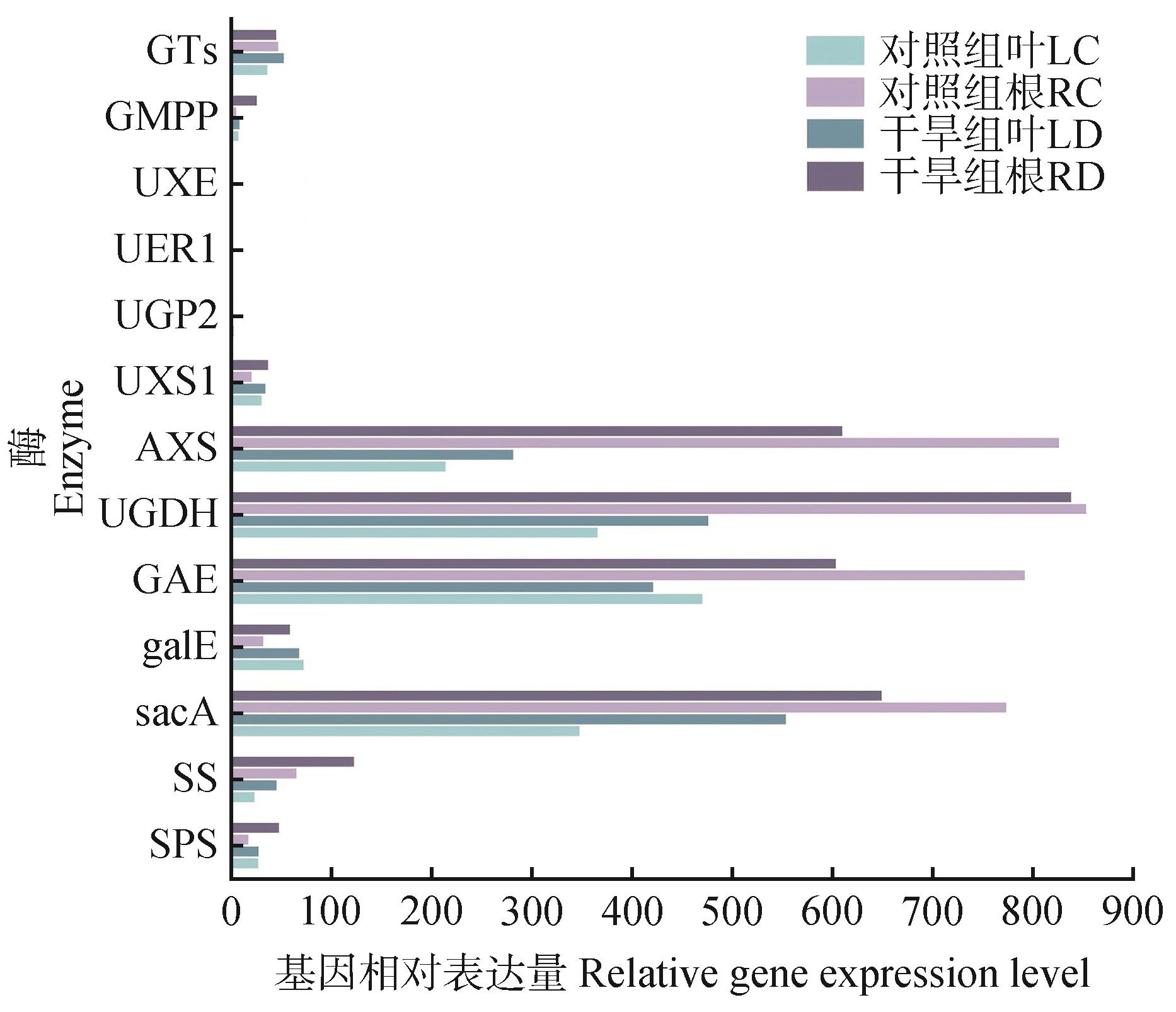

Fig.7
Differential expression of polysaccharide synthesis-associated enzyme genes in leaves and roots of Codonopsis pilosula under moderate drought stress
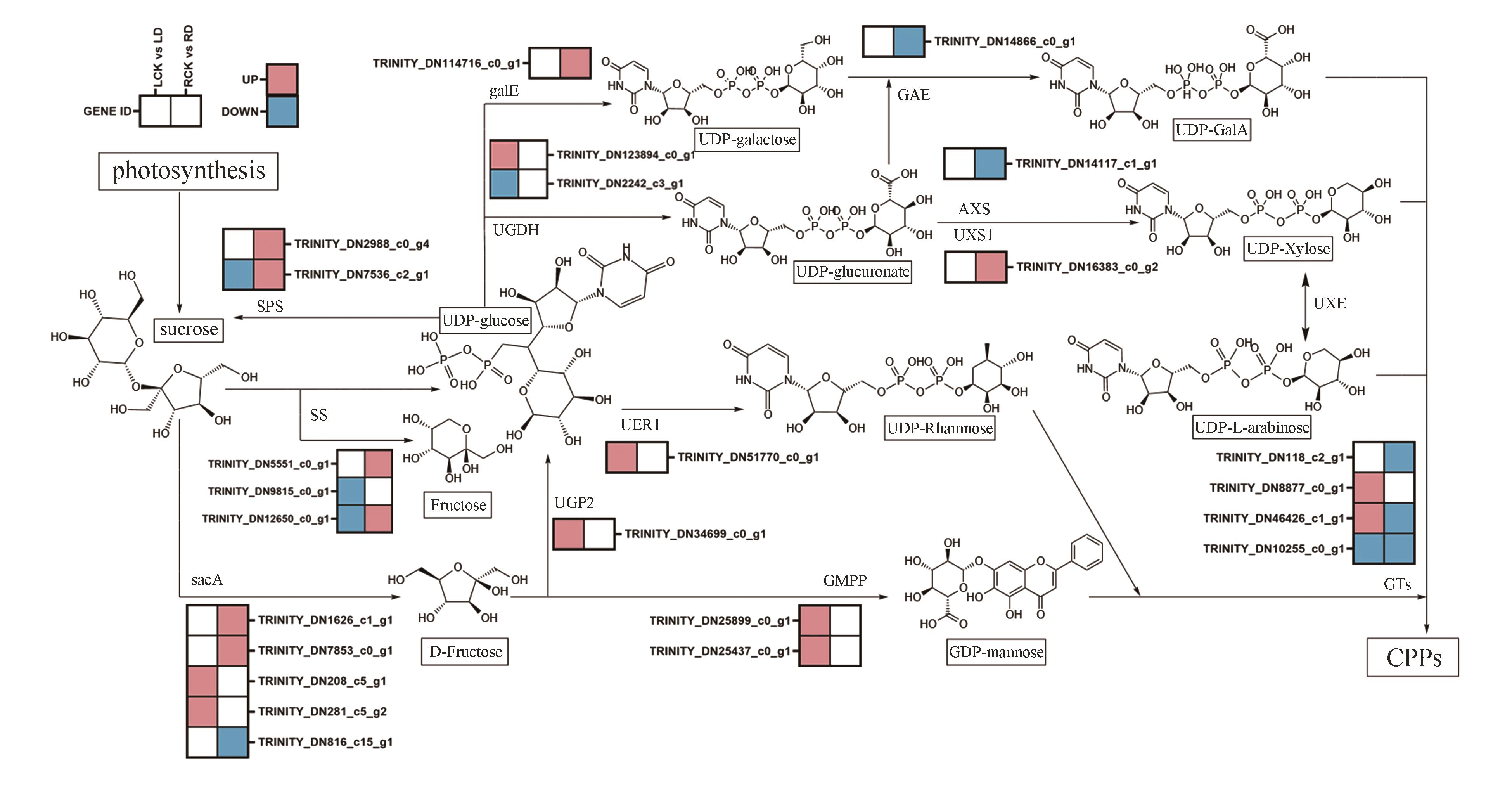
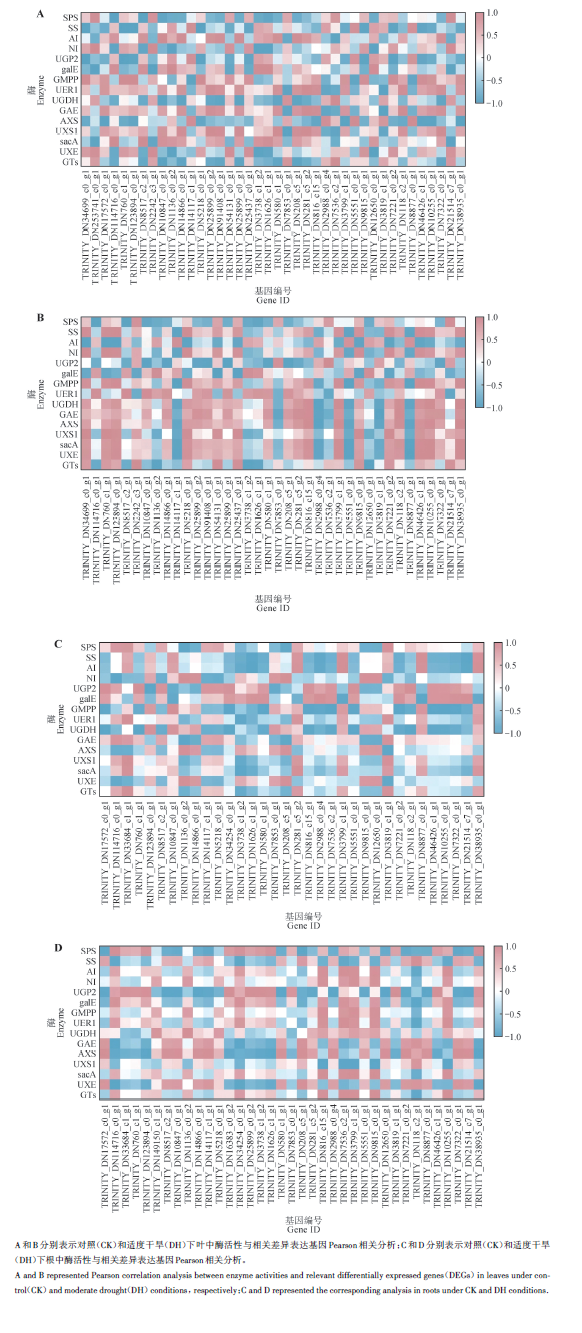
Fig.8
Pearson correlation analysis between differentially expressed genes associated with polysaccharide synthesis and key enzyme activities in leaves and roots of Codonopsis pilosulaA and B represented Pearson correlation analysis between enzyme activities and relevant differentially expressed genes(DEGs) in leaves under control(CK) and moderate drought(DH) conditions, respectively;C and D represented the corresponding analysis in roots under CK and DH conditions.
| [1] | 李静,樊佳妮,张龄芷,等.活性植物多糖在食品领域的应用综述[J].上海师范大学学报(自然科学版),2021,50(2):162-169. |
| LI J, FAN J N, ZHANG L Z,et al.A review on the applications of bioactive plant polysaccharides in food[J].Journal of Shanghai Normal University (Natural Sciences),2021,50(2):162-169. | |
| [2] | MA R X, ZHANG M, YANG X H,et al.Transcriptome analysis reveals genes related to the synthesis and metabolism of cell wall polysaccharides in goji berry(Lycium barbarum L.) from various regions[J].Journal of the Science of Food and Agriculture,2023,103(14):7050-7060. |
| [3] | 邹平,杨霞,云龙,等.巨藻Lessonia nigrescens岩藻多糖对烟草幼苗低温胁迫的缓解效应[J].山东农业科学,2022,54(12):97-103. |
| ZOU P, YANG X, YUN L,et al.Alleviating effects of fucoidan from Lessonia nigrescens on low temperature stress to tobacco seedlings[J].Shandong Agricultural Sciences,2022,54(12):97-103. | |
| [4] | 张博伦.干旱胁迫对多花黄精生长及光合生理特性的影响[D].长沙:中南林业科技大学,2022. |
| ZHANG B L.The effect of drought stress on the physiology and biochemistry of Polygonatum cyrtonema [D].Changsha:Central South University of Forestry and Technology,2022. | |
| [5] | 秦璐婕.金针菇抗冻多糖结构分析及其冷冻保护效果研究[D].上海:华东师范大学,2022. |
| QIN L J.Structure analysis and cryoprotective effect of antifreeze polysaccharides from Flammulina velutipes [D].Shanghai:East China Normal University,2022. | |
| [6] | 车前.低温和盐碱胁迫对谷物种子萌发影响的FTIR光谱研究[D].昆明:云南师范大学,2022. |
| CHE Q.Effects of low temperature and saline-alkila stress on seed germination of grain seeds guided by FTIR spectroscopy[D].Kunming:Yunnan Normal University,2022. | |
| [7] | LIU Y L, KONINGS A G, KENNEDY D,et al.Global coordination in plant physiological and rooting strategies in response to water stress[J].Global Biogeochemical Cycles,2021,35(7):e2020GB006758. |
| [8] | 张冉.水稻次生细胞壁超微结构与木质纤维高效酶解机制的研究[D].武汉:华中农业大学,2020. |
| ZHANG R.Characterization of secondary cell wall ultrastructure that determines lignocellulose enzymatic digestibility in rice[D].Wuhan:Huazhong Agricultural University,2020. | |
| [9] | 尹亚菲.硅介导的水稻细胞壁蛋白含量变化及硅-多糖化学力测定[D].武汉:华中农业大学,2022. |
| YIN Y F.Silicon-mediated changes of cell wall protein contents and determinations of silicon-polysaccharide interactions[D].Wuhan:Huazhong Agricultural University,2022. | |
| [10] | 王梦竹,方颖,李勍,等.植物细胞壁纳米结构与纳米纤维素的化学纯化处理结合机械解纤法制备[J].高分子学报,2020,51(6):586-597. |
| WANG M Z, FANG Y, LI Q,et al.Nanostructures of plant cell walls and individualization methodology of nanofibrillated cellulose[J].Acta Polymerica Sinica,2020,51(6):586-597. | |
| [11] | 蒲军保.水稻细胞壁中硅-木葡聚糖复合物存在的证据及功能研究[D].武汉:华中农业大学,2022. |
| PU J B.Evidence for the formation of silicon-xyloglucan complexes and their functions of the cell walls of rice[D].Wuhan:Huazhong Agricultural University,2022. | |
| [12] | 田大雨.烟草细胞壁多糖结构和含量的二维核磁共振波谱分析研究[D].合肥:中国科学技术大学,2023. |
| TIAN D Y.Study on the structure and content of tobacco cell wall polysaccharides by 2D NMR[D].Hefei:University of Science and Technology of China,2023. | |
| [13] | RUPRECHT C, BLAUKOPF M, PFRENGLE F.Synthetic fragments of plant polysaccharides as tools for cell wall biology[J].Current Opinion in Chemical Biology,2022,71:102208. |
| [14] | 李晓岗,张雪,俞捷,等.药用植物质量标志物多糖生物合成通路及关键酶研究进展[J].中草药,2021,52(15):4752-4762. |
| LI X G, ZHANG X, YU J,et al.Research progress on biosynthesis pathway of quality marker polysaccharide and involved key enzymes for medicinal plants[J].Chinese Traditional and Herbal Drugs,2021,52(15):4752-4762. | |
| [15] | 孙晓琛.基于转录组测序分析干旱胁迫下党参多糖合成机制[D].兰州:甘肃中医药大学,2022. |
| SUN X C.Analysis of polysaccharide biosynthesis of Codonopsis pilosula under drought stress based on transcriptome sequencing[D].Lanzhou:Gansu University of Chinese Medicine,2022. | |
| [16] | 孙晓琛,栗锦鹏,原静静,等.基于转录组测序分析干旱胁迫对党参不同组织基因表达的调控[J].中草药,2022,53(14):4465-4475. |
| SUN X C, LI J P, YUAN J J,et al.Sequencing and analysis of transcriptome to reveal regulation gene expression in different tissues of Codonopsis pilosula under drought stress[J].Chinese Traditional and Herbal Drugs,2022,53(14):4465-4475. | |
| [17] | 陈彦宏.基于碳代谢研究干旱对党参多糖积累的调控机制[D].兰州:甘肃中医药大学,2024. |
| CHEN Y H.Study on the regulation mechanism of drought on polysaccharide accumulation of Codonopsis pilosula based on carbon metabolism[D].Lanzhou:Gansu University of Chinese Medicine,2024. | |
| [18] | 段元杰,孟富宣,杨玉皎,等.PEG模拟干旱对鲜食木薯华南9号幼苗生长的影响[J].湖北农业科学,2020,59(4):42-44. |
| DUAN Y J, MENG F X, YANG Y J,et al.Effects of PEG simulated drought on the growth of fresh-eating Manihot esculenta Crantz SC9 seedlings[J].Hubei Agricultural Sciences,2020,59(4):42-44. | |
| [19] | 张璐,杨莹莹.高效液相色谱法测定党参多糖的单糖组成及含量[J].中国食品添加剂,2021,32(12):163-169. |
| ZHANG L, YANG Y Y.Determination of monosaccharide composition and content of Codonopsis pilosula polysaccharide by HPLC[J].China Food Additives,2021,32(12):163-169. | |
| [20] | 曹守波.党参多糖合成相关基因筛选及Cp1-SST真核表达载体构建[D].太原:山西医科大学,2020. |
| CAO S B.Screening of genes related to Codonopsis radix polysaccharide synthesis and construction of eukaryotic expression vector of Cp1-SST [D].Taiyuan:Shanxi Medical University,2020. | |
| [21] | 徐美蓉,李晓蓉,丁文姣,等.甘肃不同区域党参多糖含量的提取方法与生物活性研究[J].甘肃农业科技,2021,52(11):4-11. |
| XU M R, LI X R, DING W J,et al.Extraction method and biological activity of polysaccharides from Codonopsis pilosula in different regions of Gansu[J].Gansu Agricultural Science and Technology,2021,52(11):4-11. | |
| [22] | ZHANG Y, ZHANG A H, LI X M,et al.The role of chloroplast gene expression in plant responses to environmental stress[J].International Journal of Molecular Sciences,2020,21(17):6082. |
| [23] | GAO L, WEN W W, SU L T,et al.Pectins play a central role in enhancing Al tolerance of alfalfa via looseing fibre-microfiber arrangement of cell wall in root tips[J].International Journal of Biological Macromolecules,2025,302:140256. |
| [24] | 唐乙钧.糖基异构酶OsUGE3调节水稻细胞壁多糖代谢和耐盐性的机制研究[D].沈阳:沈阳农业大学,2022. |
| TANG Y J.Mechanism of OsUGE3 regulating rice cell wall polysaccharides metabolism and salt tolerance[D].Shenyang:Shenyang Agricultural University,2022. | |
| [25] | ZHANG Z F, TAN J X, CHEN Y T,et al.New fructokinase,OsFRK3,regulates starch accumulation and grain filling in rice[J].Journal of Agricultural and Food Chemistry,2023,71(2):1056-1066. |
| [1] | Hao GUO, Caixia CHEN, Xiaojing AN, Xian’en LI, Haiying WANG, Zhongting XIA. Effect of Environmental Factors on the Active Ingredients of Codonopsis pilosula [J]. Bulletin of Botanical Research, 2025, 45(4): 518-532. |
| [2] | Chu HUANG, Mingyue HE, Meile SUN, Yanhong CHEN, Huizhen WANG. Silicon-mediated Regulation on Polysaccharides Synthesis of Codonopsis pilosula under Drought Stress Based on EMP and TCA cycle Pathways [J]. Bulletin of Botanical Research, 2025, 45(1): 98-110. |
| [3] | ZHOU Xiang-Ming;LIU Yu-Tang;ZHAO Xian-Zheng;SONG Zhao-Wei;WANG Shu. Rooting Anatomy of Hardwood Cutting for Albizia julibrissin Duraxx. and Activity Change of Related Enzymes During Rooting Process [J]. Bulletin of Botanical Research, 2016, 36(1): 58-61. |
| Viewed | ||||||
|
Full text |
|
|||||
|
Abstract |
|
|||||