Bulletin of Botanical Research ›› 2026, Vol. 46 ›› Issue (2): 336-347.doi: 10.7525/j.issn.1673-5102.2026.02.012
• Original Paper • Previous Articles Next Articles
Hua YANG, Qihang LU, Yanjun DU( ), Wenna WANG()
Received:2025-12-30
Online:2026-03-20
Published:2026-04-02
Contact:
Yanjun DU, Wenna WANG
E-mail:yanjun.du@hainanu.edu.cn;wennawang@hainanu.edu.cn
CLC Number:
Hua YANG, Qihang LU, Yanjun DU, Wenna WANG. Whole-plant Carbon and Nitrogen Allocation and Trade-off Strategies of Invasive Laguncularia racemosa and Native Avicennia marina across Dry and Wet Seasons[J]. Bulletin of Botanical Research, 2026, 46(2): 336-347.
Add to citation manager EndNote|Ris|BibTeX
URL: https://bbr.nefu.edu.cn/EN/10.7525/j.issn.1673-5102.2026.02.012
Table 1
Soil physicochemical properties of the top 0-20 cm layer in Laguncularia racemosa and Avicennia marina pure and mixed stands across dry and wet seasons
土层 Soil layer/cm | 季节 Season | 群落类型 Stand type | 全氮 Total nitrogen/ (g·kg-1) | 全碳 Total carbon/ (g·kg-1) | 碳氮比 Carbon-to- nitrogen ratio | 电导率 Electric conductivity/ (mS·cm-1) | 酸碱度 pH | 含水量 Water content/% |
|---|---|---|---|---|---|---|---|---|
| [0,10) | 雨季 Wet season | Lr-P | 0.05±0.01A* | 4.27±0.63A | 93.43±8.21A* | 3.24±1.30A | 7.53±0.07A | 12.57±1.62A |
| Am-P | 0.06±0.02A* | 3.25±0.53A | 55.55±0.37B* | 2.22±0.09A | 7.30±0.06AB | 12.50±2.58A | ||
| Lr-Am-M | 0.08±0.02A* | 4.95±1.18A | 62.88±4.95B* | 2.42±0.16A | 7.20±0.12B | 13.62±2.37A | ||
旱季 Dry season | Lr-P | 0.32±0.04B* | 5.77±0.50A | 17.05±2.61A* | 5.75±4.09A | 7.37±0.15A | 15.25±5.09A | |
| Am-P | 0.62±0.07A* | 6.25±1.31A | 10.02±1.72B* | 5.07±2.01A | 7.27±0.27A | 17.52±2.88A | ||
| Lr-Am-M | 0.39±0.02B* | 3.32±0.17B | 8.95±0.80B* | 3.48±1.07A | 7.13±0.07A | 15.98±1.30A | ||
| [ | 雨季 Wet season | Lr-P | 0.04±0.00A* | 2.76±0.54A | 79.14±10.57A* | 8.23±2.17A | 7.37±0.09A | 14.23±1.99A |
| Am-P | 0.05±0.02A* | 3.21±1.64A | 49.41±7.10B* | 5.10±2.54A | 7.30±0.12A | 12.81±2.17A | ||
| Lr-Am-M | 0.06±0.01A* | 3.71±0.82A | 56.70±2.78B* | 5.08±1.22A | 7.33±0.07A | 17.44±2.46A | ||
旱季 Dry season | Lr-P | 0.25±0.11A* | 3.80±0.99A | 17.55±1.64A* | 6.10±3.15A | 7.33±0.26A | 15.28±5.07A | |
| Am-P | 0.31±0.07A* | 2.81±0.69A | 9.47±1.34B* | 2.79±0.85A | 7.27±0.07A | 9.91±2.08A | ||
| Lr-Am-M | 0.34±0.01A* | 2.84±0.17A | 8.50±0.29B* | 3.00±0.62A | 7.23±0.09A | 15.45±0.33A |
Table 2
Three-way ANOVA results of the effects of season,tree species,organ and their interactions on carbon and nitrogen mass fraction and their ratios of Laguncularia racemosa and Avicennia marina
变量 Variable | 全碳 Total carbon/(g·kg-1) | 全氮 Total nitrogen/(g·kg-1) | 碳氮比 Carbon-to-nitrogen ratio | ||||||
|---|---|---|---|---|---|---|---|---|---|
自由度 df | F | P | 自由度df | F | P | 自由度df | F | P | |
| 季节 Seasons | 1 | 19.53 | <0.01 | 1 | 3.84 | 0.06 | 1 | 0.10 | 0.75 |
| 树种 Tree species | 1 | 2.14 | 0.15 | 1 | 228.83 | <0.01 | 1 | 54.16 | <0.01 |
| 器官 Organs | 2 | 136.83 | <0.01 | 2 | 130.68 | <0.01 | 2 | 17.36 | <0.01 |
| 季节×树种 Seasons×Tree species | 1 | 0.12 | 0.73 | 1 | 2.35 | 0.13 | 1 | 0.02 | 0.88 |
| 季节×器官 Seasons×Organs | 2 | 1.88 | 0.16 | 2 | 1.39 | 0.26 | 2 | 4.16 | 0.02 |
| 树种×器官 Tree species×Organs | 2 | 1.01 | 0.37 | 2 | 19.14 | <0.01 | 2 | 5.73 | <0.01 |
| 季节×树种×器官 Seasons×Tree species×Organs | 2 | 1.37 | 0.26 | 2 | 1.36 | 0.27 | 2 | 3.84 | 0.03 |
Fig.1
Mass fraction of total carbon in each organ of Laguncularia racemosa and Avicennia marina in pure-(A,B)and mixed-(C,D)stands across seasonsA. Laguncularia racemosa pure stand;B. Avicennia marina pure stand;C. L. racemosa mixed stand;D. A. marina mixed stand. Different uppercase letters indicated significant differences between species within the same season and organ(P<0.05). Different lowercase letters indicated significant differences between stand types within the same species and organ. Asterisks (*) indicated significant differences between seasons within the same stand type and organ. The same as below.
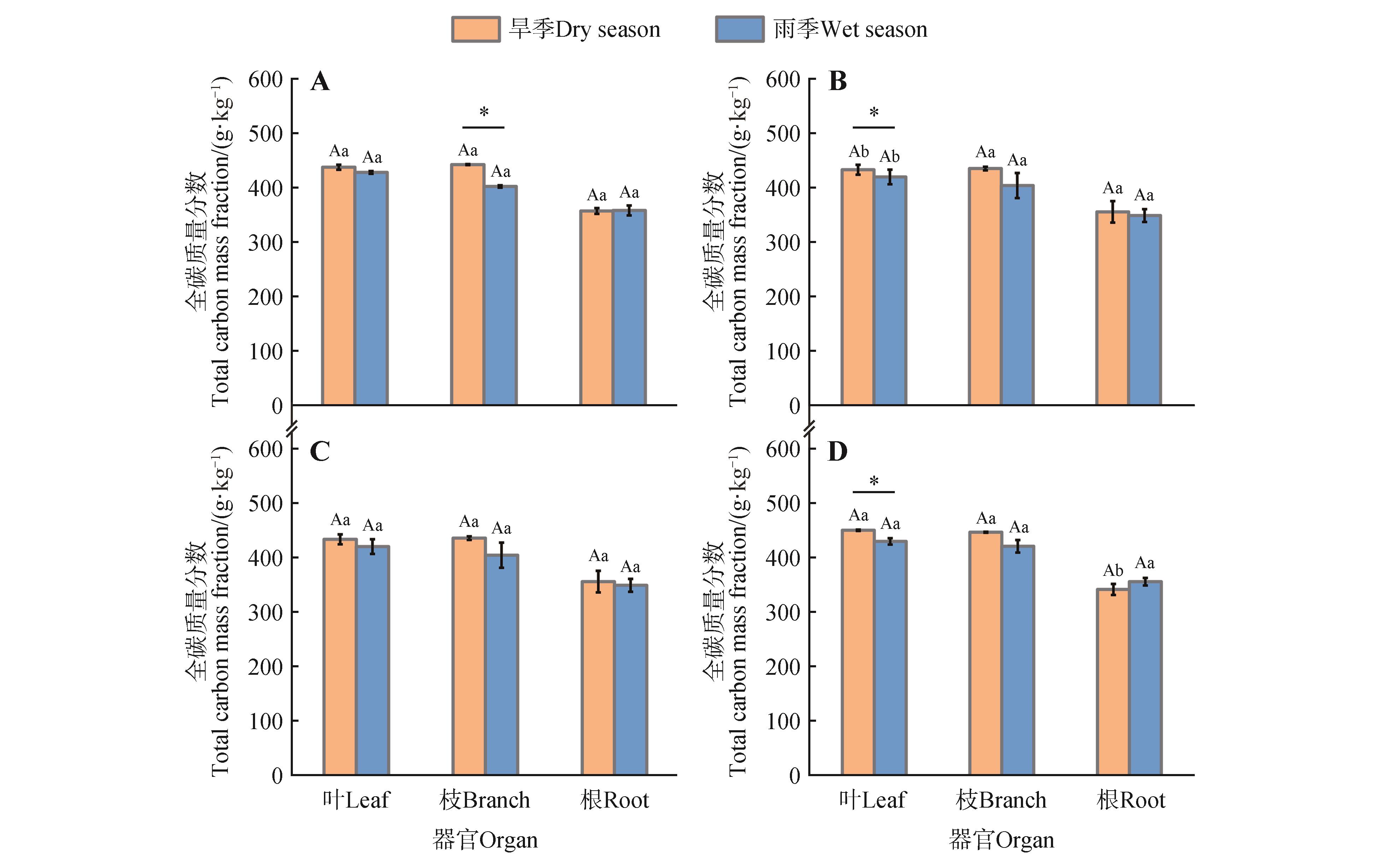
Fig.2
Mass fraction of total nitrogen in each organ of Laguncularia racemosa and Avicennia marina in pure-(A,B)and mixed-(C,D)stands across seasons
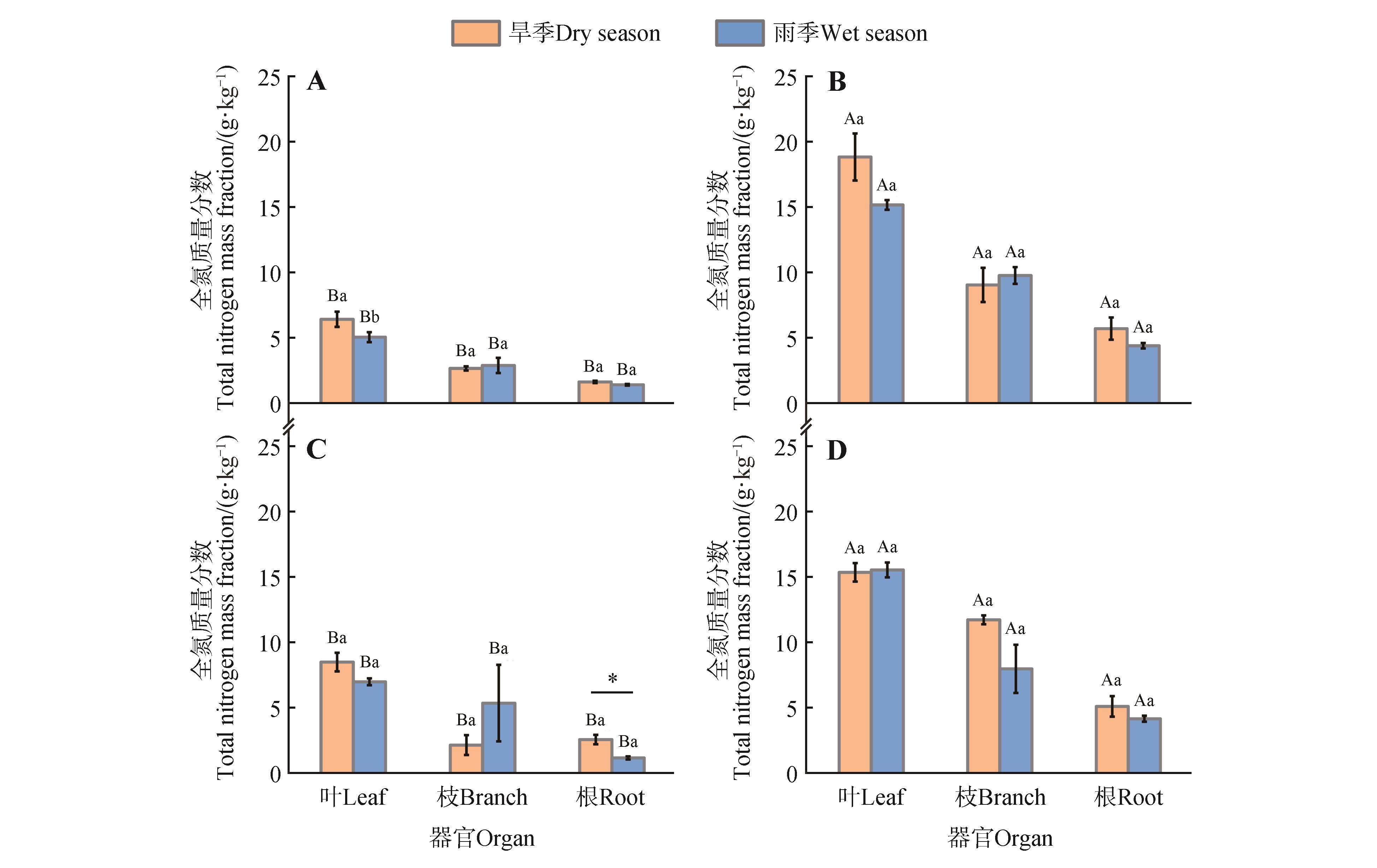
Fig.3
Carbon-to-nitrogen ratio in each organ of Laguncularia racemosa and Avicennia marina in pure-(A,B)and mixed-(C, D)stands across seasons
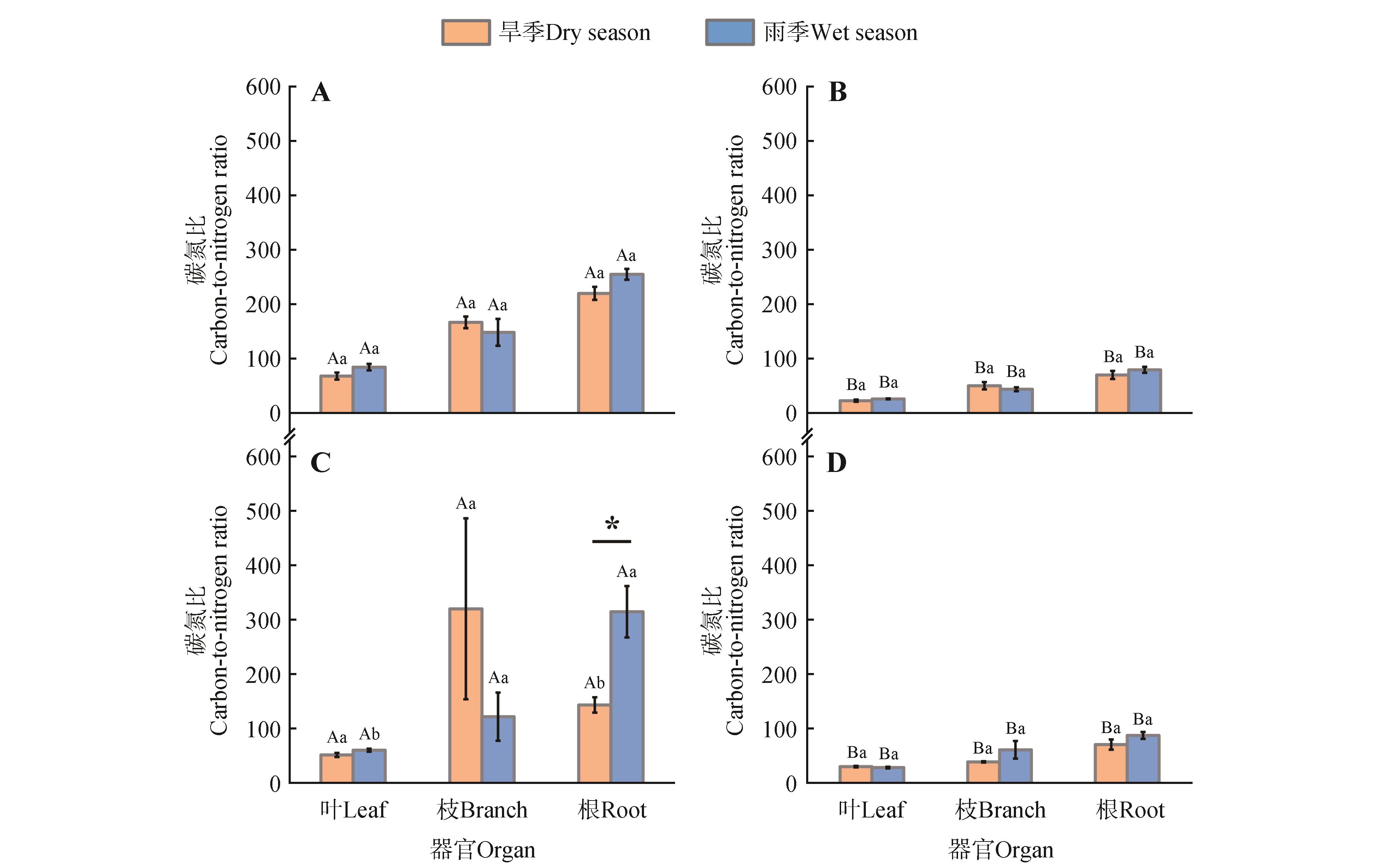
Table 3
Spearman correlation coefficients of organ carbon and nitrogen characteristics in Laguncularia racemosa and Avicennia marina with soil physicochemical properties across seasons and soil depths
土壤深度 Soil depth/cm | 季节 Season | 树种 Tree species | 关联类型 Relationship type | ||||||||
|---|---|---|---|---|---|---|---|---|---|---|---|
叶 Leaf | 土壤 Soil | 相关系数 r | 枝 Branch | 土壤 Soil | 相关系数 r | 根 Root | 土壤 Soil | 相关系数 r | |||
| [0,10) | 雨季 Wet season | 拉关木Lr | N | pH | -0.883* | C | N | 0.971** | C∶N | 含水量 | 0.829* |
| C∶N | pH | 0.883* | C | C | 1.000** | ||||||
| C | 含水量 | 0.943** | |||||||||
| 白骨壤Am | ns | C | N | 0.928** | C | 电导率 | 0.829* | ||||
| C | 含水量 | 0.886* | N | 电导率 | -0.943** | ||||||
| C∶N | 电导率 | 0.829* | |||||||||
| C∶N | pH | -0.883* | |||||||||
旱季 Dry season | 拉关木Lr | C | 电导率 | 0.841* | C | N | -0.886* | N | C | -0.829* | |
| C | 含水量 | 0.829* | N | C∶N | -0.829* | ||||||
| C∶N | C | 0.829* | C∶N | C | 0.829* | ||||||
| C∶N | C∶N | 0.829* | C∶N | C∶N | 0.829* | ||||||
| 白骨壤Am | ns | ns | ns | ||||||||
| [ | 雨季 Wet season | 拉关木Lr | ns | ns | C∶N | C | 0.829* | ||||
| C∶N | 含水量 | 0.943** | |||||||||
| 白骨壤Am | ns | C | N | 0.943* | C | 电导率 | -0.829* | ||||
| C | C | 0.829* | |||||||||
旱季 Dry season | 拉关木Lr | C | C | 0.829* | C | C∶N | 0.829* | N | C∶N | -0.829* | |
| C∶N | C∶N | 0.829* | C∶N | C∶N | 0.829* | ||||||
| 白骨壤Am | C∶N | 含水量 | 0.886* | C | N | 0.829* | ns | ||||
| C∶N | 电导率 | -0.886* | |||||||||
Fig.4
Correlations among organ carbon and nitrogen contents,and carbon-to-nitrogen ratios of Laguncularia racemosa in pure-(A,B)and mixed-(C,D)stands across seasonsA. Pure stand in the wet season;B. Pure stand in the dry season;C. Mixed stand in the wet season;D. Mixed stand in the dry season. TN. Total nitrogen content;TC. Total carbon content;C∶N.Carbon-to-nitrogen ratio;*.P<0.05. The same as below.
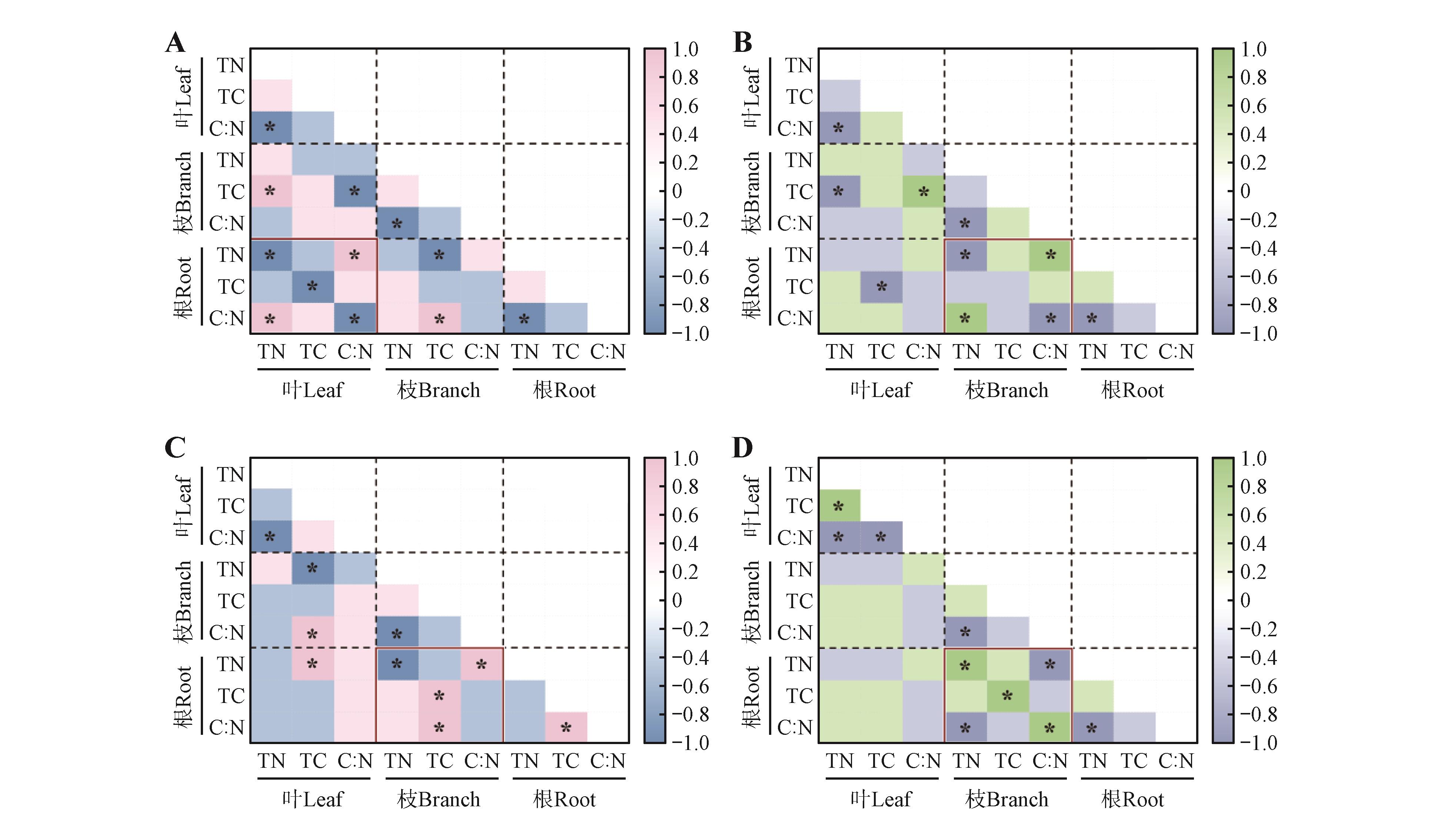
Fig.5
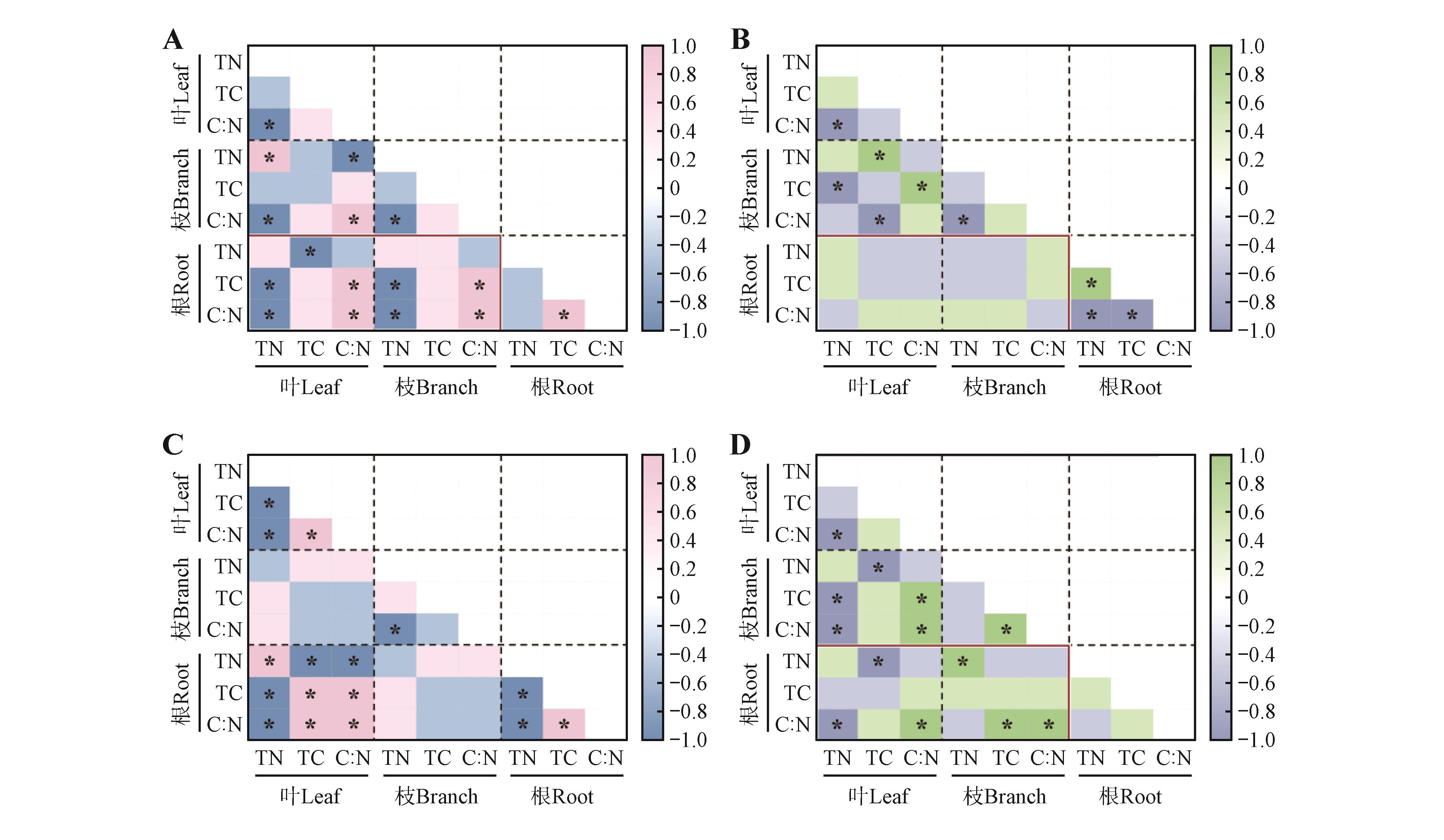
Correlations among organ carbon and nitrogen contents,and carbon-to-nitrogen ratios of Avicennia marina in pure-(A,B)and mixed-(C,D)stands across seasons
| [1] | CHEN X L, CHEN H Y H. Plant mixture balances terrestrial ecosystem C∶N∶P stoichiometry[J].Nature Communications,2021,12:4562. |
| [2] | PEÑUELAS J, SARDANS J.The global nitrogen-phosphorus imbalance[J].Science,2022,375(6578):266-267. |
| [3] | LIU R, YANG X J, GAO R R,et al.Coordination of economics spectra in leaf,stem and root within the genus Artemisia along a large environmental gradient in China[J].Global Ecology and Biogeography,2023,32(2):324-338. |
| [4] | WRIGHT I J, REICH P B, WESTOBY M,et al.The worldwide leaf economics spectrum[J].Nature,2004,428:821-827. |
| [5] | DÍAZ S, KATTGE J, CORNELISSEN J H C,et al.The global spectrum of plant form and function[J].Nature,2016,529:167-171. |
| [6] | VAN KLEUNEN M, WEBER E, FISCHER M.A meta-analysis of trait differences between invasive and non-invasive plant species[J].Ecology Letters,2010,13(2):235-245. |
| [7] | HEBERLING J M, FRIDLEY J D.Resource-use strategies of native and invasive plants in Eastern North American forests[J].New Phytologist,2013,200(2):523-533. |
| [8] | RILOV G, CANNING-CLODE J, GUY-HAIM T.Ecological impacts of invasive ecosystem engineers:a global perspective across terrestrial and aquatic systems[J].Functional Ecology,2024,38(1):37-51. |
| [9] | FUNK J L, VITOUSEK P M.Resource-use efficiency and plant invasion in low-resource systems[J].Nature,2007,446(7139):1079-1081. |
| [10] | STOTZ G C, SALGADO-LUARTE C, ESCOBEDO V M,et al.Phenotypic integration limits the variation in plant phenotypic plasticity among traits:a meta-analysis[J].Functional Ecology,2025,39(11):3021-3033. |
| [11] | HE N P, LI Y, LIU C C,et al.Plant trait networks:improved resolution of the dimensionality of adaptation[J].Trends in Ecology & Evolution,2020,35(10):908-918. |
| [12] | MATESANZ S, BLANCO-SÁNCHEZ M, RAMOS-MUÑOZ M,et al.Phenotypic integration does not constrain phenotypic plasticity:differential plasticity of traits is associated to their integration across environments[J].New Phytologist,2021,231(6):2359-2370. |
| [13] | CARRILLO Y, BELL C, KOYAMA A,et al.Plant traits,stoichiometry and microbes as drivers of decomposition in the rhizosphere in a temperate grassland[J].Journal of Ecology,2017,105(6):1750-1765. |
| [14] | TESTE F P, KARDOL P, TURNER B L,et al.Plant-soil feedback and the maintenance of diversity in Mediterranean-climate shrublands[J].Science,2017,355(6321):173-176. |
| [15] | CHENG J K, YU S X.Nitrogen allocation among leaves and roots mediates the interaction between plant life history trade-off and density dependence[J].Frontiers in Plant Science,2025,16:1549801. |
| [16] | GOLDBERG L, LAGOMASINO D, THOMAS N,et al.Global declines in human-driven mangrove loss[J].Global Change Biology,2020,26(10):5844-5855. |
| [17] | BAI J K, MENG Y C, GOU R K,et al.The linkages between stomatal physiological traits and rapid expansion of exotic mangrove species (Laguncularia racemosa) in new territories[J].Frontiers in Marine Science,2023,10:1136443. |
| [18] | LI H K, CHEN C L, ZHOU J Y,et al.Exotic mangrove Laguncularia racemosa litter input accelerates nutrient cycling in mangrove ecosystems[J].Frontiers in Plant Science,2024,15:1463548. |
| [19] | SOBUJ N, SINGH K, BYUN C.Responses of invasive and native plant species to drought stress and elevated CO2 concentrations:a meta-analysis[J].NeoBiota,2024,96:381-401. |
| [20] | COHEN I, ZANDALINAS S I, HUCK C,et al.Meta-analysis of drought and heat stress combination impact on crop yield and yield components[J].Plant Physiology,2021,171(1):66-76. |
| [21] | CARDONA-OLARTE P, KRAUSS K W, TWILLEY R R.Leaf gas exchange and nutrient use efficiency help explain the distribution of two neotropical mangroves under contrasting flooding and salinity[J].International Journal of Forestry Research,2013,2013(1):524625. |
| [22] | NGUYEN H T, STANTON D E, SCHMITZ N,et al.Growth responses of the mangrove Avicennia marina to salinity:development and function of shoot hydraulic systems require saline conditions[J].Annals of Botany,2015,115(3):397-407. |
| [23] | LEISHMAN M R, HASLEHURST T, ARES A,et al.Leaf trait relationships of native and invasive plants:community- and global-scale comparisons[J].New Phytologist,2007,176(3):635-643. |
| [24] | WANG L M, MU M R, LI X F,et al.Differentiation between true mangroves and mangrove associates based on leaf traits and salt contents[J].Journal of Plant Ecology,2011,4(4):292-301. |
| [25] | 陈毅青,陈宗铸,陈小花,等.石梅湾3种植物叶片与其群落凋落物C,N,P生态化学计量特征研究[J].林业资源管理,2020,(4):66-73. |
| CHEN Y Q, CHEN Z Z, CHEN X H,et al.A study on ecological stoichiometric characteristics of C,N and P in three kinds of plant leaves and their community litters in Shimeiwan of Hainan Island[J].Forest and Grassland Resources Research,2020,(4):66-73. | |
| [26] | ADLER P B, SALGUERO-GÓMEZ R, COMPAGNONI A,et al.Functional traits explain variation in plant life history strategies[J].Proceedings of the National Academy of Sciences of the United States of America,2014,111(2):740-745. |
| [27] | FRESCHET G T, ROUMET C, COMAS L H,et al.Root traits as drivers of plant and ecosystem functioning:current understanding,pitfalls and future research needs[J].New Phytologist,2021,232(3):1123-1158. |
| [28] | PÉREZ A, MACHADO W, SANDERS C J.Anthropogenic and environmental influences on nutrient accumulation in mangrove sediments[J].Marine Pollution Bulletin,2021,165:112174. |
| [29] | WANG Y, LI D Y, LU Z Q,et al.Decomposition and variation in carbon and nitrogen of leaf litter mixtures in a subtropical mangrove forest[J].Forests,2024,15(4):672. |
| [30] | CHAO L, LIU Y Y, FRESCHET G T,et al.Litter carbon and nutrient chemistry control the magnitude of soil priming effect[J].Functional Ecology,2019,33(5):876-888. |
| [31] | HANDA I T, AERTS R, BERENDSE F,et al.Consequences of biodiversity loss for litter decomposition across biomes[J].Nature,2014,509:218-221. |
| [32] | JOLY F X, FROMIN N, KIIKKILÄ O,et al.Diversity of leaf litter leachates from temperate forest trees and its consequences for soil microbial activity[J].Biogeochemistry,2016,129:373-388. |
| [33] | SANTONJA M, RANCON A, FROMIN N,et al.Plant litter diversity increases microbial abundance,fungal diversity,and carbon and nitrogen cycling in a Mediterranean shrubland[J].Soil Biology and Biochemistry,2017,111:124-134. |
| [34] | REEF R, FELLER I C, LOVELOCK C E.Nutrition of mangroves[J].Tree Physiology,2010,30(9):1148-1160. |
| [35] | YU Z W, WANG M L, SUN Z Y,et al.Changes in the leaf functional traits of mangrove plant assemblages along an intertidal gradient in typical mangrove wetlands in Hainan,China[J].Global Ecology and Conservation,2023,48:e02749. |
| [36] | LIU Q Y, WANG H M, XU X L.Root nitrogen acquisition strategy of trees and understory species in a subtropical pine plantation in southern China[J].European Journal of Forest Research,2020,139(5):791-804. |
| [37] | HU G, ZHANG Z H, LI L.Responses of carbon,nitrogen,and phosphorus contents and stoichiometry in soil and fine roots to natural vegetation restoration in a tropical mountainous area,southern China[J].Frontiers in Plant Science,2023,14:1181365. |
| [38] | WANG J X, VILLAR-SALVADOR P, LI G L,et al.Moderate water stress does not inhibit nitrogen remobilization,allowing fast growth in high nitrogen content Quercus variabilis seedlings under dry conditions[J].Tree Physiology,2019,39(4):650-660. |
| [39] | HEINEMANN B, HILDEBRANDT T M.The role of amino acid metabolism in signaling and metabolic adaptation to stress-induced energy deficiency in plants[J].Journal of Experimental Botany,2021,72(13):4634-4645. |
| [40] | ZAYED O, HEWEDY O A, ABDELMOTELEB A,et al.Nitrogen journey in plants:from uptake to metabolism,stress response,and microbe interaction[J].Biomolecules,2023,13(10):1443. |
| [41] | LIANG S Y, TAN T, WU D Z,et al.Seasonal variations in carbon,nitrogen,and phosphorus of Pinus yunnanensis at different stand ages[J].Frontiers in Plant Science,2023,14:1107961. |
| [42] | HASHIMOTO Y, MASUMOTO T, ITO T,et al.Can fine-root non-structural carbohydrates explain seasonal variations in the respiration in subalpine forests?[J].Physiologia Plantarum,2025,177(6):e70615. |
| [43] | ROBERT E M, SCHMITZ N, COPINI P,et al.Visualization of the stem water content of two genera with secondary phloem produced by successive cambia through Magnetic Resonance Imaging (MRI)[J].Journal of Plant Hydraulics,2014,1:e0006. |
| [44] | LOVELOCK C E, BALL M C, FELLER I C,et al.Variation in hydraulic conductivity of mangroves:influence of species,salinity,and nitrogen and phosphorus availability[J].Physiologia Plantarum,2006,127(3):457-464. |
| [45] | REEF R, MARKHAM H L, SANTINI N S,et al.The response of the mangrove Avicennia marina to heterogeneous salinity measured using a split-root approach[J].Plant and Soil,2015,393(1):297-305. |
| [46] | WEI L L, LOCKINGTON D A, POH S C,et al.Water use patterns of estuarine vegetation in a tidal creek system[J].Oecologia,2013,172(2):485-494. |
| [47] | ZIPFEL C, OLDROYD G E D.Plant signalling in symbiosis and immunity[J].Nature,2017,543:328-336. |
| [48] | SURIYAGODA L D B, RYAN M H, GILLE C E,et al.Phosphorus fractions in leaves[J].New Phytologist,2023,237(4):1122-1135. |
| [49] | MÉNDEZ-ALONZO R, LÓPEZ-PORTILLO J, MOCTEZUMA C,et al.Osmotic and hydraulic adjustment of mangrove saplings to extreme salinity[J].Tree Physiology,2016,36(12):1562-1572. |
| [50] | SOBRADO M A.Relationship of water transport to anatomical features in the mangrove Laguncularia racemosa grown under contrasting salinities[J].New Phytologist,2007,173(3):584-591. |
| [51] | SUÁREZ N.Leaf longevity,construction,and maintenance costs of three mangrove species under field conditions[J].Photosynthetica,2003,41(3):373-381. |
| [52] | KOMIYAMA A, ONG J E, POUNGPARN S.Allometry,biomass,and productivity of mangrove forests:a review[J].Aquatic Botany,2008,89(2):128-137. |
| [53] | LANG'AT J K S, KIRUI B K Y, SKOV M W,et al.Species mixing boosts root yield in mangrove trees[J].Oecologia,2013,172(1):271-278. |
| [1] | Xi LIU, Hongyuan HUANG, Shengchang YI, Yadi YU, Hao WANG, Xiaokang NI, Yuli HU, Ling ZHANG. Progress on Interaction of Invasive Plants and Mycorrhizal Fungi and Its Effect on Soil Nitrogen Cycling [J]. Bulletin of Botanical Research, 2025, 45(3): 371-385. |
| [2] | Yandong JIANG, Zhengdong PENG, Qi XU, Wanyi GAN, Liujing HUANG. Responses of Leaf and Fine Root Functional Traits of Alternanthera philoxeroides to Heterogeneous Habitats [J]. Bulletin of Botanical Research, 2024, 44(3): 410-419. |
| [3] | Jiaxing CHEN, Shu WANG, Linli CHEN, Xiali HOU, Qingzhu YANG, Renya YIN. Effects of Drought Conditions on Interspecific Interactions and Growth of Bidens pilosa and Buddleja lindleyana [J]. Bulletin of Botanical Research, 2023, 43(5): 720-728. |
| [4] | Ke-Xin MA, Mei ZHANG, Xin FANG, Li-Li TANG, Jian-Hua HAN, Li-Fang YANG, Fu-Chen SHI. Effects of Invasive Plant Datura stramonium on the Functional Traits of Native Plants and the Stoichiometric Characteristics of Soil Carbon, Nitrogen and Phosphorus [J]. Bulletin of Botanical Research, 2020, 40(6): 867-875. |
| [5] | ZU Yuan-Gang;ZHANG Xiao-Nan;REN Zhi-Guang;ZHAO Xiu-Hua. Cu,Pb accumulation of invasive plant Iva xanthifolia [J]. Bulletin of Botanical Research, 2010, 30(5): 612-616. |
| [6] | FANG Fang, MAO Wei, GUO Shui-Liang. Study on allelopathic effects of the invasive plant annual fleabane [J]. Bulletin of Botanical Research, 2005, 25(4): 449-452. |
| [7] | YAN Yue-Hong, HE Zu-Xia, SHEA She-Sang, HUANG Zhong-Liang, XING Fu-Wu. A survey on the invasive plants in Kap O Islands, Northeastern Hong Kong [J]. Bulletin of Botanical Research, 2005, 25(2): 242-248. |
| [8] | HUANG Hua, GUO Shui-Liang. Analysis of population genetic differences of the invasive plant Solidago canadensis [J]. Bulletin of Botanical Research, 2005, 25(2): 197-204. |
| Viewed | ||||||
|
Full text |
|
|||||
|
Abstract |
|
|||||