Bulletin of Botanical Research ›› 2026, Vol. 46 ›› Issue (2): 348-360.doi: 10.7525/j.issn.1673-5102.2026.02.013
• Original Paper • Previous Articles Next Articles
Hairui WEN1, Yuchun YANG2( ), Yue LIU2, Chunjing JIAO2, Jun WANG2, Fang WANG2, Yelei YANG1, Yitong LI2, Jie WANG3
Received:2025-11-24
Online:2026-03-20
Published:2026-04-02
Contact:
Yuchun YANG
E-mail:yang-yu-chun@163.com
CLC Number:
Hairui WEN, Yuchun YANG, Yue LIU, Chunjing JIAO, Jun WANG, Fang WANG, Yelei YANG, Yitong LI, Jie WANG. Responses of Non-structural Carbohydrates and Stoichiometric Characteristics of Pinus koraiensis to Thinning[J]. Bulletin of Botanical Research, 2026, 46(2): 348-360.
Add to citation manager EndNote|Ris|BibTeX
URL: https://bbr.nefu.edu.cn/EN/10.7525/j.issn.1673-5102.2026.02.013
Table 1
Basic survey of P. koraiensis plantation plots
处理 Treatment | 疏伐强度 Thinning intensity/% | 坡位 Slope position | 坡向 Aspect | 海拔 Elevation/m | 平均树高 Average tree height/m | 平均胸径 Average DBH/cm | Hegyi竞争指数 Hegyi competition index |
|---|---|---|---|---|---|---|---|
| 对照CK | 0 | 中 | 东 | 384 | 20.87±1.97d | 22.40±1.98c | 2.30±0.35a |
| 轻度疏伐LT | 10 | 下 | 东 | 371 | 21.23±2.18c | 22.53±2.85c | 1.79±0.79b |
| 中度疏伐MT | 20 | 下 | 东 | 377 | 22.15±3.62a | 23.22±2.23a | 1.17±0.63c |
| 重度疏伐HT | 30 | 下 | 东 | 369 | 21.63±2.53b | 22.81±1.67b | 0.95±0.22d |
Table 2
Two-way ANOVA for the effects of thinning on non-structural carbohydrate content in different organs of P. koraiensis
因素 Factor | F | ||
|---|---|---|---|
可溶性糖 SS | 淀粉 ST | 非结构性碳水化合物 NSC | |
| 疏伐Thinning | 119.519** | 262.840** | 595.509** |
| 器官Organ | 3 922.712** | 3 224.880** | 2 966.793** |
疏伐×器官 Thinning×Organ | 12.018** | 35.796** | 44.222** |
Fig.1
Non-structural carbohydrate mass fraction in different organs of P. koraiensis under different thinning treatmentsA-C represented the mass fraction of soluble sugars, starch, and NSC in each organ, respectively. Different capital letters indicated significant differences among different organs under the same treatment(P<0.05), while different lowercase letters indicated significant differences within the same organ under different treatments(P<0.05).
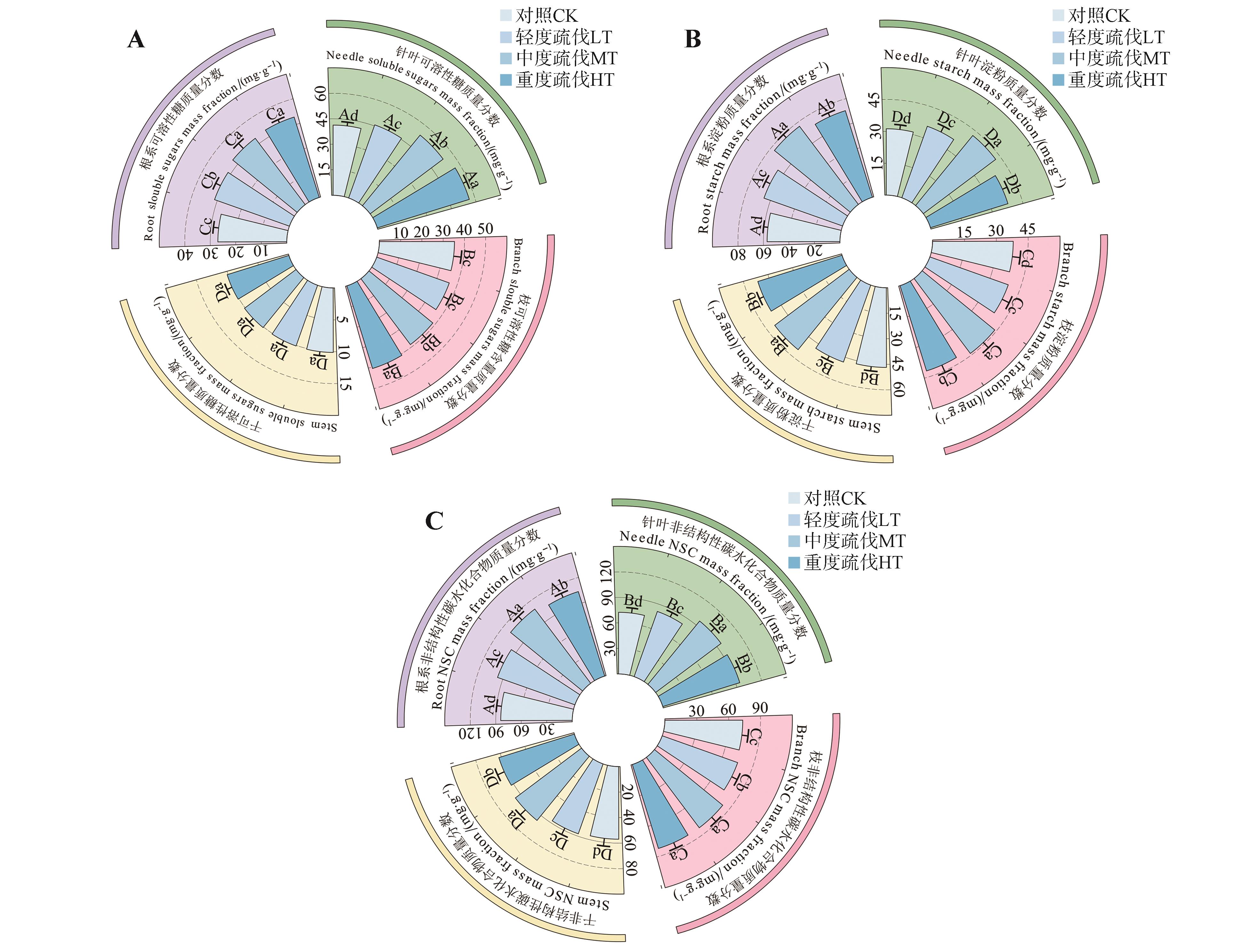
Table 3
Two-way variance analysis of C,N,and P contents and their stoichiometric ratios in different organs of P. koraiensis
因素 Factor | F | |||||
|---|---|---|---|---|---|---|
| C | N | P | C∶N | C∶P | N∶P | |
| 疏伐 Thinning | 1814.328** | 80.831** | 507.184** | 387.735** | 234.195** | 141.931** |
| 器官 Organ | 10856.168** | 9779.718** | 2961.448** | 21618.581** | 2288.668** | 3544.846** |
| 疏伐×器官 Thinning×Organ | 203.319** | 25.002** | 58.871** | 286.150** | 39.180** | 38.813** |
Fig.2
Mass fraction of carbon,nitrogen and phosphorus in P. koraiensis under different thinning treatmentsA-C represented the mass fraction of C,N and P in each organ, respectively. Different capital letters indicated significant differences among different organs under the same treatment(P<0.05), while different lowercase letters indicated significant differences within the same organ under different treatments(P<0.05).
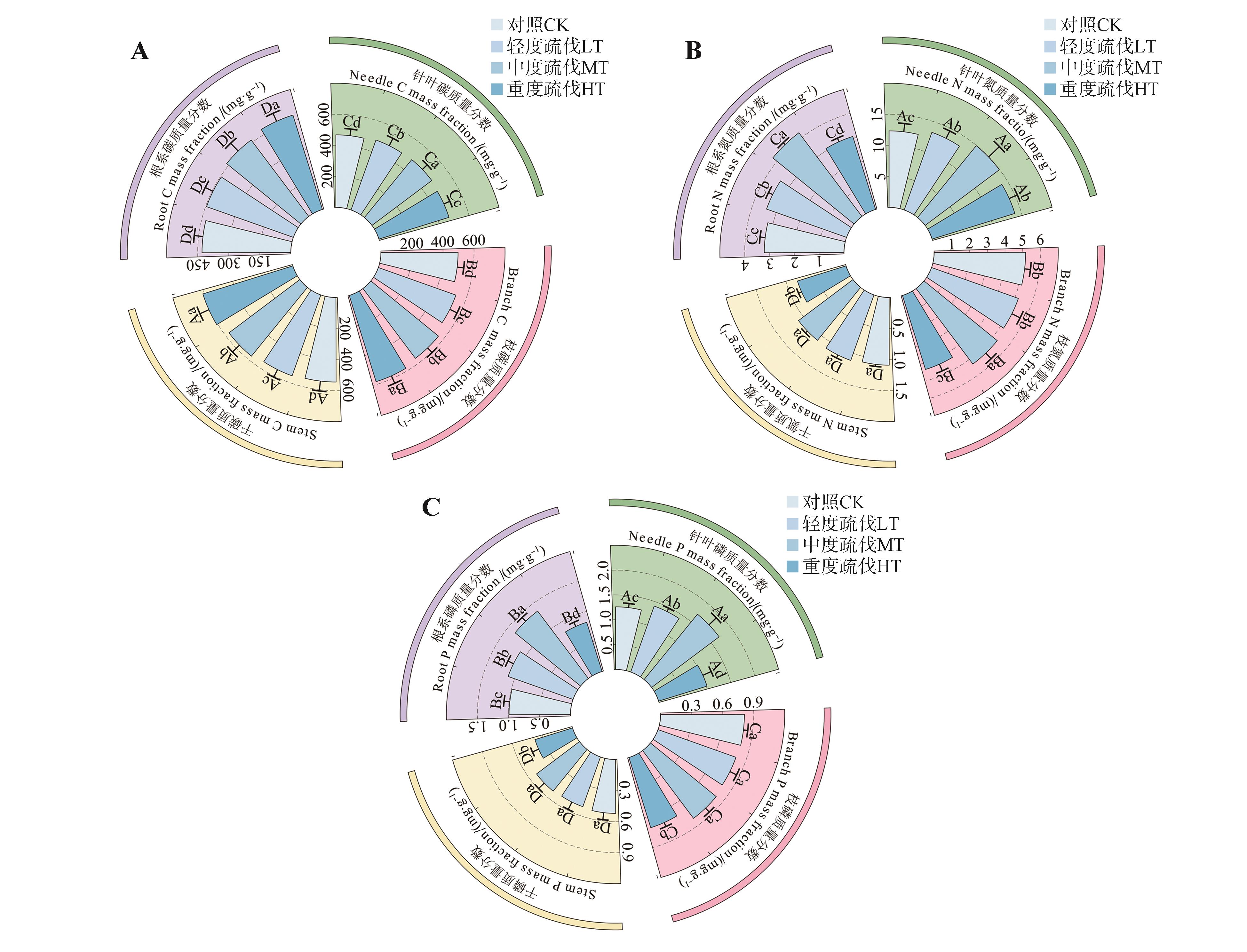
Fig.3
Stoichiometric ratios of C,N and P in P. koraiensis resulting from different thinning treatmentsA-C represented the C∶N, C∶P and N∶P ratios of each organ, respectively. Different capital letters indicated significant differences among different organs under the same treatment(P<0.05), while different lowercase letters indicated significant differences within the same organ under different treatments(P<0.05).
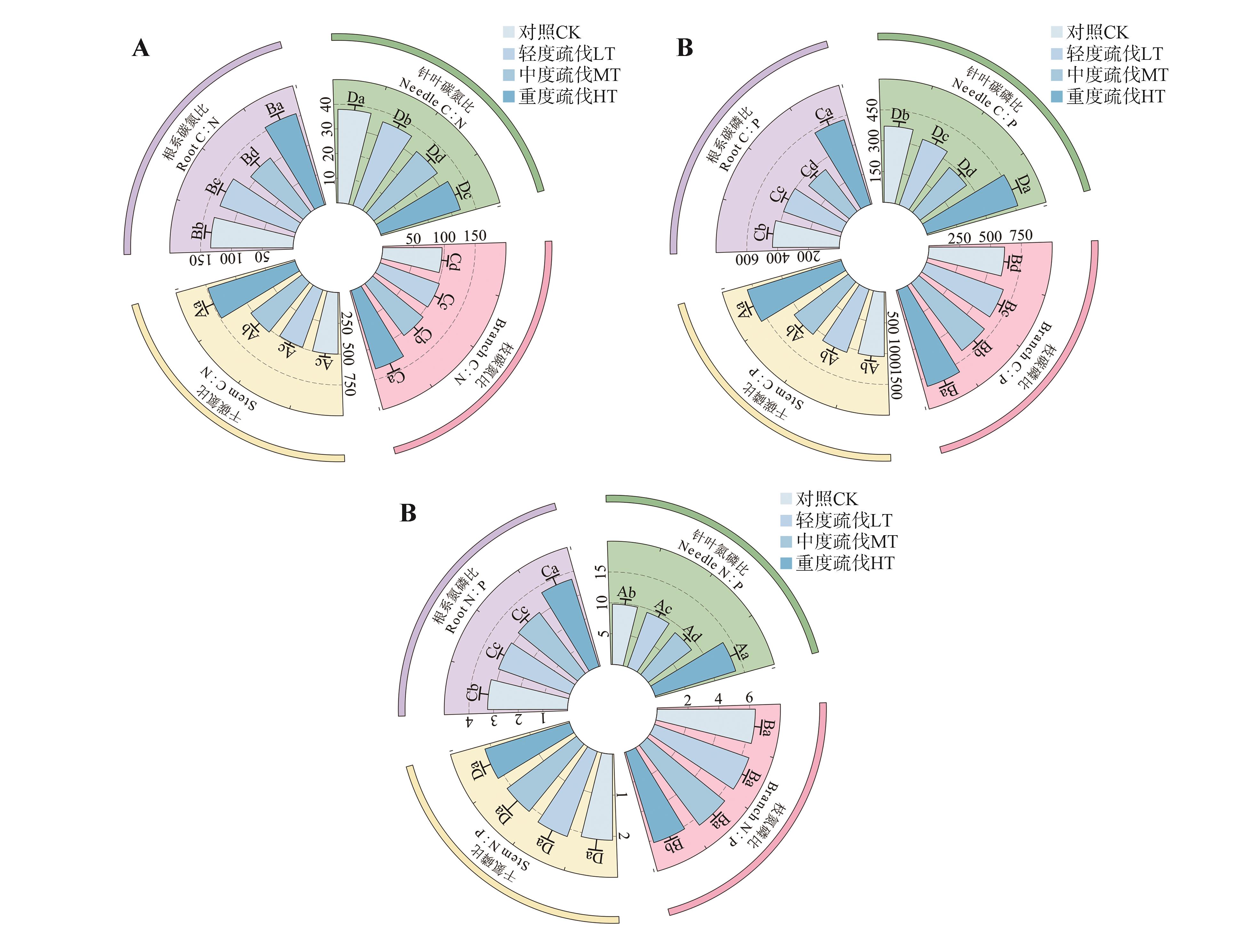
Fig.4
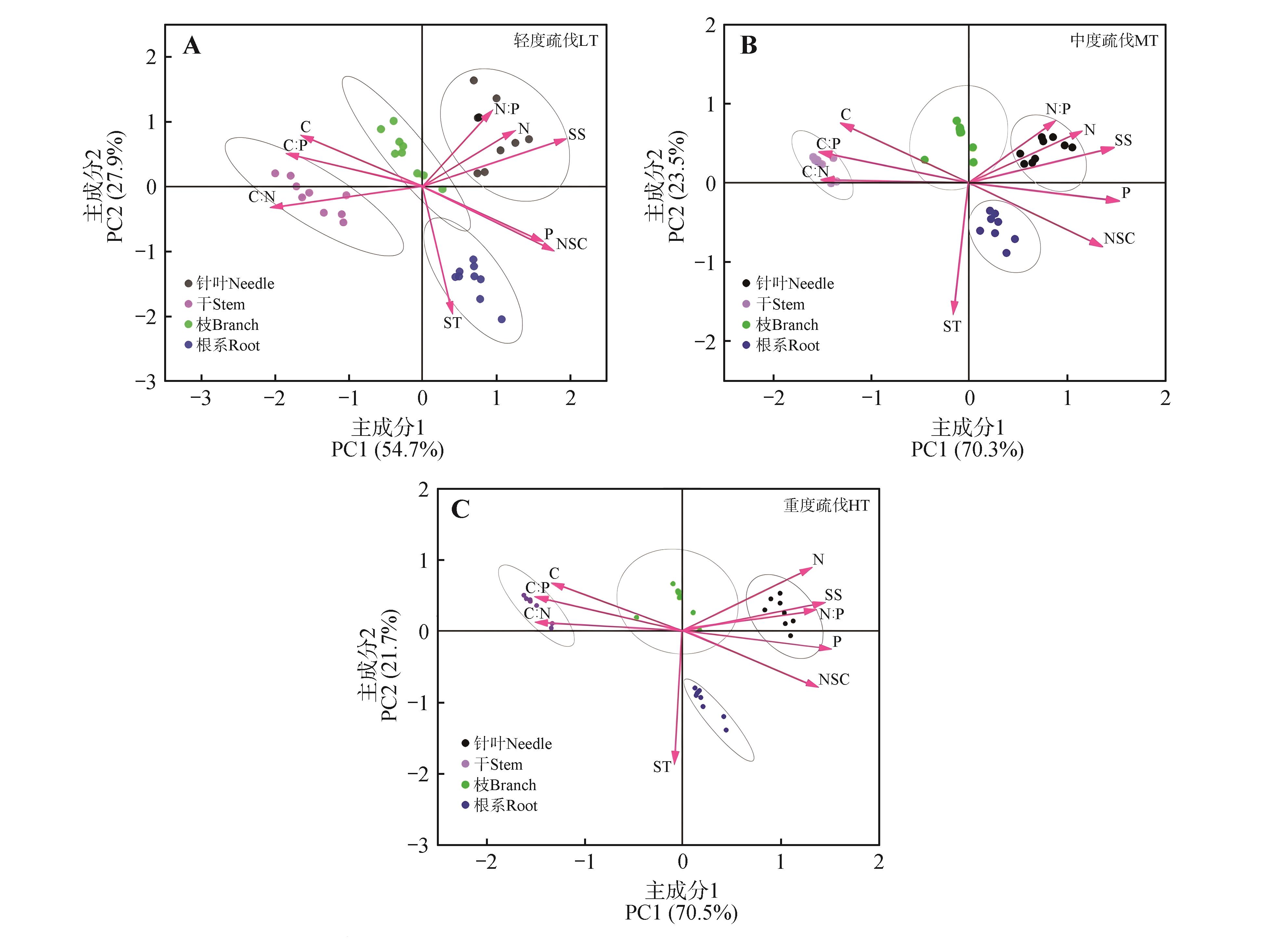
Principal component analysis(PCA) of the contents of NSC and chemical composition(carbon,nitrogen and phosphorus) as well as the stoichiometric ratios of different organs of P. koraiensis under various thinning treatments
| [1] | HE T, LEI J J, PENG Y Y,et al.Thinning intensity enhances soil multifunctionality and microbial residue contributions to organic carbon sequestration in Chinese fir plantations[J].Plants,2025,14(4):579. |
| [2] | WANG D, OLATUNJI O A, XIAO J L,et al.Thinning increased fine root production,biomass,turnover rate and understory vegetation yield in a Chinese fir plantation[J].Forest Ecology and Management,2019,440:92-100. |
| [3] | 杨诗敏,骆金初,谭钠丹,等.不同强度干旱胁迫对华南地区4种乡土树种生长和碳氮磷化学计量特征的影响[J].应用与环境生物学报,2024,30(1):75-82. |
| YANG S M, LUO J C, TAN N D,et al.Effects of drought stress on growth,nutrient content,and stoichiometry of four native tree species in South China[J].Chinese Journal of Applied and Environmental Biology,2024,30(1):75-82. | |
| [4] | 王迪生,李海文.华北落叶松人工林密度最优控制的研究[J].北京林业大学学报,1995(2):32-39. |
| WANG D S, LI H W.Study on the controlling of optimal stand density for Larix prinicipis-rapprechii plantation[J].Journal of Beijing Forestry University,1995(2):32-39. | |
| [5] | 杨蕾,赵彩鸿,邢鸿林,等.疏伐强度对红皮云杉人工林林木生长和林分蓄积的影响[J].西北林学院学报,2023,38(4):207-213. |
| YANG L, ZHAO C H, XING H L,et al.Effects of thinning intensity on the forest growth and stand accumulation of Picea koraiensis plantion[J].Journal of Northwest Forestry University,2023,38(4):207-213. | |
| [6] | 姜磊,田成玉,朱士利,等.不同间伐强度对鲁中南山区人工赤松林生长的影响研究[J].山东林业科技,2020,50(1):41-45. |
| JIANG L, TIAN C Y, ZHU S L,et al.Effects of different thinning intensities on growth of red pine plantation in middle south mountain area of Shandong Province[J].Journal of Shandong Forestry Science and Technology,2020,50(1):41-45. | |
| [7] | HUANG W J, SONG B Y, LIU Y,et al.Multifunctional evaluation of spruce-fir forest based on different thinning intensities[J].Forests,2024,15(10):1703. |
| [8] | TIAN Q Y, HE Z B, XIAO S C,et al.Soil temperature and water content as determinants of non-structural carbohydrates concentrations in Picea crassifolia under continuous drought[J].Journal of Forestry Research,2025,36(1):105. |
| [9] | MINDEN V, KLEYER M.Internal and external regulation of plant organ stoichiometry[J].Plant Biology,2014,16(5):897-907. |
| [10] | 何念鹏,于贵瑞,刘聪聪,等.植物功能生态学:从器官到生态系统[M].北京:科学出版社,2024:212-215. |
| HE N P, YU G R, LIU C C,et al.Plant functional ecology:from organs to ecosystems[M].Beijing:Science Press,2024:212-215. | |
| [11] | WANG R L, WANG Q F, LIU C C,et al.Changes in trait and phylogenetic diversity of leaves and absorptive roots from tropical to boreal forests[J].Plant and Soil,2018,432(1/2):389-401. |
| [12] | 牛鉴祺,吕彦飞,王树力,等.抚育间伐对杨桦次生林非结构性碳水化合物质量分数和碳氮磷生态化学计量特征的影响[J].东北林业大学学报,2024,52(6):51-57. |
| NIU J Q, LÜ Y F, WANG S L,et al.Effects of tending thinning on the content of non-structural carbohydrates and the ecological stoichiometry of carbon,nitrogen,and phosphorus in poplar-birch secondary forests[J].Journal of Northeast Forestry University,2024,52(6):51-57. | |
| [13] | 代林利,周丽丽,伍丽华,等.不同林分密度杉木林生态系统碳密度及其垂直空间分配特征[J].生态学报,2022,42(2):710-719. |
| DAI L L, ZHOU L L, WU L H,et al.Carbon density and vertical spatial distribution characteristics of Cunninghamia lanceolata forest ecosystem with different stand density[J].Acta Ecologica Sinica,2022,42(2):710-719. | |
| [14] | ZHANG J H, HE N P, LIU C C,et al.Variation and evolution of C∶N ratio among different organs enable plants to adapt to N-limited environments[J].Global Change Biology,2020,26(4):2534-2543. |
| [15] | 王丽娜,吴俊文,董琼,等.抚育间伐对云南松非结构性碳和化学计量特征的影响[J].北京林业大学学报,2021,43(8):70-82. |
| WANG L N, WU J W, DONG Q,et al.Effects of tending and thinning on non-structural carbon and stoichiometric characteristics of Pinus yunnanensis [J].Journal of Beijing Forestry University,2021,43(8):70-82. | |
| [16] | 成向荣,虞木奎,葛乐,等.不同间伐强度下麻栎人工林碳密度及其空间分布[J].应用生态学报,2012,23(5):1175-1180. |
| CHENG X R, YU M K, GE L,et al.Carbon density and its spatial distribution in Quercus acutissima plantations under different thinning intensities[J].Chinese Journal of Applied Ecology,2012,23(5):1175-1180. | |
| [17] | BLANCO J A, IMBERT J B, CASTILLO F J.Influence of site characteristics and thinning intensity on litterfall production in two Pinus sylvestris L. forests in the western Pyrenees[J].Forest Ecology and Management,2006, 237(1/3):342-352. |
| [18] | 王祖华,李瑞霞,关庆伟.等 .间伐对杉木不同根序细根形态、生物量和氮含量的影响[J].应用生态学报,2013,24(6):1487-1493. |
| WANG Z H, LI R X, GUAN Q W. et al.Effects of thinning on fine-root morphology,biomass and N concentration of different branch orders of Chinese fir[J].Chinese Journal of Applied Ecology,2013,24(6):1487-1493. | |
| [19] | SAKIB N.不同间伐强度对中龄红松人工林生长和林分碳储量的影响研究[D].哈尔滨:东北林业大学,2024. |
| SAKIBN.Effects of thinning intensities on carbon storage in Pinus koraiensis middle-aged plantations in Northeast China[D].Harbin:Northeast Forestry University,2024. | |
| [20] | ABDUL-QADIR I.林分密度对红松人工林生长、林下植被物种多样性及土壤性质的影响[D].哈尔滨:东北林业大学,2024. |
| ABDUL-QADIRI.Effects of stand density on tree growth,understory vegetation species diversity,and soil properties in a Pinus koraiensis plantation[D].Harbin:Northeast Forestry University,2024. | |
| [21] | 马闯,刘彦春,王梦涵,等.不同间伐强度对大别山黄山松人工林林下植物多样性的长期影响[J].北京林业大学学报,2025,47(10):11-18. |
| MA C, LIU Y C, WANG M H,et al.Long-term effects of different thinning intensities on understory plant diversity of Pinus taiwanensis plantations in Dabieshan Mountain of central China[J].Journal of Beijing Forestry University,2025,47(10):11-18. | |
| [22] | 刘元玺.不同氮添加对轻木人工林生长及生理的影响[D].昆明:西南林业大学,2024. |
| LIU Y X.Effects of different nitrogen additions on the growth and physiological characteristics of Ochroma lagopus [D].Kunming:Southwest Forestry University,2024. | |
| [23] | LIU M H, WANG Y X, LI Q,et al.Photosynthesis,ecological stoichiometry,and non-structural carbohydrate response to simulated nitrogen deposition and phosphorus addition in Chinese fir forests[J].Forests,2019,10(12):1068. |
| [24] | XIE H T, YU M K, CHENG X R,et al.Leaf non-structural carbohydrate allocation and C∶N∶P stoichiometry in response to light acclimation in seedlings of two subtropical shade-tolerant tree species[J].Plant Physiology and Biochemistry,2018,124:146-154. |
| [25] | 梁月明,潘复静,马姜明,等.不同林龄和密度马尾松人工林针叶和根系的生态化学计量特征[J].广西植物,2021,41(9):1497-1508. |
| LIANG Y M, PAN F J, MA J M,et al.Ecological stoichiometry characteristics of needle leaves and roots in different age and density stands of Pinus massoniana plantations[J].Guihaia,2021,41(9):1497-1508. | |
| [26] | 简毅,林静,张可欣,等.华西雨屏区不同林龄柳杉人工林叶片和细根非结构性碳水化合物质量分数特征[J].东北林业大学学报,2025,53(5):41-49. |
| JIAN Y, LIN J, ZHANG K X,et al.Characteristics of non-structural carbohydrate content in leaves and fine roots of Cryptomeria japonica var. sinensis plantations of different ages in rainy area of western China[J].Journal of Northeast Forestry University,2025,53(5):41-49. | |
| [27] | 张薇.抚育间伐对杉木人工林生长及碳储量的影响[D].长沙:中南林业科技大学,2024. |
| ZHANG W.Effects of tending thinning on growth and carbon storage of Cunninghamia lanceolatar plantation[D].Changsha:Central South University of Forestry and Technology,2024. | |
| [28] | 于丽敏,王传宽,王兴昌,等.三种温带树种非结构性碳水化合物的分配[J].植物生态学报,2011,35(12):1245-1255. |
| YU L M, WANG C K, WANG X C,et al.Allocation of nonstructural carbohydrates for three temperate tree species in northeast China[J].Chinese Journal of Plant Ecology,2011,35(12):1245-1255. | |
| [29] | 王凯,邢仕奇,张日升,等.不同密度下樟子松非结构性碳水化合物变化规律[J].生态学杂志,2024,43(9):2607-2614. |
| WANG K, XING S Q, ZHANG R S,et al.Changes of non-structural carbohydrates of Pinus sylvestris var. mongolica under different stand densities[J].Chinese Journal of Ecology,2024,43(9):2607-2614. | |
| [30] | CHEN L F, HE Z B, ZHAO W Z,et al.The long-term effects of thinning on soil respiration vary with season in subalpine spruce plantations[J].Agricultural and Forest Meteorology,2023,342:109756. |
| [31] | 王子纯,王晨,李耀翔,等.小兴安岭天然针阔混交林非结构性碳水化合物对间伐强度的响应[J].中南林业科技大学学报,2022,42(6) :45-54. |
| WANG Z C, WANG C, LI Y X,et al.Responses of NSC to different thinning intensities in natural coniferous and broad-leaved mixed forests in Xiaoxing’an mountains[J].Journal of Central South University of Forestry & Technology,2022,42(6):45-54. | |
| [32] | 王亚飞,祝维,曲冠博,等.间伐对毛白杨水碳生理及土壤水碳分布特征的影响[J/OL].南京林业大学学报(自然科学版),(2025-06-10)[2025-11-23].. |
| WANG Y F, ZHU W, QU G B,et al.Response of water-carbon physiology and soil water-carbon distributioncharacteristics to thinning in Populus tomentosa [J/OL].Journal of Nanjing Forestry University (Natural Sciences Edition),(2025-06-10) [2025-11-23].. | |
| [33] | HE W Q, LIU H Y, QI Y,et al.Patterns in nonstructural carbohydrate contents at the tree organ level in response to drought duration[J].Global Change Biology,2020,26(6):3627-3638. |
| [34] | 蔡妙莹,张非凡,李雪琴,等.6种阔叶树幼苗不同器官的碳、氮和磷化学计量特征及其异速关系[J].生态学报,2025,45(9):4380-4390. |
| CAI M Y, ZHANG F F, LI X Q,et al.Stoichiometric characteristics of carbon,nitrogen and phosphorus in different organs of 6 broad-leaf tree seedling[J].Acta Ecologica Sinica,2025,45(9):4380-4390. | |
| [35] | HAN H D, HE H S, WU Z F,et al.Non-structural carbohydrate storage strategy explains the spatial distribution of treeline species[J].Plants,2020,9(3):384. |
| [36] | TANG Y, SCHIESTL-AALTO P, SAURER M,et al.Tree organ growth and carbon allocation dynamics impact the magnitude and δ13C signal of stem and soil CO2 fluxes[J].Tree Physiology,2022,42(12):2404-2418. |
| [37] | OLSON M E, ROSELL J A, MUÑOZ S Z,et al.Carbon limitation,stem growth rate and the biomechanical cause of Corner’s rules[J].Annals of Botany,2018,122(4):583-592. |
| [38] | 牛青云,孟京辉.北京市油松林碳储量密度控制图研制及应用[J].西北林学院学报,2024,39(6):145-152. |
| NIU Q Y, MENG J H.Development and application of carbon stock density management diagram of Pinus tabuliformis forest in Beijing[J].Journal of Northwest Forestry University,2024,39(6):145-152. | |
| [39] | XIE T T, SHAN L S, ZHANG W T,et al.N addition alters growth,non-structural carbohydrates,and C∶N∶P stoichiometry of Reaumuria soongorica seedlings in northwest China[J].Scientific Reports,2022,12(1):15390. |
| [40] | 陈美玲,崔君滕,邓蕾,等.黄土高原两种针叶树种不同器官水碳氮磷分配格局及其生态化学计量特征[J].地球环境学报,2018,9(1):54-63. |
| CHEN M L, CUI J T, DENG L,et al.Distribution patterns and ecological stoichiometry of water,carbon,nitrogen and phosphorus in different organs of two conifer species on the Loess Plateau[J].Journal of Earth Environment,2018,9(1):54-63. | |
| [41] | 俞施龙,张明静,王光华,等.高温下减氮对水稻化学计量特征和非结构性碳水化合物分配的影响[J].中国农业大学学报,2025,30(3):71-84. |
| YU S L, ZHANG M J, WANG G H,et al.Effect of nitrogen reduction under high temperature on the stoichiometric characteristics and non-structural carbohydrate allocation in rice[J].Journal of China Agricultural University,2025,30(3):71-84. | |
| [42] | KOERSELMAN W, MEULEMAN A F M.The vegetation N∶P ratio:a new tool to detect the nature of nutrient limitation[J].Journal of Applied Ecology,1996,33(6):1441-1450. |
| [43] | HAN W X, FANG J Y, GUO D L,et al.Leaf nitrogen and phosphorus stoichiometry across 753 terrestrial plant species in China[J].New Phytologist,2005,168(2):377-385. |
| [44] | ZHANG S J, ZHANG Q, LI Y G,et al.Shrubs have a greater influence on the nonstructural carbohydrates of desert mosses along precipitation decreased[J].Environmental and Experimental Botany,2023,216:105530. |
| [45] | 林恬,郑怀舟,朱锦懋,等.隔离降雨对马尾松针叶非结构性碳水化合物和碳、氮、磷的影响[J].生态学报,2022,42(18):7641-7651. |
| LIN T, ZHENG H Z, ZHU J M,et al.Influence of rainfall exclusion on the needle non-structural carbohydrates and C,N,P concentrations in Pinus massoniana [J].Acta Ecologica Sinica,2022,42(18):7641-7651. | |
| [46] | LIN T, ZHENG H Z, HUANG Z H,et al.Non-structural carbohydrate dynamics in leaves and branches of Pinus massoniana(Lamb.) following 3-year rainfall exclusion[J].Forests,2018,9(6):315. |
| [47] | 洪琮浩,洪震,雷小华,等.氮添加对长序榆C、N、P养分含量及非结构性碳水化合物含量的影响[J].林业科学,2020,56(6):186-192. |
| HONG C H, HONG Z, LEI X H,et al.Effects of nitrogen addition on contents of C,N and P nutrient and non-structural carbohydrate in Ulmus elongata [J].Scientia Silvae Sinicae,2020,56(6):186-192. | |
| [48] | 魏红,满秀玲.中国寒温带不同林龄白桦林碳储量及分配特征[J].植物生态学报,2019,43(10):843-852. |
| WEI H, MAN X L.Carbon storage and its allocation in Betula platyphylla forests of different ages in cold temperate zone of China[J].Chinese Journal of Plant Ecology,2019,43(10):843-852. | |
| [49] | 李虹谕,杨会侠,孙佳彤,等.中、幼龄红松人工林生长季非结构性碳水化合物和碳氮磷生态化学计量特征[J].浙江农林大学学报,2025,42(3):495-502. |
| LI H Y, YANG H X, SUN J T,et al.Structural carbohydrate and carbon,nitrogen,phosphorus ecological stoichiometry in young and middle-aged Pinus koraiensis plantations during growing seasons[J].Journal of Zhejiang A&F University,2025,42(3):495-502. | |
| [50] | 陈超,罗光宇,金则新,等.光照强度对景宁木兰幼苗叶片形态结构、化学计量特征和非结构性碳水化合物的影响[J].生态学杂志,2023,42(6):1307-1315. |
| CHEN C, LUO G Y, JIN Z X,et al.Effects of light intensities on leaf morphological structure,stoichiometry and non-structural carbohydrates of Magnolia sinostellata seedlings[J].Chinese Journal of Ecology,2023,42(6):1307-1315. | |
| [51] | 吕彦飞.抚育间伐对小黑杨人工林非结构性碳和氮磷钾生态化学计量特征的影响[D].哈尔滨:东北林业大学,2024. |
| LÜ Y F.Effects of tending thinning on non-structural carbon and NPK ecological stoichiometric characteristics in Populus × xiaohei plantations[D].Harbin:Northeast Forestry University,2024. |
| [1] | Wenbiao DUAN, Zhizhen WANG, Jiayi GAO, Lixin CHEN, Yanrui FU. Carbon Density and C, N, P Stoichiometric Characteristics of Forest Litter in Different Succession Stages in the Xiaoxing'an Mountains [J]. Bulletin of Botanical Research, 2025, 45(5): 769-782. |
| [2] | Xiongzhong MA, Weihong XIONG, Zhe SUN. Analysis of Biomass Allocation and Stoichiometric Characteristics of Bidens alba in the Nanliu River Basin [J]. Bulletin of Botanical Research, 2024, 44(6): 852-862. |
| [3] | Jing XU, Ying CUI, Fusen WANG, Kailong LI, Guanzheng QU, Xiyang ZHAO. Growth and Wood Character Variation of Populus pseudo-cathyana×Populus deltoids Plantation with Different Thinning Intensity in Northeast China [J]. Bulletin of Botanical Research, 2024, 44(2): 248-258. |
| [4] | Hongbo LI, Shi CHEN, Yaohua HUANG, Dingxu KANG, Jianrong WU, Huancheng MA. Ecological Stoichiometry and Homeostasis of Alpine Quercus semicarpifolia Leaves in Subalpine Zone of Hengduan Mountains [J]. Bulletin of Botanical Research, 2023, 43(6): 923-931. |
| [5] | Meng-Tian DU, Bo-Yi WANG, Jing-Hang LI, Ming-Yuan ZHAO, Xiu-Wei WANG. Differences and Seasonal Dynamics of Soluble Sugar and Starch Concentrations in Fine Roots with Different Root Orders of Larix gmelinii [J]. Bulletin of Botanical Research, 2021, 41(4): 491-495. |
| [6] | Ke-Xin MA, Mei ZHANG, Xin FANG, Li-Li TANG, Jian-Hua HAN, Li-Fang YANG, Fu-Chen SHI. Effects of Invasive Plant Datura stramonium on the Functional Traits of Native Plants and the Stoichiometric Characteristics of Soil Carbon, Nitrogen and Phosphorus [J]. Bulletin of Botanical Research, 2020, 40(6): 867-875. |
| [7] | WANG Zong-Yan, WANG Kai, JIANG Tao, CAO Peng, SUN Ju, WANG Dao-Han. Staged Responses of Non-structural Carbohydrates of Pinus tabulaeformis Seedlings to Drought Stress [J]. Bulletin of Botanical Research, 2018, 38(3): 460-466. |
| [8] | LIANG Jing;WANG Qing-Cheng*;XU Li-Juan;WU Wen-Juan. Effect of Thinning on Litter Decomposition and Soil of Two Stands in Changbai Mountain [J]. Bulletin of Botanical Research, 2015, 35(2): 297-303. |
| [9] | LIANG Jing1,2;WANG Qing-Cheng1*;XU Li-Juan1;WU Wen-Juan1. Effect of Thinning on Respiration Rate and Soil Carbon Density of Young-age Poplar-birch Stands in Western Changbai Mountains [J]. Bulletin of Botanical Research, 2015, 35(1): 110-116. |
| Viewed | ||||||
|
Full text |
|
|||||
|
Abstract |
|
|||||