Bulletin of Botanical Research ›› 2026, Vol. 46 ›› Issue (1): 25-37.doi: 10.7525/j.issn.1673-5102.2026.01.003
• Review Article • Previous Articles Next Articles
Qinxiang CHANG1,2, Wenxin GAO2, Donghong ZHANG3, Lin LI1, Qiang ZHANG2, Zongsuo LIANG1,2( )
)
Received:2025-08-03
Online:2026-01-20
Published:2026-01-20
Contact:
Zongsuo LIANG
E-mail:liangzs@ms.iswc.ac.cn
CLC Number:
Qinxiang CHANG, Wenxin GAO, Donghong ZHANG, Lin LI, Qiang ZHANG, Zongsuo LIANG. Research Progress on the Seed Dormancy and Germination of Astragalus membranaceus and Astragalus membranaceus var. mongholicus[J]. Bulletin of Botanical Research, 2026, 46(1): 25-37.
Add to citation manager EndNote|Ris|BibTeX
URL: https://bbr.nefu.edu.cn/EN/10.7525/j.issn.1673-5102.2026.01.003
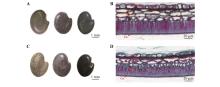
Fig.1
Seed morphology at different maturity levels(A,C) and seed-coat structure(B,D)A-B.A. membranaceus var. mongholicus;C-D.A. membranaceus;Cu. Cuticle; Pl.Palisade layer; Osl. Bone-like stone cell layer; Ccl. Senescent cell layer.
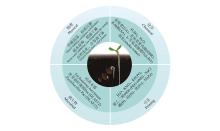
Fig.2
Methods of breaking dormancy for seeds of Astragalus membranaceus and A. membranaceus var. mongholicus
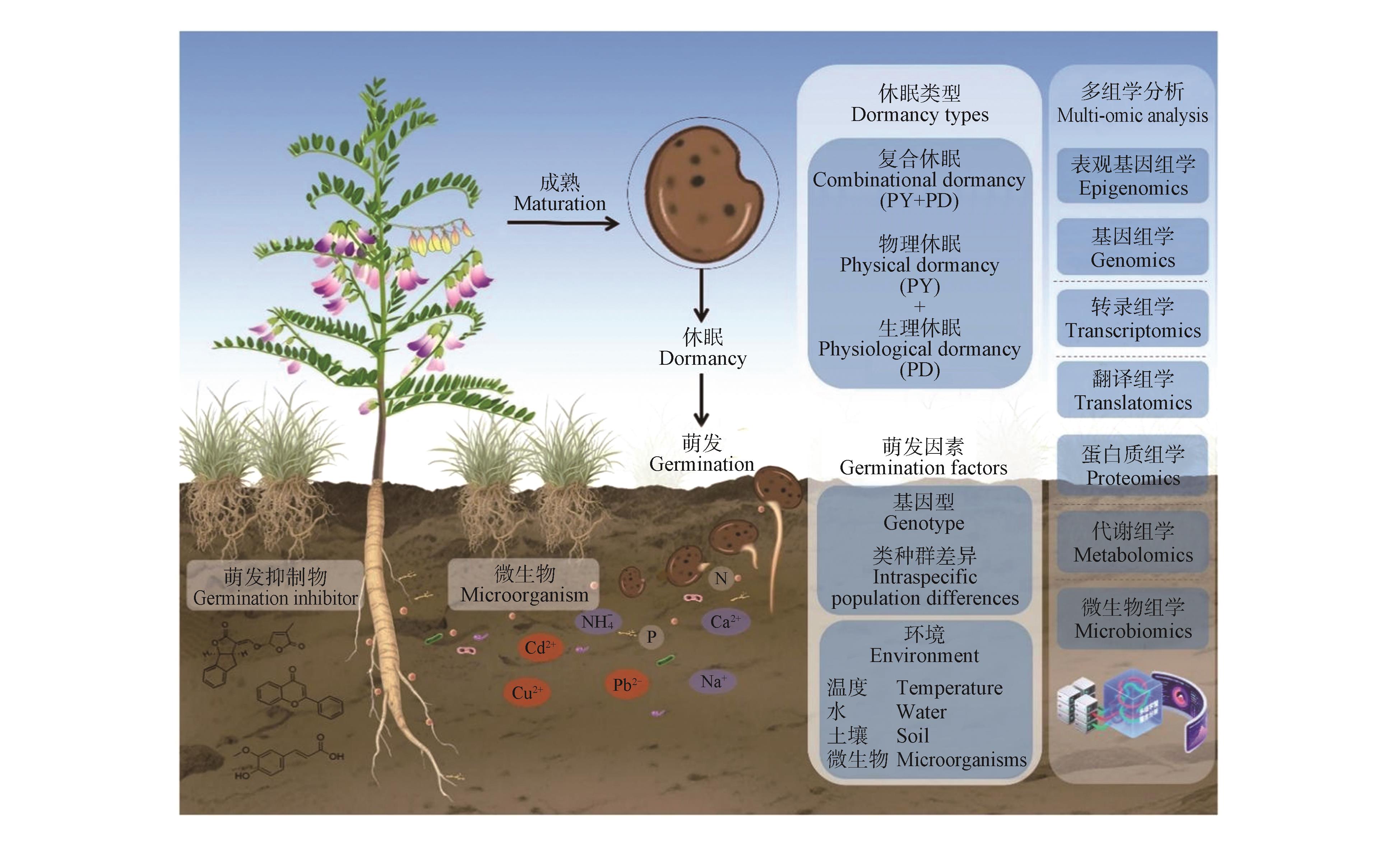
Fig.3
Research on Astragalus membranaceus and A. membranaceus var. mongholicus seed dormancy-germination and multi-omics analysis
| [1] | 国家药典委员会.中华人民共和国药典[M].北京:中国医药科技出版社,2025. |
| Chinese Pharmacopoeia Commission.Pharmacopoeia of the People’s Republic of China[M].Beijing:China Medical Science and Technology Press,2025. | |
| [2] | 段琦梅,梁宗锁,聂小妮,等.黄芪和党参提取物的抗氧化活性研究[J].西北植物学报,2010,30(10):2123-2127. |
| DUAN Q M, LIANG Z S, NIE X N,et al.Antioxidant activity detection of Astragalus membranaceus and Codonopsis pilosula ethanol extracts by DPPH method[J].Acta Botanica Boreali-Occidentalia Sinica,2010,30(10):2123-2127. | |
| [3] | 秦雪梅,李震宇,孙海峰,等.我国黄芪药材资源现状与分析[J].中国中药杂志,2013,38(19):3234-3238. |
| QIN X M, LI Z Y, SUN H F,et al.Status and analysis of Astragali Radix resource in China[J].China Journal of Chinese Materia Medica,2013,38(19):3234-3238. | |
| [4] | 周盛茂,吴卫刚,郭亮,等.中国黄芪产区变迁及栽培产业发展历程[J].中国现代中药,2023,25(11):2428-2433. |
| ZHOU S M, WU W G, GUO L,et al.Changes of Astragali Radix producing regions and development process of cultivation industry in China[J].Modern Chinese Medicine,2023,25(11):2428-2433. | |
| [5] | PAGANO A, MACOVEI A, BALESTRAZZI A.Molecular dynamics of seed priming at the crossroads between basic and applied research[J].Plant Cell Reports,2023,42(4):657-688. |
| [6] | 樊良帅,尚兴朴,朱勇,等.蒙古黄芪种子质量评价研究[J].种子,2022,41(8):116-120. |
| FAN L S, SANG X P, ZHU Y,et al.Evaluation on seed quality of Astragalus membranaceus var.mongholicus [J].Seed,2022,41(8):116-120. | |
| [7] | LIU X D, ZHANG H, ZHAO Y,et al.Auxin controls seed dormancy through stimulation of abscisic acid signaling by inducing ARF-mediated ABI3 activation in Arabidopsis [J].Proceedings of the National Academy of Sciences of the United States of America,2013,110(38):15485-15490. |
| [8] | YANG M, LI Z Y, LIU L B,et al.Ecological niche modeling of Astragalus membranaceus var.mongholicus medicinal plants in Inner Mongolia,China[J].Scientific Reports,2020,10(1):12482. |
| [9] | 药用植物试验场中草药组.黄芪硬实种子处理试验初报[J].特产科学实验,1975(2):44-46. |
| Medicinal Plant Experimental Station,Chinese herbal medicine group.Preliminary report on the treatment of hard seeds in Astragalus membranaceus [J].Special Wild Economic Animal and Plant Research,1975(2):44-46. | |
| [10] | 赵一之.中药黄芪植物分类及其区系地理分布研究[J].植物研究,2006,26(5):532-538. |
| ZHAO Y Z.Taxonomy and floristic geographical distribution of the Chinese medicinal Huangqi[J].Bulletin of Botanical Research,2006,26(5):532-538. | |
| [11] | 刘宇.膜荚黄芪种子萌发生态特性及生理生化活性的研究[D].长春:吉林农业大学,2006. |
| LIU Y.Study on ecology characteristics and physiology and biochemistry activity for seed germination of Astragalus membranaceus [D].Changchun:Jilin Agricultural University,2006. | |
| [12] | 段琦梅,梁宗锁,慕小倩,等.黄芪种子萌发特性的研究[J].西北植物学报,2005,25(6):1246-1249. |
| DUAN Q M, LIANG Z S, MU X Q,et al.Germination characteristics of Astragalus membranaceus seeds[J].Acta Botanica Boreali-Occidentalia Sinica,2005,25(6):1246-1249. | |
| [13] | 王尔彤,刘鸣远.两种药用黄芪比较生物学研究[J].植物研究,1996,16(1):85-91. |
| WANG E T, LIU M Y.A comparative biology study on the two medicinal Astragalus [J].Bulletin of Botanical Research,1996,16(1):85-91. | |
| [14] | 荆志宇,郭凤霞,陈垣,等.蒙古黄芪种子灌浆特性研究[J].草业学报,2011,20(1):161-166. |
| JING Z Y, GUO F X, CHEN Y,et al.Studies on seed filling characteristics of Astragalus membranaceus var. mongholicus [J].Acta Prataculturae Sinica,2011,20(1):161-166. | |
| [15] | 刘宇,王萍娟,李天昊,等.聚乙二醇渗透处理对膜荚黄芪种子发芽及幼苗抗冷害的影响[J].吉林农业大学学报,2007,29(1):61-64. |
| LIU Y, WANG P J, LI T H,et al.Effect of PEG on seed germination and chilling resistance of seedling in Astragalus membranaceus [J].Journal of Jilin Agricultural University,2007,29(1):61-64. | |
| [16] | 张琳,秦雪梅.黄芪种子萌发实验[J].中药材,1994(11):9-10. |
| ZHANG L, QIN X M.Seed germination experiments of Astragalus mongholicus [J].Journal of Chinese Medicinal Materials,1994(11):9-10. | |
| [17] | LI D, CHEN W M, LUO W,et al.Seed microbiomes promote Astragalus mongholicus seed germination through pathogen suppression and cellulose degradation[J].Microbiome,2025,13(1):23. |
| [18] | 闫冲,聂凤禔,董兰凤,等.两种黄芪种子的扫描电镜与紫外光谱鉴别[J].时珍国医国药,2005,16(8):720-721. |
| YAN C, NIE F Z, DONG L F,et al.Identification of two species of Huangqi seeds by SEM and UV spectrophotometry[J].Lishizhen Medicine and Materia Medica Research,2005,16(8):720-721. | |
| [19] | 王俊杰,张红霞,金雄.蒙古黄芪与膜荚黄芪种子形态特征及其鉴别方法的研究[J].中草药,2005,36(7):1072-1075. |
| WANG J J, ZHANG H X, JIN X,Morphologic characteristics and identification methods of seeds in Astragalus membranaceus var. mongholicus and A.membranaceus[J].Chinese Traditional and Herbal Drugs,2005,36(7):1072-1075. | |
| [20] | 常晖,张小燕,张跃进,等.黄芪种子内源抑制物质的初步研究[J].种子,2015,34(1):44-47. |
| CHANG H, ZHANG X Y, ZHANG Y J,et al.Study on endogenesis inhibitory substances in seed of Astragalus membranaceus [J].Seed,2015,34(1):44-47. | |
| [21] | 赵敏,王炎.膜荚黄芪种子萌发抑制物质特性的初步研究[J].中草药,2001,32(7):643-646. |
| ZHAO M, WANG Y.Elementary studies on intrinsic inhibitor that retards germinaton of seed of Astragalus membranaceus [J].Chinese Traditional and Herbal Drugs,2001,32(7):643-646. | |
| [22] | XU F, TANG J Y, WANG S X,et al.Antagonistic control of seed dormancy in rice by two bHLH transcription factors[J].Nature Genetics,2022,54(12):1972-1982. |
| [23] | TUAN P A, KUMAR R, REHAL P K,et al.Molecular mechanisms underlying abscisic acid/gibberellin balance in the control of seed dormancy and germination in cereals[J].Frontiers in Plant Science,2018,9:668. |
| [24] | BEAUDOIN N, SERIZET C, GOSTI F,et al.Interactions between abscisic acid and ethylene signaling cascades[J].The Plant Cell,2000,12(7):1103-1115. |
| [25] | 于倩.基于转录组对黄芪种子萌发过程及其内源激素分析[D].呼和浩特:内蒙古大学,2016. |
| YU Q.Integrating transcriptomics to analyse the process of Astragalus seed germination and endogenous hormones[D].Hohhot:Inner Mongolia University,2016. | |
| [26] | BASKIN J M, BASKIN C C.A classification system for seed dormancy[J].Seed Science Research,2004,14(1):1-16. |
| [27] | FINCH-SAVAGE W E, FOOTITT S.To germinate or not to germinate:a question of dormancy relief not germination stimulation[J].Seed Science Research,2012,22(4):243-248. |
| [28] | BASKIN J M, BASKIN C C, LI X J.Taxonomy,anatomy and evolution of physical dormancy in seeds[J].Plant Species Biology,2000,15(2):139-152. |
| [29] | JAGANATHAN G K, BERRY K.Climate change during cretaceous/paleogene as a driving force for the evolutionary radiation of physical dormancy in Fabaceae[J].Seeds,2023,2(3):309-317. |
| [30] | 陈家裘,侯兆新,覃初贤,等.几种作物种子破休眠法试验[J].广西农业科学,1991(5):214-216. |
| CHEN J Q, HOU Z X, QIN C X,et al.Experiments on dormancy breaking methods of several crop seeds[J].Guangxi Agricultural Sciences,1991(5):214-216. | |
| [31] | 王晓飞,魏国江,关向军,等.不同种子处理方法对两种黄芪种子萌发的影响[J].贵州农业科学,2019, 47(5):116-119. |
| WANG X F, WEI G J, GUAN X J,et al.Effects of different seed treatment methods on germination of two kinds of Astragalus membranaceus seeds[J].Guizhou Agricultural Sciences,2019,47(5):116-119. | |
| [32] | 郑天翔,陈叶.黄芪硬实种子的破除方法研究[J].种子,2016,35(6):90-93. |
| ZHENG T X, CHEN Y.Study on the method of breaking hard seed of Astragalus [J].Seed,2016,35(6):90-93. | |
| [33] | 王楠,高静,黄文静,等.赤霉素浸种时长和施用浓度对重度干旱和盐胁迫下黄芪种子萌发的影响[J].生态学杂志,2018,37(8):2339-2344. |
| WANG N, GAO J, HUANG W J,et al.Time-concentration effects of GA3 on germination of Astragalus membranaceus under severe drought and salt stresses[J].Chinese Journal of Ecology,2018,37(8):2339-2344. | |
| [34] | 郭先龙,冯津,王君杰,等.77份山西恒山野生蒙古黄芪种子萌发特性研究[J].种子,2018,37(10):64-67. |
| GUO X L, FENG J, WANG J J,et al.Study on seed germination characteristics of 77 wild Astragalus membranaceus var.mongholicus accessions from Shanxi Hengshan[J].Seed,2018,37(10):64-67. | |
| [35] | 胡艳改,杜宇忠,郝磊,等.中药材蒙古黄芪与膜荚黄芪优质种源的研究[J].山西农业科学,2017,45(10):1662-1666. |
| HU Y G, DU Y Z, HAO L,et al.Study on high quality provenances of Astragalus membranaceus(Fisch.) Bge.var. mongholicus(Bge.) Hsiao and Astragalus membranaceus(Fisch.) Bge.[J].Journal of Shanxi Agricultural Sciences,2017,45(10):1662-1666. | |
| [36] | 张延红,李金田,卢有媛,等.黄芪种子发芽检验标准化研究[J].中国药房,2016,27(7):998-1001. |
| ZHANG Y H, LI J T, LU Y Y,et al.Study on standardization of germination test of Astragalus membranacus seed[J].China Pharmacy,2016,27(7):998-1001. | |
| [37] | 何军,浦俊,王渭玲,等.引发对黄芪种子萌发及幼苗抗旱性的影响[J].干旱地区农业研究,2013,31(5):233-237. |
| HE J, PU J, WANG W L,et al.Effects of different priming treatments on germination and seedling drought-resistances of Astragalus membranaceus(Fisch) Bge.[J].Agricultural Research in the Arid Areas,2013,31(5):233-237. | |
| [38] | TAN Y, LIANG Z S, SHAO H B,et al.Effect of water deficits on the activity of anti-oxidative enzymes and osmoregulation among three different genotypes of Radix Astragali at seeding stage[J].Colloids and Surfaces B:Biointerfaces,2006,49(1):60-65. |
| [39] | 王楠,高静,岳正刚,等.黄芪种子萌发对光温条件和旱盐胁迫的响应特征[J].中国中药杂志,2019,44(12):2444-2451. |
| WANG N, GAO J, YUE Z G,et al.Responses of seed germination of Astragalus membranaceus to light and temperature conditions accompanied with drought and salt stresses[J].China Journal of Chinese Materia Medica,2019,44(12):2444-2451. | |
| [40] | 鲁小名,魏永胜,梁宗锁.黄芪种子萌发的基础温度与积温需要:一种模型方法[J].西北农业学报,2012,21(7):127-133. |
| LU X M, WEI Y S, LIANG Z S.Basal temperature and thermaltime requirement for the germination of Astragalus membranaceus seeds:a modeling approach[J].Acta Agriculturae Boreali-Occidentalis Sinica,2012,21(7):127-133. | |
| [41] | 徐蓉蓉,高静,任炳浩,等.温度对干旱、盐胁迫下两种黄芪属种子萌发和幼苗生长的影响[J].生态学杂志,2020,39(9):2930-2943. |
| XU R R, GAO J, REN B H,et al.Effects of temperature on seed germination and seedling growth of two Astragalus species under drought and salt stresses[J].Chinese Journal of Ecology,2020,39(9):2930-2943. | |
| [42] | 梁泰帅,赵肖琼,高建平.EBR对PEG胁迫下蒙古黄芪种子萌发、幼苗生长和类黄酮合成关键酶活性的影响[J].中国实验方剂学杂志,2021,27(17):139-145. |
| LIANG T S, ZHAO X Q, GAO J P.Effect of EBR on seed germination,seedling growth and key enzyme activities for flavonoid biosynthesis in Astragalus membranaceus var.mongholicus under PEG-induced drought stress[J].Chinese Journal of Experimental Traditional Medical Formulae,2021,27(17):139-145. | |
| [43] | ZHAO C R, BAI A Z, REN J Q,et al.Effect of negative high-voltage corona field on hydrophilicity and vigor of Astragalus mongolicus seeds[J].IEEE Transactions on Plasma Science,2022,50(9):2917-2925. |
| [44] | WEI S C, ZHAO L, LIU Z,et al.Cold plasma treatment for Astragalus membranaceus seed germination and seedling growth improvement[J].Legume Research,2023,46(5):609-615. |
| [45] | 刘杰,张雄杰,霍秉新,等.蒙古黄芪种子处理方式的响应面优化[J].种子,2021,40(3):23-28. |
| LIU J, ZHANG X J, HUO B X,et al.Response surface optimization of seed treatment of Astragalus mongholicus [J].Seed,2021,40(3):23-28. | |
| [46] | 程瑶,方向文,蒋志荣,等.温水浸种对蒙古黄芪种子萌发特性的影响[J].植物科学学报,2017,35(3):413-420. |
| CHENG Y, FANG X W, JIANG Z R,et al.Effect of warm water treatment on seed germination characteristics of Astragalus membranaceus var.mongholicus L.[J].Plant Science Journal,2017,35(3):413-420. | |
| [47] | 白效令,陈素萍,颜雪琴.硫酸处理黄芪硬实种子的实验简报[J].中药材科技,1983(1):12. |
| BAI X L, CHEN S P, YAN X Q.Brief report on sulfuric acid treatment of hard seeds of Astragalus membranaceus [J].Journal of Chinese Medicinal Materials,1983(1):12. | |
| [48] | 李红玲,陈垣,郭凤霞,等.水杨酸对NaHCO3胁迫下黄芪幼苗生长及生理特性的调节效应[J].江西农业大学学报,2024,46(1):50-59. |
| LI H L, CHEN Y, GUO F X,et al.Effects of salicylic acid on growth and physiological characteristics of Astragalus mongholicus seedlings under NaHCO3 stress[J].Acta Agriculturae Universitatis Jiangxiensis,2024,46(1):50-59. | |
| [49] | 冀瑞朴,李晗,胡凯基,等.外源物质对黄芪种子萌发的影响[J].河北北方学院学报(自然科学版),2021,37(9):9-12. |
| JI R P, LI H, HU K J,et al.Effects of exogenous substances on germination of Astragalus seeds[J].Journal of Hebei North University(Natural Science Edition),2021,37(9):9-12. | |
| [50] | ZHOU J, KULKARNI M G, HUANG L Q,et al.Effects of temperature,light,nutrients and smoke-water on seed germination and seedling growth of Astragalus membranaceus,Panax notoginseng and Magnolia officinalis:highly traded Chinese medicinal plants[J].South African Journal of Botany,2012,79:62-70. |
| [51] | 边丽华,周冰谦,刘伟,等.植物源烟水及生长调节剂对5种常用中药材种子萌发的影响[J].中国实验方剂学杂志,2017,23(4):47-51. |
| BIAN L H, ZHOU B Q, LIU W,et al.Effect of smoke water and other plant growth regulators on seed germination of five commonly used traditional Chinese medicinal plants[J].Chinese Journal of Experimental Traditional Medical Formulae,2017,23(4):47-51. | |
| [52] | PAPARELLA S, ARAÚJO S S, ROSSI G,et al.Seed priming:state of the art and new perspectives[J].Plant Cell Reports,2015,34(8):1281-1293. |
| [53] | 尹琦翔,刘霞.元素引发对Na2CO3胁迫下膜荚黄芪种子萌发的影响[J].东北师大学报(自然科学版),2024,56(3):111-120. |
| YIN Q X, LIU X.The effect of elemental priming on the germination of membranous Astragalus membranaceus seeds under Na2CO3 stress[J].Journal of Northeast Normal University (Natural Science Edition),2024,56(3):111-120. | |
| [54] | FAROOQ M A, ZHANG X M, ZAFAR M M,et al.Roles of reactive oxygen species and mitochondria in seed germination[J].Frontiers in Plant Science,2021,12:781734. |
| [55] | 杨宗鹏,孙倩,朱荣,等.黄芪种子引发及质量分级标准研究[J].农业科学研究,2017,38(2):23-26. |
| YANG Z P, SUN Q, ZHU R,et al.Study on seed priming and seed quality classification standard of Astragalus membranaceus [J].Journal of Agricultural Sciences,2017,38(2):23-26. | |
| [56] | 陈臻,曾翠云.盐胁迫下哈茨木霉对黄芪种子萌发及幼苗生长的影响[J].磷肥与复肥,2022,37(12):50-52. |
| CHEN Z, ZENG C Y.Effects of Trichoderma harzianum on seed germination and seedling growth of Astragalus mongolicus under salt stress[J].Phosphate & Compound Fertilizer,2022,37(12):50-52. | |
| [57] | NELSON E B.The seed microbiome:origins,interactions,and impacts[J].Plant and Soil,2018,422(1/2):7-34. |
| [58] | ZHOU X, WANG J T, LIU F,et al.Cross-kingdom synthetic microbiota supports tomato suppression of Fusarium wilt disease[J].Nature Communications,2022,13(1):7890. |
| [59] | CHOI J H, LEE J G, SEONG E S,et al.The germination characteristics of seed by storage and germination temperature in Astragalus membranaceus [J].Korean Journal of Medicinal Crop Science,2013,21(6):461-465. |
| [60] | 贾文秀,王俊杰,侯永霞.蒙古黄芪种子发芽检验方法研究[J].中国草地学报,2011,33(5):115-119. |
| JIA W X, WANG J J, HOU Y X.Studies on germination testing methods of seeds of Astragalus membranaceus (Fisch.) Bge.var.mongholicus (Bge.) Hsiao[J].Chinese Journal of Grassland,2011,33(5):115-119. | |
| [61] | 孙淑英,陈贵林.不同种源黄芪种子萌发期抗旱性鉴定[J].分子植物育种,2017,15(10):4248-4255. |
| SUN S Y, CHEN G L.Drought resistance identification of Astragalus membranaceus seeds germination from different provenances[J].Molecular Plant Breeding,2017,15(10):4248-4255. | |
| [62] | 杨祎辰,牛惠杰,张跃进,等.干旱胁迫对蒙古黄芪种子萌发及生长生理的影响[J].种子,2015,34(3):30-35. |
| YANG Y C, NIU H J, ZHANG Y J,et al.Effects of drought stress on germination and growth physiology of Mongolian Astragalus [J].Seed,2015,34(3):30-35. | |
| [63] | 王惠珍,陆国弟,胡茹英,等.聚乙二醇-6000模拟干旱胁迫下硅对蒙古黄芪种子萌发特性和幼苗质量的影响[J].甘肃中医药大学学报,2020,37(1):31-36. |
| WANG H Z, LU G D, HU R Y,et al.Effects of silicon on seed germination characteristics and seedling quality of Astragalus membranaceus (Fish) Bge.var.mongholicus (Bunge.) Hsiao under PEG-6000 simulated drought stress[J].Journal of Gansu University of Chinese Medicine,2020,37(1):31-36. | |
| [64] | 曹阳,张奥,张传领,等.蒙古黄芪种子萌发和幼苗生长对盐碱胁迫的响应[J].种子,2023,42(11):101-105. |
| CAO Y, ZHANG A, ZHANG C L,et al.Responses of seed germination and seedling growth of Astragalus mongholicus Bunge to saline-sodic stress[J].Seed,2023,42(11):101-105. | |
| [65] | 马彦军,倪强,杨永义,等.盐胁迫对蒙古黄芪种子萌发与幼苗生长的影响[J].水土保持通报,2018,38(3):106-111. |
| MA Y J, NI Q, YANG Y Y,et al.Effect of salt stress on seed germination and seedling growth of Astragalus mongholicus [J].Bulletin of Soil and Water Conservation,2018,38(3):106-111. | |
| [66] | 苏丹,赵凯鑫,张永霞,等.不同盐碱条件对黄芪种子及幼苗的影响[J].人参研究,2010,22(1):29-34. |
| SU D, ZHAO K X, ZHANG Y X,et al.Effects of different saline-alkali conditions on germination rate of Astragalus menbranaceus seeds and seedlings[J].Ginseng Research,2010,22(1):29-34. | |
| [67] | 戈珍梅,刘治国,赵露,等.盐胁迫对膜荚黄芪种子萌发的影响[J].作物杂志,2019,35(6):187-194. |
| GE Z M, LIU Z G, ZHAO L,et al.Effects of salt stress on seeds germination of Astragalus membranaceus[J].Crops,2019,35(6):187-194. | |
| [68] | 韩多红,王恩军,张勇.外源GB对盐胁迫下2种黄芪种子萌发及幼苗抗氧化酶的影响[J].福建农业学报,2020,35(8):891-895. |
| HAN D H, WANG E J, ZHANG Y.Effect of glycine betaine on seed germination and antioxidant enzymes in seedlings of Astragalus membranaceus under salt stress[J].Fujian Journal of Agricultural Sciences,2020,35(8):891-895. | |
| [69] | 梁泰帅,郑淑涵,赵肖琼.独脚金内酯(SLs)对盐碱胁迫下恒山黄芪种子萌发和幼苗生长的影响[J].种子,2023,42(12):90-95. |
| LIANG T S, ZHENG S H, ZHAO X Q.Effects of strigolactones on seed germination and seedling growth of Hengshan Astragalus membranaceus under saline-alkali stress[J].Seed,2023,42(12):90-95. | |
| [70] | 刘旭光.盐碱胁迫下接种AMF对蒙古黄芪幼苗生长及有效成分含量的影响[D].呼和浩特:内蒙古大学,2017. |
| LIU X G.Effects of AMF on growth and effective constituent content of Astragalus mongholicus under salt-alkaline stresses[D].Hohhot:Inner Mongolia University,2017. | |
| [71] | 杨光,钱丹,郭兰萍,等.重金属对膜荚黄芪种子生长及抗氧化系统的影响[J].中国中药杂志,2010,35(9):1095-1099. |
| YANG G, QIAN D, GUO L P,et al.Effects of heavy metal on Astragalus membranaceus seeds germination and physiological target[J].China Journal of Chinese Materia Medica,2010,35(9):1095-1099. | |
| [72] | 姜志艳,王建英,杨雪梅.铜、铅、锌对黄芪生长及其DNA损伤的影响[J].南方农业学报,2013,44(2):205-209. |
| JIANG Z Y, WANG J Y, YANG X M.Effect of copper,lead and zinc on growth of Astragalus membranaceus(Fisch.) Bge.var. mongholicus(Bge.) Hsiao and its DNA damage[J].Journal of Southern Agriculture,2013,44(2):205-209. | |
| [73] | 田伟,谢晓亮,温春秀,等.土壤重金属污染度与黄芪药材重金属含量关系的研究[J].河北农业科学,2008,12(9):6-7. |
| TIAN W, XIE X L, WEN C X,et al.Study on the relationship between heavy metal contamination of soil and heavy metal contents in Astragalus membranaceus[J].Journal of Hebei Agricultural Sciences,2008,12(9):6-7. | |
| [74] | 吴洁婷,杨东广,王立,等.植物-菌根真菌联合修复重金属污染土壤[J].微生物学通报,2018,45(11):2503-2516. |
| WU J T, YANG D G, WANG L,et al.Remediation of heavy-metal contaminated soil by plant-mycorrhizal fungal combinations[J].Microbiology China,2018,45(11):2503-2516. | |
| [75] | 王洪政,余绍莲,马月花,等.硒对膜荚黄芪镉胁迫的缓解机制解析[J].植物研究,2024,44(4):565-575. |
| WANG H Z, YU S L, MA Y H,et al.Analysis of the alleviating mechanism of selenium on cadmium stress in Astragalus membranaceus [J].Bulletin of Botanical Research,2024,44(4):565-575. | |
| [76] | LIU X, HOU X L.Antagonistic regulation of ABA and GA in metabolism and signaling pathways[J].Frontiers in Plant Science,2018,9:251. |
| [77] | YANG N, GUO X R, WU Y,et al.The inhibited seed germination by ABA and MeJA is associated with the disturbance of reserve utilizations in Astragalus membranaceus [J].Journal of Plant Interactions,2018,13(1):388-397. |
| [78] | 鲁海坤,姜业成,隋昕,等.不同贮藏条件对蒙古黄芪种子生理生化及活力的影响[J].种子,2022,41(3):18-24. |
| LU H K, JIANG Y C, SUI X,et al.Effects of different storage conditions on physiology and biochemistry and seed vigor of Astragalus mongolicus [J].Seed,2022,41(3):18-24. | |
| [79] | 韩多红,晋玲,张勇.NaCl胁迫对膜荚黄芪种子萌发和幼苗生理特性的影响[J].中草药,2012,43(10):2045-2049. |
| HAN D H, JIN L, ZHANG Y.Effects of NaCl stress on seed germination and seedling physiological characteristics of Astraglus membranaceus [J].Chinese Traditional and Herbal Drugs,2012,43(10):2045-2049. | |
| [80] | 杨楠,王曦,郭晓瑞,等.黄芪种子萌发及萌发后生长过程中黄酮类化合物合成的动态变化[J].植物研究,2018,38(2):298-305. |
| YANG N, WANG X, GUO X R,et al.Variation in flavonoids biosynthesis during seed germination and post-germination growth in Astragalus membranaceus [J].Bulletin of Botanical Research,2018,38(2):298-305. | |
| [81] | LI J L, GUO S H, ZHANG X,et al.Identification of key genes involved in seed germination of Astragalus mongholicus [J].International Journal of Molecular Sciences,2024,25(22):12342. |
| [82] | WATERWORTH W M, MASNAVI G, BHARDWAJ R M,et al.A plant DNA ligase is an important determinant of seed longevity[J].The Plant Journal,2010,63(5):848-860. |
| [83] | BAYSOY A, BAI Z L, SATIJA R,et al.The technological landscape and applications of single-cell multi-omics[J].Nature Reviews Molecular Cell Biology,2023,24(10):695-713. |
| [84] | SAJEEV N, KOORNNEEF M, BENTSINK L.A commitment for life:decades of unraveling the molecular mechanisms behind seed dormancy and germination[J].The Plant Cell,2024,36(5):1358-1376. |
| [85] | 徐志超,陈士林.本草基因组学赋能中药资源可持续利用[J].植物研究,2025,45(4):471-478. |
| XU Z C, CHEN S L.Herbgenomics empowers sustainable utilization of traditional Chinese medicine resources[J].Bulletin of Botanical Research,2025,45(4):471-478. | |
| [86] | CHEN Y, FANG T, SU H,et al.A reference-grade genome assembly for Astragalus mongholicus and insights into the biosynthesis and high accumulation of triterpenoids and flavonoids in its roots[J].Plant Communications,2023,4(2):100469. |
| [87] | XU B Y, HUANG J P, PENG G Q. et al.Total biosynthesis of the medicinal triterpenoid saponin astragalosides[J].Nature Plants,2024,10:1826-1837. |
| [1] | Siqi WANG, Yunjie BI, Huixian LI, Zhengbao SONG, Runke LIU, Ruixin GAO. Effect of Exogenous Gibberellin on Seed Germination of Agastache rugosa under Salt Stress [J]. Bulletin of Botanical Research, 2026, 46(3): 481-492. |
| [2] | Zhiyu LUO, Jingya YU, Qingqing ZHENG, Faqi ZHANG. Seed Germination Characteristics and Chromosome Karyotype of Different Provenances of Artemisia hedinii [J]. Bulletin of Botanical Research, 2025, 45(6): 898-908. |
| [3] | Hongzheng WANG, Shaolian YU, Yuehua MA, Lingyun REN, Hongwei NI. Analysis of the Alleviating Mechanism of Selenium on Cadmium Stress in Astragalus membranaceus [J]. Bulletin of Botanical Research, 2024, 44(4): 565-575. |
| [4] | Chunjing JIAO, Mingyue LI, Peng ZHANG. Effects of Exogenous Hormones Soaking and Osmotic Treatment on Thermal Dormancy of Seeds of Fraxinus mandshurica [J]. Bulletin of Botanical Research, 2023, 43(3): 370-378. |
| [5] | Yingying TANG, Chuanchao GUO, Dang SHI, Nanlin JIANG, Zheng XU, Liqiang LIU. Effects of Pulp and Buried Depth on Seed Germination and Seedling Growth of Armeniaca vulgaris [J]. Bulletin of Botanical Research, 2023, 43(2): 251-260. |
| [6] | Huan WANG, Yunfei XU, Yibo LIU, Qinsong LIU, Wenjuan XU, Yun LONG, Xiao XU. Allelopathic Effects on Seed Germination and Seedling Growth of Brassica pekinensi, Caused by Water Extracts of Branches and Leaves from Davidia involucrata and Bothrocaryum controversum [J]. Bulletin of Botanical Research, 2022, 42(5): 866-875. |
| [7] | Xingui LE, Zhengwei WANG, Xin NING, Xiqing SUN, Yigang SONG. The Germination Characteristics and Dormancy Type of the Seed of Castanopsis sclerophylla [J]. Bulletin of Botanical Research, 2022, 42(4): 688-693. |
| [8] | Hai-Jun XU, Qin YAO, Xin-Yu CHENG, Xiao-Fei WANG. Interspecies Difference of Astragalus on Root Development, Component Accumulation and Apparent Growth in Northern China [J]. Bulletin of Botanical Research, 2021, 41(6): 862-869. |
| [9] | Jian-Xin LIU, Rui-Rui LIU, Xiu-Li LIU, Hai-Yan JIA, Ting BU, Na LI. Effect of Soaking Seeds with NaHS on Seed Germination Characteristics of Naked Oat under Saline-Alkali Stress [J]. Bulletin of Botanical Research, 2021, 41(6): 870-877. |
| [10] | Si-Han WANG, Tao YANG, Jin-Zhu ZHANG, Jie DONG, Zhi-Ling KOU, Dai-Di CHE. Effects of Changes in Seed Cell Tissue Structure and Endogenous Hormones on Dormancy of Wild Rosa rugosa Fruit during Development [J]. Bulletin of Botanical Research, 2021, 41(3): 387-394. |
| [11] | Yue ZHANG, Quan-Ling ZHANG, Zhi HONG, KAN Zi-Han, Zhao-Yue CHU, Ye TAO. Intraspecific and Interspecific Allelopathy of Invasive Plants Plantago virgica and Daucus carota [J]. Bulletin of Botanical Research, 2021, 41(3): 441-448. |
| [12] | LU Yan, YAN Yue, CUI Cheng-Cheng, ZHANG Peng. Effects of Primary Dormancy-released Status and Drying Treatment on Germination of Fraxinus mandshurica Seeds [J]. Bulletin of Botanical Research, 2020, 40(4): 490-495. |
| [13] | YANG He, ZHANG Nan, LIU Zi-Guang, LIN Jian-Hui, SUN Shi-Chen, LIU Sheng-Yi, CEN Xi, WU Juan. Expression and Function of BoNR8 lncRNA in Cabbage under Cold Stress [J]. Bulletin of Botanical Research, 2020, 40(3): 441-446. |
| [14] | XIAO Zhi-Peng, YIN Chong-Min, GUO Lian-Jin, WU Yuan-Rong, HU Jin-Ping, LIU Yan-Yan, ZHONG You-Chun, XUE Ping-Ping. Effect of Light Quality on Seed Germination and Seeding Growth of Emmenopterys henryi [J]. Bulletin of Botanical Research, 2020, 40(2): 189-195. |
| [15] | LIU Jian-Xin, OU Xiao-Bin, WANG Jin-Cheng. Cytosolic Ca2+ Involved in Seed Germination of Naked Oat Enhanced by Exogenous H2S under Saline-Alkali Stress [J]. Bulletin of Botanical Research, 2020, 40(1): 58-65. |
| Viewed | ||||||
|
Full text |
|
|||||
|
Abstract |
|
|||||