Bulletin of Botanical Research ›› 2026, Vol. 46 ›› Issue (1): 167-180.doi: 10.7525/j.issn.1673-5102.2026.01.015
• Original Paper • Previous Articles Next Articles
Kaile MAI1, Xiangjun ZHANG1( ), Zhenge HE1, Meihua LIANG1, Guangjie LAO1, Yujiao TAO2
Received:2025-05-23
Online:2026-01-20
Published:2026-01-20
Contact:
Xiangjun ZHANG
E-mail:zxj-nefu@163.com
CLC Number:
Kaile MAI, Xiangjun ZHANG, Zhenge HE, Meihua LIANG, Guangjie LAO, Yujiao TAO. Plant Diversity and Its Driving Mechanisms in Exbucklandia populnea Communities in China[J]. Bulletin of Botanical Research, 2026, 46(1): 167-180.
Add to citation manager EndNote|Ris|BibTeX
URL: https://bbr.nefu.edu.cn/EN/10.7525/j.issn.1673-5102.2026.01.015
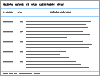
Table 1
General characteristics of the studied forest stands
地点 Location | 经纬度 Latitude and longitude | 海拔 Elevation /m | 年均温度 Mean annual temperature/℃ | 年降水量 Annual precipitation /mm | 林龄 Stand age /a | 更新起源 Regeneration origin(Natural/ plantation) | 抚育强度 Tending intensity | 郁闭度 Canopy cover | 平均胸径 Mean diameter at breast height/cm | 平均高 Mean height/m |
|---|---|---|---|---|---|---|---|---|---|---|
云南大围山 Dawei Mountains,Yunnan | 22°55′52.84″N 103°45′38.12″E | 1 868 | 15.1 | 1 750 | 27 | 天然林 | 林下未抚育 | 0.73±0.02 | 17.0±1.9 | 15.3±0.8 |
云南高黎贡山 Gaoligong Mountains, Yunnan | 24°48′56.03″N 98°34′2.99″E | 1 863 | 14.1 | 1 450 | 24 | 天然林 | 林下进行中等强度抚育,并种植杉木 | 0.73±0.02 | 17.1±2.6 | 17.3±3.1 |
广西凤山林场 Fengshan Forest Farm, Guangxi | 24°33′24.80″N 107°11′21.03″E | 710 | 18.4 | 1 367 | 20 | 人工林 | 林下强度抚育,灌木草本极少 | 0.73±0.02 | 20.4±0.8 | 18.0±0.6 |
广西那坡林场 Napo Forest Farm, Guangxi | 23°27′48.86″N 105°47′3.81″E | 1 023 | 18.6 | 1 358 | 40 | 人工林 | 林下强度抚育,灌木草本极少 | 0.77±0.02 | 24.9±1.4 | 25.5±4.4 |
广西大山塘林场 Dashantang Forest Farm, Guangxi | 24°43′11.23″N 107°45′20.15″E | 761 | 17.8 | 1 432 | 32 | 人工林 | 林下轻度抚育 | 0.80±0.01 | 27.6±1.4 | 18.7±1.3 |
贵州新然村 Xinran Village,Guizhou | 25°46′47.64″N 106°26′38.40″E | 949 | 16.1 | 1 204 | 60 | 天然林 | 林下未抚育 | 0.88±0.02 | 29.3±4.6 | 20.9±1.8 |
Table 2
Species composition statistics of Exbucklandia populnea communities at different locations
地点 Location | 物种 Species | 科 Family | 属 Genus | 乔木 Tree | 灌 Shrub | 藤本 Liana | 草本 Herb |
|---|---|---|---|---|---|---|---|
云南大围山 Dawei Mountains,Yunnan | 27 | 22 | 27 | 7 | 9 | 2 | 9 |
云南高黎贡山 Gaoligong Mountains,Yunnan | 34 | 26 | 31 | 14 | 7 | 3 | 10 |
广西凤山林场 Fengshan Forest Farm,Guangxi | 8 | 8 | 8 | 2 | 3 | 0 | 3 |
广西那坡林场 Napo Forest Farm,Guangxi | 11 | 10 | 11 | 3 | 3 | 0 | 5 |
广西大山塘林场 Dashantang Forest Farm,Guangxi | 23 | 19 | 22 | 7 | 6 | 1 | 9 |
贵州新然村 Xinran Village,Guizhou | 56 | 30 | 43 | 12 | 20 | 11 | 13 |
Table 3
Importance values of dominant species in Exbucklandia populnea communities
地点 Location | 植被层 Vegetation layer | 物种 Species | 重要值 Importance value |
|---|---|---|---|
云南大围山 Dawei Mountains,Yunnan | 乔木层Tree layer | 马蹄荷Exbucklandia populnea | 0.633 |
| 山樱花Prunus serrulata | 0.228 | ||
| 云南波罗栎Quercus yunnanensis | 0.116 | ||
| 灌木层Shrub layer | 香樟Cinnamomum camphora | 0.285 | |
| 马蹄荷Exbucklandia populnea | 0.185 | ||
| 铺地柏Juniperus procumbens | 0.127 | ||
| 枇杷Eriobotrya japonica | 0.118 | ||
| 草本层Herb layer | 伏地卷柏Selaginella nipponica | 0.369 | |
| 川西火绒草Leontopodium wilsonii | 0.323 | ||
| 铁芒箕Dicranopteris linearis | 0.124 | ||
云南高黎贡山 Gaoligong Mountains,Yunnan | 乔木层Tree layer | 马蹄荷Exbucklandia populnea | 0.780 |
| 灌木层Shrub layer | 鹿角锥Castanopsis lamontii | 0.281 | |
| 丛林素馨Jasminum duclouxii | 0.109 | ||
| 凌霄Campsis grandiflora | 0.106 | ||
| 草本层Herb layer | 铁芒箕Dicranopteris linearis | 0.273 | |
| 长叶肾蕨Nephrolepis biserrata | 0.202 | ||
| 香附子Cyperus rotundus | 0.155 | ||
广西凤山林场 Fengshan Forest Farm,Guangxi | 乔木层Tree layer | 马蹄荷Exbucklandia populnea | 0.937 |
| 灌木层Shrub layer | 杜茎山Maesa japonica | 0.688 | |
| 木蓝Indigofera tinctoria | 0.260 | ||
| 草本层Herb layer | 铁芒箕Dicranopteris linearis | 0.593 | |
| 华南毛蕨Cyclosorus parasiticus | 0.316 | ||
广西那坡林场 Napo Forest Farm,Guangxi | 乔木层Tree layer | 马蹄荷Exbucklandia populnea | 1.000 |
| 灌木层Shrub layer | 阴香Cinnamomum burmanni | 0.239 | |
| 野牡丹Paeonia delavayi | 0.239 | ||
| 乌药Lindera aggregata | 0.197 | ||
| 粗叶榕Ficus hirta | 0.170 | ||
| 荷木Schima superba | 0.155 | ||
| 草本层Herb layer | 艳山姜Alpinia zerumbet | 0.351 | |
| 铁芒箕Dicranopteris linearis | 0.314 | ||
| 五节芒Miscanthus floridulus | 0.118 | ||
广西大山塘林场 Dashantang Forest Farm,Guangxi | 乔木层Tree layer | 马蹄荷Exbucklandia populnea | 0.828 |
| 灌木层Shrub layer | 水麻Debregeasia orientalis | 0.201 | |
| 矮冬青Ilex lohfauensis | 0.149 | ||
| 毛勾藤Uncaria hirsuta | 0.149 | ||
| 油桐Vernicia fordii | 0.149 | ||
| 草本层Herb layer | 华南楼梯草Elatostema balansae | 0.411 | |
| 华南毛蕨Cyclosorus parasiticus | 0.212 | ||
贵州新然村 Xinran Village,Guizhou | 乔木层Tree layer | 马蹄荷Exbucklandia populnea | 0.816 |
| 红锥Castanopsis hystrix | 0.174 | ||
| 灌木层Shrub layer | 三叶地锦Parthenocissus semicordata | 0.159 | |
| 疏花卫矛Euonymus laxiflorus | 0.154 | ||
| 草本层Herb layer | 狗脊Woodwardia japonica | 0.326 | |
| 华南毛蕨Cyclosorus parasiticus | 0.122 | ||
| 狭叶落地梅Lysimachia paridiformis var. stenophylla | 0.109 |
Table 4
Species richness of Exbucklandia populnea communities
地点 Location | 物种丰富度 Species richness | ||||||
|---|---|---|---|---|---|---|---|
科 Family | 属 Genus | 物种 Species | 乔木 Tree | 灌木 Shrub | 藤本 Liana | 草本 Herb | |
云南大围山 Dawei Mountains,Yunnan | 14.3±1.5b | 17.0±1.0b | 17.0±1.0b | 5.0±2.0abc | 5.7±0.6b | 0.7±1.2b | 5.7±0.6b |
云南高黎贡山 Gaoligong Mountains,Yunnan | 13.0±1.0bc | 14.0±1.7b | 14.3±2.1bc | 6.0±2.0ab | 2.3±0.6c | 1.7±0.6b | 4.3±1.5bc |
广西凤山林场 Fengshan Forest Farm,Guangxi | 5.0±1.7d | 5.0±1.7c | 5.0±1.7c | 1.3±0.6c | 1.7±1.2c | 0b | 2.0±0c |
广西那坡林场 Napo Forest Farm,Guangxi | 5.7±1.2d | 5.7±1.2c | 5.7±1.2c | 2.0±1.0bc | 1.3±0.6c | 0b | 2.3±0.6bc |
广西大山塘林场 Dashantang Forest Farm,Guangxi | 9.0±1.7cd | 9.7±2.1bc | 10.0±2.7bc | 3.7±1.2bc | 2.3±1.5c | 0.3±0.6b | 3.7±1.5bc |
贵州新然村 Xinran Village,Guizhou | 25.3±2.1a | 33.0±5.6a | 39.3±8.1a | 8.3±2.1a | 13.7±1.5a | 7.0±2.7a | 10.3±2.1a |
Table 5
Species diversity of Exbucklandia populnea communities
地点 Location | Simpson指数 Simpson’s diversity Index | Shannon-Wiener指数 Shannon-Wiener diversity Index | ||||
|---|---|---|---|---|---|---|
乔木层 Tree layer | 灌木层 Shrub layer | 草本层 Herb layer | 乔木层 Tree layer | 灌木层 Shrub layer | 草本层 Herb layer | |
云南大围山 Dawei Mountains,Yunnan | 0.531±0.088a | 0.728±0.063bc | 0.542±0.137ab | 0.933±0.151a | 1.530±0.172b | 0.993±0.223b |
云南高黎贡山 Gaoligong Mountains,Yunnan | 0.370±0.090ab | 0.661±0.117bc | 0.617±0.169ab | 0.684±0.101a | 1.360±0.167bc | 1.180±0.460ab |
广西凤山林场 Fengshan Forest Farm,Guangxi | 0.091±0.158bc | 0.193±0.335c | 0.426±0.060b | 0.149±0.258bc | 0.315±0.545c | 0.616±0.062b |
广西那坡林场 Napo Forest Farm,Guangxi | 0c | 0.545±0.094bc | 0.451±0.080b | 0c | 0.816±0.229bc | 0.703±0.187b |
广西大山塘林场 Dashantang Forest Farm,Guangxi | 0.303±0.100abc | 0.479±0.419bc | 0.517±0.192ab | 0.580±0.220ab | 0.879±0.797bc | 0.953±0.401b |
贵州新然村 Xinran Village,Guizhou | 0.293±0.199abc | 0.911±0.019a | 0.807±0.059a | 0.469±0.236abc | 2.830±0.254a | 1.920±0.222a |
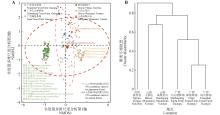
Fig.1
Non-metric multidimensional scaling (NMDS)(A)and cluster analysis(B) of the Exbucklandia populnea community structurePlant points in corresponding colors indicated the indicator species of forest stands at their respective geographic locations(Fig.1A).
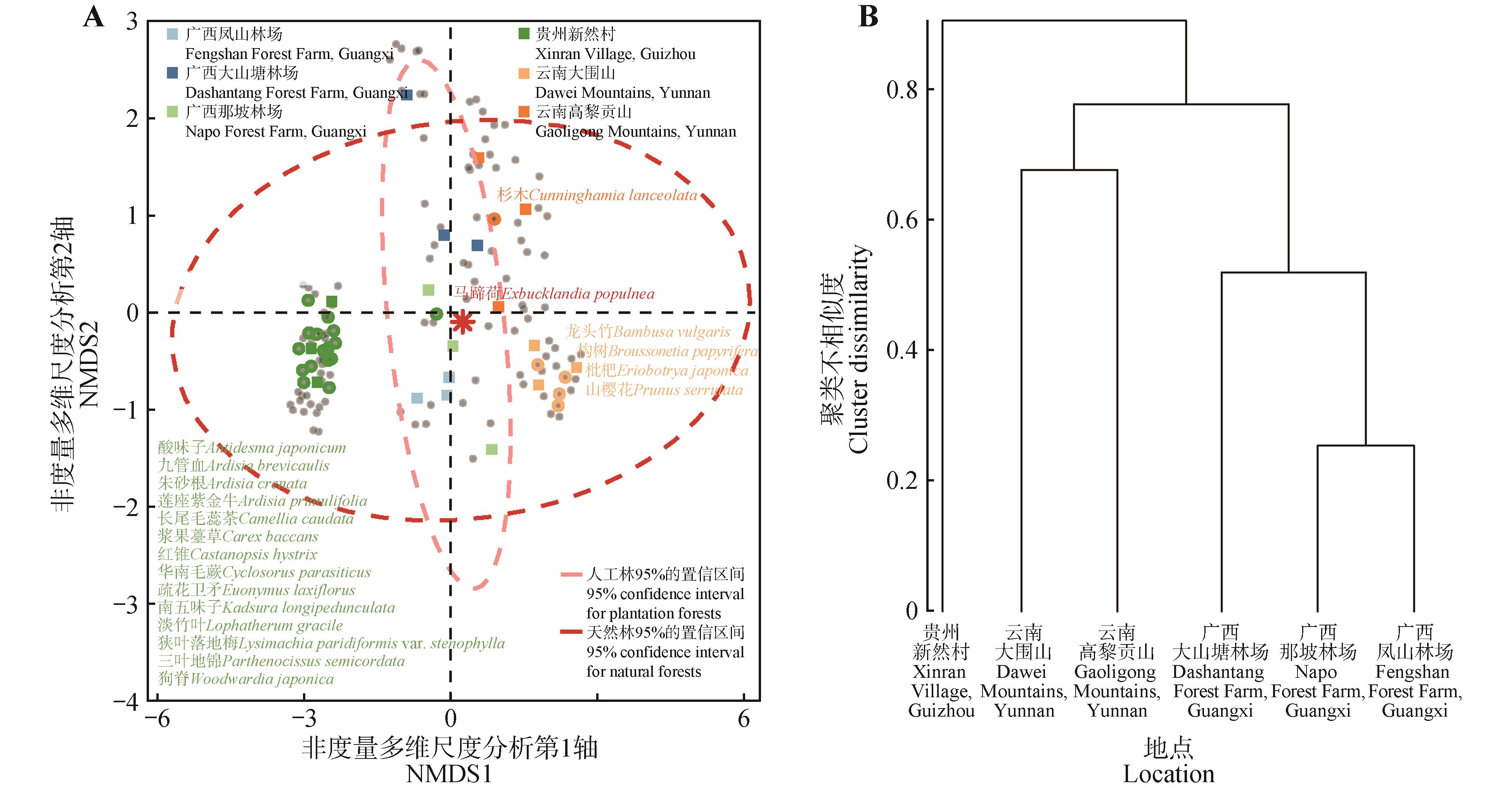
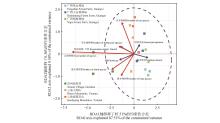
Fig.2
Redundancy analysis of species richness of different plant groups in the Exbucklandia populnea community and its driving factorsRed arrows represented species richness variables of different vegetation layers,while blue arrows indicated explanatory variables. Square points represented different plots,color-coded by geographic location. Dashed ellipses indicated the 95% confidence intervals of all plots.
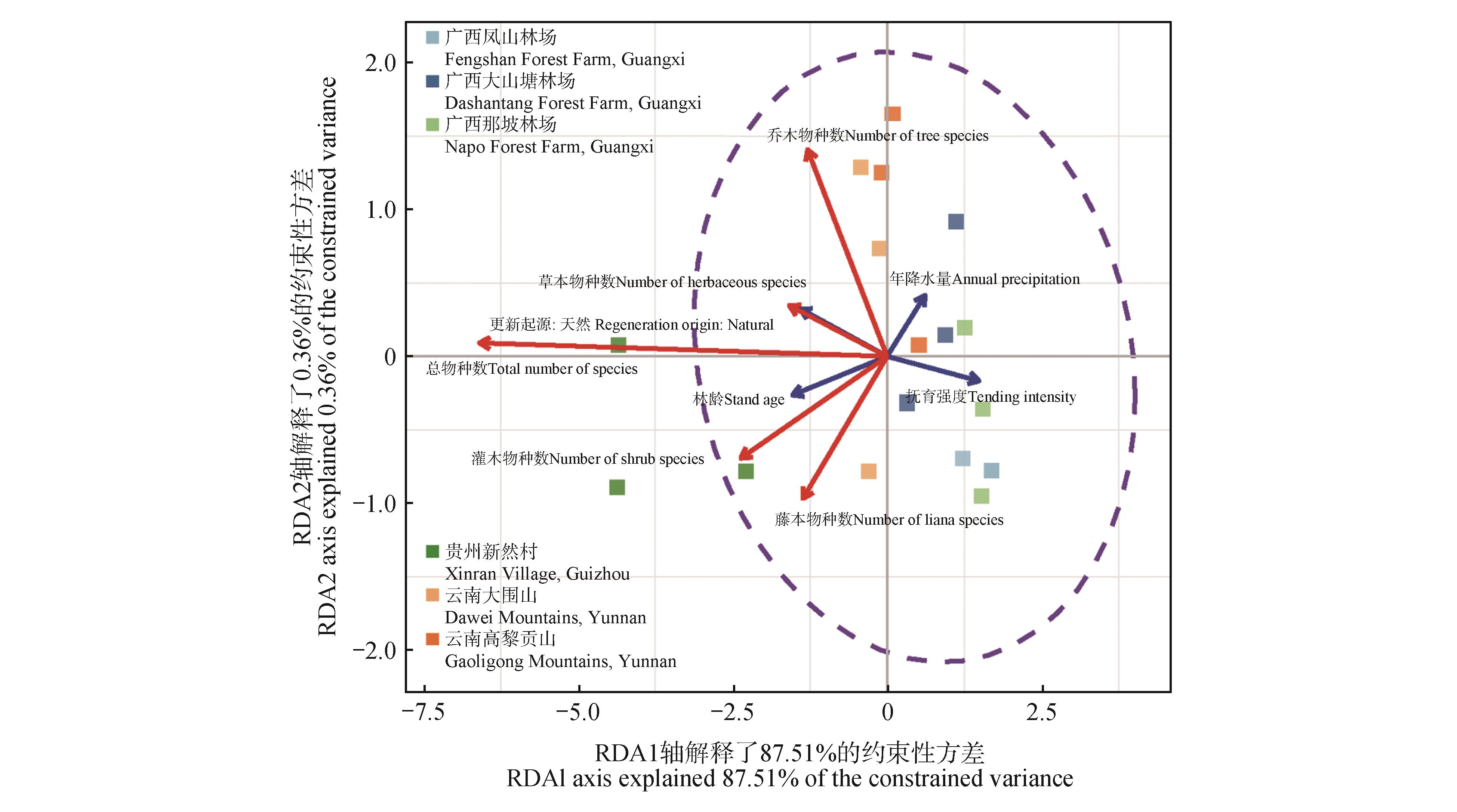
Table 6
Variance partitioning from redundancy analysis of species richness of different plant types and driving factors
项目 Item | 乔木 Tree | 灌木 Shrub | 藤本 Liana | 草本 Herb | 全部植物种 Total species |
|---|---|---|---|---|---|
更新起源 Regeneration origin (Natural/plantation) | 54.97 | 21.41 | 25.70 | 29.94 | 30.62 |
林龄 Stand age | 13.52 | 34.82 | 32.11 | 28.01 | 28.80 |
抚育强度 Tending intensity | 29.46 | 32.65 | 15.87 | 35.34 | 29.52 |
年降水量 Annual precipitation | 2.13 | 11.11 | 26.29 | 6.74 | 11.10 |
Fig.3
Redundancy analysis of diversity indices of different plant groups in the Exbucklandia populnea community and driving factorsRed arrows represented species richness variables of different vegetation layers,while blue arrows indicated explanatory variables. Square points represented different plots,color-coded by geographic location. Dashed ellipses indicated the 95% confidence intervals of all plots.
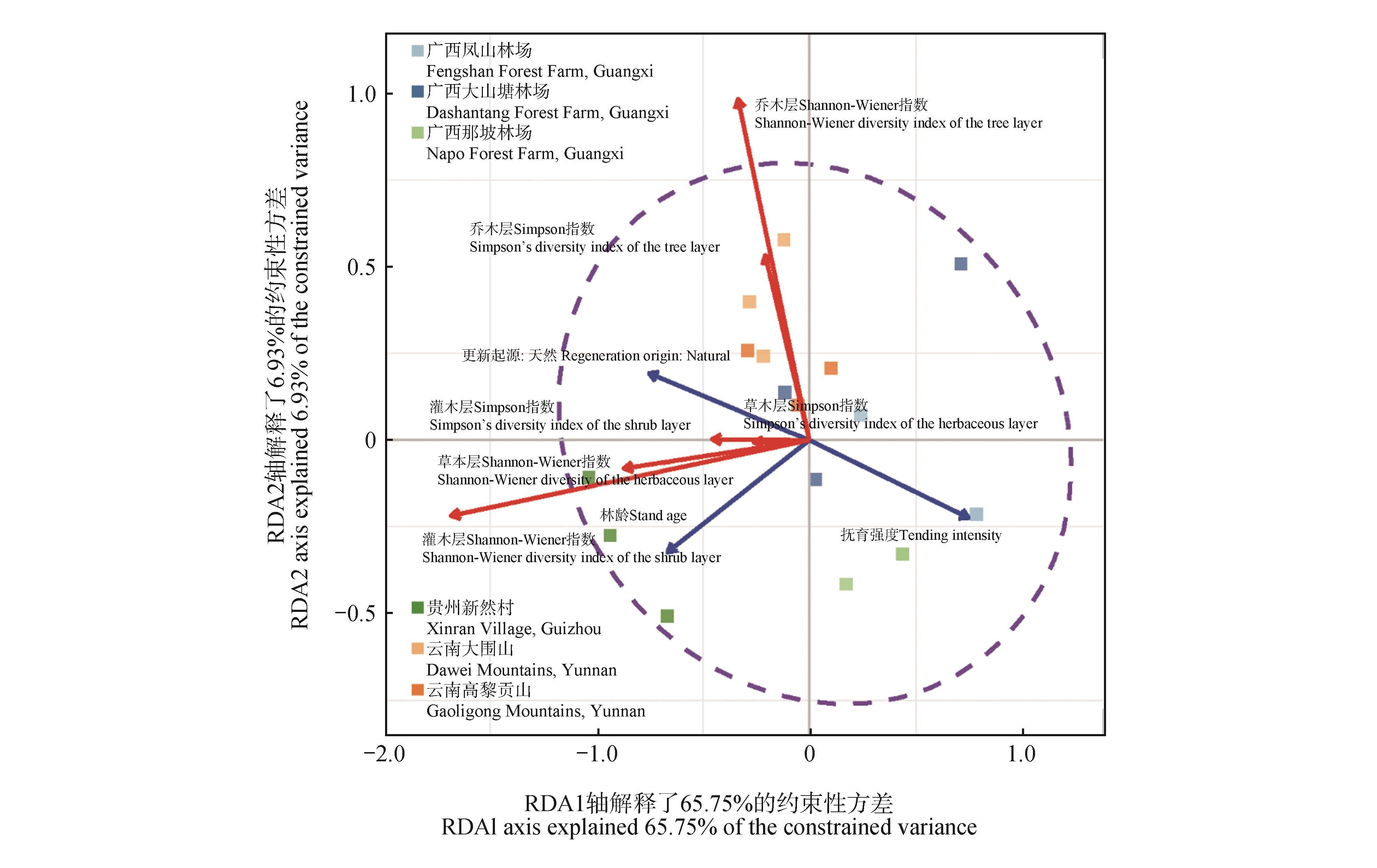
Table 7
Variance partitioning from redundancy analysis of diversity indices of different plant groups and driving factors
项目 Item | 乔木层 Tree layer | 灌木层 Shrub layer | 草本层 Herb layer | |||
|---|---|---|---|---|---|---|
Simpson指数 Simpson’s diversity Index | Shannon-Wiener指数 Shannon-Wiener diversity Index | Simpson指数 Simpson’s diversity Index | Shannon-Wiener指数 Shannon-Wiener diversity Index | Simpson指数 Simpson’s diversity Index | Shannon-Wiener指数 Shannon-Wiener diversity Index | |
更新起源 Regeneration origin (Natural/plantation) | 34.42 | 31.13 | 46.10 | 35.34 | 44.41 | 34.79 |
林龄 Stand age | 11.62 | 16.22 | 28.68 | 38.85 | 30.87 | 37.65 |
抚育强度 Tending intensity | 53.96 | 52.64 | 25.13 | 25.82 | 24.61 | 27.51 |
| [1] | HUANG J, SHI G L, SU T,et al.Miocene Exbucklandia (Hamamelidaceae) from Yunnan,China and its biogeographic and palaeoecologic implications[J].Review of Palaeobotany and Palynology,2017,244:96-106. |
| [2] | 张志耘.马蹄荷属植物(金缕梅科)学名考[J].植物分类学报,1999,37(1):110-112. |
| ZHANG Z Y.Nomenclatural notes on Exbucklandia (Hamamelidaceae)[J].Acta Phytotaxonomica Sinica,1999,37(1):110-112. | |
| [3] | 巫国富,苏付保,马朝忠,等.马蹄荷木材材性与加工性能研究[J].广西农学报,2018,33(6):14-16. |
| WU G F, SU F B, MA C Z,et al.Study on wood properties and processing performance of Exbucklandia populnea [J].Journal of Guangxi Agriculture,2018,33(6):14-16. | |
| [4] | 姚福广,毛俊娥.大围山自然保护区内发现成片的马蹄荷[J].云南林业,2005,26(5):26. |
| YAO F G, MAO J E.Discovery of extensive stands of Exbucklandia populnea in Dawei Nature Reserve[J].Yunnan Forestry,2005,26(5):26. | |
| [5] | GBIF Secretariat. Exbucklandia populnea distribution records[EB/OL].[2025-05-11].. |
| [6] | 苏彬,龚映匀,覃洋恺龙,等.马蹄荷优良家系育苗技术试验初报[J].林业科技通讯,2024(12):107-108. |
| SU B, GONG Y Y, QIN Y K L,et al.Preliminary study on seedling technology of fine families of Exbucklandia populnea [J].Forest Science and Technology,2024(12):107-108. | |
| [7] | TIAN K, CHAI P T, WANG Y Q,et al.Species diversity pattern and its drivers of the understory herbaceous plants in a Chinese subtropical forest[J].Frontiers in Ecology and Evolution,2023,10:1113742. |
| [8] | ZU K L, CHEN F S, HUANG C,et al.The elevational distribution patterns of plant diversity and phylogenetic structure vary geographically across eight subtropical mountains[J].Ecology and Evolution,2024,14(12):e70722. |
| [9] | CHEN L, SWENSON N G, JI N N,et al.Differential soil fungus accumulation and density dependence of trees in a subtropical forest[J].Science,2019,366(6461):124-128. |
| [10] | REN Y J, LÜ Y H, FU B J,et al.Biodiversity and ecosystem functional enhancement by forest restoration:a meta-analysis in China[J].Land Degradation & Development,2017,28(7):2062-2073. |
| [11] | 苏付保,苏彬,马朝忠,等.两种基质条件下马蹄荷播种苗施肥效应[J].北方园艺,2017(6):74-77. |
| SU F B, SU B, MA C Z,et al.Effect of loading fertilizer on Exbucklandia populnea seedling in two matrixes[J].Northern Horticulture,2017(6):74-77. | |
| [12] | 黎明,吴光枝,王群能.马蹄荷轻基质网袋容器育苗技术[J].广西林业科学,2009,38(1):66-67. |
| LI M, WU G Z, WANG Q N.Container seedling cultivation technology of Exbucklandia populnea with light matrix[J].Guangxi Forestry Science,2009,38(1):66-67. | |
| [13] | 韦艳.马蹄荷防火林带的营造技术[J].广西林业科学,2003,32(2):99. |
| WEI Y.Construction techniques for Exbucklandia populnea firebreak forest belts[J].Guangxi Forestry Science,2003,32(2):99. | |
| [14] | 韦凤花.马蹄荷防火林带营造技术及效益分析[J].现代农业科技,2013(11):202-203. |
| WEI F H.Construction techniques and benefit analysis of Exbucklandia populnea fire prevention forest belts[J].Modern Agricultural Science and Technology,2013(11):202-203. | |
| [15] | 罗甫书.国营坡桃林场试种马蹄荷防火林带成功[J].森林防火,1992(4):26-27. |
| LUO F S.Successful trial planting of Exbucklandia populnea fire prevention forest belt in Potao State Forest Farm[J].Journal of Wildland Fire Science,1992(4):26-27. | |
| [16] | 刘忠成,朱晓枭,凡强,等.大果马蹄荷(Exbucklandia tonkinensis)群落的纬度地带性[J].生态学报,2017,37(10):3445-3458. |
| LIU Z C, ZHU X X, FAN Q,et al.Latitudinal zonalization characteristics of the Exbucklandia tonkinensis communities from Hainan Island to the midsection of the Luoxiao Mountains[J].Acta Ecologica Sinica,2017,37(10):3445-3458. | |
| [17] | 中国植物志编辑委员会. Exbucklandia tonkinensis物种信息[EB/OL].[2025-05-11].. |
| Editorial Committee of Flora of China. Exbucklandia tonkinensis species information[EB/OL].[2025-05-11].. | |
| [18] | HUANG C Y, FAN Q, XU K W,et al.Multiple dataset-based insights into the phylogeny and phylogeography of the genus Exbucklandia (Hamamelidaceae):additional evidence on the evolutionary history of tropical plants[J].Plants,2025,14(7):1061. |
| [19] | NGALIMAN M P.A phytosociological study of Exbucklandia populnea species and its communities at highland forests of Cameron Highland[D].Serdang:Universiti Putra Malaysia,2018. |
| [20] | 田长城,蒋学龙,彭华,等.云南中部无量山黑长臂猿(Nomascus concolor jingdongensis)栖息地乔木层物种多样性和结构特征[J].生态学报,2007,27(10):4002-4010. |
| TIAN C C, JIANG X L, PENG H,et al.Tree species diversity and community structure characteristics in black crested gibbon (Nomascus concolor jingdongensis) habitats at Mt.Wuliang,central Yunnan,China[J].Acta Ecologica Sinica,2007,27(10):4002-4010. | |
| [21] | OKSANEN J, SIMPSON G L, BLANCHET F G,et al.Vegan:community ecology package[EB/OL] [2025-08-24].. |
| [22] | DE CÁCERES M, JANSEN F, Endicott S,et al.Indicspecies:relationship between species and groups of sites[EB/OL] [2025-05-11].. |
| [23] | LAI J S, ZOU Y, ZHANG J L,et al.Generalizing hierarchical and variation partitioning in multiple regression and canonical analyses using the rdacca.hp R package[J].Methods in Ecology and Evolution,2022,13(4):782-788. |
| [24] | BROWN H C A, APPIAH M, BERNINGER F A,et al.Old timber plantations and secondary forests attain levels of plant diversity and structure similar to primary forests in the West African humid tropics[J].Forest Ecology and Management,2022,518:120271. |
| [25] | NICHOL J E, ABBAS S.Evaluating plantation forest vs.natural forest regeneration for biodiversity enhancement in Hong Kong[J].Forests,2021,12(5):593. |
| [26] | GONG Z L, TANG Y.Impacts of reforestation on woody species composition,species diversity and community structure in dry-hot valley of the Jinsha River,southwestern China[J].Journal of Mountain Science,2016,13(12):2182-2191. |
| [27] | WANG C, ZHANG W W, LI X N,et al.A global meta-analysis of the impacts of tree plantations on biodiversity[J].Global Ecology and Biogeography,2022,31(3):576-587. |
| [28] | HÄMÄLÄINEN A, RUNNEL K, RANIUS T,et al.Diversity of forest structures important for biodiversity is determined by the combined effects of productivity,stand age,and management[J].Ambio,2024,53(5):718-729. |
| [29] | LANGRIDGE J, DELABYE S, GILG O,et al.Biodiversity responses to forest management abandonment in boreal and temperate forest ecosystems:a meta-analysis reveals an interactive effect of time since abandonment and climate[J].Biological Conservation,2023,287:110296. |
| [30] | NAGAIKE T, KAMITANI T, NAKASHIZUKA T.Effects of different forest management systems on plant species diversity in a Fagus crenata forested landscape of central Japan[J].Canadian Journal of Forest Research,2005,35(12):2832-2840. |
| [31] | WU W, HU Y M, LI Y H,et al.Plant diversity and vegetation structures in the understory of mixed boreal forests under different management regimes[J].Polish Journal of Environmental Studies,2016,25(4):1749-1757. |
| [32] | HARTLEY M J.Rationale and methods for conserving biodiversity in plantation forests[J].Forest Ecology and Management,2002,155(1/2/3):81-95. |
| [33] | BÁTORI Z, TÖLGYESI C, LI G,et al.Forest age and topographic position jointly shape the species richness and composition of vascular plants in karstic habitats[J].Annals of Forest Science,2023,80(1):16. |
| [34] | STORCH F, BOCH S, GOSSNER M M,et al.Linking structure and species richness to support forest biodiversity monitoring at large scales[J].Annals of Forest Science,2023,80(1):3. |
| [35] | REICH K F, KUNZ M, BITTER A W,et al.Do different indices of forest structural heterogeneity yield consistent results?[J].iForest,2022,15(5):424-432. |
| [36] | HU Y H, SHENG D Y, XIANG Y Z,et al.The environment,not space,dominantly structures the landscape patterns of the richness and composition of the tropical understory vegetation[J].PLoS One,2013,8(11):e81308. |
| [37] | MEJSTŘÍK M, SVÁTEK M, POLLASTRINI M,et al.Differential roles of seed and sprout regeneration in forest diversity and productivity after disturbance[J].Forest Ecosystems,2024,11:100198. |
| [38] | LINDGREN P M F, SULLIVAN T P.Influence of alternative vegetation management treatments on conifer plantation attributes:abundance,species diversity,and structural diversity[J].Forest Ecology and Management,2001,142(1/2/3):163-182. |
| [39] | DEWALT S J, SCHNITZER S A, ALVES L F,et al.Biogeographical patterns of liana abundance and diversity[M]//SCHNITZER S A,BONGERS F,BURNHAM R J,et al.Ecology of lianas.Chichester:John Wiley & Sons,Ltd,2015:131-146. |
| [40] | KAÇAMAK B, RÉJOU-MÉCHAIN M, ROWE N,et al.Local forest structure and host specificity influence liana community composition in a moist Central African forest[J].Ecology and Evolution,2025,15(3):e71075. |
| [41] | ROSWELL M, DUSHOFF J, WINFREE R.A conceptual guide to measuring species diversity[J].Oikos,2021,130(3):321-338. |
| [42] | CHYTRÝ M, TICHÝ L, HOLT J,et al.Determination of diagnostic species with statistical fidelity measures[J].Journal of Vegetation Science,2002,13(1):79-90. |
| [43] | ZHU H L, ZHANG J L, CHEUK M L,et al.Monoculture plantations impede forest recovery:evidence from the regeneration of lowland subtropical forest in Hong Kong[J].Frontiers in Forests and Global Change,2023,6:1098666. |
| [44] | BARSOUM N, COOTE L, EYCOTT A E,et al.Diversity,functional structure and functional redundancy of woodland plant communities:how do mixed tree species plantations compare with monocultures?[J].Forest Ecology and Management,2016,382:244-256. |
| [45] | SLABEJOVÁ D, BACIGÁL T, HEGEDÜŠOVÁ K,et al.Comparison of the understory vegetation of native forests and adjacent Robinia pseudoacacia plantations in the Carpathian-Pannonian region[J].Forest Ecology and Management,2019,439:28-40. |
| [1] | Xiting ZHANG, Jianyu ZHANG, Zhaoliang ZHONG, Wenjie WANG. Characteristics of Plant Diversity in Chuona River Reserve, Daxing'anling Mountains [J]. Bulletin of Botanical Research, 2024, 44(5): 730-737. |
| [2] | Xi ZHEN, Xuyang LIU, Wenjie LI, Feng ZHANG, Yue SU, Yao XIAO, Jie ZHANG, Tao WAN. Characteristics of Apocynum venetum Community and Its Relationship to Climatic Factors [J]. Bulletin of Botanical Research, 2024, 44(3): 448-458. |
| [3] | DUAN Yi-Zhong, DU Zhong-Yu, KANG Fu-Ren. Community Characteristics of Endangered Plant of Ammopiptanthus mongolicus to Environmental Factors in Northwest Arid Area of China [J]. Bulletin of Botanical Research, 2018, 38(6): 834-842. |
| [4] | DU Jing-Qi, ZHANG Qiao-Xian, TIAN Xiao-Dong, WANG Yue, XU Xin-Yun, SONG Li, YUAN Zi-Qiang. Relationships between Vegetation Distribution, Species Diversity of Subalpine Meadow and Soil Chemical Factors in the Yundingshan, China [J]. Bulletin of Botanical Research, 2016, 36(3): 444-451. |
| [5] | PAN Sha;ZHANG Zhao-Hui;*. Bryophyte Communities from Abandoned Mercury Mine in Eastern Guizhou Province [J]. Bulletin of Botanical Research, 2011, 31(2): 241-248. |
| Viewed | ||||||
|
Full text |
|
|||||
|
Abstract |
|
|||||