植物研究 ›› 2025, Vol. 45 ›› Issue (6): 898-908.doi: 10.7525/j.issn.1673-5102.2025.06.007
罗植煜1, 余静雅2, 郑清清3, 张发起2,3( )
)
收稿日期:2025-07-21
出版日期:2025-11-20
发布日期:2025-11-27
通讯作者:
张发起
E-mail:fqzhang@nwipb.cas.cn
作者简介:罗植煜(2001—),男,硕士研究生,主要从事药物分析与质量标准制订研究。
基金资助:
Zhiyu LUO1, Jingya YU2, Qingqing ZHENG3, Faqi ZHANG2,3()
Received:2025-07-21
Online:2025-11-20
Published:2025-11-27
Contact:
Faqi ZHANG
E-mail:fqzhang@nwipb.cas.cn
摘要:
该文对青海省唐古拉山镇(TGL)和约改镇(YG)2个自然居群的臭蒿(Artemisia hedinii)种子植物学特征及萌发特性展开研究,测定形态特征、种子活力、吸水率和含水量等功能性状,以发芽率、发芽势、发芽指数为测定指标,研究恒温、变温和赤霉素(GA3)处理对臭蒿种子萌发特性的影响。同时,采用染色体常规压片技术和核型分析方法分析臭蒿染色体核型,揭示2个居群间染色体核型特征差异。结果表明:臭蒿种子扁平细长,千粒质量分别为0.121 2 g(YG)和0.090 1 g(TGL),吸水24 h可达到饱和;温度是影响臭蒿种子萌发的重要因素,在适宜的萌发温度(25 ℃)下种子发芽率在85%以上,低温(5 ℃)导致种子不能萌发,高温(35 ℃)抑制种子萌发,萌发率降至72%以下,变温和赤霉素处理可显著提高萌发指标,赤霉素在一定程度上可以缓解高温环境对臭蒿种子萌发的抑制效应,但对低温抑制种子萌发没有效果;臭蒿染色体的数目为18条,基数为9,核型公式为2n=2x=18m,核型类型为1A,较为对称;唐古拉山镇居群染色体的长度比、平均臂比和核不对称系数均大于约改镇居群。综上可知,温度是调节臭蒿种子萌发的重要因素,2个居群的臭蒿种子适宜萌发温度为恒温25 ℃与变温25 ℃/15 ℃,赤霉素能有效促进种子在高温条件下萌发;臭蒿为二倍体植物,具有18条染色体,染色体较为稳定对称,异质环境可能对臭蒿染色体的进化方向产生重要影响,驱动染色体核型朝向特定的方向演化。
中图分类号:
罗植煜, 余静雅, 郑清清, 张发起. 不同种源臭蒿种子萌发特性与染色体核型[J]. 植物研究, 2025, 45(6): 898-908.
Zhiyu LUO, Jingya YU, Qingqing ZHENG, Faqi ZHANG. Seed Germination Characteristics and Chromosome Karyotype of Different Provenances of Artemisia hedinii[J]. Bulletin of Botanical Research, 2025, 45(6): 898-908.
表1
臭蒿种子信息
居群编号 Population code | 凭证标本号 Voucher specimen number | 材料名称 Material name | 采集地点 Collection site | 生境 Habitat | 纬度 Latitude | 经度 Longitude | 海拔 Elevation/m |
|---|---|---|---|---|---|---|---|
| YG | QTPGB507 | 臭蒿A. hedinii | 曲麻莱县约改镇 | 路边碎石 | 34.131 18°N | 95.811 27°E | 4 376 |
| TGL | YF2024566 | 臭蒿A. hedinii | 格尔木市唐古拉山镇 | 路边碎石 | 34.231 82°N | 92.447 97°E | 4 547 |

图1
臭蒿2个居群种子形态

表2
臭蒿种子质量及形状
居群编号 Population code | 千粒质量 1000-seed mass/g | 三维方差 Three-dimensional variance | 种子生活力 Seed viability/% | 水分活度 Water activity/% |
|---|---|---|---|---|
| YG | 0.121 2±0.003 9** | 0.119 6±0.002 7** | 86.00±4.00 | 40.12±1.22* |
| TGL | 0.090 1±0.001 6** | 0.106 7±0.002 2** | 88.00±2.00 | 44.42±4.76* |
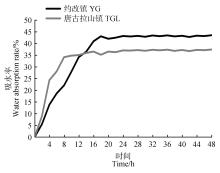
图2
臭蒿种子吸水率随吸水时间变化
表3
2个居群臭蒿种子萌发特征
居群编号 Population code | 温度 Temperature/℃ | 处理方式 Treatment method | 平均发芽率 Average germination rate/% | 平均发芽势 Average germination potential/% | 发芽指数 Germination index |
|---|---|---|---|---|---|
| TGL | 5 | — | — | — | — |
| 15 | CK1 | 86.00±1.15cd | 66.67±6.36c | 8.54±0.38f | |
| 100 mg⋅L-1 GA₃ | 86.67±2.67bcd | 69.33±5.81bc | 8.81±0.44ef | ||
| 200 mg⋅L-1 GA₃ | 91.33±1.76abc | 81.33±4.67ab | 9.76±0.23de | ||
| 800 mg⋅L-1 GA₃ | 86.67±1.76bcd | 72.00±2.31bc | 8.89±0.23ef | ||
| 25 | CK2 | 89.33±3.06bcd | 68.67±8.33bc | 9.31±0.14ef | |
| 100 mg⋅L-1 GA₃ | 92.67±1.76ab | 72.00±4.16bc | 10.58±0.39cd | ||
| 200 mg⋅L-1 GA₃ | 97.33±1.33a | 86.67±1.76a | 12.91±0.10a | ||
| 800 mg⋅L-1 GA₃ | 91.33±0.67abc | 74.00±3.46abc | 11.35±0.23bc | ||
| 35 | CK3 | 71.33±1.76e | 48.00±5.29d | 6.38±0.36g | |
| 100 mg⋅L-1 GA₃ | 86.00±2.00cd | 62.00±1.15c | 10.42±0.24cd | ||
| 200 mg⋅L-1 GA₃ | 89.33±1.76bcd | 70.00±5.77bc | 11.65±0.48b | ||
| 800 mg⋅L-1 GA₃ | 84.67±4.06d | 68.00±6.11bc | 11.29±0.56bc | ||
| 25/5 | — | 89.33±0.67bcd | 67.32±2.40c | 8.68±0.20f | |
| 25/15 | — | 90.00±2.31bcd | 71.33±1.76bc | 10.58±0.78cd | |
| 35/15 | — | 84.00±4.16d | 64.67±4.37c | 8.59±0.38f | |
| YG | 5 | — | — | — | — |
| 15 | CK4 | 85.33±2.40bc | 65.33±5.46bc | 7.35±0.33g | |
| 100 mg⋅L-1 GA₃ | 86.67±2.40bc | 66.00±2.00bc | 9.08±0.35ed | ||
| 200 mg⋅L-1 GA₃ | 88.00±2.31abc | 72.00±4.00ab | 9.71±0.61cd | ||
| 800 mg⋅L-1 GA₃ | 87.33±1.33abc | 70.00±5.77abc | 9.18±0.65de | ||
| 25 | CK5 | 86.67±1.76bc | 66.67±3.53bc | 8.66±0.25de | |
| 100 mg⋅L-1 GA₃ | 90.67±0.67ab | 68.67±2.40bc | 10.55±0.16bcd | ||
| 200 mg⋅L-1 GA₃ | 93.33±1.76a | 80.67±2.91a | 11.78±0.49a | ||
| 800 mg⋅L-1 GA₃ | 89.33±1.76abc | 71.33±3.71ab | 11.28±0.42ab | ||
| 35 | CK6 | 69.33±5.46d | 49.33±4.06d | 6.57±0.75g | |
| 100 mg⋅L-1 GA₃ | 84.00±1.15c | 62.67±3.71bc | 10.73±0.17abcd | ||
| 200 mg⋅L-1 GA₃ | 86.67±1.76bc | 68.67±4.67bc | 11.39±0.49ab | ||
| 800 mg⋅L-1 GA₃ | 85.33±0.67bc | 67.33±3.71bc | 11.12±0.27abc | ||
| 25/5 | — | 86.00±1.15bc | 67.33±1.76bc | 8.88±0.06de | |
| 25/15 | — | 88.67±1.76abc | 68.67±0.67bc | 9.74±0.63cde | |
| 35/15 | — | 81.33±0.67c | 59.33±1.76cd | 8.41±0.09ef |
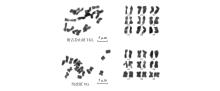
图3
2个居群的臭蒿有丝分裂中期染色体01. 1号染色体;02. 2号染色体;03. 3号染色体;04. 4号染色体;05. 5号染色体;06. 6号染色体;07. 7号染色体;08. 8号染色体;09. 9号染色体。
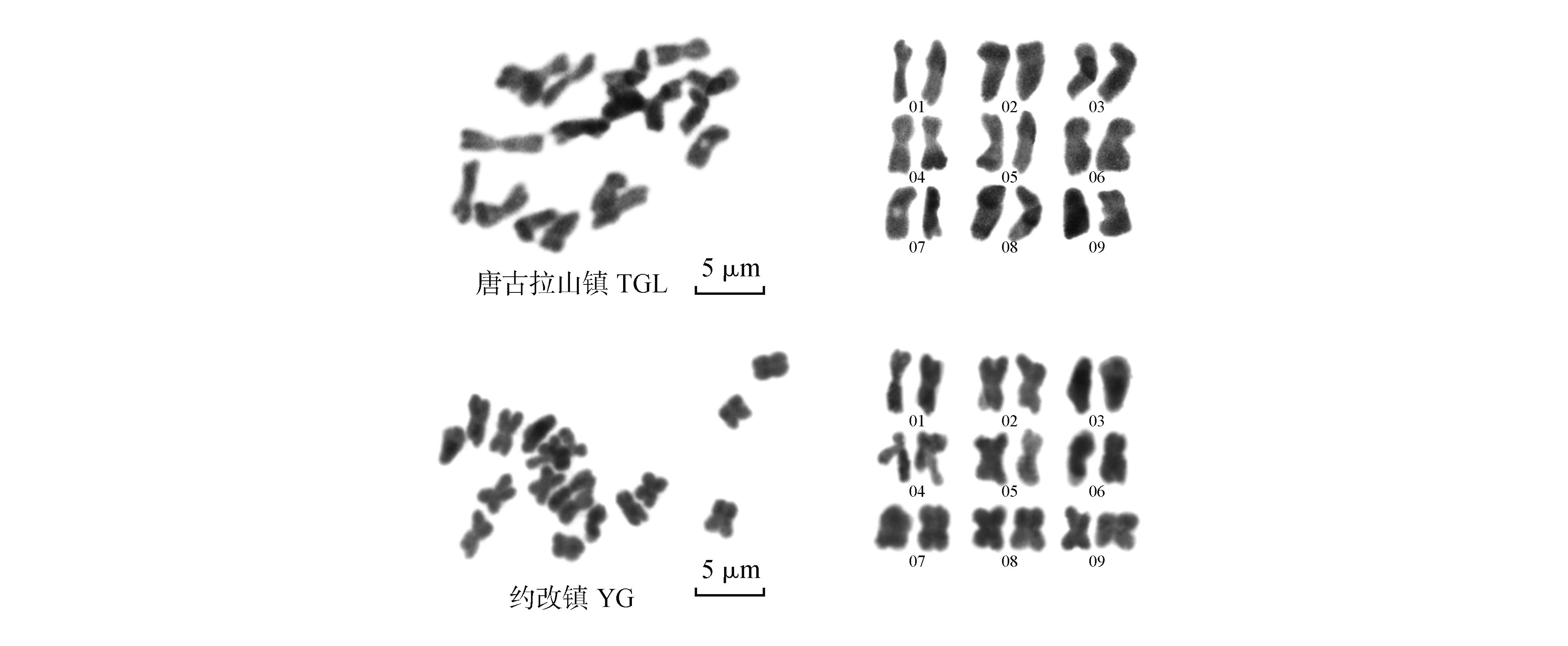
表4
2个居群臭蒿染色体参数
居群编号 Population code | 染色体序号 Code of chromosome | 长度 Length/μm | 标准偏差 Standard deviation/μm | 臂比 Arm ratio | 类型 Type | 相对长度 Relative length | 相对长度系数 Relative length coefficient | 长度分类 Length classification |
|---|---|---|---|---|---|---|---|---|
| YG | 1 | 2.21+2.05=4.26 | 0.35 | 1.09 | m | 14.49 | 1.30 | L |
| 2 | 2.01+1.84=3.85 | 0.32 | 1.10 | m | 13.08 | 1.17 | M2 | |
| 3 | 1.86+1.74=3.60 | 0.31 | 1.07 | m | 12.18 | 1.10 | M2 | |
| 4 | 1.77+1.64=3.41 | 0.29 | 1.08 | m | 11.49 | 1.04 | M2 | |
| 5 | 1.70+1.55=3.25 | 0.28 | 1.09 | m | 10.97 | 0.99 | M1 | |
| 6 | 1.61+1.49=3.10 | 0.26 | 1.08 | m | 10.49 | 0.95 | M1 | |
| 7 | 1.52+1.39=2.91 | 0.24 | 1.10 | m | 9.86 | 0.89 | M1 | |
| 8 | 1.40+1.32=2.72 | 0.23 | 1.07 | m | 9.22 | 0.83 | M1 | |
| 9 | 1.29+1.12=2.41 | 0.20 | 1.14 | m | 8.22 | 0.74 | S | |
| TGL | 1 | 2.49+2.15=4.18 | 0.35 | 1.16 | m | 14.35 | 1.29 | L |
| 2 | 2.26+2.04=3.81 | 0.34 | 1.11 | m | 13.21 | 1.19 | M2 | |
| 3 | 2.15+1.89=3.53 | 0.30 | 1.15 | m | 12.50 | 1.13 | M2 | |
| 4 | 1.99+1.78=3.32 | 0.28 | 1.13 | m | 11.68 | 1.05 | M2 | |
| 5 | 1.89+1.65=3.14 | 0.27 | 1.16 | m | 10.99 | 0.99 | M1 | |
| 6 | 1.79+1.58=2.95 | 0.25 | 1.12 | m | 10.45 | 0.94 | M1 | |
| 7 | 1.69+1.47=2.85 | 0.23 | 1.16 | m | 9.83 | 0.88 | M1 | |
| 8 | 1.54+1.36=2.62 | 0.22 | 1.13 | m | 8.94 | 0.80 | M1 | |
| 9 | 1.38+1.20=2.40 | 0.19 | 1.17 | m | 8.05 | 0.72 | S |
图4
2个居群臭蒿染色体核型模式
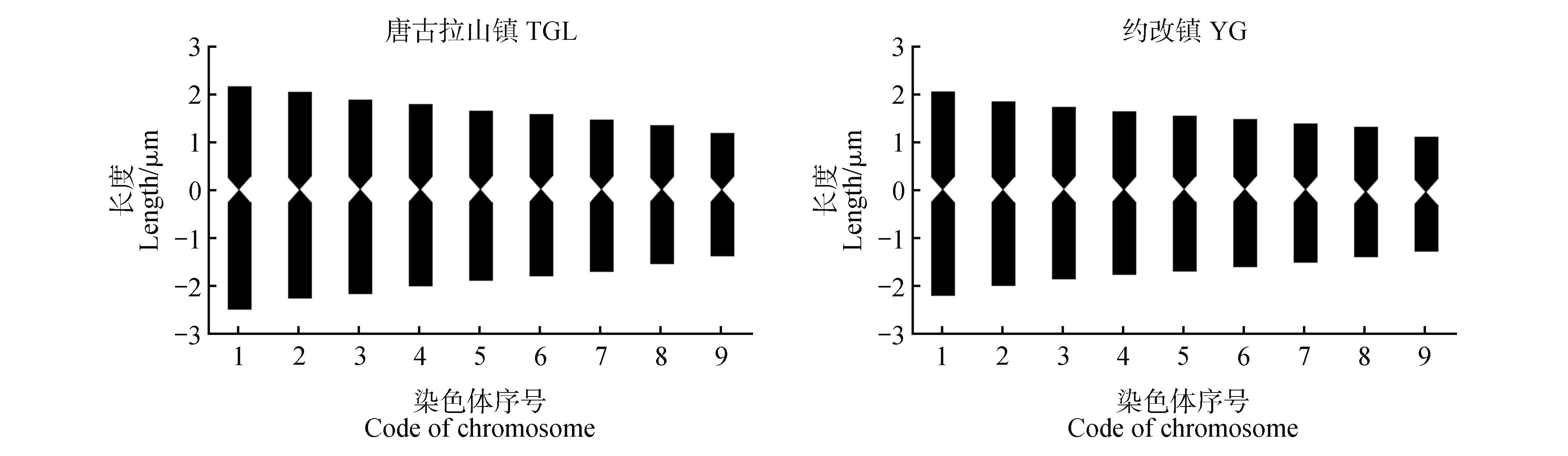
表5
2个居群的臭蒿染色体核型比较
居群编号 Population code | 核型公式 Karyotype formula | 长度比 Length ratio | 臂比>2的染色体比例 Chromosomes proportion of arm ratio excess to 2/% | 核型类型 Karyotype type | 平均臂比 Average arm ratio | 平均着丝粒 不对称系数 MCA | 核型不 对称系数 As.K/% | 核型不对 称程度 A | 核型对 称指数 Syi | 着丝粒指数 变异系数 CVCI | 染色体长度 变异系数 CVCL |
|---|---|---|---|---|---|---|---|---|---|---|---|
| YG | 2n=2x=18m | 1.83 | 0 | 1A | 1.09 | 4.33 | 52.15 | 0.04 | 91.79 | 2.64 | 18.10 |
| TGL | 2n=2x=18m | 1.91 | 0 | 1A | 1.14 | 6.65 | 53.31 | 0.07 | 87.64 | 3.84 | 18.89 |
| [1] | 李拓径,王雨华.青藏高原植物种质资源数据库及应用平台建设[J].植物分类与资源学报,2013,35(3):234-240. |
| LI T J, WANG Y H.The plant germplasm database and platform of Qinghai-Tibet Plateau[J].Plant Diversity and Resources,2013,35(3):234-240. | |
| [2] | YANG X J, HUANG Z Y, VENABLE D L,et al.Linking performance trait stability with species distribution:the case of Artemisia and its close relatives in northern China[J].Journal of Vegetation Science,2016,27(1):123-132. |
| [3] | 李雪华,刘志民,蒋德明,等.七种蒿属植物种子重量形状及萌发特性的比较研究[J].生态学杂志,2004,23(5):57-60. |
| LI X H, LIU Z M, JIANG D M,et al.A comparative study on seed weight,shape and germination characteristics of 7 Artemisia species[J].Chinese Journal of Ecology,2004,23(5):57-60. | |
| [4] | 乔有明,富象乾,阎贵兴,等.20种蒿属植物的染色体核型研究[J].中国草地,1990(6):24-31. |
| QIAO Y M, FU X Q, YAN G X,et al.A study on chromosomes of 20 species in genus Artemisia [J].Grassland of China,1990(6):24-31. | |
| [5] | ZARIFI E, AGHYEV Y M, GHANAVATI F,et al.Cytogenetics and evolution of karyotype in wormwood,Artemisia vulgaris L.[J].Seed and Plant,2006,22(1):1-12. |
| [6] | 中国科学院西北高原生物研究所.藏药志[M].西宁:青海人民出版社,2019:344-345. |
| Northwest Institute of Plateau Biology.Pharmacopoeia of Tibetan medicine[M].Xining:Qinghai People’s Publishing House,2019:344-345. | |
| [7] | 余静雅,夏铭泽,徐浩,等.青藏高原地区3种蒿属植物转录组比较分析[J].植物研究,2022,42(2):200-210. |
| YU J Y, XIA M Z, XU H,et al.Comparative transcriptome analysis of three Artemisia species in Qinghai-Tibet Plateau[J].Bulletin of Botanical Research,2022,42(2):200-210. | |
| [8] | 帝玛尔·丹增彭措.晶珠本草[M].上海:上海科学技术出版社,1986:128-129. |
| TEMARTH T P.Crystal materia medica[M].Shanghai:Shanghai Science and Technology Press,1986:128-129. | |
| [9] | 国家中医药管理局《中华本草》编委会.中华本草:第7卷[M].上海:上海科学技术出版社,1999:679-680. |
| Editorial Board of “Chinese Materia Medica”,State Administration of Traditional Chinese Medicine.Chinese Materia Medica:Vol.7[M].Shanghai:Shanghai Science and Technology Press,1999:679-680. | |
| [10] | 刘尚武.青海植物志:第3卷[M].西宁:青海人民出版社,1996:385-388. |
| LIU S W.Flora of Qinghai:Vol.3[M].Xining:Qinghai People’s Publishing House,1996:385-388. | |
| [11] | 许静,李文龙,吴鑫悦,等.青藏高原高寒草甸种子萌发行为沿海拔梯度的分异特征[J].草地学报,2021,29():10-18. |
| XU J, LI W L, WU X Y,et al.Differentiation of seed germination behavior in alpine meadow on the Tibetan Plateau along the elevation gradient[J].Acta Agrestia Sinica,2021,29(Sup.1):10-18. | |
| [12] | THOMPSON K, BAND S R, HODGSON J G.Seed size and shape predict persistance in soil[J].Functional Ecology,1993,7(2):236-241. |
| [13] | 李合生.植物生理生化实验原理和技术[M].北京:高等教育出版社,2000:260-265. |
| LI H S.Principles and techniques of plant physiological and biochemical experiments[M].Beijing:Higher Education Press,2000:260-265. | |
| [14] | 张绍山,刘璇,王景富,等.多因素处理对云南重楼及其多芽品系种子萌发的影响[J].中草药,2017,48(10):2111-2115. |
| ZHANG S S, LIU X, WANG J F,et al.Effect of multiple factors on seeds germination of Paris polyphylla var. yunnanensis and polygerm varieties[J].Chinese Traditional and Herbal Drugs,2017,48(10):2111-2115. | |
| [15] | 王朔楠,孙静,郭嘉莹,等.种子发芽指标及其测算方法[J].麦类作物学报,2023,43(2):190-196. |
| WANG S N, SUN J, GUO J Y,et al.Overview of seed germination indices and their determination methods[J].Journal of Triticeae Crops,2023,43(2):190-196. | |
| [16] | 李懋学,陈瑞阳.关于植物核型分析的标准化问题[J].植物科学学报,1985,3(4):297-302. |
| LI M X, CHEN R Y.A suggestion on the standardization of karyotype analysis in plants[J].Plant Science Journal,1985,3(4):297-302. | |
| [17] | STEBBINS G L.Chromosomal evolution in higher pl-ants[M].London:Edward Arnol Ltd.,1971:87-93. |
| [18] | LEVAN A, FREDGA K, SANDBERG A A.Nomenclature for centromeric position on chromosomes[J].Hereditas,1964,51(2):201-202. |
| [19] | PERUZZI L, EROĞLU H E.Karyotype asymmetry:again,how to measure and what to measure?[J].Comparative Cytogenetics,2013,7(1):1-9. |
| [20] | KUO S R, WANG T T, HUANG T C.Karyotype analysis of some Formosan gymnosperms[J].Taiwania,1972,17(1):66-80. |
| [21] | GREILHUBER J, SPETA F.C-banded karyotypes in the Scilla hohenackeri group,S. persica,and Puschkinia (Liliaceae)[J].Plant Systematics and Evolution,1976,126(2):149-188. |
| [22] | PASZKO B.A critical review and a new proposal of karyotype asymmetry indices[J].Plant Systematics and Evolution,2006,258(1):39-48. |
| [23] | HARPER J L, WILLIAMS J T, SAGAR G R.The behaviour of seeds in soil:I.The heterogeneity of soil surfaces and its role in determining the establishment of plants from seed[J].Journal of Ecology,1965,53(2):273-286. |
| [24] | 李文良,张小平,郝朝运,等.珍稀植物连香树(Cercidiphyllum japonicum)的种子萌发特性[J].生态学报,2008,28(11):5445-5453. |
| LI W L, ZHANG X P, HAO C Y,et al.Characteristics of seed germination of the rare plant Cercidiphyllum japonicum [J].Acta Ecologica Sinica,2008,28(11):5445-5453. | |
| [25] | 马君玲,吴世杰,张晓妮,等.铁路沿线4种蒿属植物植冠储藏种子的重量形状及萌发特性[J].农学学报,2019,9(6):28-33. |
| MA J L, WU S J, ZHANG X N,et al.Canopy-stored seeds of 4 Artemisia species along the railway:weight,shape and germination characteristics[J].Journal of Agriculture,2019,9(6):28-33. | |
| [26] | 王学经,卜海燕,周显辉,等.青藏高原东缘高寒草甸常见植物种子形状对萌发的影响[J].植物科学学报,2016,34(3):391-396. |
| WANG X J, BU H Y, ZHOU X H,et al.Effect of seed shape on germination in an alpine meadow on the eastern Qinghai-Tibet Plateau[J].Plant Science Journal,2016,34(3):391-396. | |
| [27] | 陈利军,王靖靖,陈香来,等.基于水活度测定草类植物种子含水量[J].草业科学,2018,35(9):2148-2156. |
| CHEN L J, WANG J J, CHEN X L,et al.Determination of seed moisture content based on seed water activity[J].Pratacultural Science,2018,35(9):2148-2156. | |
| [28] | 刘佳哲,余小红,陈乃健,等.濒危植物膝柄木果实特征和种子萌发特性[J].种子,2024,43(3):90-95. |
| LIU J Z, YU X H, CHEN N J,et al.Fruit characters and seed germination characteristics of endangered plant Bhesa robusta [J].Seed,2024,43(3):90-95. | |
| [29] | 吴晓艳.浅谈发芽试验在种子室内检验中存在的问题及对策[J].特种经济动植物,2024,27(7):142-144. |
| WU X Y.Discussion on problems and countermeasures of germination test in indoor seed inspection[J].Special Economic Animal and Plants,2024,27(7):142-144. | |
| [30] | MURDOCH A J.Seeds:ecology,biogeography,and evolution of dormancy and germination[J].Crop Science,2000,40(2):564-565. |
| [31] | 黄振英, GUTTERMAN Y,胡正海,等.白沙蒿种子萌发特性的研究 II.环境因素的影响[J].植物生态学报,2001,25(2):240-246. |
| HUANG Z Y, GUTTERMAN Y, HU Z H,et al.Seed germination in Artemisia sphaerocephala II.the influence of environmental factors[J].Chinese Journal of Plant Ecology,2001,25(2):240-246. | |
| [32] | 魏建兵,孙晓倩,侯永侠,等.山蒿生物学特征及其生态保护应用价值潜力初探[J].环境生态学,2019, 1(3):10-14. |
| WEI J B, SUN X Q, HOU Y X,et al.Preliminary study on biological features of Artemisia brachyloba Franch.and its application potential in ecological conservation[J].Environmental Ecology,2019,1(3):10-14. | |
| [33] | 卢晓宁,海志霞,张雁明,等.典型草原和高寒草甸种子萌发性状差异及其对群落物种共存的影响[J].科学通报,2025,70(11):1537-1550. |
| LU X N, HAI Z X, ZHANG Y M,et al.Differences in seed germination traits between typical steppe and alpine meadow and their effects on species coexistence in community[J].Chinese Science Bulletin,2025,70(11):1537-1550. | |
| [34] | 许静,杜国祯,李文龙,等.温度和海拔对高寒草甸植物种子萌发进化特性的影响[J].兰州大学学报(自然科学版),2013,49(3):377-383. |
| XU J, DU G Z, LI W L,et al.Effects of temperature and altitude on the evolutional characteristics of seed germination in an alpine meadow[J].Journal of Lanzhou University(Natural Sciences),2013,49(3):377-383. | |
| [35] | 刘玥辰,金昆,薛焱.外源激素对盐碱胁迫下蒙药材阿给(冷蒿)种子萌发的影响[J].种子,2024,43(2):60-65. |
| LIU Y C, JIN K, XUE Y.Effects of exogenous hormones on seed germination of Inner Mongolia medicine Agi (Artemisia frigida Willd.) under saline-alkali stress[J].Seed,2024,43(2):60-65. | |
| [36] | 罗建民,刘欢,王敬龙,等.打破野生藏沙蒿种子休眠方法的筛选与评价[J].草地学报,2022,30(6):1603-1612. |
| LUO J M, LIU H, WANG J L,et al.Screening and evaluation of methods for breaking seed dormancy of wild Artemisia wellbyi [J].Acta Agrestia Sinica,2022,30(6):1603-1612. | |
| [37] | 李林娜,李敏,吴双英,等.不同处理条件对野生蒙药材小白蒿种子萌发的影响[J].特种经济动植物,2024,27(5):18-20. |
| LI L N, LI M, WU S Y,et al.Effects of different treatments on seed germination of wild Mongolian medicinal material Artemisia frigida [J].Special Economic Animal and Plants,2024,27(5):18-20. | |
| [38] | 王亚男,刘玉萍,刘雪利,等.沙鞭不同居群染色体数目及核型分析[J].西北植物学报,2021,41(9):1489-1499. |
| WANG Y N, LIU Y P, LIU X L,et al.Chromosome number and karyotype analysis from different populations of Psammochloa villosa (Poaceae)[J].Acta Botanica Boreali-Occidentalia Sinica,2021,41(9):1489-1499. | |
| [39] | 雷海英,侯沁文,白凤麟,等.八种不同产地苦参的染色体数目及核型分析[J].植物生理学报,2019,55(7):967-974. |
| LEI H Y, HOU Q W, BAI F L,et al.Chromosome number and karyotype analysis of Sophora flavescens Ait.from eight different habitats[J].Plant Physiology Journal,2019,55(7):967-974. | |
| [40] | 乌云格日勒.白沙蒿和油蒿的染色体核型分析研究[J].内蒙古草业,2010,22(2):33-36. |
| WUYUN G.Karyotype analysis of Artemisia sphaerocephala and Artemisia ordosica [J].Inner Mongolia Prataculture,2010,22(2):33-36. | |
| [41] | 曲荣举,刘玉萍,陈金元,等.苦马豆(Sphaerophysa salsula)6个不同居群的染色体核型分析[J].草地学报,2024,32(8):2469-2477. |
| QU R J, LIU Y P, CHEN J Y,et al.Chromosome karyotype analysis from six different populations of Sphaerophysa salsula (Fabaceae)[J].Acta Agrestia Sinica,2024,32(8):2469-2477. | |
| [42] | 宁伟,吴杰,赵婷,等.东北地区7种蒲公英核型研究[J].中国中药杂志,2012,37(6):771-776. |
| NING W, WU J, ZHAO T,et al.Karyomorphology research in seven kinds of dandelion in Northeast[J].China Journal of Chinese Materia Medica,2012,37(6):771-776. | |
| [43] | 靳佳瑞,刘玉萍,苏旭,等.青藏高原特有种—黄缨菊不同居群的染色体核型研究[J].草地学报,2025,33(1):53-61. |
| JIN J R, LIU Y P, SU X,et al.Chromosome karyotype studies on different populations of Xanthopappus subacaulis (Asteraceae),an endemic species from the Qinghai-Xizang Plateau[J].Acta Agrestia Sinica,2025,33(1):53-61. | |
| [44] | DU Y P, BI Y, ZHANG M F,et al.Genome size diversity in Lilium (Liliaceae) is correlated with karyotype and environmental traits[J].Frontiers in Plant Science,2017, 8:1303. |
| [1] | 张恺欣, 余心泽, 高恺阳, 程晨, 韩雪莹, 史倩倩. 陕西羽叶报春四倍体诱导、鉴定与性状分析[J]. 植物研究, 2026, 46(3): 399-410. |
| [2] | 王思奇, 毕云杰, 李慧贤, 宋正宝, 刘润柯, 高瑞馨. 外源赤霉素对盐胁迫下藿香种子萌发的影响[J]. 植物研究, 2026, 46(3): 481-492. |
| [3] | 昌秦湘, 高文鑫, 张东红, 李林, 张强, 梁宗锁. 膜荚黄芪与蒙古黄芪种子休眠与萌发研究进展[J]. 植物研究, 2026, 46(1): 25-37. |
| [4] | 杨莹, 李媛, 陈洁, 刘博, 窦全文. 新麦草基因组重复序列组成及在赖草属物种染色体上的分布[J]. 植物研究, 2024, 44(4): 634-640. |
| [5] | 管岳, 申文靖, 宋晓萌, 王妍欣, 阿克居力得孜·努尔改里得, 陈鹏飞, 周龙. 巴尔鲁克山野扁桃种子萌发特性[J]. 植物研究, 2024, 44(3): 400-409. |
| [6] | 矫春晶, 李明月, 张鹏. 外源激素浸种与渗透处理对水曲柳种子热休眠的作用[J]. 植物研究, 2023, 43(3): 370-378. |
| [7] | 唐莹莹, 郭传超, 石荡, 蒋南林, 许正, 刘立强. 果肉和埋土深度对新疆野杏种子萌发与幼苗生长的影响[J]. 植物研究, 2023, 43(2): 251-260. |
| [8] | 胡夏宇, 刘玉萍, 苏旭, 杨萍, 王亚男. 苦豆子不同居群染色体数目及核型分析[J]. 植物研究, 2023, 43(1): 9-19. |
| [9] | 肖佳伟, 王颖嘉, 黄文轩, 黎维平, 康公平. 长柄马兰(菊科)的形态补充描述及细胞学研究[J]. 植物研究, 2022, 42(5): 741-745. |
| [10] | 王欢, 徐云飞, 刘一伯, 刘沁松, 徐文娟, 龙芸, 胥晓. 珙桐—灯台树枝和叶的水提物对白菜种子萌发和幼苗生长的化感效应[J]. 植物研究, 2022, 42(5): 866-875. |
| [11] | 过雪莹, 朱凯琳, 陈昕, 付雪晴, 唐东芹. 6个香雪兰品种的染色体核型及聚类分析[J]. 植物研究, 2022, 42(4): 637-646. |
| [12] | 刘建新, 刘瑞瑞, 刘秀丽, 贾海燕, 卜婷, 李娜. 外源H2S供体NaHS浸种对盐碱胁迫下裸燕麦种子萌发特性的影响[J]. 植物研究, 2021, 41(6): 870-877. |
| [13] | 陈意兰, 廖海民, 王峥峰, 黄向旭, 刘东明. 橙花破布木染色体制片及核型分析[J]. 植物研究, 2021, 41(5): 684-689. |
| [14] | 张玥, 张泉灵, 洪志, 阚子涵, 储昭月, 陶冶. 入侵植物北美车前和野胡萝卜种内及种间的化感作用[J]. 植物研究, 2021, 41(3): 441-448. |
| [15] | 卢艳, 闫月, 崔程程, 张鹏. 初生休眠解除状态和干燥处理对水曲柳种子萌发的影响[J]. 植物研究, 2020, 40(4): 490-495. |
| 阅读次数 | ||||||
|
全文 |
|
|||||
|
摘要 |
|
|||||