植物研究 ›› 2026, Vol. 46 ›› Issue (5): 777-790.doi: 10.7525/j.issn.1673-5102.2026.05.001
• 综述文章 • 下一篇
刘晓彤1,2, 张慧婷1, 刘世龙1, 郭瑞1, 石铮1,2, 杨宗岐3, 薛哲勇1, 华欣1,2( )
收稿日期:2026-03-23
出版日期:2026-08-28
发布日期:2026-10-10
通讯作者:
华欣
E-mail:xinhua_1985@126.com
作者简介:刘晓彤(2000—),女,硕士研究生,主要从事刺五加三萜皂苷代谢通路解析研究。
基金资助:
Xiaotong LIU1,2, Huiting ZHANG1, Shilong LIU1, Rui GUO1, Zheng SHI1,2, Zongqi YANG3, Zheyong XUE1, Xin HUA1,2()
Received:2026-03-23
Online:2026-08-28
Published:2026-10-10
Contact:
Xin HUA
E-mail:xinhua_1985@126.com
摘要:
五加科(Araliaceae)药用植物中三萜皂苷是重要的次生代谢产物,也是决定药材品质和药理活性的核心成分,其生物合成受多种植物激素及其信号网络的协同调控。茉莉酸(jasmonic acid,JA)、水杨酸(salicylic acid,SA)、生长素(auxin,IAA)、赤霉素(gibberellin,GA)、细胞分裂素(cytokinin,CK)和乙烯(ethylene,ETH)等激素可通过激活或抑制MYC2、WRKY、AP2/ERF、MYB和bHLH等转录因子,构建复杂的调控网络,并通过协同或拮抗作用精细调控三萜皂苷生物合成通路中关键结构基因的表达。现有研究表明,JA是促进三萜皂苷积累的核心正向调控激素,SA则偏向调控皂苷后续修饰阶段,而生长发育相关激素主要通过调节“生长-防御”权衡间接影响皂苷积累。不同激素信号间的互作进一步增强了五加科植物对环境变化的适应能力,并塑造了三萜皂苷积累的动态模式。本文综述了近年来植物激素调控五加科药用植物三萜皂苷生物合成的研究进展,旨在为活性成分积累机制解析、药用植物品质改良及三萜皂苷高效生物制造提供理论参考。
中图分类号:
刘晓彤, 张慧婷, 刘世龙, 郭瑞, 石铮, 杨宗岐, 薛哲勇, 华欣. 五加科植物三萜皂苷生物合成的激素调控网络及分子机制[J]. 植物研究, 2026, 46(5): 777-790.
Xiaotong LIU, Huiting ZHANG, Shilong LIU, Rui GUO, Zheng SHI, Zongqi YANG, Zheyong XUE, Xin HUA. Molecular Mechanisms of Hormone Regulatory Networks and Biosynthesis of Triterpene Saponins in Araliaceae Plants[J]. Bulletin of Botanical Research, 2026, 46(5): 777-790.
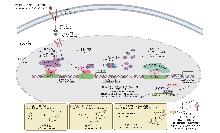
图1
茉莉酸在五加科植物萜类皂苷生物合成中的核心调控网络
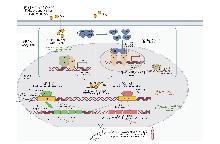
图2
水杨酸调控五加科植物萜类皂苷合成机制:SA-WRKY介导的修饰主导网络
图3
生长发育相关激素对五加科萜类皂苷的调控
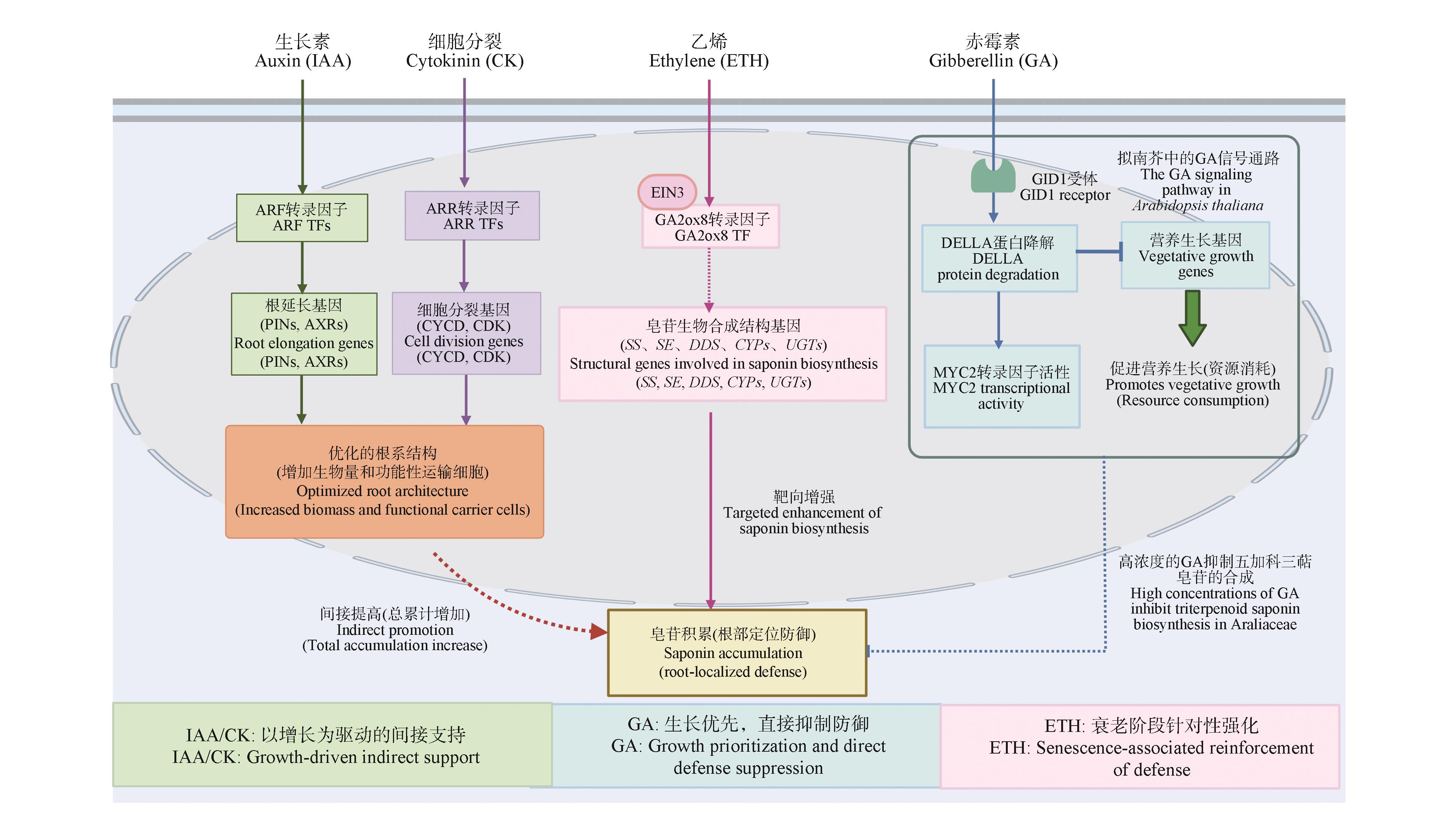
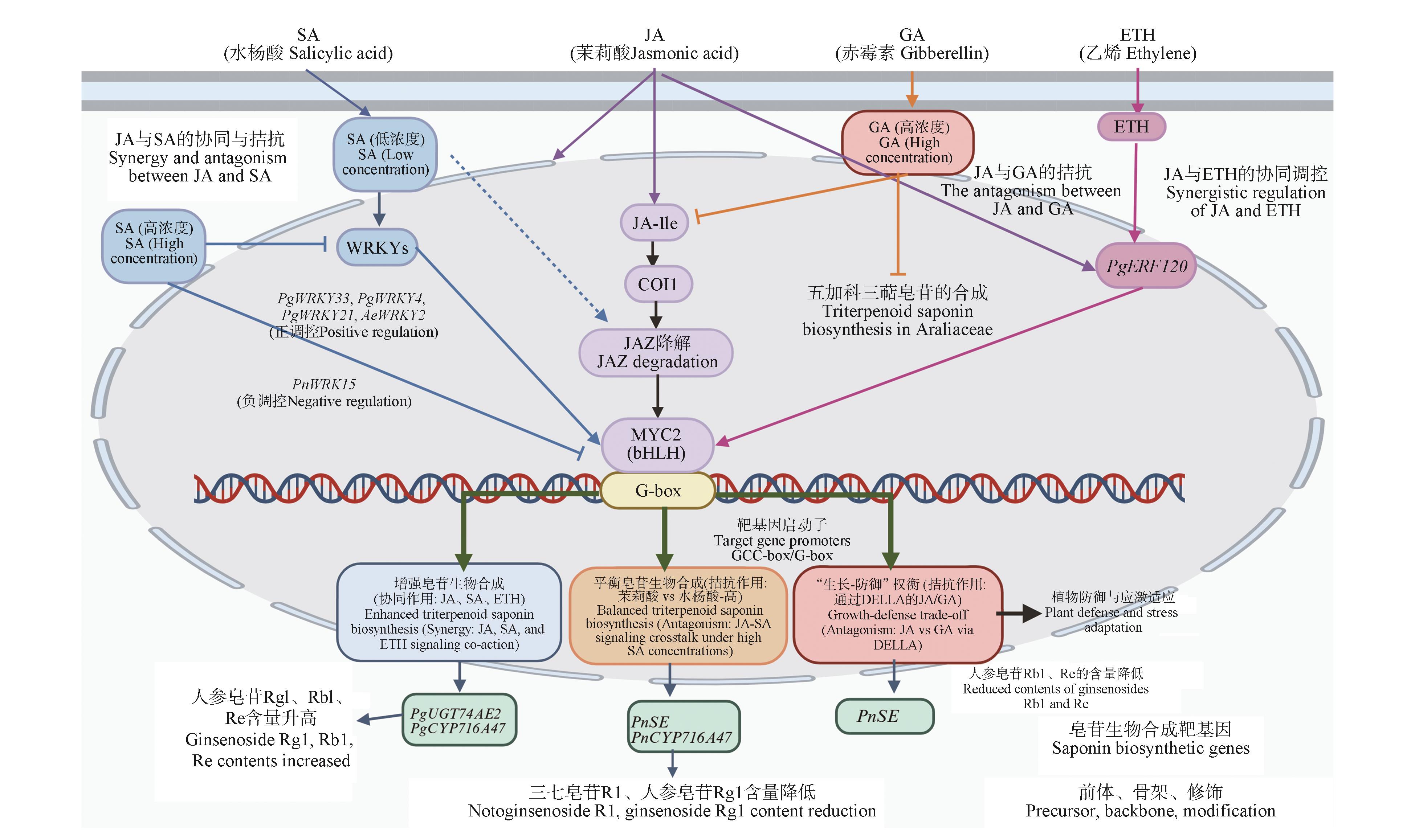
图4
调控五加科植物三萜皂苷生物合成的激素信号交叉网络
| [1] | 徐立新,赵寿经,梁彦龙,等.外源调节物质对人参毛状根生长及皂苷合成的影响[J].吉林大学学报(工学版),2010,40(6):1619-1623. |
| Xu Lixin, Zhao Shoujing, Liang Yanlong,et al.Effect of extrinsic regulators on growth and ginsenoside content of hairy roots of Panax ginseng [J].Journal of Jilin University(Engineering and Technology Edition),2010,40(6):1619-1623. | |
| [2] | 姜森,于怡琳,姜利,等.三七转录因子PnWRKY1对三七皂苷生物合成的影响[J].西北植物学报,2019,39(3):430-438. |
| Jiang Sen, Yu Yilin, Jiang Li,et al.Effect of transcription factor PnWRKY1 on the biosynthesis of Panax notoginseng saponins[J].Acta Botanica Boreali-Occidentalia Sinica,2019,39(3):430-438. | |
| [3] | Zhao X Y, Ding J W, Ma J C,et al.Functional characterization of EsMYB transcription factors in triterpene glycosides biosynthesis pathway in Eleutherococcus senticosus [J].Industrial Crops and Products,2025,236:122046. |
| [4] | Liu H, Sun P P, Tong Y Q,et al.Establishment of transient and stable gene transformation systems in medicinal woody plant Acanthopanax senticosus [J].Chemical and Biological Technologies in Agriculture,2024,11(1):142. |
| [5] | 贺欣怡,张晶,余晗,等.洋常春藤中三萜皂苷生物合成相关HhSE基因克隆与表达分析[J/OL].分子植物育种,2024-03-13.. |
| He Xinyi, Zhang Jing, Yu Han,et al.Cloning and expression analysis of HhSE related to triterpenoid saponins biosynthesis in Hedera helix [J/OL].Molecular Plant Breeding,2024-03-13.. | |
| [6] | Chen X, Zhou X Y, Lan C,et al.Araloside a induces Raf/MEK/ERK-dependent autophagy to mitigate Alzheimer’s and Parkinson’s pathology in cellular and C. elegans models[J].Molecular Neurobiology,2025,62(12):16061-16080. |
| [7] | Li Z R, Liu Y W, Liu K D,et al.Saponins from Aralia taibaiensis protect against brain ischemia/reperfusion injuries by regulating the apelin/AMPK pathway[J].Chinese Journal of Natural Medicines,2025,23(3):299-310. |
| [8] | 周丛叶,孙文松,刘莹,等.人参皂苷及其合成相关转录因子的研究进展[J].中草药,2026,57(7):2865-2876. |
| Zhou Congye, Sun Wensong, Liu Ying,et al.Research progress on ginsenosides and their biosynthesis-related transcription factors[J].Chinese Traditional and Herbal Drugs,2026,57(7):2865-2876. | |
| [9] | Bai Z Q, Xia P G, Wang R L,et al.Molecular cloning and characterization of five SmGRAS genes associated with tanshinone biosynthesis in Salvia miltiorrhiza hairy roots[J].PLoS One,2017,12(9):e0185322. |
| [10] | Zheng T, Wei L Z, Zhang M C,et al.Mevinolin(MEV) modulates terpenoid biosynthesis in ‘Shine Muscat’ grapes by regulating HMGR enzyme[J].BMC Plant Biology,2025,26(1):38. |
| [11] | Wang J, Yang Z X, Xu S Y,et al.Aralianudasides C-E:three undescribed triterpenoid saponins from the buds of Aralia elata and its airway inflammation inhibitory activity[J].Natural Product Research,2025:1-7. |
| [12] | 向文珍,张贺,王鑫,等.茉莉酸甲酯诱导刺人参不定根三萜皂苷合成及其关键酶基因表达研究[J].中药材,2024,47(9):2146-2153. |
| Xiang Wenzhen, Zhang He, Wang Xin,et al.Biosynthesis of triterpenoid saponins and key enzymes gene expression from adventitious root of Oplopanax elatus induced by methyl jasmonate[J].Journal of Chinese Medicinal Materials,2024,47(9):2146-2153. | |
| [13] | 杨莉颖.油茶三萜皂苷生物合成与调控的关键基因研究[D].长沙:中南林业科技大学,2023. |
| Yang Liying.The key genes research of triterpenoid saponin biosynthesis and regulation in Camellia oleifera [D].Changsha:Central South University of Forestry & Technology,2023. | |
| [14] | Yao S S, Liu D, Wang L,et al.Constructing haloarchaeal MVA pathway in Serratia marcescens for synthesis of ocimene[J].Biotechnology and Applied Biochemistry,2026,73(4):2022-2031. |
| [15] | Hu K, Chen J, Shi T,et al.Selenium enhances floral terpene emission in tree peony by upregulating MEP pathway genes and terpene synthase genes[J].Industrial Crops and Products,2026,239:122386. |
| [16] | 张斌,梁苗苗,谭政委,等.植物2,3-氧化鲨烯环化酶的研究进展[J].世界科学技术,2022,24(5):1751-1759. |
| Zhang Bin, Liang Miaomiao, Tan Zhengwei,et al.Research progress in plant 2,3-oxidosqualene cyclase[J].World Science and Technology,2022,24(5):1751-1759. | |
| [17] | Cui Y Q, Ma J C, Jiao M Y,et al.Identification of 2,3-oxidosqualene cyclase gene in Eleutherococcus senticosus and its regulatory mechanism in saponin synthesis[J].Horticulture Research,2025,12(8):uhaf133. |
| [18] | Liu K Y, Li P, Li W L.Methyl jasmonate enhances saponin accumulation in cultured Panax notoginseng adventitious roots[J].Plants,2025,14(22):3462. |
| [19] | Zhao M L, Li X Y, Lan C X,et al.Promoting photosynthetic production of dammarenediol-Ⅱ in Chlamydomonas reinhardtii via gene loading and culture optimization[J].International Journal of Molecular Sciences,2023,24(13):11002. |
| [20] | Li Y B, Wu F M, Li C Y.Jasmonate signaling:integrating stress responses with developmental regulation in plants[J].Journal of Genetics and Genomics,2025,52(12):1490-1506. |
| [21] | 牛耀星.茉莉酸甲酯和水杨酸诱导采后猕猴桃果实抗冷机制研究[D].杨凌:西北农林科技大学,2025. |
| Niu Yaoxing.Study on the cold resistance mechanism of postharvest kiwifruit induced by methyl jasmonate and salicylic acid [D].Yangling:Northwest A & F University,2025. | |
| [22] | Sood M.Jasmonates:“the master switch” for regulation of developmental and stress responses in plants[J].Journal of Plant Growth Regulation,2023,42(8):5247-5265. |
| [23] | 张悦.茉莉酸甲酯应答转录因子的鉴定及其在人参皂苷生物合成与逆境抗性中的功能研究[D].长沙:中南大学,2024. |
| Zhang Yue.Identification of methyl jasmonate-responsive transcription factors and their roles in ginsenoside biosynthesis and stress resistance[D].Changsha:Central South University,2024. | |
| [24] | Zhou K, Han T T, Pan B Q,et al.Robustness in jasmonate signaling:mechanisms of concerted regulation and implications for crop improvement[J].aBIOTECH,2025,6(4):618-637. |
| [25] | Jiang Y, He G H, Li R Q,et al.Functional validation of the cytochrome P450 family PgCYP309 gene in Panax ginseng [J].Biomolecules,2024,14(6):715. |
| [26] | Nguyen N Q, Lee O R.Overexpression of ginseng UGT72AL1 causes organ fusion in the axillary leaf branch of Arabidopsis [J].Journal of Ginseng Research,2017, 41(3):419-427. |
| [27] | Yang Z R, Yang X N, Zheng X S.Genome-wide identification and characterization of the AP2/ERF gene family in Cinnamomum camphora [J].BMC Genomics,2025,26(1):972. |
| [28] | Deng B, Huang Z J, Ge F,et al.An AP2/ERF family transcription factor PnERF1 raised the biosynthesis of saponins in Panax notoginseng [J].Journal of Plant Growth Regulation,2017,36(3):691-701. |
| [29] | Chen J, Zhou Y H, Zhang Q,et al.Structural variation,functional differentiation and expression characteristics of the AP2/ERF gene family and its response to cold stress and methyl jasmonate in Panax ginseng C.A.Meyer[J].PLoS One,2020,15(3):e0226055. |
| [30] | 张儒,谭时泉,张变玲,等.MeJA响应的人参PgJAZ1基因克隆、表达与功能分析[J].中国细胞生物学学报,2021,43(10):1964-1975. |
| Zhang Ru, Tan Shiquan, Zhang Bianling,et al.Cloning,expression and functional analysis of MeJA responsive PgJAZ1 gene from Panax ginseng [J].Chinese Journal of Cell Biology,2021,43(10):1964-1975. | |
| [31] | 左格格.人参TIFY基因家族的挖掘及其成员PgJAZ13抗烟草赤星病研究[D].长沙:中南大学,2024. |
| Zuo Gege.Mining of TIFY gene family of Panax ginseng C.A.Meyer and its member PgJAZ13 against brown spot of tobacco[D].Changsha:Central South University,2024. | |
| [32] | Yang Z, Yang L F, Zhu Z Y,et al.The transcription factor PnMYB38 orchestrates methyl jasmonate-induced saponin biosynthesis in Panax notoginseng [J].Horticulture Research,2026,13(6):uhag052. |
| [33] | Li Z, Xing X Z, Ding L W,et al.MeJA-responsive transcription factors AeMYB9/73 promote oleanolic acid and hederagenin accumulation in Aralia elata [J].Plant Science,2026,364:112887. |
| [34] | Kang S M, Zhang Q Y, Wang F.SalicS1 FRET sensor enables real-time visualization of salicylic acid dynamics in plant immunity[J].Advanced Agrochem,2026,5(1):7-9. |
| [35] | 张一格,韦伟,单守明.植物激素水杨酸:生物合成、信号转导与运输[J].智慧农业导刊,2024,4(8):13-16. |
| Zhang Yige, Wei Wei, Shan Shouming.Plant hormone salicylic acid:biosynthesis,signal transduction and transportation[J].Journal of Smart Agriculture,2024,4(8):13-16. | |
| [36] | 汪霞.水杨酸调控紫花苜蓿响应低温的分子基础[D].兰州:甘肃农业大学,2023. |
| Wang Xia.The molecular basis of salicylic acid regulating alfalfa response to low temperature[D].Lanzhou:Gansu Agricultural University,2023. | |
| [37] | Liu Y N, Wu M S, Li X,et al.Conserved and divergent:salicylic acid biosynthesis and signaling pathways across the plant kingdom[J].Molecular Plant,2026,19(3):587-605. |
| [38] | Ding Y L, Sun T J, Ao K,et al.Opposite roles of salicylic acid receptors NPR1 and NPR3/NPR4 in transcriptional regulation of plant immunity[J].Cell,2018,173(6):1454-1467. |
| [39] | 孙嘉曼,傅俊范,王燕平,等.外源水杨酸诱导人参抗锈腐病的生理机制[J].沈阳农业大学学报,2011,42(5):555-558. |
| Sun Jiaman, Fu Junfan, Wang Yanping,et al.Physiological mechanism of ginseng resistant to ginseng rusty root rot induced by exogenous salicylic acid[J].Journal of Shenyang Agricultural University,2011,42(5):555-558. | |
| [40] | Li M Q, Che X L, Liang Q W,et al.Genome-wide identification and characterization of WRKYs family involved in responses to Cylindrocarpon destructans in Panax notoginseng [J].BMC Genomics,2025,26(1):104. |
| [41] | Di P, Wang P, Yan M,et al.Genome-wide characterization and analysis of WRKY transcription factors in Panax ginseng [J].BMC Genomics,2021,22(1):834. |
| [42] | Yao L, Wang J, Sun J C,et al.A WRKY transcription factor,PgWRKY4X,positively regulates ginsenoside biosynthesis by activating squalene epoxidase transcription in Panax ginseng [J].Industrial Crops and Products,2020,154:112671. |
| [43] | Wang P, Wang Y H, Lian J M,et al.Transcription factors PgWRKY21 and PgWRKY101 regulate protopanaxatriol ginsenoside biosynthesis in Panax ginseng [J].Industrial Crops and Products,2025,236:121819. |
| [44] | 赵越.三七不定根培养体系的建立及皂苷合成调控机制的研究[D].哈尔滨:东北林业大学,2024. |
| Zhao Yue.Establishment of adventitious roots culture system of Panax notoginseng and study on the regulation mechanism of saponins synthesis[D].Harbin:Northeast Forestry University,2024. | |
| [45] | Li J B, Li L L, Hou J E,et al.Genome-wide characterization and expression analysis of WRKY transcription factors reveals biotic stress response potential mechanisms in Panax notoginseng [J].Physiological and Molecular Plant Pathology,2024,134:102432. |
| [46] | Xu H H, Liu H F, Liu Y,et al.Over-expression of AeWRKY2 promotes oleanolic acid and hederagenin accumulation in Aralia elata [J].Biochimie,2025,233:99-108. |
| [47] | Tian H N, Xu L, Li X,et al.Salicylic acid:the roles in plant immunity and crosstalk with other hormones[J].Journal of Integrative Plant Biology,2025,67(3):773-785. |
| [48] | Moe-Lange J, Shabek N.An emerging signaling hub:KAI2 at the nexus of phytohormone networks[J].The Plant Journal,2025,124(5):e70609. |
| [49] | Moore S, Jervis G, Topping J F,et al.A predictive model for ethylene-mediated auxin and cytokinin patterning in the Arabidopsis root[J].Plant Communications,2024,5(7):100886. |
| [50] | Zheng X Y, Zhang X J, Zeng F K.The regulatory network composed of phytohormones,transcription factors and non-coding RNAs is involved in the flavonoids biosynthesis of fruits[J].Horticultural Plant Journal,2026,12(3):497-508. |
| [51] | Titova M V, Lunkova M K, Tyurina T M,et al.Suspension cell cultures of Panax vietnamensis as a biotechnological source of ginsenosides:growth,cytology,and ginsenoside profile assessment[J].Frontiers in Plant Science,2024,15:1349494. |
| [52] | 修景润,廉美兰,朴成日,等.生长素和细胞分裂素对悬浮培养人参细胞生长和皂苷合成的影响[J].延边大学农学学报,2011,33(2):83-88. |
| Xiu Jingrun, Lian Meilan, Chengri Piao,et al.Effect of auxins and cytokinins on cell growth and ginsenoside production of Panax ginseng during suspension culture[J].Journal of Agricultural Science Yanbian University,2011,33(2):83-88. | |
| [53] | Jha R, Manonmani V, Sundaralingam K,et al.Harnessing root system architecture plasticity to improve crop performance under abiotic stress conditions[J].Russian Journal of Plant Physiology,2026,73(2):85. |
| [54] | Zhu W, Bao Y, Cao H J,et al.The TCP transcription factor RmTCP5 shapes leaf development by modulating auxin and cytokinin homeostasis in Rosa multiflora [J].Journal of Plant Physiology,2026,320:154755. |
| [55] | 张萌.人参主根及根茎形态建成的分子生态机制研究[D].长春:吉林农业大学,2024. |
| Zhang Meng.Studies on the molecular ecological mechanism of the morphogenesis of taproot and rhizome in Panax ginseng [D].Changchun:Jilin Agricultural University,2024. | |
| [56] | 苏德悦.外源物质对人参苗期低温胁迫的缓解效应及生理机制[D].长春:吉林农业大学,2023. |
| Su Deyue.Mitigating effect and physiological mechanism of exogenous substances on low temperature stress of Panax ginseng seedling stage [D].Changchun:Jilin Agricultural University,2023. | |
| [57] | 赵露,周新芳,孙天尊,等.人参多越冬芽发育的生理解析:基于HPLC-MS/MS法的内源植物激素分析[J].东北师大学报(自然科学版),2020,52(1):127-135. |
| Zhao Lu, Zhou Xinfang, Sun Tianzun,et al.Physiological basis of ginseng overwintering bud development:based on HPLC-MS/MS method for analysis of endogenous plant hormone[J].Journal of Northeast Normal University(Natural Science Edition),2020,52(1):127-135. | |
| [58] | 邢朝斌,吴鹏,龙月红,等.刺五加与其愈伤组织中皂苷合成关键酶基因表达的差异分析[J].中药材,2012,35(8):1210-1213. |
| Xing Zhaobin, Wu Peng, Long Yuehong,et al.Analyze on the expression differences of key genes in saponins biosynthesize in Eleutherococcus senticosus and its callus[J].Journal of Chinese Medicinal Materials,2012,35(8):1210-1213. | |
| [59] | Ke D P, Xie Y P, Li H P,et al.Anchorene,a carotenoid-derived growth regulator,modulates auxin homeostasis by suppressing GH3-mediated auxin conjugation[J].Journal of Integrative Plant Biology,2024,66(11):2490-2504. |
| [60] | Xu Y S, Wang H K, Chen X D,et al.Gibberellin delays floral transition in cultivated strawberry via the coordinated modulation of photoperiod signaling and nitrogen metabolism[J].Horticulture Advances,2026,4(1):10. |
| [61] | Du F W, Huang H L, Cao Y L,et al.Notoginsenoside R1 protects against high glucose-induced cell injury through AMPK/Nrf2 and downstream HO-1 signaling[J].Frontiers in Cell and Developmental Biology,2021,9:791643. |
| [62] | Nishijima T, Murakami F, Koshioka M,et al.Endogenous gibberellins in Aralia cordata [J].Bioscience,Biotechnology,and Biochemistry,1993,57(11):1953-1954. |
| [63] | Gao Z, Deng H, He X Q,et al.EIN3-binding F-box protein SlEBF3 modulates resistance against Botrytis cinerea and carotenoid biosynthesis by degradation of BBX20 in tomato[J].Horticulture Research,2025,12(11):uhaf219. |
| [64] | Hong J, Meng K, Thomas H R,et al. Reframing agriculture by light: the role of light-mediated jasmonates/salicylic acid regulation in plant defense, development and beyond[J]. Vegetable Research,2024,4:e027. |
| [65] | 宋莹,吴可心,邵文达,等.刺五加和短梗五加叶片初生代谢的发育特异性调控研究[J].植物研究,2022,42(2):268-277. |
| Song Ying, Wu Kexin, Shao Wenda,et al.Development-specific investigation of leaf primary metabolism of Acanthopanax senticosus and Acanthopanax sessiliflorus [J].Bulletin of Botanical Research,2022,42(2):268-277. | |
| [66] | 刘艳艳,萧凤回.JAs、SAs介导的植物防御反应及在药用植物中的应用[J].中国农学通报,2010,26(14):98-100. |
| Liu Yanyan, Xiao Fenghui.Jasmonate and salicylate-mediated plant defense responses and their application in medicinal plants[J].Chinese Agricultural Science Bulletin,2010,26(14):98-100. | |
| [67] | Yin R Z, Liu X Y, Yu J F,et al.Up-regulation of autophagy by low concentration of salicylic acid delays methyl jasmonate-induced leaf senescence[J].Scientific Reports,2020,10:11472. |
| [68] | Kim Y H, Park C W, Lee K M,et al.The roles of MYC2 transcription factor in JA-signaling pathway in plants[J].Journal of Plant Biology,2025,68(2):113-131. |
| [69] | Singh P, Mishra S, Singh S,et al.Regulating plant growth and defense:multifaceted roles of auxin in plants[J].Journal of Plant Growth Regulation,2026,45(3):1697-1723. |
| [70] | 邓江霞,张国良,李边豪,等.WRKY类转录因子在植物激素ABA、SA和JA信号转导中的作用[J].黑龙江农业科学,2023(10):138-144. |
| Deng Jiangxia, Zhang Guoliang, Li Bianhao,et al.Role of WRKY transcription factors in plant hormone ABA,SA and JA signal transduction[J].Heilongjiang Agricultural Sciences,2023(10):138-144. | |
| [71] | 刘禹涵,杜欣洋,吴春雨,等.联合转录和代谢组学技术揭示水杨酸对低温胁迫下人参的生理生化调控机制[J].中国中药杂志,2026, 51(15): 4321-4330. |
| Liu Yuhan, Du Xinyang, Wu Chunyu,et al.Physiological and biochemical regulatory mechanisms of salicylic acid in Panax ginseng under low-temperature stress based on transcriptomics and metabolomics[J].China Journal of Chinese Materia Medica,2026, 51(15): 4321-4330. | |
| [72] | Sun Y, Zhao S J, Liang Y L,et al.Regulation and differential expression of protopanaxadiol synthase in Asian and American ginseng ginsenoside biosynthesis by RNA interferences[J].Plant Growth Regulation,2013,71(3):207-217. |
| [73] | 陈享.多算法协同的三七PnbZIP和PnWRKY基因家族分析研究[D].杭州:浙江理工大学,2023. |
| Chen Xiang.Multi-algorithm collaboration for Panax notoginseng PnbZIP and PnWRKY gene families analysis[D].Hangzhou:Zhejiang Sci-Tech University,2023. | |
| [74] | Mu T T, Luo S L, Li L,et al.A review of the interaction mechanisms between jasmonic acid(JA) and various plant hormones,as well as the core regulatory role of MYC2 [J].Plant Science,2025,353:112407. |
| [75] | Wang Y H, Wang S R, Meng X R,et al.Genome-wide identification of the AP2/ERF gene family and functional analysis of PgAP2/ERF187 under cold stress in Panax ginseng C.A.Meyer[J].Plants,2025,14(18):2922. |
| [76] | 潘建英.超表达三七PnFPS基因对番茄中萜类物质含量影响的研究[D].北京:北京中医药大学,2023. |
| Pan Jianying.Study on the effect of overexpression of PnFPS gene of Panax notoginseng on the content of terpenoids in tomato[D].Beijing:Beijing University of Chinese Medicine,2023. | |
| [77] | Meng F W, Chao Y, Cao J D,et al.A bHLH transcription activator regulates defense signaling by nucleo-cytosolic trafficking in rice[J].Journal of Integrative Plant Biology,2020,62(10):1552-1573. |
| [78] | Lantzouni O, Alkofer A, Falter-Braun P,et al.GROWTH-REGULATING FACTORS interact with DELLAs and regulate growth in cold stress[J].The Plant Cell,2020,32(4):1018-1034. |
| [79] | 郑锂蕾.转录因子PnWRKY15协同茉莉酸信号正调控三七对根腐病的抗性[D].昆明:昆明理工大学,2022. |
| Zheng Lilei.The transcription factor PnWRKY15 cooperating with jasmonic acid signaling positively regulated the resistance of Panax notoginseng to root rot[D].Kunming:Kunming University of Science and Technology,2022. | |
| [80] | 葛娜,杨玲,陈军文.不同浓度赤霉素和脱落酸对顽拗性三七种子后熟种胚发育和内源激素的影响[J].应用与环境生物学报,2020,26(3):574-581. |
| Ge Na, Yang Ling, Chen Junwen.Effects of varying gibberellin and abscisic acid levels on embryo development and endogenous hormones in recalcitrant Panax notoginseng seeds during the after-ripening process[J].Chinese Journal of Applied & Environmental Biology,2020, 26(3):574-581. | |
| [81] | 崔北米.ABA、GA3和乙烯利诱导丹参毛状根酚酸类物质的积累研究[D].杨凌:西北农林科技大学,2012. |
| Cui Beimi.Effects of ABA,ethephon and GA3 on the accmulation of phenolic acids in the hairy roots of Salvia miltiorrhiza Bunge[D].Yangling:Northwest A & F University,2012. |
| [1] | 董楚星, 张梦圆, 史鑫波, 张岗, 宋忠兴, 王楠, 焦红红. 酸枣WRKY转录因子家族鉴定及脱落酸介导类黄酮合成的关键基因筛选[J]. 植物研究, 2026, 46(5): 851-865. |
| [2] | 沈芳宇, 张宇, 张胤, 陈凡, 刘健, 代羽洁, 张雪驰, 张胜. 植物激素介导雌雄青杨对UV-B胁迫的生理响应[J]. 植物研究, 2026, 46(4): 642-654. |
| [3] | 李沃森, 翟睿, 赵晴, 赵金凤, 孟德恺, 陈艳杰, 李爽, 周晨光. 杨树C2H2型锌指转录因子PtrZAT11在木材形成中的功能[J]. 植物研究, 2026, 46(4): 677-687. |
| [4] | 张力鹏, 武美, 王宏鹏, 李天宇. 大花红景天盐胁迫调控基因RcNAC22克隆及功能分析[J]. 植物研究, 2026, 46(2): 246-258. |
| [5] | 吴卫倩, 胡子建, 沈诗雅, 张贵芳, 林金星, 张曦. 植物不定根再生与扦插生根相关激素调控研究进展[J]. 植物研究, 2026, 46(1): 13-24. |
| [6] | 张政, 张鹏. 黑龙江西部3种杨树生长及生理特征比较[J]. 植物研究, 2025, 45(5): 807-815. |
| [7] | 李卓穗, 高一琳, 刘寒, 尚旭岚. 二倍体青钱柳愈伤组织诱导及次生代谢物积累[J]. 植物研究, 2025, 45(4): 533-545. |
| [8] | 武晓倩, 何旭, 高境烩, 李爽. 转PsnNAC007高耐旱性小黑杨种质创制及其特性分析[J]. 植物研究, 2024, 44(3): 349-360. |
| [9] | 郭冰冰, 刘明洋, 代龙军, 杨洪, 王立丰. 植物激素调控橡胶树产排胶机制研究进展[J]. 植物研究, 2024, 44(2): 161-167. |
| [10] | 刘玮, 朱自强. 植物根部热形态建成的研究进展[J]. 植物研究, 2024, 44(1): 1-7. |
| [11] | 孙宇, 张艺腾, 成慧慧. 紫穗槐WRKY42基因耐盐碱性的功能研究[J]. 植物研究, 2023, 43(4): 612-621. |
| [12] | 裘喻平, 王益川, 郭红卫. 植物根毛发育调控机制的研究进展[J]. 植物研究, 2023, 43(3): 321-332. |
| [13] | 廖诗贤, 王宇婷, 董立本, 顾咏梅, 贾丰璘, 姜廷波, 周博如. 小黑杨转录因子PsnbZIP1应答盐胁迫功能分析[J]. 植物研究, 2023, 43(2): 288-299. |
| [14] | 钱婷, 赵凡, 张玉洁, 李雪丽, 孙坤, 张辉. 肋果沙棘和西藏沙棘转录因子bHLH94基因对海拔适应性分化的研究[J]. 植物研究, 2022, 42(6): 976-985. |
| [15] | 陈坤, 方功桂, 穆怀志, 姜静. 白桦BpPIN3基因启动子序列及应答特性分析[J]. 植物研究, 2022, 42(4): 592-601. |
| 阅读次数 | ||||||
|
全文 |
|
|||||
|
摘要 |
|
|||||