Bulletin of Botanical Research ›› 2026, Vol. 46 ›› Issue (3): 399-410.doi: 10.7525/j.issn.1673-5102.2026.03.002
• Original Paper • Previous Articles Next Articles
Kaixin ZHANG, Xinze YU, Kaiyang GAO, Chen CHENG, Xueying HAN, Qianqian SHI( )
)
Received:2026-01-23
Online:2026-05-20
Published:2026-06-01
Contact:
Qianqian SHI
E-mail:shiqianqian2005@163.com
CLC Number:
Kaixin ZHANG, Xinze YU, Kaiyang GAO, Chen CHENG, Xueying HAN, Qianqian SHI. Induction, Identification, and Trait Analysis of Tetraploid Primula filchnerae[J]. Bulletin of Botanical Research, 2026, 46(3): 399-410.
Add to citation manager EndNote|Ris|BibTeX
URL: https://bbr.nefu.edu.cn/EN/10.7525/j.issn.1673-5102.2026.03.002
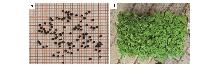
Fig.1
Materials used in polyploidy induction experimentA. Seeds for soaking treatment; B. Seedlings for apical meristem treatment.
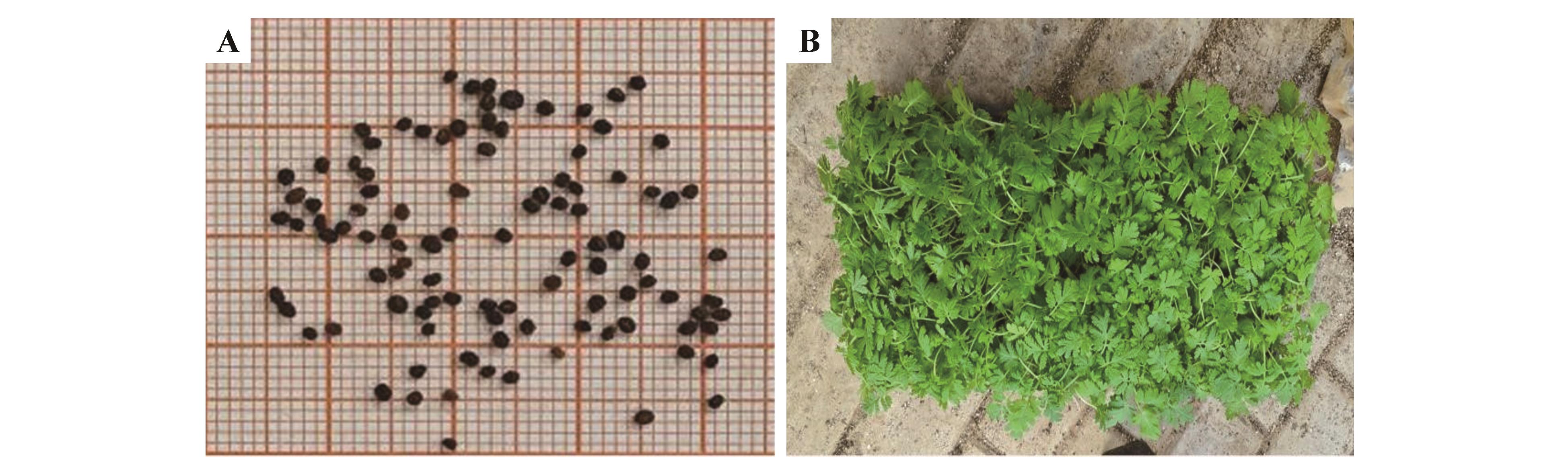
Table 1
Treatments of the seed induction group
秋水仙素质量浓度 Colchicine mass concentration/(g⋅L-1) | 浸泡时间 Soaking time/h | 种子数量 Number of seeds |
|---|---|---|
| CK | 12 | 300 |
| 24 | 300 | |
| 48 | 300 | |
| 0.02 | 12 | 300 |
| 24 | 300 | |
| 48 | 300 | |
| 0.05 | 12 | 300 |
| 24 | 300 | |
| 48 | 300 | |
| 0.10 | 12 | 300 |
| 24 | 300 | |
| 48 | 300 |
Table 2
Treatments of the apical meristem induction group
秋水仙素质量浓度 Colchicine mass concentration/(g⋅L-1) | 处理时间 Treatment time/h | 幼苗数量 Number of seedlings |
|---|---|---|
| CK | 48 | 30 |
| 0.02 | 48 | 30 |
| 0.05 | 48 | 30 |
| 0.10 | 48 | 30 |
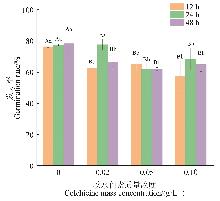
Fig.2
Effect of colchicine treatment on the germination rate of Primula filchnerae seedsDifferent lowercase letters indicated significant differences at the P<0.05 level when comparing different soaking time treatments at the same mass concentration. Different uppercase letters indicated significant differences at the P<0.05 level when comparing different colchicine mass concentrations at the same soaking time.
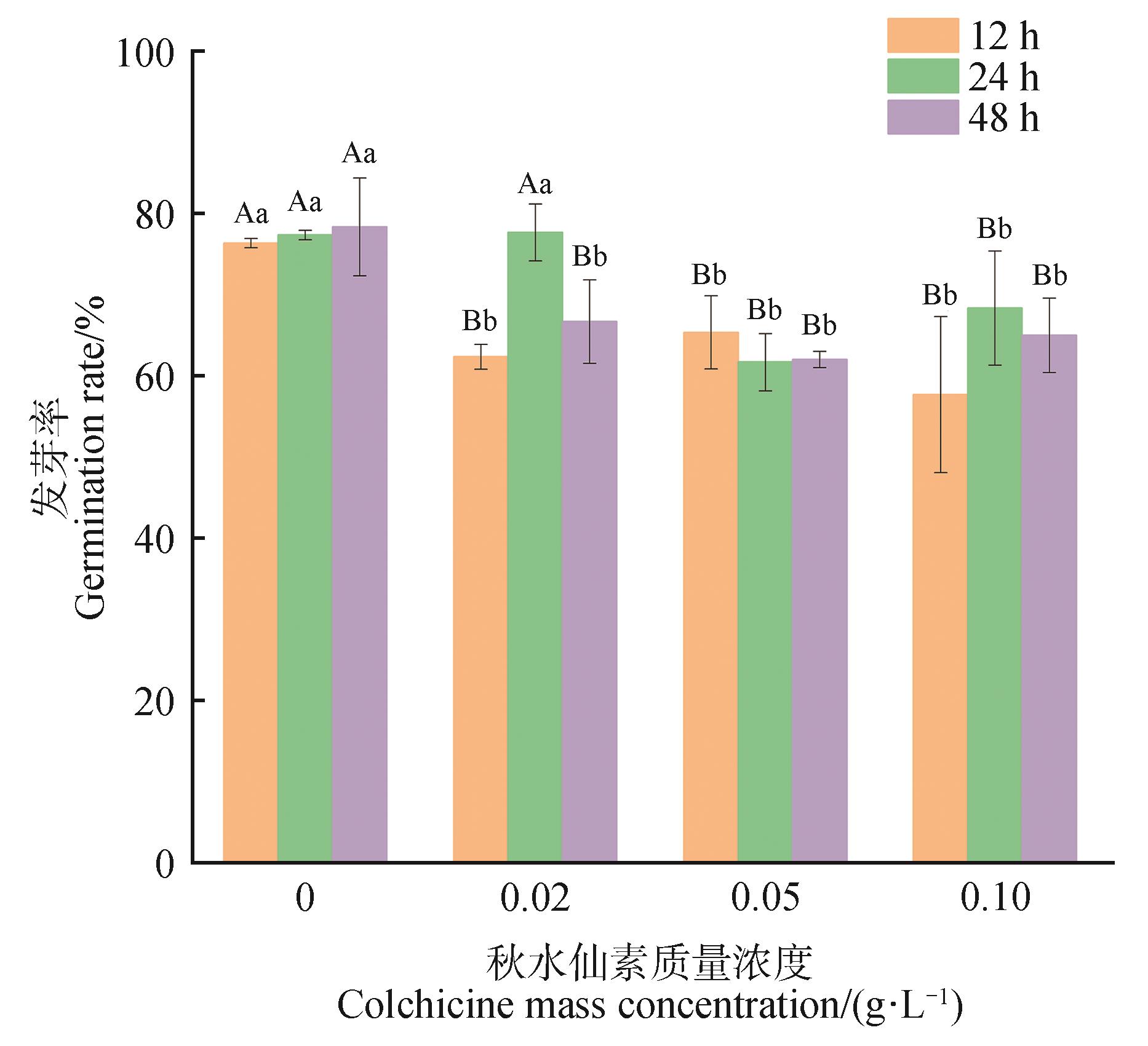
Table 3
Two-factor analysis of colchicine mass concentration and soaking time on seed germination rate of Primula filchnerae
变异来源 Source of variation | 自由度 df | 发芽率 Germination rate | |
|---|---|---|---|
| F | P | ||
浸泡时间 Soaking time | 2 | 127.370 | <0.001 |
秋水仙素质量浓度 Colchicine mass concentration | 3 | 204.765 | <0.001 |
浸泡时间×秋水仙素质量浓度 Soaking time×Colchicine mass concentration | 6 | 80.870 | <0.001 |
Fig.3
Effect of colchicine treatment on the mortality rate of Primula filchnerae seedlingsDifferent lowercase letters indicated significant differences at the P<0.05 level when comparing different soaking time treatments at the same mass concentration. Different uppercase letters indicated significant differences at the P<0.05 level when comparing different mass concentrations at the same soaking time.
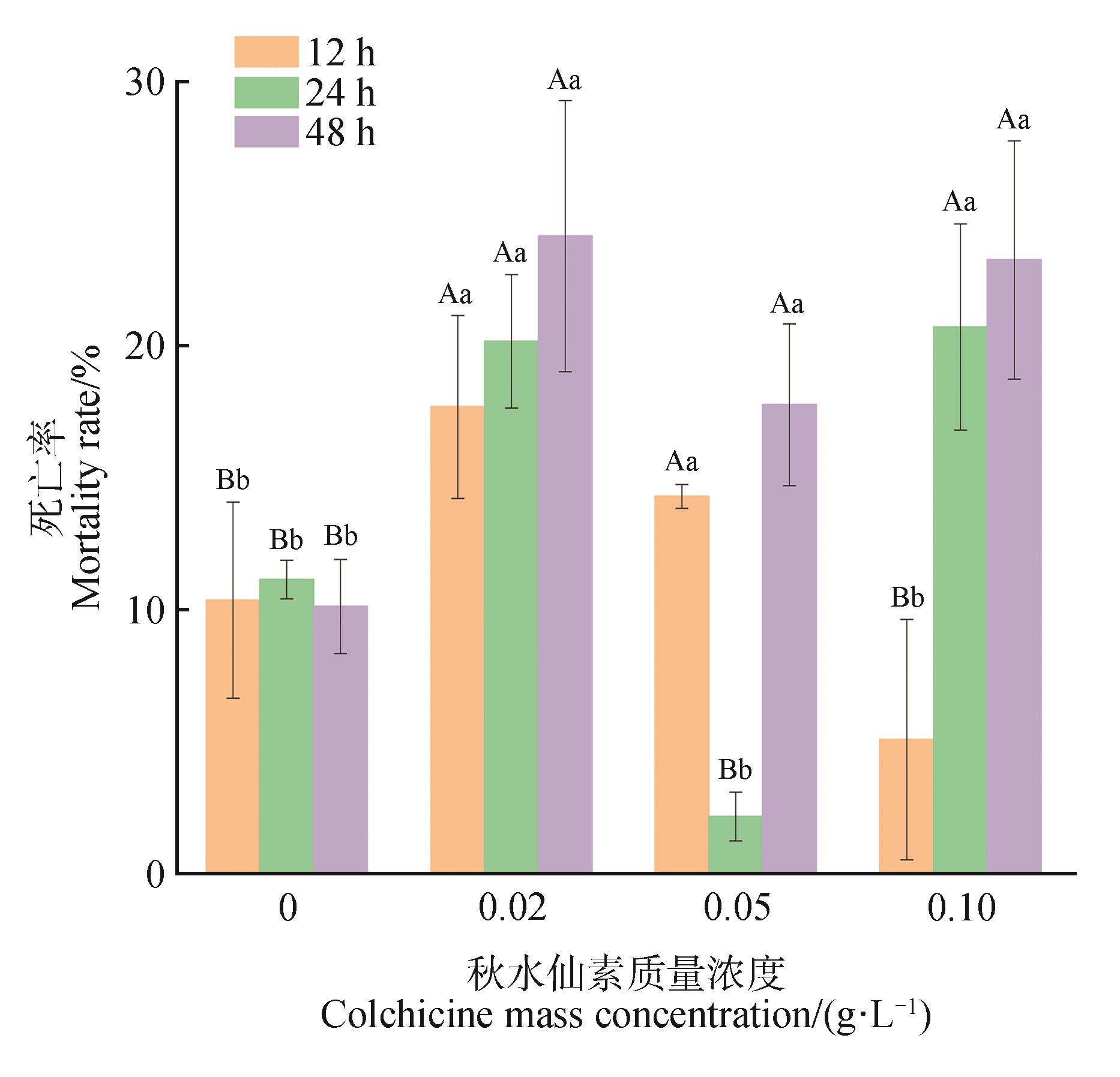
Table 4
Two-factor analysis of the effects of different colchicine mass concentrations and soaking time treaments on seedling mortality rate in Primula filchnerae
变异来源 Source of variation | 自由度 df | 死亡率 Mortality rate | |
|---|---|---|---|
| F | P | ||
浸泡时间 Soaking time | 2 | 18.856 | <0.001 |
秋水仙素质量浓度 Colchicine mass concentration | 3 | 20.100 | <0.001 |
浸泡时间×秋水仙素质量浓度 Soaking time×Colchicine mass concentration | 6 | 13.303 | <0.001 |
Fig.4
Flow cytometry analysis histograms of diploid and suspected tetraploidA. Diploid; B. Suspected tetraploid.
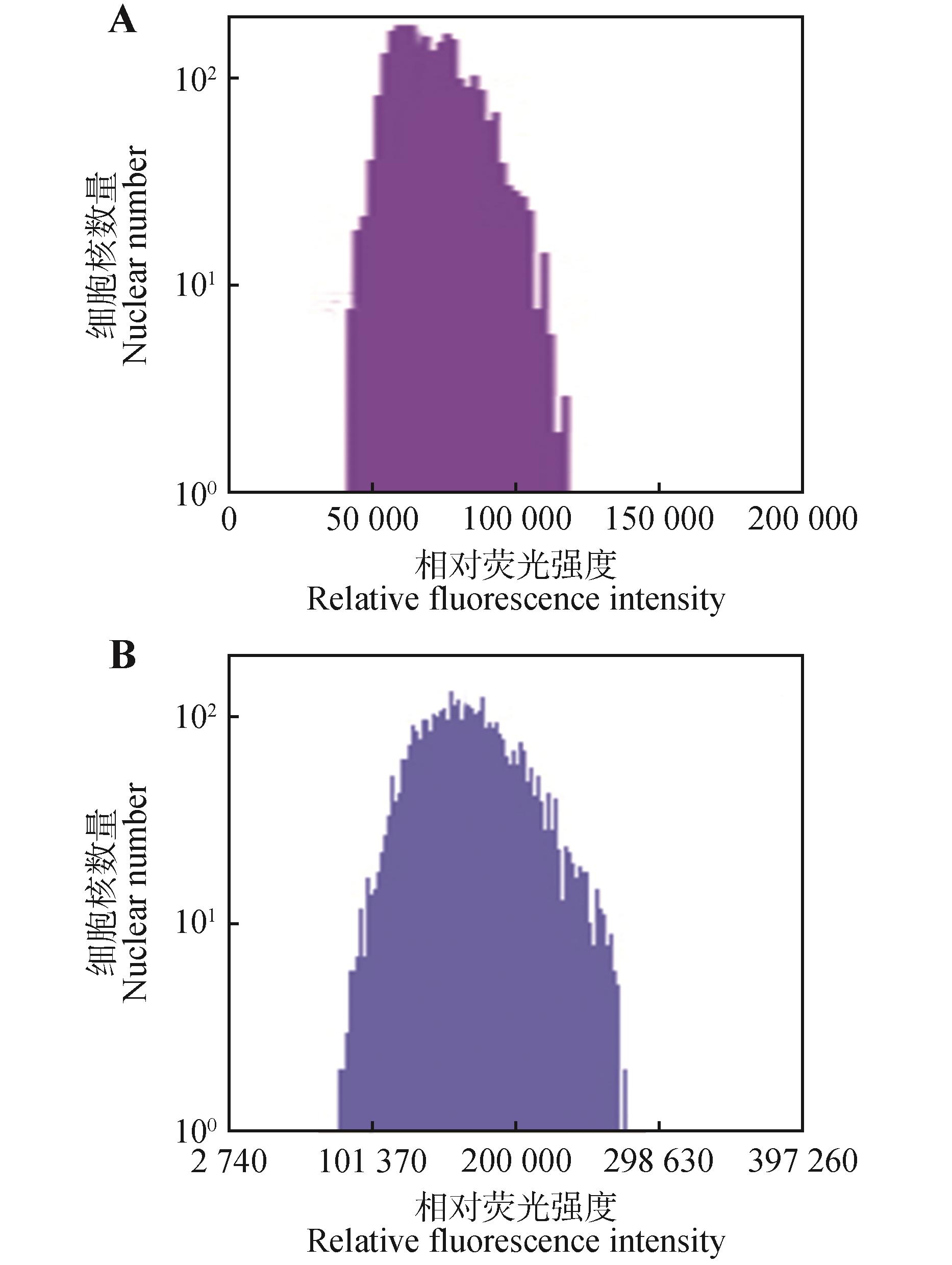
Fig.5
Root tip chromosomesA. Diploid; B. Tetraploid.
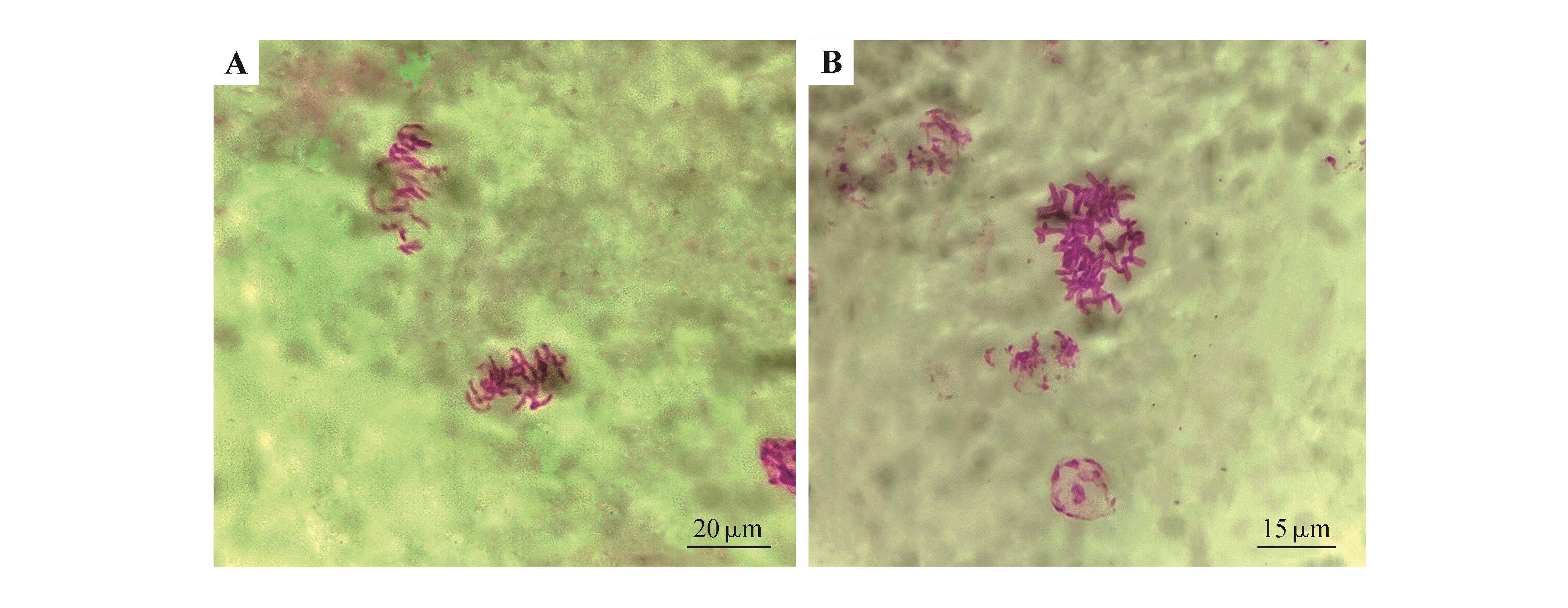
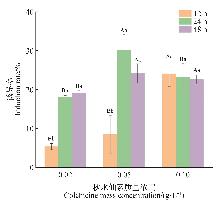
Fig.6
Effect of colchicine treatment on the tetraploid induction rate of Primula filchneraeDifferent lowercase letters indicated significant differences at the P<0.05 level when comparing different soaking time treatments at the same colchicine mass concentration. Different uppercase letters indicated significant differences at the P<0.05 level when comparing different colchicine mass concentrations at the same soaking time.

Table 5
Two-factor analysis of the effects of different colchicine mass concentrations and soaking time treatments on the induction rate of Primula filchnerae
变异来源 Source of variation | 自由度 df | 诱导率 Induction rate | |
|---|---|---|---|
| F | P | ||
浸泡时间 Soaking time | 2 | 63.194 | <0.001 |
秋水仙素质量浓度 Colchicine mass concentration | 3 | 43.045 | <0.001 |
浸泡时间×秋水仙素质量浓度 Soaking time×Colchicine mass concentration | 6 | 15.166 | <0.001 |
Table 6
Mortality and tetraploid induction rate under colchicine treatments
秋水仙素质量浓度 Colchicine mass concentration/(g⋅L-1) | 死亡率 Mortality rate/% | 诱导率 Induction rate/% |
|---|---|---|
| CK | 0a | 0c |
| 0.02 | 6.67±5.77a | 33.33±5.77ab |
| 0.05 | 3.33±5.77a | 40.00±10.00a |
| 0.10 | 0a | 26.67±5.77b |
Table 7
Single-factor analysis of mortality and induction rate under colchicine treatment
变异来源 Source of variation | 死亡率Mortality rate | 诱导率Induction rate | ||||
|---|---|---|---|---|---|---|
| df | F | P | df | F | P | |
秋水仙素质量浓度 Colchicine mass concentration | 3 | 1.833 | 0.219 | 3 | 22.133 | <0.001 |
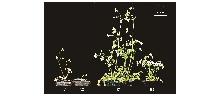
Fig.7
Plant comparison diagram of diploids and tetraploids of Primula filchneraeA1. Tetraploid seed treatment group;A2. Diploid seed treatment group; B1. Tetraploid apical meristem treatment group;B2. Diploid apical meristem treatment group.

Table 8
Morphological index differences between diploids and tetraploids of Primula filchnerae
处理方案 Treatment scheme | 植株类型 Type | 叶面积 Leaf area/cm² | 叶片数量 Number of leaves | 花葶高 Flower stalk height/cm | 花葶数量 Number of flower stalks | 花朵直径 Diameter of the flower/cm | 花朵数量 Number of flowers | 地径 Ground diameter/mm |
|---|---|---|---|---|---|---|---|---|
种子处理 Seed treatment | 二倍体 | 1.03±0.22 | 2.53±0.52 | 3.21±0.52 | 1.33±0.62 | 1.14±0.13 | 1.94±0.57 | 1.13±0.10 |
| 四倍体 | 2.05±0.08** | 5.07±0.70** | 11.14±1.18** | 2.60±0.63** | 1.73±0.14** | 4.25±0.93** | 1.12±0.07 | |
生长点处理 Apical meristem treatment | 二倍体 | 2.08±0.47 | 13.17±2.42 | 23.00±4.03 | 4.60±0.95 | 2.17±0.11 | 27.33±2.14 | 2.50±0.37 |
| 四倍体 | 3.62±0.71** | 16.76±3.10** | 29.90±3.49** | 5.17±1.29** | 2.53±0.30** | 27.78±2.26 | 3.16±0.49** |
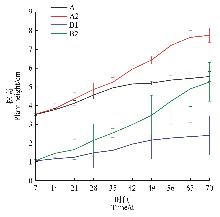
Fig.8
Comparison of plant height changes in Primula filchnerae under colchicine treatmentA. Apical meristem treatment group; B. Seed treatment group; A1, B1. Diploids; A2, B2. Tetraploids.
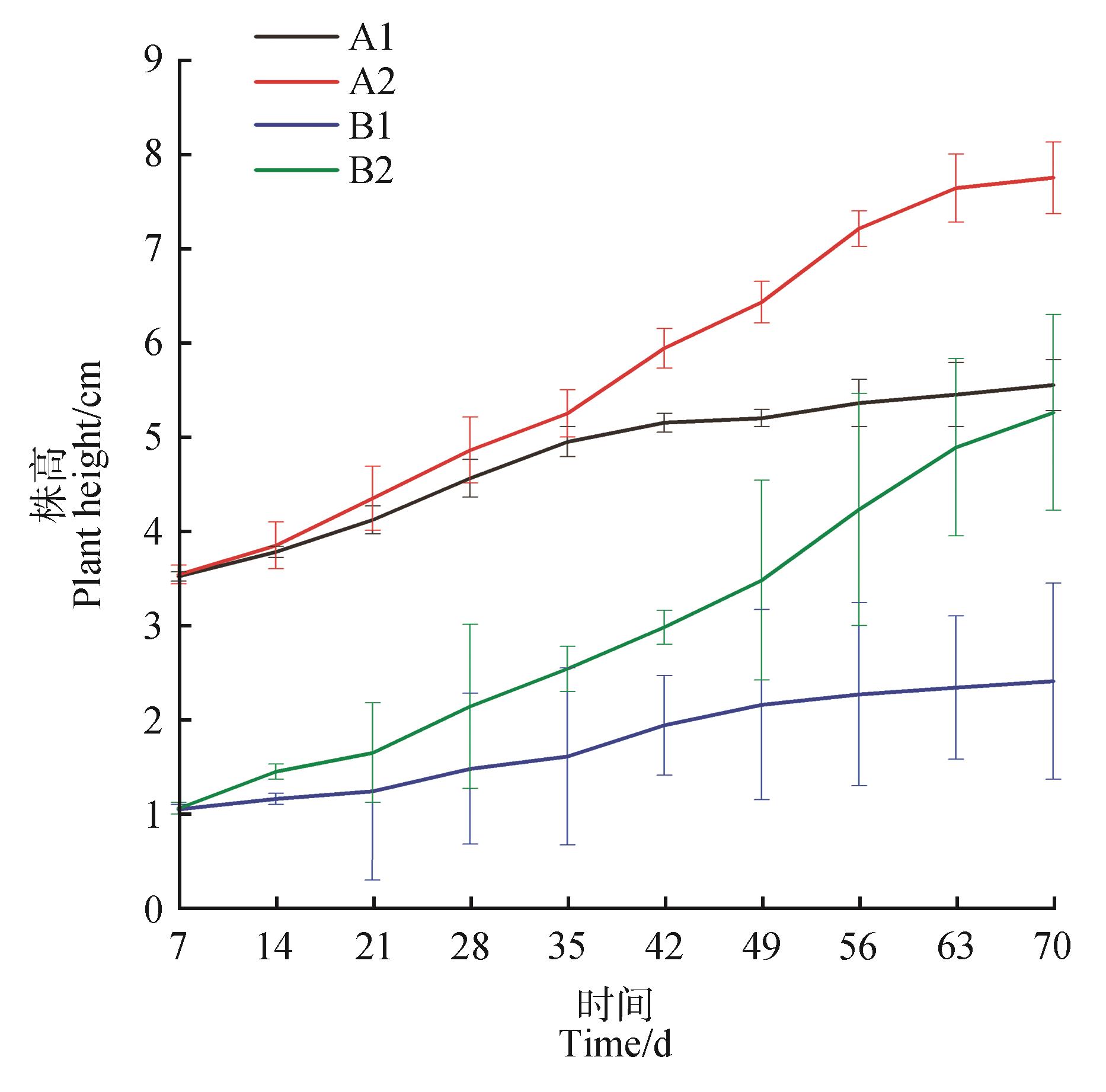
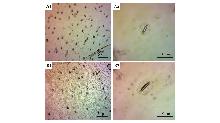
Fig.9
Comparison of stomata of diploid and tetraploid plants of Primula filchneraeA1, A2. Density and individual stomata of diploid plants; B1, B2. Density and individual stomata of tetraploid plants.

Table 9
Differences in stomatal characteristics between diploid and tetraploid plants
植株类型 Plant type | 气孔长度 Stomata length/μm | 气孔宽度 Stomata width/μm | 气孔密度 Stomata density/ (个·mm-2) |
|---|---|---|---|
二倍体植株 Diploid | 7.5±0.2b | 6.8±0.2b | 58.9±7.8a |
四倍体植株 Tetraploid | 12.2±0.5a | 7.6±0.2a | 33.3±5.0b |
| [1] | 李霖锋,刘宝.植物多倍化与多倍体基因组进化研究进展[J].中国科学:生命科学,2019,49(4):327-337. |
| LI L F, LIU B.Recent advances of plant polyploidy and polyploid genome evolution[J].Science in China:Series C,2019,49(4):327-337. | |
| [2] | 裴芸,虞夏清,赵晓坤,等.多倍化与植物新表型关联性的研究进展[J].园艺学报,2023,50(9):1854-1866. |
| PEI Y, YU X Q, ZHAO X K,et al.Progress in the study of the association of polyploidy with new plant phenotypes[J].Acta Horticulturae Sinica,2023,50(9):1854-1866. | |
| [3] | SINGH B, YUN S, GIL Y,et al.The role of colchicine in plant breeding[J].International Journal of Molecular Sciences,2025,26(14):6743. |
| [4] | TOUCHELL D H, PALMER I E, RANNEY T G. In vitro ploidy manipulation for crop improvement[J].Frontiers in Plant Science,2020,11:722. |
| [5] | BHATTARAI K, KAREEM A, DENG Z N. In vivo induction and characterization of polyploids in gerbera daisy[J].Scientia Horticulturae,2021,282:110054. |
| [6] | REN J, LU X, DUAN Y Y,et al. In vivo tetraploid induction of mono-embryonic citrus genotypes by colchicine treatment[J].Scientia Horticulturae,2024,338:113701. |
| [7] | HA T H, KIM D G, KIM J,et al.Induction of polyploidy and its effect on cannabinoid content in Cannabis sativa L.[J].Industrial Crops and Products,2026,239:122423. |
| [8] | MO L, CHEN J H, LOU X Z,et al.Colchicine-induced polyploidy in Rhododendron fortunei Lindl[J].Plants,2020,9(4):424. |
| [9] | LUO Z N, IAFFALDANO B J, CORNISH K.Colchicine-induced polyploidy has the potential to improve rubber yield in Taraxacum kok-saghyz [J].Industrial Crops and Products,2018,112:75-81. |
| [10] | 季必霞,陈达伟,张晨晨,等.大花蕙兰多倍体的高效诱导[J].植物研究,2011,31(5):558-562. |
| JI B X, CHEN D W, ZHANG C C,et al.High efficient polyploid induction of Cymbidium hybridium [J].Bulletin of Botanical Research,2011,31(5):558-562. | |
| [11] | PRASATH D, NAIR R R, BABU P A.Effect of colchicine induced tetraploids of ginger (Zingiber officinale Roscoe) on cytology,rhizome morphology,and essential oil content[J].Journal of Applied Research on Medicinal and Aromatic Plants,2022,31:100422. |
| [12] | 刘金,夏齐平,王建,等.自花授粉在安徽羽叶报春花色选育中应用的初步研究[J].植物研究,2018,38(2):232-237. |
| LIU J, XIA Q P, WANG J,et al.A preliminary study on the application of self pollination in Primula merrilliana flower color selection[J].Bulletin of Botanical Research,2018,38(2):232-237. | |
| [13] | 吴宪,廖建雄,甘啟良,等.环境因子对陕西羽叶报春种子萌发及成苗的影响[J].植物科学学报,2011,29(2):212-217. |
| WU X, LIAO J X, GAN Q L,et al.Influence of environmental factors on seed germination and seedling formation of Primula filchnerae [J].Plant Science Journal,2011,29(2):212-217. | |
| [14] | 中国科学院动物研究所.中国生物多样性红色名录[EB/OL].(2023-05-19)[2025-12-20].. |
| Institute of Zoology, Chinese Academy of Sciences. Redlist of China’s Biodiversity[EB/OL].(2023-05-19)[2025-12-20]. . | |
| [15] | IUCN 2025. The IUCN Red List of Threatened Species[EB/OL].[2025-12-20]. . |
| [16] | 中华人民共和国生态环境部.濒危特有植物:陕西羽叶报春保护与可持续利用[R/OL]. (2023-06-12)[2025-12-20]. . |
| Ministry of Ecology and Enviroment of the People’s Republic of China. Endemic endangered plant: conservation and sustainable use of Primula filchnerae [R/OL]. (2023-06-12)[2025-12-20]. . | |
| [17] | JIANG X, LIU W J, ZHU Y Z,et al.Impacts of climate changes on geographic distribution of Primula filchnerae,an endangered herb in China[J].Plants,2023,12(20):3561. |
| [18] | 张晓曼,孙晓光,杨建民.田埂报春多倍体诱导及其形态学研究[J].植物遗传资源学报,2010,11(6):789-792. |
| ZHANG X M, SUN X G, YANG J M.Polyploid induction and morphology of Primula forbesii [J].Journal of Plant Genetic Resources,2010,11(6):789-792. | |
| [19] | 张超,李枝林,李佳,等.滇北球花报春多倍体诱导及核型分析[J].西北植物学报,2011,31(2):236-241. |
| ZHANG C, LI Z L, LI J,et al.Polyploid induction and karyomorphological studies of Primula denticulata ssp.sinodenticulata [J].Acta Botanica Boreali-Occidentalia Sinica,2011,31(2):236-241. | |
| [20] | 余道平,李策宏.迎阳报春四倍体诱导及鉴定[J].核农学报,2014,28(6):961-966. |
| YU D P, LI C H.The tetraploid induction and identification of Primula oreodoxa Franch[J].Journal of Nuclear Agricultural Sciences,2014,28(6):961-966. | |
| [21] | NIAZIAN M, NALOUSI A M.Artificial polyploidy induction for improvement of ornamental and medicinal plants[J].Plant Cell,Tissue and Organ Culture,2020,142(3):447-469. |
| [22] | 周慧文,冯斗,严华兵.秋水仙素离体诱导多倍体研究进展[J].核农学报,2015,29(7):1307-1315. |
| ZHOU H W, FENG D, YAN H B.The progress of polyploids induced in vitro via colchicine[J].Journal of Nuclear Agricultural Sciences,2015,29(7):1307-1315. | |
| [23] | DOLEŽEL J, GREILHUBER J, SUDA J.Estimation of nuclear DNA content in plants using flow cytometry[J].Nature Protocols,2007,2(9):2233-2244. |
| [24] | 林晓璇,陈林静,容晨毓,等.铺地黍染色体制片优化及核型分析[J].草业科学,2021,38(1):89-98. |
| LIN X X, CHEN L J, RONG C Y,et al.Optimization of chromosome preparation and karyotype analysis of Panicum repens [J].Pratacultural Science,2021,38(1):89-98. | |
| [25] | MARAVILLA A J, ROSATO M, ROSSELLÓ J A.Preparation of mitotic chromosomes with the squash technique[M]//HEITKAM T,GARCIA S.Plant cytogenetics and cytogenomics:methods and protocols.New York:Springer,2023:141-149. |
| [26] | CHEN C H, CHEN P, WU Z X,et al.Colchicine-induced chromosome doubling in Cinnamomum camphora and its effect on morphological and terpenoid storage structures[J].Industrial Crops and Products,2025,233:121338. |
| [27] | ENG W H, HO W S.Polyploidization using colchicine in horticultural plants:a review[J].Scientia Horticulturae,2019,246:604-617. |
| [28] | NASIRVAND S, ZAKARIA R A, ZARE N,et al.Polyploidy induction in parsley (Petroselinum crispum L.) by colchicine treatment[J].Cytologia,2018,83(4):393-396. |
| [29] | HUY N P, TAM D T T, LUAN V Q,et al. In vitro polyploid induction of Paphiopedilum villosum using colchicine[J].Scientia Horticulturae,2019,252:283-290. |
| [30] | 施春晖,徐兰兰,王晓庆,等.流式细胞仪鉴定猕猴桃倍性技术研究[J].植物研究,2014,34(6):845-849. |
| SHI C H, XU L L, WANG X Q,et al.Identification of kiwifruit ploidy using flow cytometry[J].Bulletin of Botanical Research,2014,34(6):845-849. | |
| [31] | BECKER F W, OBERLANDER K C, TRÁVNÍČEK P,et al.Inconsistent expression of the gigas effect in polyploid Oxalis [J].American Journal of Botany,2022,109(10):1607-1621. |
| [32] | PACEY E K, MAHERALI H, HUSBAND B C.Polyploidy increases storage but decreases structural stability in Arabidopsis thaliana [J].Current Biology,2022,32(18):4057-4063. |
| [33] | SONG M J, POTTER B I, DOYLE J J,et al.Gene balance predicts transcriptional responses immediately following ploidy change in Arabidopsis thaliana [J].The Plant Cell,2020,32(5):1434-1448. |
| [34] | SUN W Q, LI M D, WANG J B.Characteristics of duplicated gene expression and DNA methylation regulation in different tissues of allopolyploid Brassica napus [J].BMC Plant Biology,2024,24(1):518. |
| [35] | KONG D X, LI Y Q, BAI M,et al.A comparative study of the dynamic accumulation of polyphenol components and the changes in their antioxidant activities in diploid and tetraploid Lonicera japonica [J].Plant Physiology and Biochemistry,2017,112:87-96. |
| [36] | KUNENE E N, FANG J Y.Oryzalin-induced autopolyploidy in sweet marjoram (Origanum majorana L.)[J].Scientia Horticulturae,2026,357:114638. |
| [37] | KRUTHIKA H S, RUKMANGADA M S, NAIK V G.Genome size,chromosome number variation and its correlation with stomatal characters for assessment of ploidy levels in a core subset of mulberry (Morus spp.) germplasm[J].Gene,2023,881:147637. |
| [38] | TARATIMA W, ROHMAH K N, PLAIKHUNTOD K,et al.Optimal protocol for in vitro polyploid induction of Cymbidium aloifolium (L.) Sw[J].BMC Plant Biology,2023,23(1):295. |
| [39] | YAO P Q, CHEN J H, MA P F,et al.Stomata variation in the process of polyploidization in Chinese chive (Allium tuberosum)[J].BMC Plant Biology,2023,23(1):595. |
| [40] | WANG J X, RENNINGER H J, MA Q,et al.Measuring stomatal and guard cell metrics for plant physiology and growth using StoManager1[J].Plant Physiology,2024,195(1):378-394. |
| [41] | ŠMARDA P, KLEM K, KNÁPEK O,et al.Growth,physiology,and stomatal parameters of plant polyploids grown under ice age,present-day,and future CO2 concentrations[J].New Phytologist,2023,239(1):399-414. |
| [42] | BERTOLINO L T, CAINE R S, GRAY J E.Impact of stomatal density and morphology on water-use efficiency in a changing world[J].Frontiers in Plant Science,2019,10:225. |
| [1] | Qi QI, Wenxiang HOU, Jin QIU, Liyang GENG, Xin CHEN. Ploidy Level and Genome Size Variation in Sorbus sect. Sorbus(Rosaceae) [J]. Bulletin of Botanical Research, 2024, 44(3): 441-447. |
| [2] | Yang LIU, Liying XU, Tongchao WEI, Lanyi SHEN, Dounan LIU, Yue LIU. Response of Leaf Functional Traits and their relationships to Seasonal Changes in Four Acer Species [J]. Bulletin of Botanical Research, 2023, 43(2): 242-250. |
| [3] | ZOU Man-Yu, LU Yong-Liang, YIN Li-Ping, GUO Shui-Liang. Morphological Variations, Genetics and Geographic Background of Echinochloa crus-galli in China [J]. Bulletin of Botanical Research, 2017, 37(2): 227-235. |
| [4] | ZHAO Qing, ZHANG Qiang, ZHOU Peng, LIN Feng, FANG Yan-Ming. Analysis of DNA C-value and Ploidy of Five Species in Magnoliaceae [J]. Bulletin of Botanical Research, 2016, 36(6): 853-859. |
| [5] | LI Yun-Ling, TIAN Bao-Ming, YANG Yan, CUI Ming-Zhu, HAO Zhi-Da, WEI Fang. Molecular and Cytological analysis of Meiosis in Autotetraploid Arabidopsis thaliana [J]. Bulletin of Botanical Research, 2016, 36(3): 354-359. |
| [6] | LUAN Qi-Fu;LI Yan-Jie;JIANG Jing-Min*. Variation of Stem Growth and Morphology Traits of Exotic Pine Hybrids and their Correlations [J]. Bulletin of Botanical Research, 2014, 34(1): 95-102. |
| [7] | JI Bi-Xia;CHEN Da-Wei;ZHANG Chen-Chen;MIN Di;HUANG Wen-Jing;WANG Yu;*. igh Efficient Polyploid Induction of Cymbidium hybridium [J]. Bulletin of Botanical Research, 2011, 31(5): 558-562. |
| [8] | ZHANG Li-Zhen;LI Qian-Zhong*;YANG Lin-Yuan;WU Cheng-Yan. Effect of N+ Implantation on the Inducement of Polyploid Astragalus membranaceus(Fisch.) Bge. var. mongholicus(Bge.) Hsiao [J]. Bulletin of Botanical Research, 2011, 31(5): 563-568. |
| [9] | SUN Peng;LI Yun*;JIANG Jin-Zhong;YUAN Cun-Quan;ZHANG Li-Ling. Progress of Variations in Floral Organs and Seeds of Autotetraploid Plants [J]. Bulletin of Botanical Research, 2011, 31(2): 249-256. |
| [10] | LI Zhi-Xin;LI Kai-Long*;LI Cheng-Hao;YANG Chuan-Ping;LI Hai-Tao. Effect of Colchicine Treatment after Pollination on Growth Characteristics of Poupulus ussuriensis Progeny [J]. Bulletin of Botanical Research, 2008, 28(5): 622-626. |
| [11] | WANG Jin-Long;GAO Yu-Bao*;ZHAO Nian-Xi;LIU Jing-Ling;LIN Feng;SONG Tao. Morphological and RAPD genetic differentiation of Stipa krylovii in middle and eastern Inner Mongolia steppe [J]. Bulletin of Botanical Research, 2006, 26(6): 708-714. |
| Viewed | ||||||
|
Full text |
|
|||||
|
Abstract |
|
|||||