Bulletin of Botanical Research ›› 2026, Vol. 46 ›› Issue (2): 280-293.doi: 10.7525/j.issn.1673-5102.2026.02.008
• Original Paper • Previous Articles Next Articles
Mengyao ZHAO1,2, Baoyu JI1,3,4, Nuo LI1, Yaozu HAN1, Lixin PEI1( )
)
Received:2025-12-05
Online:2026-03-20
Published:2026-04-02
Contact:
Lixin PEI
E-mail:xlpxlp@aliyun.com
CLC Number:
Mengyao ZHAO, Baoyu JI, Nuo LI, Yaozu HAN, Lixin PEI. Effects of Composite Inducers and Light Quality Inducers on Secondary Metabolites in Epimedium sagittatum Suspension Cells[J]. Bulletin of Botanical Research, 2026, 46(2): 280-293.
Add to citation manager EndNote|Ris|BibTeX
URL: https://bbr.nefu.edu.cn/EN/10.7525/j.issn.1673-5102.2026.02.008
Table 1
L9 (33 ) orthogonal experimental design of factors
水平 Level | 因素Factor | ||
|---|---|---|---|
茉莉酸甲酯 MeJA/(μmol·L-1) | 水杨酸 SA/(μmol·L-1) | 壳聚糖 CTS/(mg·L-1) | |
| -1 | 25 | 25 | 0 |
| 0 | 50 | 50 | 10 |
| 1 | 75 | 75 | 20 |
Table 2
Composite inducer combination table
编号 Number | 因素Factor | ||
|---|---|---|---|
茉莉酸甲酯 MeJA/(μmol·L-1) | 水杨酸 SA/(μmol·L-1) | 壳聚糖 CTS/(mg·L-1) | |
| F1 | 25 | 75 | 20 |
| F2 | 25 | 25 | 0 |
| F3 | 25 | 50 | 10 |
| F4 | 50 | 25 | 20 |
| F5 | 50 | 50 | 0 |
| F6 | 50 | 75 | 10 |
| F7 | 75 | 50 | 20 |
| F8 | 75 | 75 | 0 |
| F9 | 75 | 25 | 10 |
Table 3
Composite light-quality inducer combination table
编号 Number | 光质 Light quality | 光周期 Photoperiod/h | 黑暗时间 Darkness time/h |
|---|---|---|---|
| G1 | 黑暗 | 0 | 24 |
| G2 | 白光 | 12 | 12 |
| G3 | 黄光 | 12 | 12 |
| G4 | 蓝光 | 12 | 12 |
| G5 | 蓝光 | 8 | 16 |
| G6 | 蓝光 | 16 | 8 |
| G7 | 蓝光 | 24 | 0 |
Table 4
Standard curves for epimedin A,epimedin B,epimedin C,and icariin
成分 Ingredients | 方程 Equation | 线性范围 Linear range/ (μg·mL-1) | 相关系数 r |
|---|---|---|---|
朝藿定A Epimedin A | y=17.800x+63.130 | 3.96~507.50 | 0.999 8 |
朝藿定B Epimedin B | y=16.962x-34.273 | 3.89~498.00 | 0.999 8 |
朝藿定C Epimedin C | y=16.562x+58.388 | 3.88~495.00 | 0.999 9 |
淫羊藿苷 Icariin | y=19.478x+28.747 | 3.89~497.50 | 0.999 9 |
Table 5
Effects of composite inducers on the growth of Epimedium sagittatum suspension-cultured cells
编号 Number | 细胞生长量 Cell growth increment/g | 细胞增长率 Cell growth rate/% |
|---|---|---|
| CK | 3.76±0.35a | 87.83±17.51a |
| M-50 | 3.44±0.37a | 72.17±18.58a |
| F1 | 3.38±0.35a | 68.83±17.50a |
| F2 | 3.33±0.39a | 66.33±19.63a |
| F3 | 3.88±0.52a | 94.17±25.85a |
| F4 | 4.28±0.33a | 114.17±16.54a |
| F5 | 3.61±0.35a | 80.33±17.58a |
| F6 | 4.19±0.19a | 109.50±9.66a |
| F7 | 4.03±0.18a | 101.67±9.02a |
| F8 | 3.98±0.52a | 99.17±25.87a |
| F9 | 3.61±0.35a | 80.33±17.58a |
Fig.1
Effects of composite inducers on flavonol glycoside mass fraction in suspension cells of Epimedium sagittatumCK.Control; M-50.50 μmol?L-1 MeJA; F1.25 μmol?L-1 MeJA, 75 μmol?L-1 SA, 20 mg?L-1 CTS; F2. 25 μmol?L-1 MeJA, 25 μmol?L-1 SA; F3. 25 μmol?L-1 MeJA, 50 μmol?L-1 SA, 10 mg?L-1 CTS; F4. 50 μmol?L-1 MeJA, 25 μmol?L-1 SA, 20 mg?L-1 CTS; F5. 50 μmol?L-1 MeJA, 50 μmol?L-1 SA; F6. 50 μmol?L-1 MeJA, 75 μmol?L-1 SA, 10 mg?L-1 CTS; F7. 75 μmol?L-1 MeJA, 50 μmol?L-1 SA, 20 mg?L-1 CTS; F8. 75 μmol?L-1 MeJA, 75 μmol?L-1 SA; F9. 75 μmol?L-1 MeJA, 25 μmol?L-1 SA, 10 mg?L-1 CTS. Different lowercase letters indicated significant differences between treatments(P<0.05).
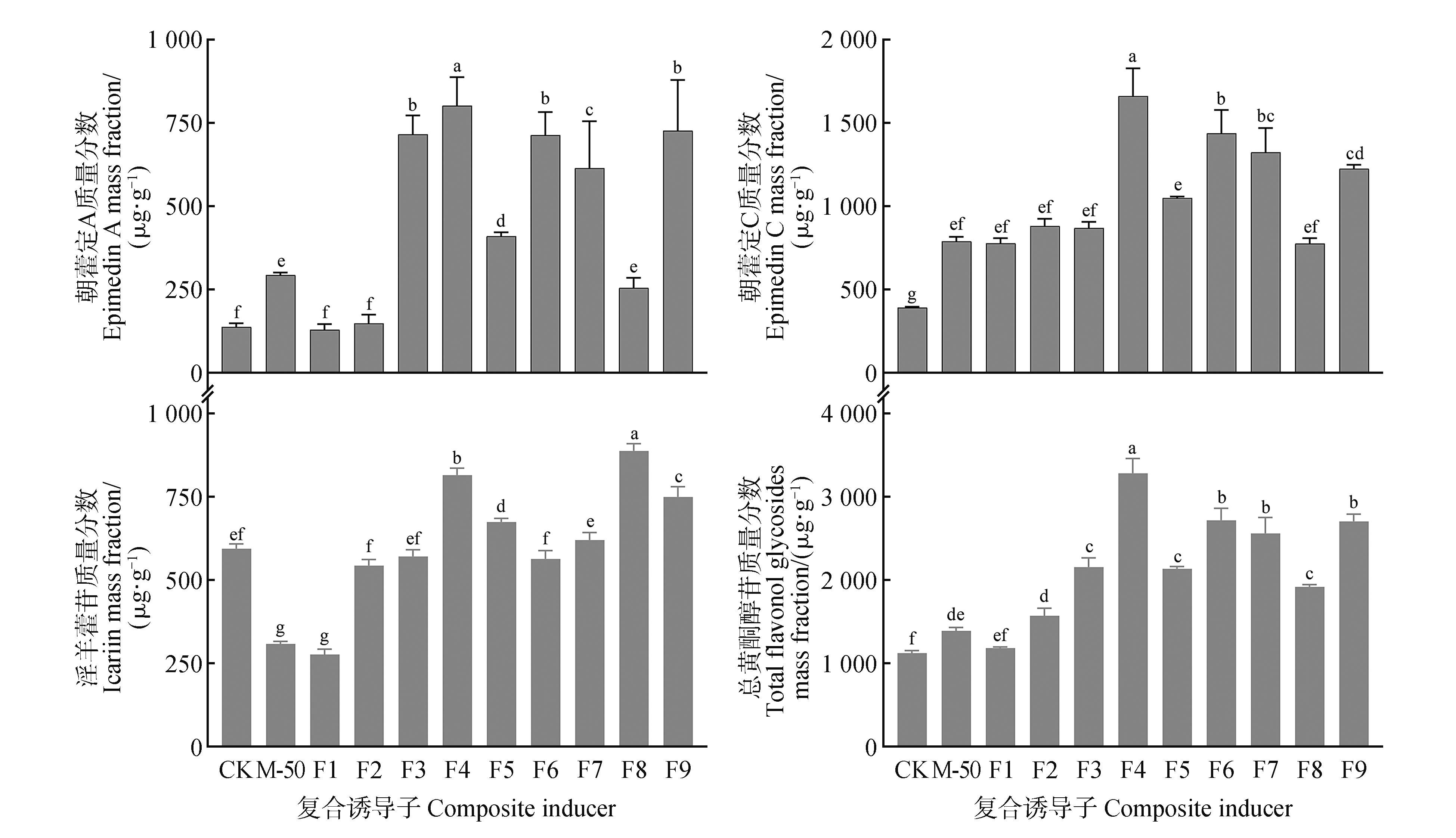
Fig.2
Effects of composite inducers on mass fraction of total flavonoids, total phenolic acid, total alkaloids, and total saponins in suspension cells of Epimedium sagittatumCK.Control; M-50. 50 μmol?L-1 MeJA; F1. 25 μmol?L-1 MeJA, 75 μmol?L-1 SA, 20 mg?L-1 CTS; F2. 25 μmol?L-1 MeJA, 25 μmol?L-1 SA; F3. 25 μmol?L-1 MeJA, 50 μmol?L-1 SA, 10 mg?L-1 CTS; F4. 50 μmol?L-1 MeJA, 25 μmol?L-1 SA, 20 mg?L-1 CTS; F5. 50 μmol?L-1 MeJA, 50 μmol?L-1 SA; F6. 50 μmol?L-1 MeJA, 75 μmol?L-1 SA, 10 mg?L-1 CTS; F7. 75 μmol?L-1 MeJA, 50 μmol?L-1 SA, 20 mg?L-1 CTS; F8. 75 μmol?L-1 MeJA, 75 μmol?L-1 SA; F9. 75 μmol?L-1 MeJA, 25 μmol?L-1 SA, 10 mg?L-1 CTS. Different lowercase letters indicated significant differences between treatments(P<0.05).
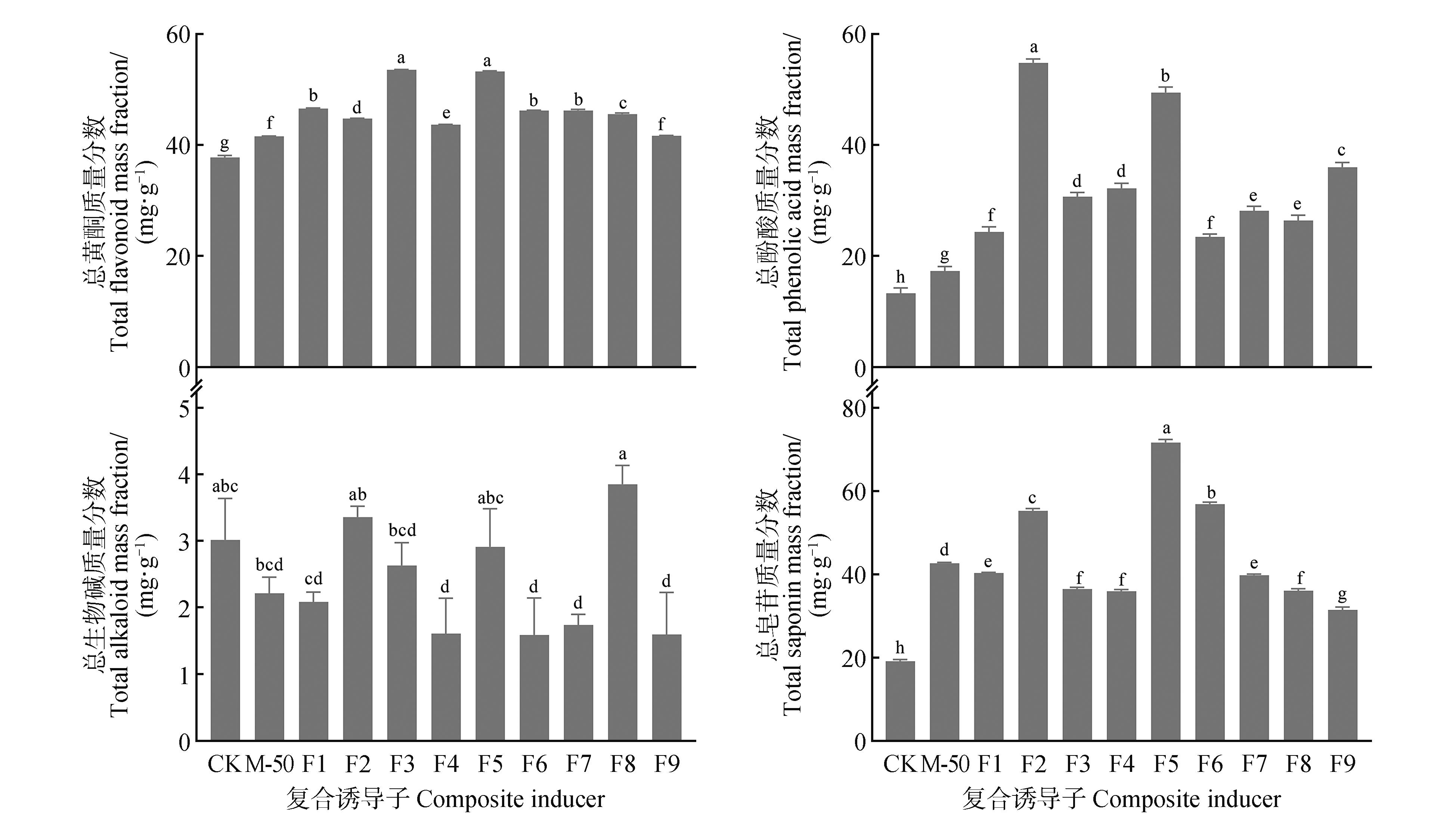
Fig.3
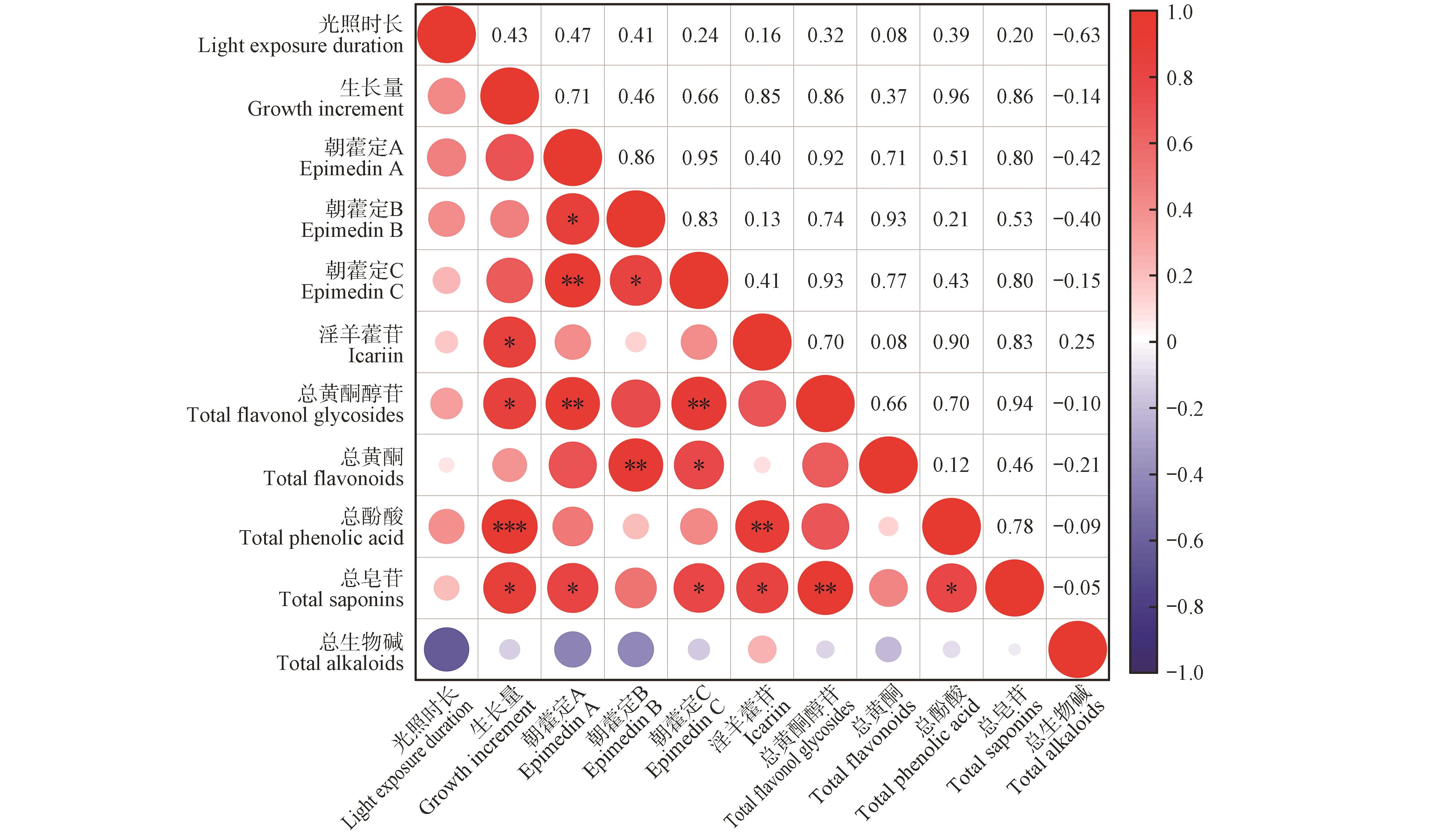
Correlation analysis of metabolic products in Epimedium sagittatum suspension cells under composite inducer regulation****. Significant at the 0.000 1 level; **. Significant at the 0.01 level; *. Significant at the 0.05 level.
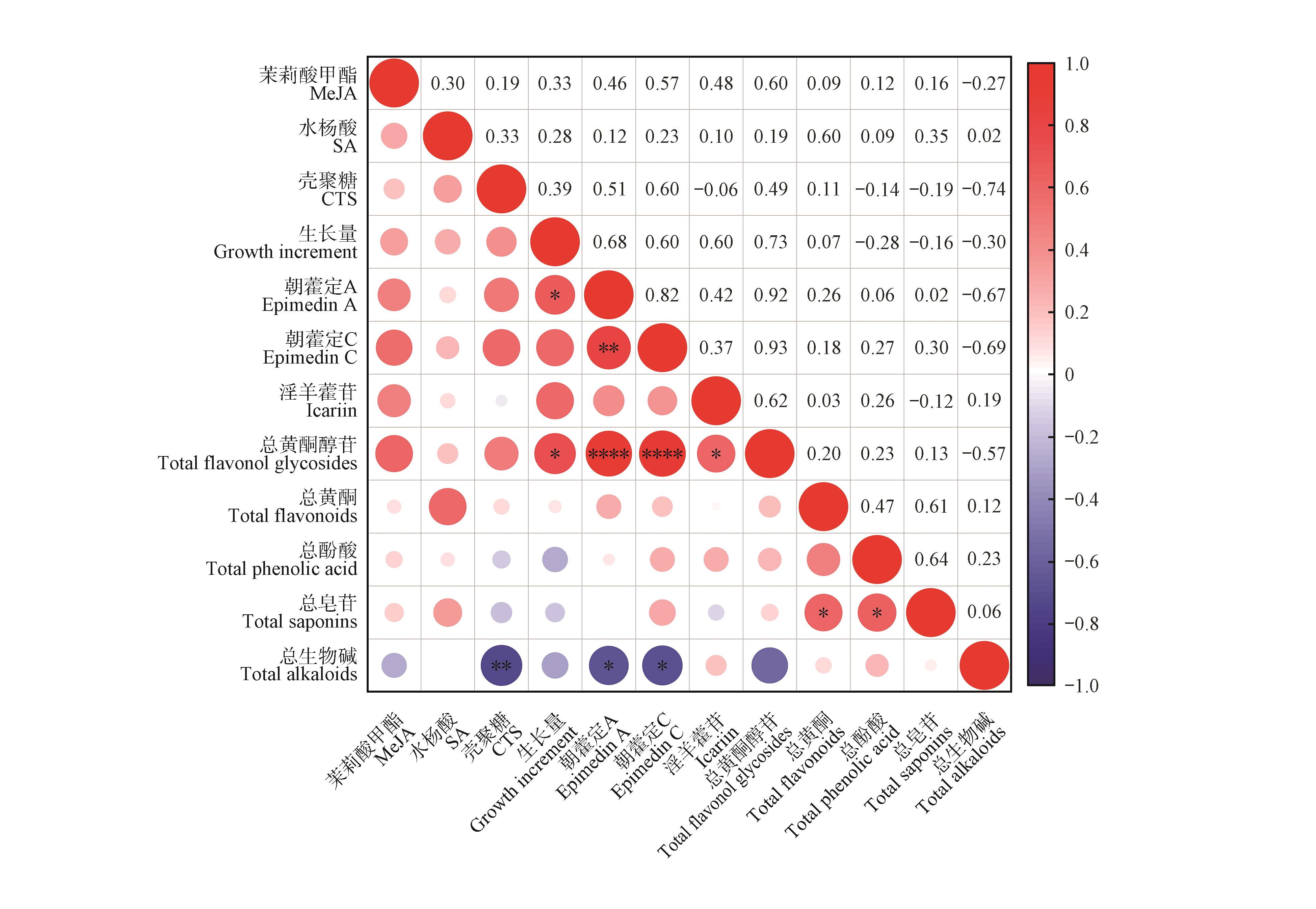
Table 6
Effects of light-quality inducers on the growth of Epimedium sagittatum suspension-cultured cells
编号 Number | 细胞生长量 Cell growth increment /g | 细胞增长率 Cell growth rate/% |
|---|---|---|
| G1 | 3.76±0.35c | 87.83±17.51c |
| G2 | 4.65±0.29b | 132.33±14.74b |
| G3 | 4.52±0.27b | 126.17±13.29b |
| G4 | 5.26±0.13a | 163.00±6.39a |
| G5 | 2.99±0.13d | 49.50±6.27d |
| G6 | 5.37±0.16a | 168.67±8.13a |
| G7 | 4.29±0.31bc | 114.33±15.27bc |
Fig.4
Effects of light-quality inducers on flavonol glycoside mass fraction in suspension cells of Epimedium sagittatumG1. Dark;G2. White light,12 h;G3. Yellow light,12 h;G4. Blue light,12 h;G5. Blue light,8 h;G6. Blue light,16 h;G7. Blue light,24 h. Different lowercase letters indicated significant differences among different treatments(P<0.05).
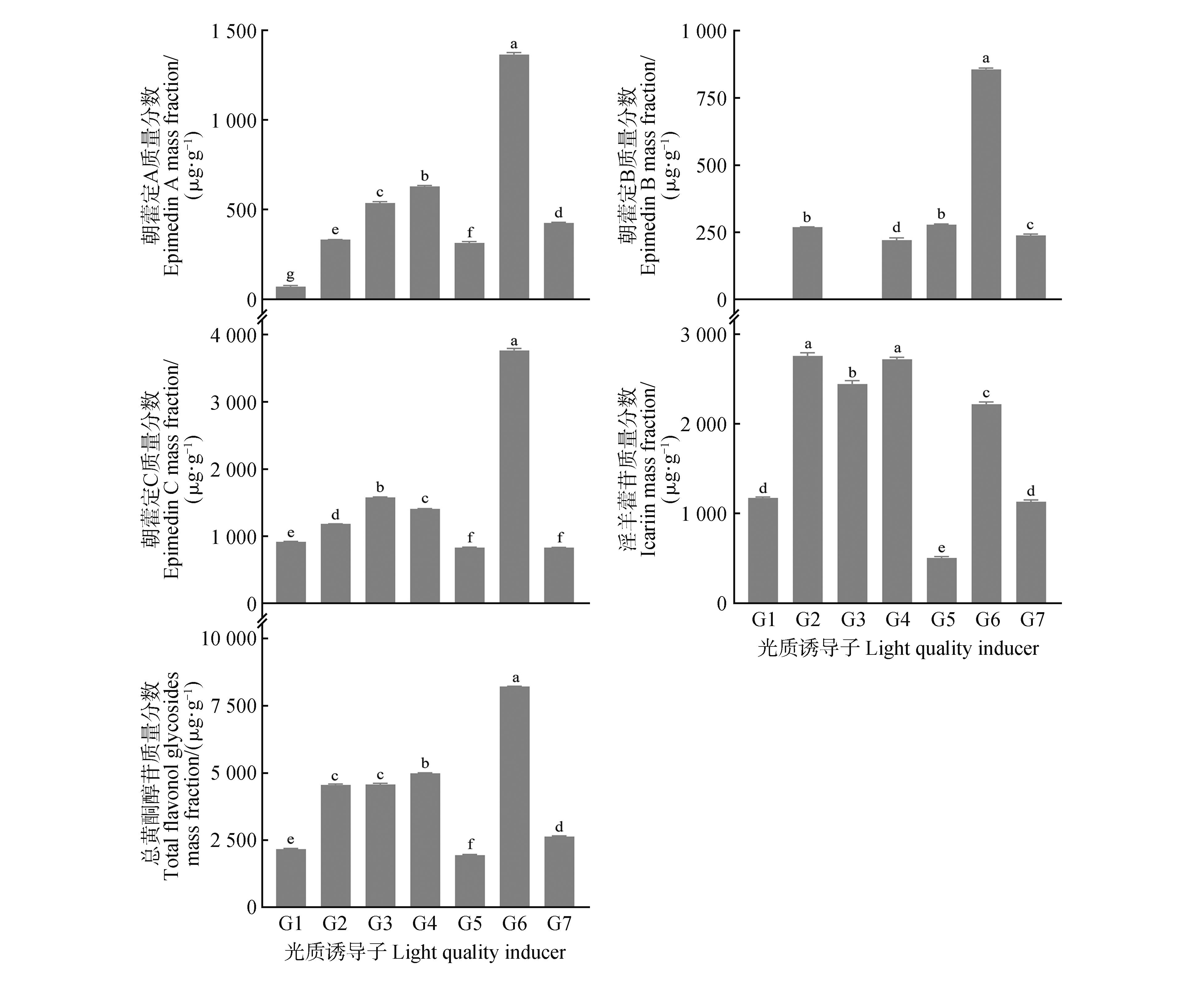
Fig.5
Effects of light-quality inducer on mass fraction of total flavonoids, total phenolic acid, total alkaloids, and total saponins in suspension-cultured cells of Epimedium sagittatumG1. Dark; G2. White light,12 h; G3. Yellow light,12 h; G4. Blue light,12 h; G5. Blue light,8 h; G6. Blue light,16 h; G7. Blue light,24 h. Different lowercase letters indicated significant differences among different treatments(P<0.05).
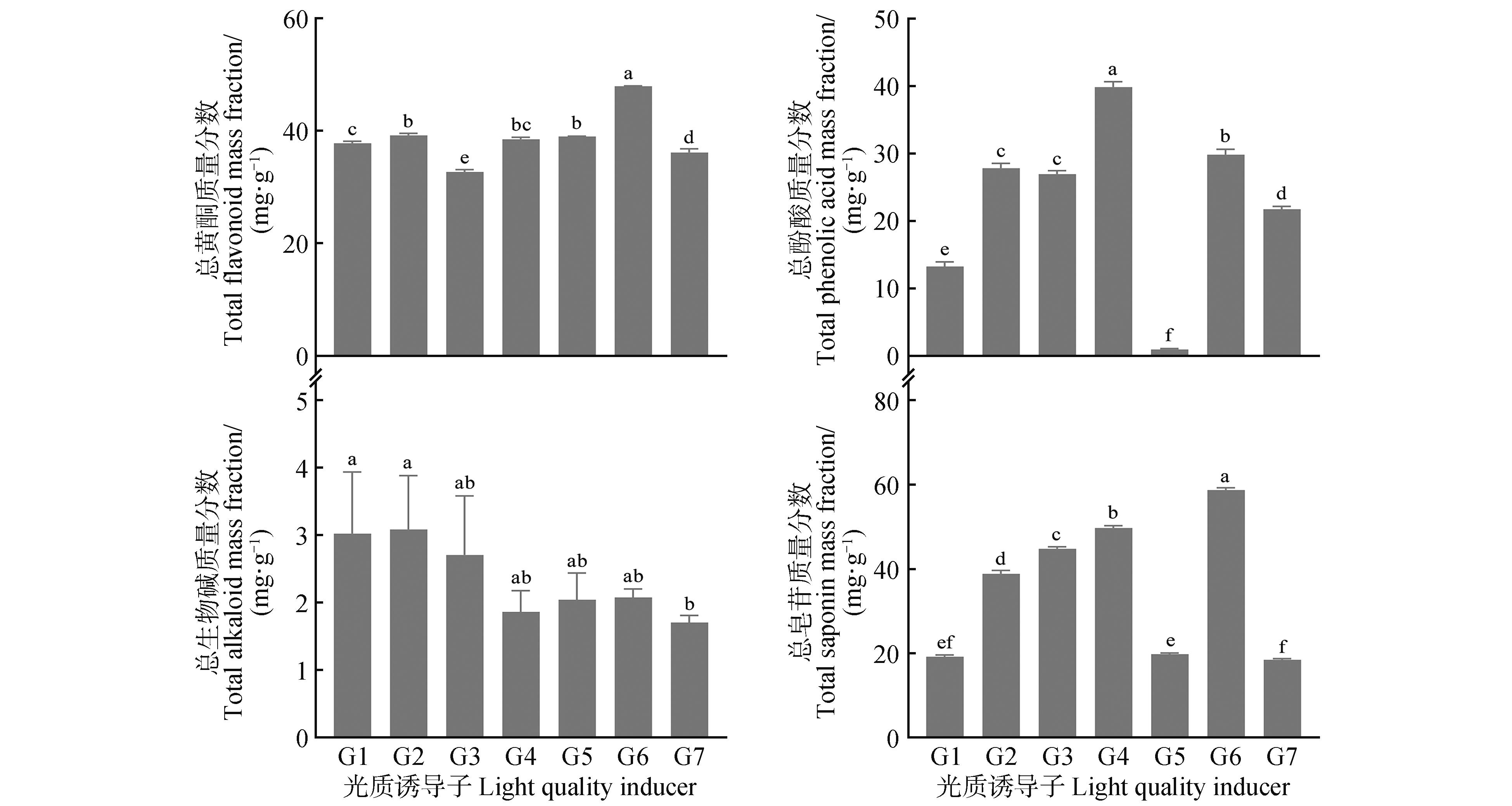
Fig.6
Correlation analysis of metabolic products in Epimedium sagittatum suspension-cultured cells regulated by light-quality inducer***. Significant at the 0.001 level; **. Significant at the 0.01 level; *. Significant at the 0.05 level.
| [1] | 国家药典委员会.中华人民共和国药典:2020年版:一部[M].北京:中国医药科技出版社,2020:340. |
| Chinese Pharmacopoeia Commission.Pharmacopoeia of the People’s Republic of China:2020 Edition:Volume 1[M].Beijing:China Medical Science and Technology Press,2020:340. | |
| [2] | 裴莉昕,陈琳,李诺,等.箭叶淫羊藿化学成分与药理作用研究进展[J].中国实验方剂学杂志,2025,31(21):282-290. |
| PEI L X, CHEN L, LI N,et al.Chemical constituents and pharmacological effect of Epimedium sagittatum:a review[J].Chinese Journal of Experimental Traditional Medical Formulae,2025,31(21):282-290. | |
| [3] | 刘奕杉,唐林涛,刘澳,等.月季细胞悬浮培养研究进展与前瞻[J].北方园艺,2023,542(23):121-128. |
| LIU Y S, TANG L T, LIU A,et al.Progress and prospect of Chinese rose cells suspension culture research[J].Northern Horticulture,2023,542(23):121-128. | |
| [4] | 何海燕,付跃,覃拥灵,等.三叶青细胞悬浮培养体系的条件优化和总黄酮含量的测定研究[J].饲料研究,2023,46(7):77-80. |
| HE H Y, FU Y, QIN Y L,et al.Study on condition optimization of Cymbidium trifolium cell suspension culture system and determination of total flavonoids content[J].Feed Research,2023,46(7):77-80. | |
| [5] | 陶兴魁,张兴桃,冯凡,等.宿半夏悬浮细胞培养及体细胞胚发生的研究[J].宿州学院学报,2022,37(6):31-35. |
| TAO X K, ZHANG X T, FENG F,et al.Research on suspension cell culture and somatic embryogenesis of Pinellia Ternate [J].Journal of Suzhou University,2022,37(6):31-35. | |
| [6] | 何江峰,王力伟,刘红葵,等.荒漠肉苁蓉组织培养和细胞悬浮培养体系的建立[J].畜牧与饲料科学,2020,41(4):69-76. |
| HE J F, WANG L W, LIU H K,et al.Establishment of tissue culture and cell suspension culture system of Cistanche deserticola Y.C.Ma[J].Animal Husbandry and Feed Science,2020,41(4):69-76. | |
| [7] | 河南中医药大学.一种箭叶淫羊藿细胞悬浮体系及其构建方法和应用:CN202510378991.5[P].2025-06-20. |
| Henan University of Chinese Medicine.A cell suspension system of Epimedium sagittatum and its construction method and application:CN202510378991.5[P].2025-06-20. | |
| [8] | 陈艳阳.诱导子对人参和西洋参愈伤组织生长及人参皂苷生物合成的影响[D].长春:吉林农业大学,2022. |
| CHEN Y Y.Effects of elicitors on callus growth and ginsenoside biosynthesis of Panax Ginseng C.A.Mey.and Panax quinquefolium L.[D].Changchun:Jilin Agricultural University,2022. | |
| [9] | 刘益宏,聂江力,裴毅.诱导子对药用植物次生代谢产物积累的作用综述[J].天津农林科技,2024(5):39-42. |
| LIU Y H, NIE J L, PEI Y.A review of the role of elicitors in the accumulation of secondary metabolites in medicinal plants[J].Science and Technology of Tianjin Agriculture and Forestry,2024(5):39-42. | |
| [10] | 王晓丽,杨莉莉,何泽东,等.不同诱导子对雷公藤发状根生长及主要次生代谢产物的影响[J].西北农林科技大学学报(自然科学版),2025,53(2):109-117. |
| WANG X L, YANG L L, HE Z D,et al.Effects of different inducers on the growth and main secondary metabolites of Tripterygium wilfordii hairy roots[J].Journal of Northwest A&F University(Natural Science Edition),2025,53(2):109-117. | |
| [11] | 郝甜甜,陈艳阳,苗佳琪,等.茉莉酸甲酯和水杨酸对西洋参愈伤组织生长和皂苷形成的影响[J].天然产物研究与开发,2022,34(12):2063-2068. |
| HAO T T, CHEN Y Y, MIAO J Q,et al.Effects of methyl jasmonate and salicylic acid on callus growth and saponins production of American ginseng[J].Natural Product Research and Development,2022,34(12):2063-2068. | |
| [12] | 雷瑞祥,杨冰月,胡本祥,等.水杨酸对秦艽愈伤组织总酚·总黄酮含量及抗氧化酶活性的影响[J].安徽农业科学,2021,49(2):165-169. |
| LEI R X, YANG B Y, HU B X,et al.Effects of salicylic acid on total phenol,total flavonoids content and antioxidant enzyme activities in callus of Gentiana macrophylla [J].Journal of Anhui Agricultural Sciences,2021,49(2):165-169. | |
| [13] | 王俊燚.外源诱导子对银杏组织培养中黄酮积累的影响[D].长沙:中南林业科技大学,2019. |
| WANG J Y.Effects of exogenous inducers on flavonoid accumulation in Ginkgo Biloba L.tissue culture[D].Changsha:Central South University of Forestry and Technology,2019. | |
| [14] | YANG L L, ZHOU S W, HOU Y W,et al.Blue light induces biosynthesis of flavonoids in Epimedium sagittatum (Sieb.et Zucc.) Maxim. leaves,a study on a light-demanding medicinal shade herb[J].Industrial Crops and Products,2022,187:115512. |
| [15] | 李秀清.箭叶淫羊藿悬浮培养体系的建立及不同诱导子对其代谢产物的影响[D].郑州:河南中医药大学,2024. |
| LI X Q.Establishment of suspension culture system of Epimedium sagittatum (Sieb.et Zucc.) Maxim. and effect of different inducers on its metabolites[D].Zhengzhou:Henan University of Chinese Medicine,2024. | |
| [16] | 刘泽波.黄栀子细胞培养生产绿原酸类物质及茉莉酸甲酯的诱导作用[D].南昌:江西农业大学,2018. |
| LIU Z B.Production of chlorogenic acid and its derivatives by Gardenia Jasminoides cell culture and elicitation of methyl jasmonate[D].Nanchang:Jiangxi Agricultural University,2018. | |
| [17] | 刘永刚.雪莲细胞培养及其次生代谢产物黄酮的代谢调控[D].北京:中国农业大学,2005. |
| LIU Y G. Saussurea involucrata cell cultures and the secondary metabolic regulation of flavonoids[D].Beijing:China Agricultural University,2005. | |
| [18] | 李星,孟飞,郝佳奇,等.NaCl胁迫下壳聚糖对菜用大豆叶、根蔗糖代谢的调控效应[J].华北农学报,2023,38(4):112-118. |
| LI X, MENG F, HAO J Q,et al.Regulatory effects of chitosan on sucrose metabolism in leaves and roots of vegetable soybean under NaCl stress[J].Acta Agriculturae Boreali-Sinica,2023,38(4):112-118. | |
| [19] | 李杰,赵声兰,陈朝银.Folin-Ciocalteu比色法测定核桃青皮果蔬酵素总多酚含量[J].中国酿造,2015,34(9):130-134. |
| LI J, ZHAO S L, CHEN Z Y.Determination of total polyphenol in walnut green husk fruit and vegetable compound ferment by Folin-Ciocalteu colorimetry[J].China Brewing,2015,34(9):130-134. | |
| [20] | 魏颖.关黄柏叶不同炮制品的抗急性痛风性关节炎作用研究[D].长春:吉林农业大学,2021. |
| WEI Y.Study on anti gouty arthritis effect of different processed products of Phellodendron amurense Rupr.leaves[D].Changchun:Jilin Agricultural University,2021. | |
| [21] | 焦妮.黄柏中总生物碱的制备工艺研究[J].基层医学论坛,2017,21(25):3458-3460. |
| JIAO N.Study on the preparation process of total alkaloids in Huangbai[J].The Medical Forum,2017,21(25):3458-3460. | |
| [22] | 葛思琪,赵庆生,孙广利,等.芦笋总皂苷的提取纯化及抗氧化研究[J].食品研究与开发,2018,39(20):57-62. |
| GE S Q, ZHAO Q S, SUN G L,et al.Study on extraction purification and antioxidant activity of total saponins from Asparagus officinalis L.[J].Food Research and Development,2018,39(20):57-62. | |
| [23] | 吴欣,龚一富,郦露群,等.正交设计的诱导子组合对三角褐指藻岩藻黄素含量和光合生理及基因表达的影响[J].中国药学杂志,2024,59(10):879-886. |
| WU X, GONG Y F, LI L Q,et al.Effects of orthogonal design optimized elicitor combinations on fucoxanthin content and photosynthetic physiology and gene expression of Phaeodactylum tricornutum [J].Chinese Pharmaceutical Journal,2024,59(10):879-886. | |
| [24] | SUDHA G, RAVISHANKAR G A.Elicitation of anthocyanin production in callus cultures of Daucus carota and the involvement of methyl jasmonate and salicylic acid[J].Acta Physiologiae Plantarum,2003,25(3):249-256. |
| [25] | 李俊伶,吴家慧,李堰,等.复合诱导子不同处理时间对丹参毛状根生长和初次生代谢产物积累的影响[J].中南药学,2023,21(6):1422-1428. |
| LI J L, WU J H, LI Y,et al.Effect of different treatment time of combined elicitors on the growth of Salvia miltiorrhiza hairy roots and accumulation of the primary and secondary metabolites[J].Central South Pharmacy,2023,21(6):1422-1428. | |
| [26] | CHAYJARUNG P, PHONHERM M, INMANO O,et al.Influence of peanut hairy root cultivars on prenylated stilbenoid production and the response mechanism for combining the elicitors of chitosan,methyl jasmonate,and cyclodextrin[J].Planta,2022,256(2):32. |
| [27] | KAMI C, LORRAIN S, HORNITSCHEK P,et al.Light-regulated plant growth and development[J].Current Topics in Developmental Biology,2010,91:29-66. |
| [28] | LANDI M, ZIVCAK M, SYTAR O,et al.Plasticity of photosynthetic processes and the accumulation of secondary metabolites in plants in response to monochromatic light environments:a review[J].Biochimica et Biophysica Acta(BBA)-Bioenergetics,2020,1861(2):148131. |
| [29] | 李梦雪,曾文敏,魏依婷,等.箭叶淫羊藿黄酮醇苷类成分空间分布格局及环境因子影响分析[J].中国实验方剂学杂志,2025,31(15):217-226. |
| LI M X, ZENG W M, WEI Y T,et al.Spatial distribution patterns and environmental influencing factors of flavonoid glycosides in Epimedium sagittatum [J].Chinese Journal of Experimental Traditional Medical Formulae,2025,31(15):217-226. | |
| [30] | 范诗濛,冯嘉欣,孔维一,等.不同LED光质对紫花苜蓿种子萌发及幼苗酚类化合物合成的影响[J].南京农业大学学报,2024,47(4):625-634. |
| FAN S M, FENG J X, KONG W Y,et al.Effects of different LED light quality on alfalfa seed germination and phenolic compounds synthesis of seedlings[J].Journal of Nanjing Agricultural University,2024,47(4):625-634. | |
| [31] | 王改萍,章雷,赵慧琴,等.光质对银杏苗木生长及黄酮类化合物积累的影响[J].云南农业大学学报(自然科学),2024,39(3):163-171. |
| WANG G P, ZHANG L, ZHAO H Q,et al.Effects of light quality on growth and accumulation of flavonoids compounds of Ginkgo biloba seedlings[J].Journal of Yunnan Agricultural University (Natural Science),2024,39(3):163-171. | |
| [32] | 张玉彬,刘文科,杨其长,等.LED红蓝光对西洋参植株生长、产量和皂苷含量的影响[J].中国农业科技导报,2020,22(4):171-176. |
| ZHANG Y B, LIU W K, YANG Q C,et al.Effects of LED red and blue light on growth,yield and saponin content of American ginseng (Panax quinquefolius)[J].Journal of Agricultural Science and Technology,2020,22(4):171-176. | |
| [33] | 方平,杨鹤,张誉荠,等.人参在不同LED光质下的生理响应和皂苷含量变化的研究[J].植物生理学报,2022,58(8):1543-1554. |
| FANG P, YANG H, ZHANG Y Q,et al.Study on the physiological response and saponin content of ginseng under different LED light quality[J].Plant Physiology Journal,2022,58(8):1543-1554. | |
| [34] | 李坤,毛纯,刘军,等.LED光质对走马胎生长和生理及活性成分含量的影响[J].西北植物学报,2022, 42(5):819-828. |
| LI K, MAO C, LIU J,et al.Effects of LED light quality on growth,physiology and active component contents of Ardisia gigantifolia [J].Acta Botanica Boreali-Occidentalia Sinica,2022,42(5):819-828. |
| [1] | Zhuosui LI, Yilin GAO, Han LIU, Xulan SHANG. Callus Induction and Secondary Metabolites Accumulation of Diploid Cyclocarya paliurus [J]. Bulletin of Botanical Research, 2025, 45(4): 533-545. |
| [2] | Kunlin ZOU, Siyuan JIANG, Yajing WEI, Shun ZHANG, Peng LI, Jing YIN. Evaluation of Antioxidant, Anti-ultraviolet Radiation, and Antibacterial Functions of Endophytic Extracts from Different Plant Sources [J]. Bulletin of Botanical Research, 2025, 45(3): 433-446. |
| [3] | Zhihui HUANG, Yining ZHANG, Nana LI, Baojiang ZHENG, Yuhong ZHANG. Responses of Supplemental UV-B Radiation to Physiological Properties and Secondary Metabolites of Thlaspi arvense [J]. Bulletin of Botanical Research, 2022, 42(6): 1079-1087. |
| [4] | CAO Ming-Wu, LUO Rui, AN Hui, PANG Qiu-Ying. Physiological Response of Suspension Cells of Helianthus tuberosus to NaCl Stress [J]. Bulletin of Botanical Research, 2019, 39(2): 222-228. |
| [5] | FAN Yan-Min, DANG Shi-Kun, WANG Wen-Jie, WANG Hui-Mei. Effect of Carbon Source, Auxin and Elicitor on the Growth and Synthesis of Secondary Metabolites of Adventitious Roots of Cajanus cajan(Linn.) Millsp. [J]. Bulletin of Botanical Research, 2018, 38(3): 391-398. |
| [6] | QU Dan;WANG Hui-Mei*;REN Jie. Effects of Sugar content on Cell Growth,Accumulation of Rosemary Acid, and Antioxidative Enzyme Activity in Suspension Cells of Rosemary [J]. Bulletin of Botanical Research, 2015, 35(4): 623-627. |
| [7] | LI Min;QU Dan;YU Hai-Di;WANG Hui-Mei*. Characteristics and Biochemical Indexes of Cajanus cajan Hairy Root [J]. Bulletin of Botanical Research, 2014, 34(3): 339-342. |
| [8] | SUN Shou-Hui;LI Wei;LÜChang-Li;GAO Guo-Ping;Qi Jin-Yu;XU Zhe. Extraction and Analysis of Secondary Metabolites in Poplar Phloem [J]. Bulletin of Botanical Research, 2009, 29(1): 120-123. |
| [9] | YANG Bei-Fen;JIN Ze-Xin*;SHAO Hong;LI Jun-Min. Analysis of Secondary Metabolites Contents in the Different Organs of Heptacodium miconioides [J]. Bulletin of Botanical Research, 2007, 27(2): 229-232. |
| Viewed | ||||||
|
Full text |
|
|||||
|
Abstract |
|
|||||