Bulletin of Botanical Research ›› 2026, Vol. 46 ›› Issue (1): 38-50.doi: 10.7525/j.issn.1673-5102.2026.01.004
• Review Article • Previous Articles Next Articles
Wenhao BO1,2, Qianqian WU3, Mengzhen LÜ1,2, Haizhen WANG1,2( )
)
Received:2025-09-08
Online:2026-01-20
Published:2026-01-20
Contact:
Haizhen WANG
E-mail:wanghz@zju.edu.cn
CLC Number:
Wenhao BO, Qianqian WU, Mengzhen LÜ, Haizhen WANG. Bibliometric Analysis of Research Progress on Sesbania[J]. Bulletin of Botanical Research, 2026, 46(1): 38-50.
Add to citation manager EndNote|Ris|BibTeX
URL: https://bbr.nefu.edu.cn/EN/10.7525/j.issn.1673-5102.2026.01.004
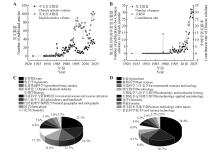
Fig.1
Research publications on Sesbania in Chinese and EnglishA. Number of publications; B. Number of publications by Chinese scholars in English journals and their contribution rate; C and D. The top ten disciplines in CNKI and WOS databases, respectively.
Fig.2
The cooperative relationship network among the main countries(A) and institutions(B) that published English papers
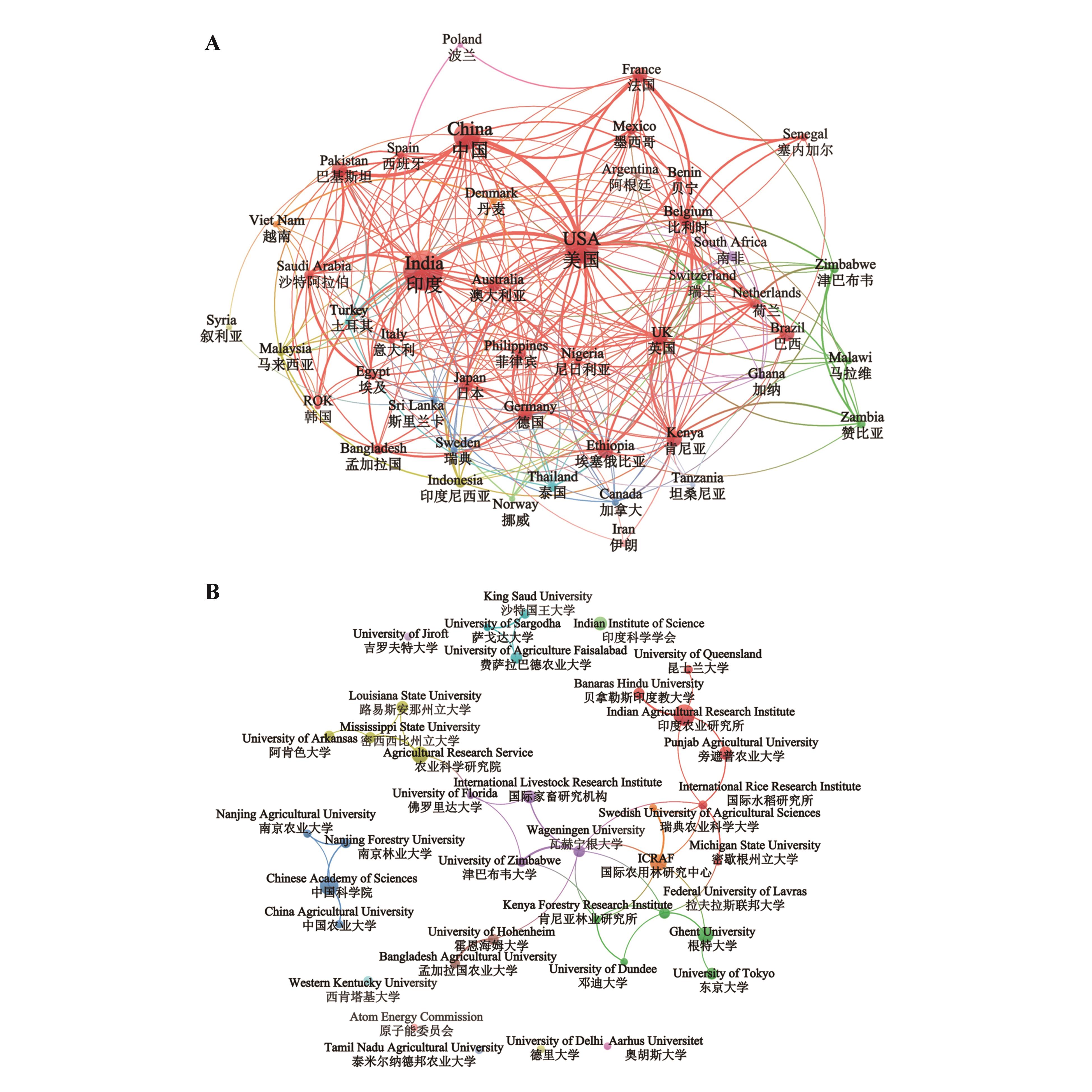
Table 1
Top 5 scholars with the number of published papers on Sesbania research in the CNKI and WOS databases
数据库 Database | 作者 Author | 发文量 Publication volume | 机构 Institution | 研究方向 Research direction | 本地引用(TLCS) | 总引用(TGCS) |
|---|---|---|---|---|---|---|
| CNKI | 崔元臣 Cui Y C | 16 | 河南大学 Henan University | 化学、有机化工、轻工业手工业 Chemistry,organic chemical industry,light industry and handicraft industry | 10 | 192 |
李德亮 Li D L | 10 | 湖南农业大学 Hunan Agricultural University | 环境科学与资源利用、化学、水产和渔业 Environmental science and resource utilization,chemistry,aquaculture and fisheries | 6 | 141 | |
杨中艺 Yang Z Y | 10 | 湖南工学院 Hunan Institute of Technology | 生态学、环境生物学、环境教育、循环低碳发展 Ecology,environmental biology,environmental education,circular low-carbon development | 5 | 120 | |
解志红 Xie Z H | 9 | 山东农业大学 Shandong Agricultural University | 盐生植物根际微生物多样性及功能微生物资源开发、植物-微生物互作及联合修复技术 Diversity of microorganisms in halophytes rhizosphere and development of functional microbial resources,plant-microbe interaction and combined remediation technology | 21 | 112 | |
朱小梅 Zhu X M | 8 | 江苏沿海地区农业科学研究所 Institute of Agricultural Sciences of Jiangsu Coastal Area | 农业资源利用 Agricultural resources utilization | 22 | 98 | |
| WOS | Holsters M | 52 | 根特大学 Ghent University | 植物科学、生物化学与分子生物学、微生物学 Plant science,biochemistry and molecular biology,microbiology | 43 | 1 509 |
| Boyette C D | 35 | 美国农业部 United States Department of Agriculture | 植物科学、农业、生物技术与应用微生物学、化学 Plant science,agriculture,biotechnology and applied microbiology,chemistry | 10 | 290 | |
| Ladha J K | 35 | 加州大学戴维斯分校 University of California,Davis | 农业、植物科学、微生物学、环境科学与生态学 Agriculture,plant science,microbiology,environmental science and ecology | 18 | 1 520 | |
| Savithri H S | 34 | 印度科学研究所 Indian Institute of Science | 生物化学与分子生物学、生物物理学、病毒学 Biochemistry and molecular biology,biophysics,virology | 19 | 607 | |
| Xie Z H | 31 | 中康涅狄格州立大学 Central Connecticut State University | 微生物学、工程学、材料科学、生物技术与应用微生物学 Microbiology,engineering,materials science,biotechnology and applied microbiology | 63 | 663 |
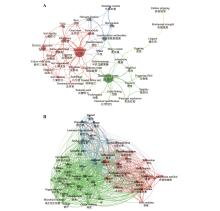
Fig. 3
The co-occurrence network of keywords in Chinese (A) and English (B) papers
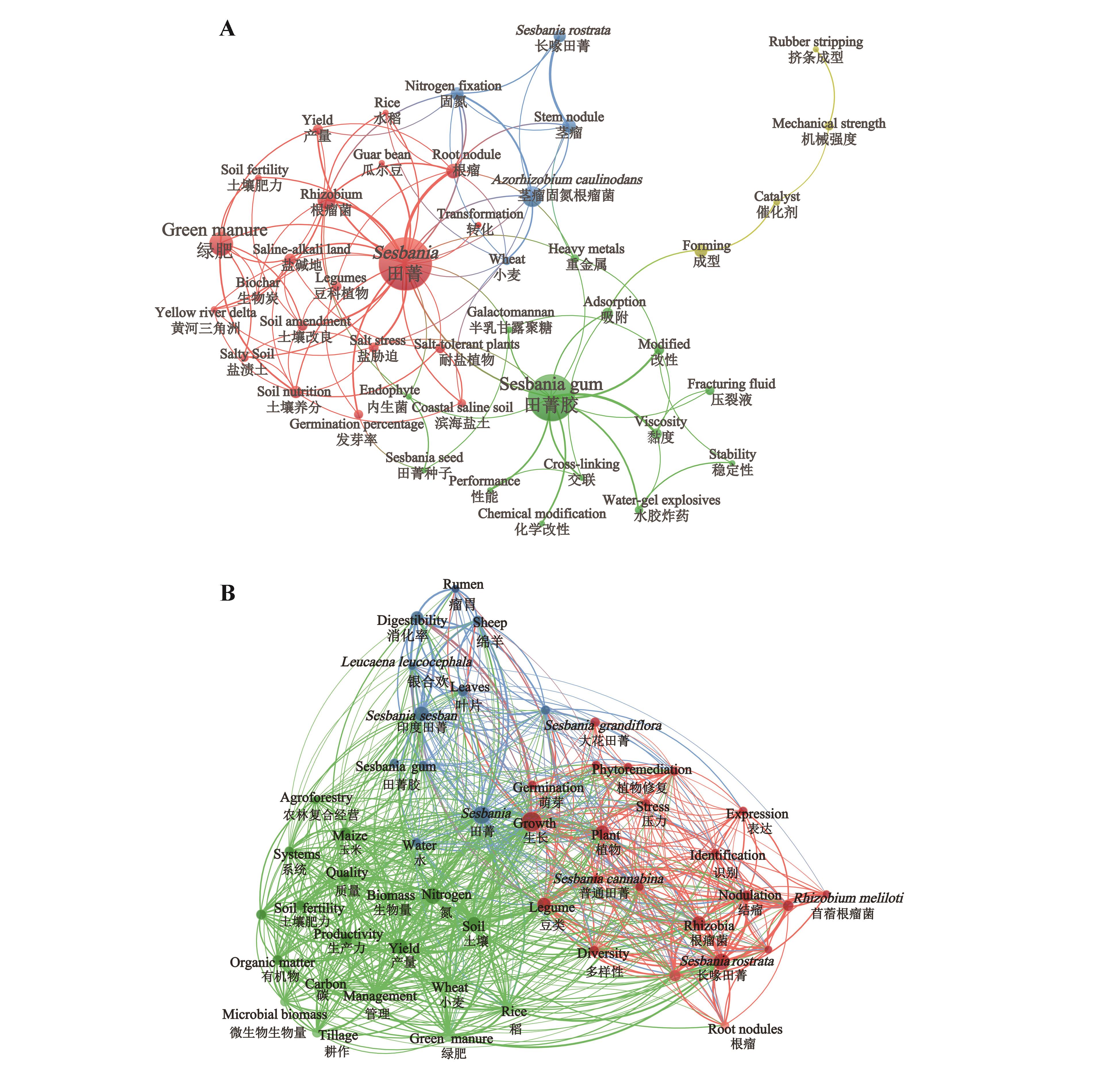
Fig.4
The emergence of keywords in Chinese(A) and English(B) papers
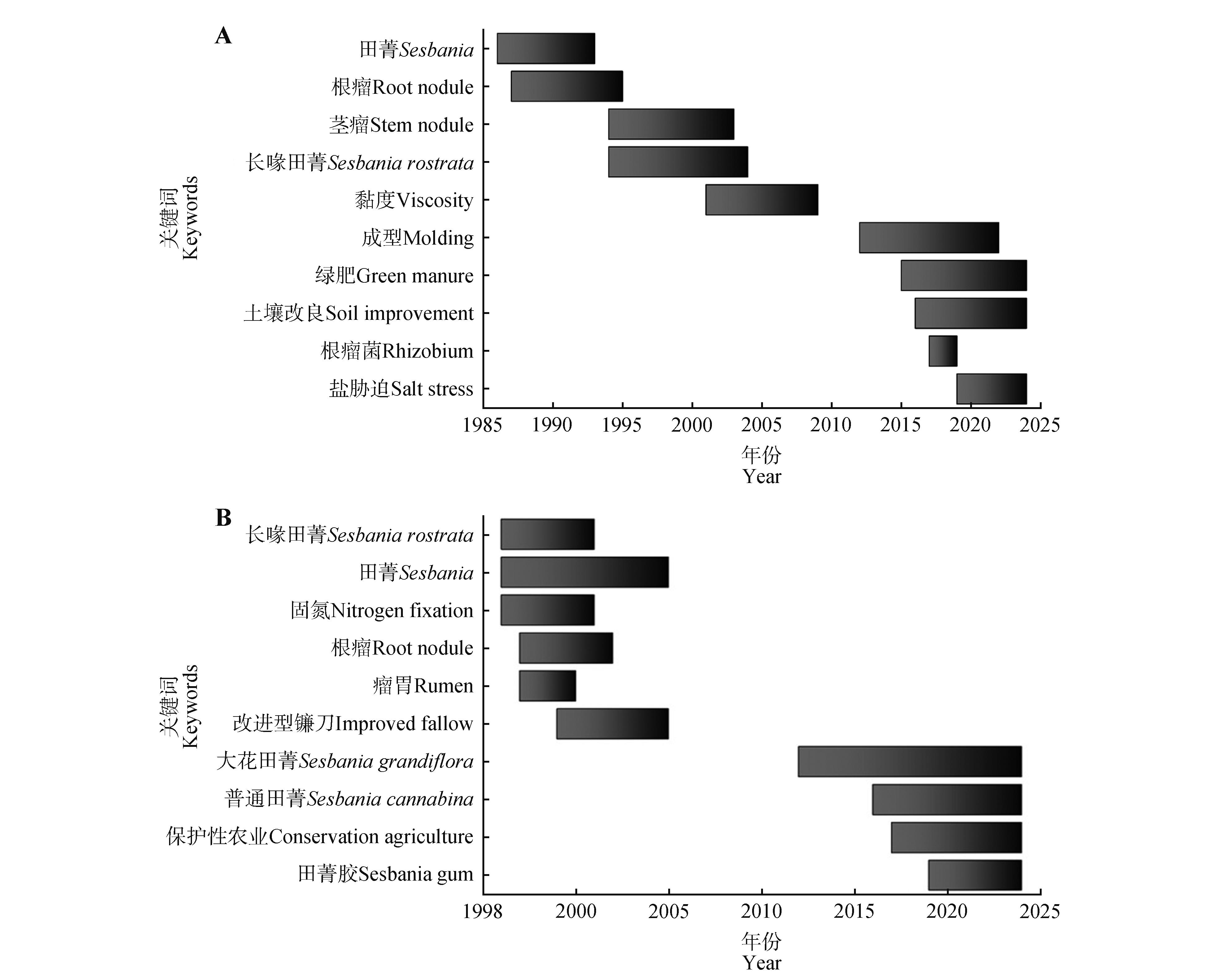
Fig.5
Comparison of nitrogen fixation functional genes of rhizobia of Sesbania
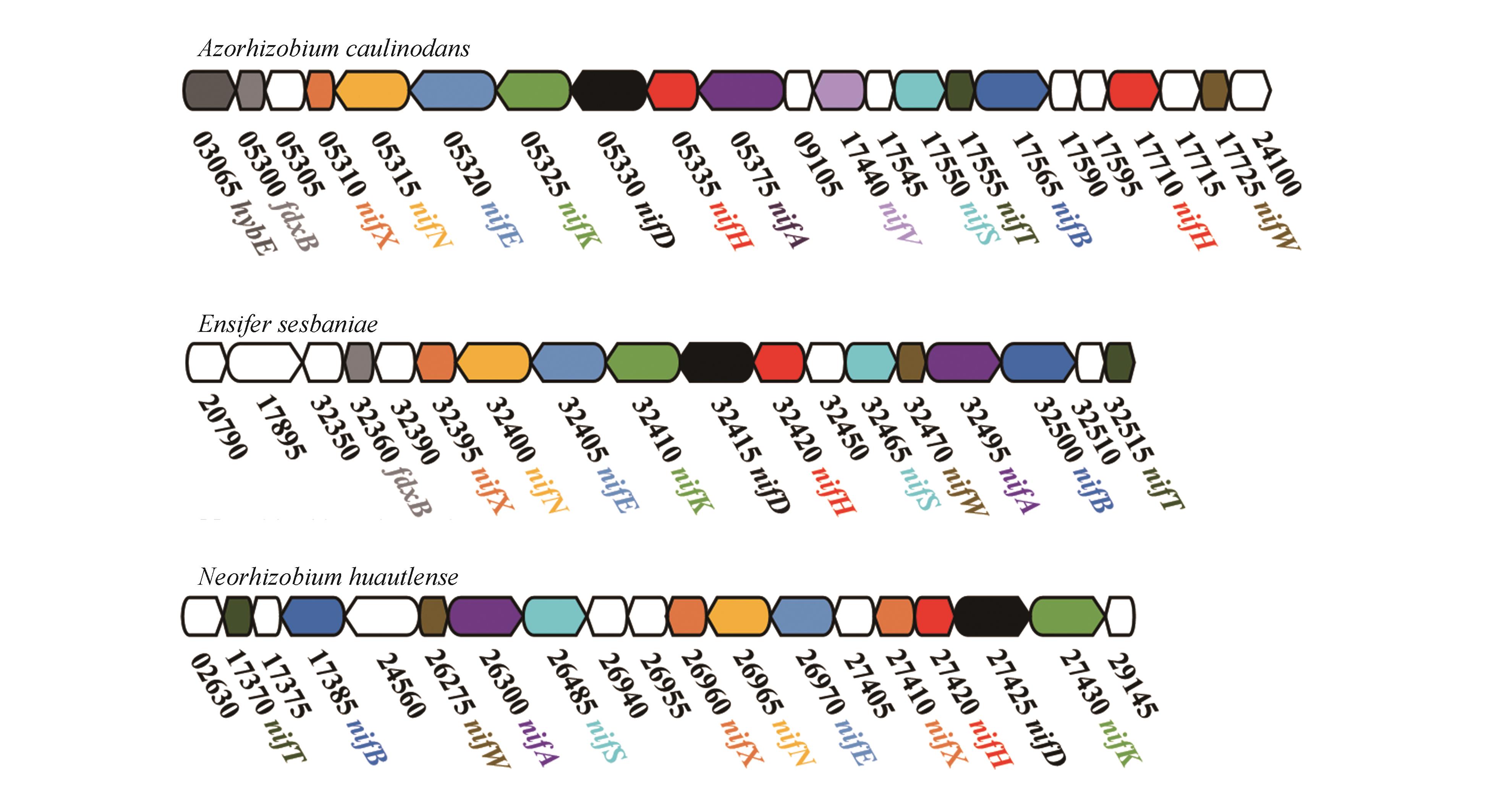
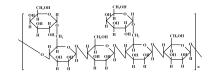
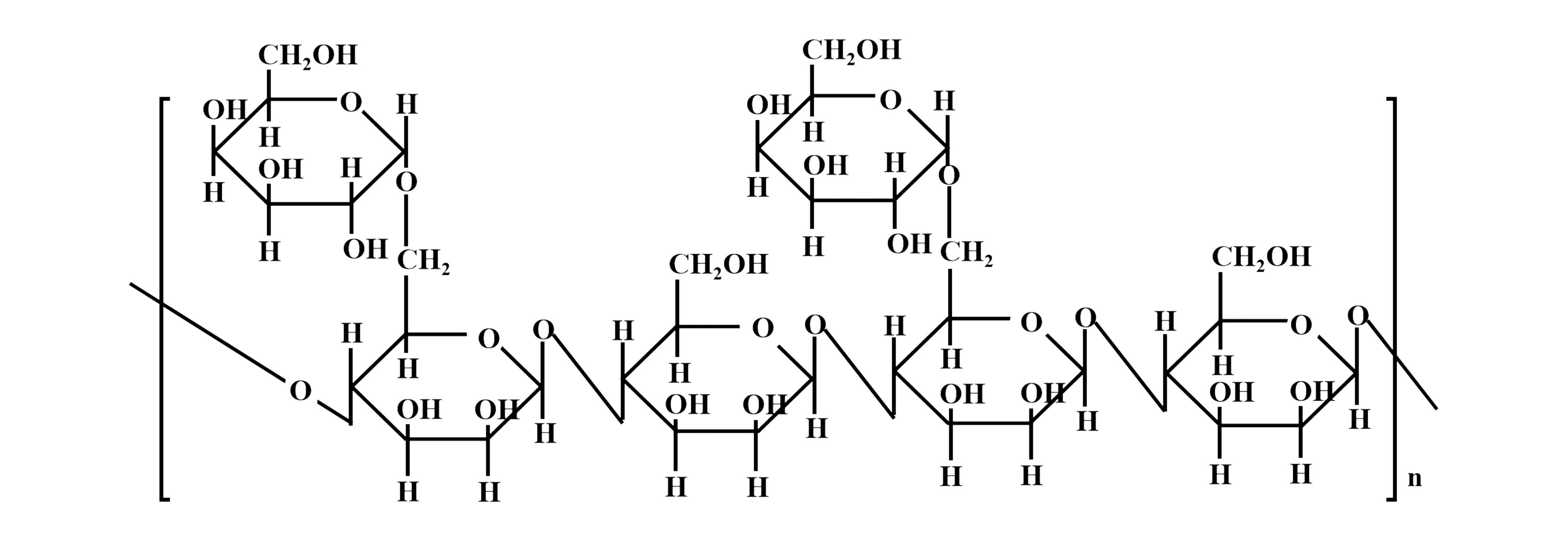
Fig.6
The chemical structure of sesbania gum[59]
| [1] | SINGH S, KUMAR A, SRIVASTAVA M.Chemical profiling and in-vitro α-amylase inhibitory activity of Sesbania sesban and Sesbania grandiflora seeds[J].International Journal of Food Properties,2023,26:428-436. |
| [2] | BUNMA S, BALSLEV H.A review of the economic botany of Sesbania(Leguminosae)[J].The Botanical Review,2019,85:185-251. |
| [3] | 董鑫,刘晓云,张斌,等.云南省田菁根瘤菌及根瘤内生细菌遗传多样性研究[J].热带作物学报,2010,31(1):88-92. |
| DONG X, LIU X Y, ZHANG B,et al.Diversity ofrhizobia andendophytic bacteria isolated from root nodules of Sesbania spp.[J].Chinese Journal of Tropical Crops,2010,31(1):88-92. | |
| [4] | YU C X, WANG G M, LIU X L,et al.Effect of Sesbania and Triticale rotation on plant characteristics and soil quality in coastal saline-alkaline land:a two-year field experiment[J].Bioresources,2023,18(4):7109-7123. |
| [5] | LIU Y N, LIU X L, DONG X Y,et al.The effect of Azorhizobium caulinodans ORS571 and γ-aminobutyric acid on salt tolerance of Sesbania rostrata [J].Frontiers in Plant Science,2022,13:926850. |
| [6] | 赵秋,宁晓光,张新建,等.绿肥对稻田土壤改良试验研究[J].天津农林科技,2022(1):5-7. |
| ZHAO Q, NING X G, ZHANG X J,et al.Study on improvement of paddy soil with green manure crops[J].Science and Technology of Tianjin Agriculture and Forestry,2022(1):5-7. | |
| [7] | CAPOEN W, OLDROYD G, GOORMACHTIG S,et al. Sesbania rostrata:a case study of natural variation in legume nodulation[J].New Phytologist,2010,186(2):340-345. |
| [8] | DONG X Y, LI Z Y, WANG Q,et al.Enhancing the growth performance of Sesbania cannabina using Ensifer alkalisoli and biochar under salt stress[J].Rhizosphere,2024,30:100888. |
| [9] | BHAT R, KARIM A A.Exploring the nutritional potential of wild and underutilized legumes[J].Comprehensive Reviews in Food Science and Food Safety,2009,8(4):305-331. |
| [10] | ANONYMOUS.A flower vegetable of the Singalese:Sesbania (Agati) grandiflora [J].Journal of Heredity,1928,19(3):96. |
| [11] | BONSI M L K, OSUJI P O, NSAHLAI I V,et al.Graded levels of Sesbania sesban and Leucaena leucocephala as supplements to teff straw given to Ethiopian Menz sheep[J].Animal Science,1994,59(2):235-244. |
| [12] | 曹丽雯,卢蕊,范吉标,等.新型饲草开发利用的基础生物学问题[J].植物学报,2022,57(6):826-836. |
| CAO L W, LU R, FAN J B,et al.The fundamental biological problems in the development and utilization of new forage grass[J].Chinese Bulletin of Botany,2022,57(6):826-836. | |
| [13] | RAMASUBBU K, DEVI RAJESWARI V.Green synthesising ZnO nanoparticle using Sesbania grandiflora and their evaluation of anti-diabetic anti-advanced glycation end products and cytotoxic effects[J].Applied Biochemistry and Biotechnology,2024,196(5):2652-2672. |
| [14] | LI R, JIA X, WANG Y Q,et al.The effects of extrusion processing on rheological and physicochemical properties of sesbania gum[J].Food Hydrocolloids,2019,90:35-40. |
| [15] | 罗彤彤.半乳甘露聚糖植物胶在选矿上的应用[J].铜业工程,2011,107(1):12-15. |
| LUO T T.Application of galactomannan plant gum in mineral processing[J].Copper Engineering,2011,107(1):12-15. | |
| [16] | VAN ECK N J, WALTMAN L.Software survey:VOSviewer,a computer program for bibliometric mapping[J].Scientometrics,2010,84(2):523-538. |
| [17] | 严康,楼骏,汪海珍,等.污染场地研究现状与发展趋势:基于知识图谱的分析[J].土壤学报,2021,58(5):1234-1245. |
| YAN K, LOU J, WANG H Z,et al.Research of contaminated sites based on knowledge graph analysis and its development trend[J].Acta Pedologica Sinica,2021,58(5):1234-1245. | |
| [18] | GARFIELD E.From the science of science to Scientometrics visualizing the history of science with HistCite software[J].Journal of Informetrics,2009,3(3):173-179. |
| [19] | COOPER W E.Top necrosis a virus disease of guar[J].Phytopathology,1949,39(5):347-358. |
| [20] | 崔元臣,王新海,李德亮,等.季铵型阳离子田菁胶的制备及絮凝作用[J].应用化学,2004,21(7):717-721. |
| CUI Y C, WANG X H, LI D L,et al.Preparation and flocculating effect of quaternary ammonium cationic sesbania gum[J].Chinese Journal of Applied Chemistry,2004,21(7):717-721. | |
| [21] | 王新海,崔元臣,李德亮,等.两性田菁胶在处理生活污水中的助凝作用[J].化学研究,2003,14(1):32-34. |
| WANG X H, CUI Y C, LI D L,et al.Flocculation aid of amphoteric sesbania gum to the treatment of domestic wastewater[J].Chemical Research,2003,14(1):32-34. | |
| [22] | LIU X L, XIE Z H, WANG Y X,et al.A dual role of amino acids from Sesbania rostrata seed exudates in the chemotaxis response of Azorhizobium caulinodans ORS571[J].Molecular Plant-Microbe Interactions,2019,32(9):1134-1147. |
| [23] | SCHROEYERS K, CHAPARRO C, GOORMACHTIG S,et al.Nodulation-enhanced sequences from the water stress-tolerant tropical legume Sesbania rostrata [J].Plant Science,2004,167(2):207-216. |
| [24] | 简曙光,杨中艺.茎瘤对长喙田菁在铅锌尾矿环境适应中的意义Ⅱ.茎瘤对长喙田菁固氮和积累重金属的影响[J].植物生态学报,2002,26(2):209-215. |
| JIAN S G, YANG Z Y.The role of stem nodule in the adaptation of Sesbania rostrata to Pb/Zn tailings environment Ⅱ.The effect of stem nodule on nitrogen and heavy metals accumulation of Sesbania rostrata [J].Chinese Journal of Plant Ecology,2002,26(2):209-215. | |
| [25] | 庞诗琪,李玮,王丹丹,等.田菁内生菌定殖及其与多糖混合浸种的耐盐促生效果[J].微生物学通报,2023,50(8):3429-3439. |
| PANG S Q, LI W, WANG D D,et al.Colonization of Sesbania seed endophytic bacterium and salt-tolerant and growth-promoting effect of mixed seed soaking with endophytic bacterium and polysaccharide[J].Microbiology China,2023,50(8):3429-3439. | |
| [26] | LADHA J K, MIYAN S, GARCIA M. Sesbania rostrata as a green manure for lowland rice:growth,N2 fixation,Azorhizobium sp.inoculation,and effects on succeeding crop yields and nitrogen balance[J].Biology and Fertility of Soils,1989,7(3):191-197. |
| [27] | 朱小梅,王甫同,邢锦城,等.田菁翻压还田对滩涂土壤碳氮及微生物生物量的影响[J].土壤,2021,53(3):529-536. |
| ZHU X M, WANG F T, XING J C,et al.Effects of overturning Sesbania cannabina on soil carbon,nitrogen and microbiological biomass in coastal area[J].Soils,2021,53(3):529-536. | |
| [28] | 袁剑刚,徐昊娟,杨中艺.茎瘤作用对长喙田菁-Azorhizobium caulinodans共生体系固氮效率的影响[J].中山大学学报(自然科学版),2001,40(2):89-92. |
| YUAN J G, XU H J, YANG Z Y.Effects of stem nodulation on N-fixation of Sesbania rostrata-Azorhizobium caulinodans symbiosis[J].Acta Scientiarum Naturalium Universitatis Sunyatseni,2001,40(2):89-92. | |
| [29] | RINAUDO G, DREYFUS B, DOMMERGUES Y. Sesbania rostrata green manure and the nitrogen content of rice crop and soil[J].Soil Biology and Biochemistry,1983,15(1):111-113. |
| [30] | 陈妍,王富强,龙永,等.一株田菁根瘤菌新种的分离与鉴定[J].微生物学报,2025,65(8):3301-3316. |
| CHEN Y, WANG F Q, LONG Y,et al.Isolation and identification of a new species of Rhizobium from Sesbania cannabina [J].Acta Microbiologica Sinica,2025,65(8):3301-3316. | |
| [31] | ZHANG Z P, LIU W, SHAO S,et al.Diverse genomic backgrounds vs. highly conserved symbiotic genes in Sesbania-nodulating bacteria:shaping of the rhizobial community by host and soil properties[J].Microbial Ecology,2020,80(1):158-168. |
| [32] | 陆保福,康文娟,师尚礼,等.豆科植物-根瘤菌固氮系统及其碳氮互作[J].中国草地学报,2023,45(11):119-135. |
| LU B F, KANG W J, SHI S L,et al.Nitrogen fixation system of legume-rhizobia and its carbon-nitrogen interaction[J].Chinese Journal of Grassland,2023,45(11):119-135. | |
| [33] | HAN K M, LI Y, ZHANG Z P,et al.Comparative genome analysis of Sesbania cannabina-nodulating Rhizobium spp. revealing the symbiotic and transferrable characteristics of symbiosis plasmids[J].Microbial Genomics,2023,9(5):001004. |
| [34] | ZHAO Y, NICKELS L M, WANG H,et al.OxyR-regulated catalase activity is critical for oxidative stress resistance,nodulation and nitrogen fixation in Azorhizobium caulinodans [J].FEMS Microbiology Letters,2016,363(13):fnw130. |
| [35] | 陈雪莲,江高飞,钟增涛.基因水平转移在根瘤菌进化中的研究进展[J].生物技术通报,2019,35(10):18-24. |
| CHEN X L, JIANG G F, ZHONG Z T.Research progress of horizontal gene transfer in rhizobia evolution[J].Biotechnology Bulletin,2019,35(10):18-24. | |
| [36] | 王立志,孟英,潘多锋,等.黑龙江省中度盐碱地田菁栽培技术[J].农业与技术,2025,45(5):71-73. |
| WANG L Z, MENG Y, PAN D F,et al.Cultivation techniques for Sesbania in moderately saline-alkali soil in Heilongjiang Province[J].Agriculture and Technology,2025,45(5):71-73. | |
| [37] | WANG T W, ZHANG J Q, SHI W X,et al.Dynamic changes in fermentation quality and structure and function of the microbiome during mixed silage of Sesbania cannabina and sweet sorghum grown on saline-alkaline land[J].Microbiology Spectrum,2022,10(5):e0248322. |
| [38] | 李燕青,孙文彦,许建新,等.华北盐碱地耐盐经济作物筛选[J].华北农学报,2013,28(S1):227-232. |
| LI Y Q, SUN W Y, XU J X,et al.The evaluation of salt tolerant cash crops in northern China[J].Acta Agriculturae Boreali-Sinica,2013,28(S1):227-232. | |
| [39] | LUO H F, WANG X F, YOU C Q,et al.Telomere-to-telomere genome of the allotetraploid legume Sesbania cannabina reveals transposon-driven subgenome divergence and mechanisms of alkaline stress tolerance[J].Science China Life Sciences,2024,67(1):149-160. |
| [40] | ZHENG Y F, LIANG J, ZHAO D L,et al.The root nodule microbiome of cultivated and wild halophytic legumes showed similar diversity but distinct community structure in Yellow River Delta saline soils[J].Microorganisms,2020,8(2):207. |
| [41] | 刘亚楠.滨海耐盐植物田菁根瘤菌乙酰化调控及共生耐盐机制[D].烟台:中国科学院大学(中国科学院烟台海岸带研究所),2023. |
| LIU Y N.Mechanism of acetylation regulation and symbiotic salt tolerance in Rhizobium of coastal salt-tolerant plant Sesbania rostrata [D].Yantai:University of Chinese Academy of Sciences (Yantai Institute of Coastal Zone Research,Chinese Academy of Sciences),2023. | |
| [42] | 张立宾,郭新霞,常尚连.田菁的耐盐能力及其对滨海盐渍土的改良效果[J].江苏农业科学,2012,40(2):310-312. |
| ZHANG L B, GUO X X, CHANG S L.The salt tolerance of Sesbania and its improvement effect on coastal saline soil[J].Jiangsu Agricultural Sciences,2012,40(2):310-312. | |
| [43] | AN X C, SUN M L, REN K Y,et al.Effect and mechanism of the improvement of coastal silt soil by application of organic fertilizer and gravel combined with Sesbania cannabina cultivation[J].Frontiers in Plant Science,2022,13:1092089. |
| [44] | CUI Q, XIA J B, YANG H J,et al.Biochar and effective microorganisms promote Sesbania cannabina growth and soil quality in the coastal saline-alkali soil of the Yellow River Delta,China[J].Science of The Total Environment,2021,756:143801. |
| [45] | KAMAL A, NAZISH M, AKBAR M,et al.Enhancing Sesbania sesban L.(Merr.) growth and metal resilience by synergistic application of Trichoderma harzianum loaded biochar and biochar-zinc oxide nanocomposite[J].BMC Plant Biology,2025,25(1):771. |
| [46] | 李福岭.田菁的饲料利用价值及饲喂试验[J].饲料研究,1993(5):30-31. |
| LI F L.Feed utilization value and feeding trial of Sesbania [J].Feed Research,1993(5):30-31. | |
| [47] | 王路遥,江应松,曹晓风,等.田菁不同部位营养价值、分子结构特性和体外瘤胃降解率研究[J].动物营养学报,2024,36(5):3386-3400. |
| WANG L Y, JIANG Y S, CAO X F,et al.Study on nutritional value,molecular structure characteristics and in vitro rumen degradation rate in different parts of Sesbania cannabina [J].Chinese Journal of Animal Nutrition,2024,36(5):3386-3400. | |
| [48] | TAHIR M, WANG T W, ZHANG J Q,et al.Compound lactic acid bacteria enhance the aerobic stability of Sesbania cannabina and corn mixed silage[J].BMC Microbiology,2025,25:68. |
| [49] | ABDULLAH A Y, QUDSIEH R I, NUSAIRAT B M.Effect of crossbreeding with exotic breeds on meat quality of Awassi lambs[J].Livestock Science,2011,142(1/3):121-127. |
| [50] | FARGHALY M M, YOUSSEF I M I, RADWAN M A,et al.Effect of feeding Sesbania sesban and reed grass on growth performance,blood parameters,and meat quality of growing lambs[J].Tropical Animal Health and Production,2022,54:3. |
| [51] | 景海春,张景昱,金京波,等.饲草作物基础生物学与生物育种[J].中国科学基金,2023,37(4):537-551. |
| JING H C, ZHANG J Y, JIN J B,et al.Fundamental biology and molecular breeding of forage crops[J].Bulletin of National Natural Science Foundation of China,2023,37(4):537-551. | |
| [52] | KUMARI S, SINGH M K, DENDUKURI U L.Studies on Sesbania,rice residue mulching and post emergence herbicides on weed growth and yield in unpuddled transplanted hybrid rice[J].Weed Biology and Management,2023,23(3/4):122-130. |
| [53] | SURIPTO S, SUKIMAN S, GUNAWAN E R.Insecticidal selectivity of jayanti plant (Sesbania sesban) for integrated control of diamondback moth (Plutella xylostella)[J].Asian Journal of Agriculture,2017,1(2):80-84. |
| [54] | 秦俊豪,温莹,李君菲,等.绿肥植物田菁的化感效应及对土壤肥力的影响[J].土壤,2015,47(3):524-529. |
| QIN J H, WEN Y, LI J F,et al.Allelopathic effect of green manure Sesbania and its impact on soil fertility[J].Soils,2015,47(3):524-529. | |
| [55] | 岳芸莹,丁婷婷,段廷玉.绿肥对主作物农艺性状、病虫草害及土壤的影响[J].草业科学,2023,40(8):2058-2071. |
| YUE Y Y, DING T T, DUAN T Y.Research progress on the effects of green manure on the growth,disease,pests,weeds,and soil of main crops[J].Pratacultural Science,2023,40(8):2058-2071. | |
| [56] | 律泽,苏澳,胡芳雨,等.田菁对农田氯嘧磺隆去除及土壤微生物群落的影响[J].生态学杂志,2024,43(9):2750-2757. |
| LÜ Z, SU A, HU F Y,et al.Effects of Sesbania on chlorimuron-ethyl removal and soil microbial community in farmland[J].Chinese Journal of Ecology,2024,43(9):2750-2757. | |
| [57] | 李睿,贾鑫,王晨,等.田菁胶的改性和应用的研究进展[J].中国食物与营养,2019,25(7):52-55. |
| LI R, JIA X, WANG C,et al.Research advancement on modifications and applications of sesbania gum[J].Food and Nutrition in China,2019,25(7):52-55. | |
| [58] | 卢慧,宋艾颖,凌峰,等.基于反向传播神经网络分析的田菁胶添加对萨拉米发酵香肠品质的影响[J].食品科学,2025,46(13):54-62. |
| LU H, SONG A Y, LING F,et al.Impact of sesbania gum addition on the quality of salami based on backpropagation-artificial neural network analysis[J].Food Science,2025,46(13):54-62. | |
| [59] | 崔元臣,周大鹏,李德亮.田菁胶的化学改性及应用研究进展[J].河南大学学报(自然科学版),2004,34(4):30-33. |
| CUI Y C, ZHOU D P, LI D L.Progress of study on chemical modification and application of sesbania gum[J].Journal of Henan University (Natural Science),2004,34(4):30-33. | |
| [60] | ZHOU M Y, TAO Y H, WANG T,et al.Assessing the in vitro digestion of sesbania gum,a galactomannan from S.cannabina,and subsequent impact on the fecal microbiota[J].Journal of Functional Foods,2021,87:104766. |
| [1] | SUN Guo-Rong, PENG Yong-Zhen, YUE Zhong-Hui, YAN Xiu-Feng. Effect of different ameliorative ways on the nutrition status of nitrogen of basification soil [J]. Bulletin of Botanical Research, 2004, 24(3): 369-373. |
| Viewed | ||||||
|
Full text |
|
|||||
|
Abstract |
|
|||||