Bulletin of Botanical Research ›› 2026, Vol. 46 ›› Issue (3): 542-556.doi: 10.7525/j.issn.1673-5102.2026.03.014
• Original Paper • Previous Articles Next Articles
Doudou MA1,2, Bosong LIN3, Xinjie ZHANG1, Yanhong WANG3, Guozhong JIA3, Yuanyuan XUE3, Fangming LIU3, Jianghui CUI1,2( )
)
Received:2026-01-21
Online:2026-05-20
Published:2026-06-01
Contact:
Jianghui CUI
E-mail:cjianghui521@126.com
CLC Number:
Doudou MA, Bosong LIN, Xinjie ZHANG, Yanhong WANG, Guozhong JIA, Yuanyuan XUE, Fangming LIU, Jianghui CUI. Genetic Analysis and Efficient Screening of Processing Potato F₁ Population[J]. Bulletin of Botanical Research, 2026, 46(3): 542-556.
Add to citation manager EndNote|Ris|BibTeX
URL: https://bbr.nefu.edu.cn/EN/10.7525/j.issn.1673-5102.2026.03.014
Table 1
Descriptive statistics and genetic parameters of quantitative traits in the F1 population
性状 Trait | ‘大西洋’均值 ‘Atlantic’ mean | ‘露辛达’均值 ‘Lucinda’ mean | 中亲值 Mid-parent value | F1均值 F1 mean | 分离范围 Range | 变异系数 CV/% | 遗传传递力 Ta/% | 中亲优势率 H/% | 超高亲率 HH/% | 超低亲率 L/% |
|---|---|---|---|---|---|---|---|---|---|---|
| 亮度L* | 71.46 | 59.12 | 65.29 | 67.98 | 34.94~92.34 | 12.74 | 104.12 | 4.12 | 36.15 | 7.69 |
| 红绿值a* | -5.76 | 10.56 | 2.40 | 0.29 | -14.92~36.71 | 391.67 | 12.08 | -87.92 | 1.54 | 69.23 |
| 黄蓝值b* | 20.27 | 37.56 | 28.91 | 48.53 | 0.73~77.40 | 24.89 | 167.84 | 67.84 | 78.46 | 0 |
| 褐变指数BI | 24.77 | 106.67 | 65.72 | 118.88 | 1.54~294.81 | 45.02 | 180.87 | 80.87 | 54.68 | 0.75 |
| 理论产量TY/(kg·hm-2) | 41 049.00 | 18 711.00 | 29 880.00 | 37 691.00 | 1 079.00~93 283.00 | 51.09 | 126.15 | 26.15 | 39.33 | 17.60 |
| 商品薯率MTR/% | 42.95 | 33.03 | 37.99 | 63.90 | 0.00~100.00 | 34.75 | 168.18 | 68.18 | 85.77 | 7.12 |
| 平均单薯质量ATW/g | 86.12 | 73.82 | 79.97 | 135.85 | 2.65~481.25 | 40.19 | 169.86 | 69.86 | 86.89 | 8.24 |
| 单株结薯数量TNPP | 12.23 | 6.67 | 9.45 | 7.90 | 1.72~18.65 | 43.28 | 83.65 | -16.35 | 11.61 | 42.32 |
| 总薯数量TTN | 36.50 | 20.75 | 28.62 | 20.07 | 1.75~45.25 | 42.92 | 70.11 | -29.89 | 4.12 | 53.93 |
| 大薯数量LTN | 16.25 | 6.00 | 11.12 | 11.98 | 0.00~26.50 | 47.84 | 107.70 | 7.70 | 22.47 | 16.10 |
| 大薯总质量LTW/kg | 1.35 | 0.82 | 1.09 | 2.32 | 0.00~6.24 | 55.34 | 213.13 | 113.13 | 74.53 | 10.49 |
| 小薯数量STN | 18.75 | 12.25 | 15.50 | 7.64 | 0.00~22.75 | 75.28 | 49.29 | -50.71 | 4.49 | 77.53 |
| 总质量TTW | 3.17 | 1.35 | 2.25 | 2.61 | 0.04~7.04 | 51.37 | 115.90 | 15.90 | 32.96 | 17.98 |
| 淀粉含量SC/% | 17.98 | 14.68 | 16.33 | 18.11 | 12.17~22.43 | 14.68 | 110.89 | 10.89 | 49.81 | 12.36 |
| 干物质含量DMC/% | 23.38 | 20.48 | 21.93 | 24.84 | 16.91~31.44 | 15.36 | 113.26 | 13.26 | 63.30 | 13.48 |
| 还原糖含量TRSC/% | 0.15 | 0.30 | 0.23 | 0.16 | 0.01~0.41 | 64.54 | 69.98 | -30.02 | 11.61 | 57.30 |
| 硬度TH/N | 10.67 | 10.97 | 10.82 | 12.59 | 2.81~29.34 | 45.93 | 116.33 | 16.33 | 52.81 | 46.07 |
| 脆度TB/N | 8.86 | 9.79 | 9.32 | 11.44 | 2.33~26.51 | 45.42 | 122.67 | 22.67 | 52.43 | 36.33 |
| 黏着性TA/N | -0.12 | -0.15 | -0.13 | -0.27 | -0.74~0.00 | 56.65 | 207.91 | 107.91 | 14.98 | 74.91 |
| 弹性TSP | 0.28 | 0.32 | 0.30 | 0.27 | 0.12~0.44 | 20.97 | 90.91 | -9.09 | 18.35 | 55.81 |
| 咀嚼性TCH/N | 1.67 | 1.72 | 1.69 | 1.08 | 0.04~4.29 | 100.97 | 63.60 | -36.40 | 21.72 | 74.53 |
| 胶着性TG/N | 2.78 | 2.84 | 2.81 | 2.13 | 0.17~7.26 | 77.47 | 75.76 | -24.24 | 28.09 | 69.66 |
| 内聚性TCO | 0.17 | 0.17 | 0.17 | 0.13 | 0.04~0.25 | 36.86 | 75.62 | -24.38 | 12.36 | 84.27 |
| 回复性TRE | 0.59 | 1.52 | 1.06 | 1.50 | 0.10~3.33 | 38.84 | 141.48 | 41.48 | 46.44 | 7.12 |
Fig.1
Genetic variation characteristics of quantitative traits in F1 populationA. Frequency distribution of agronomic traits variation; B. Ranking of genetic diversity index (H').
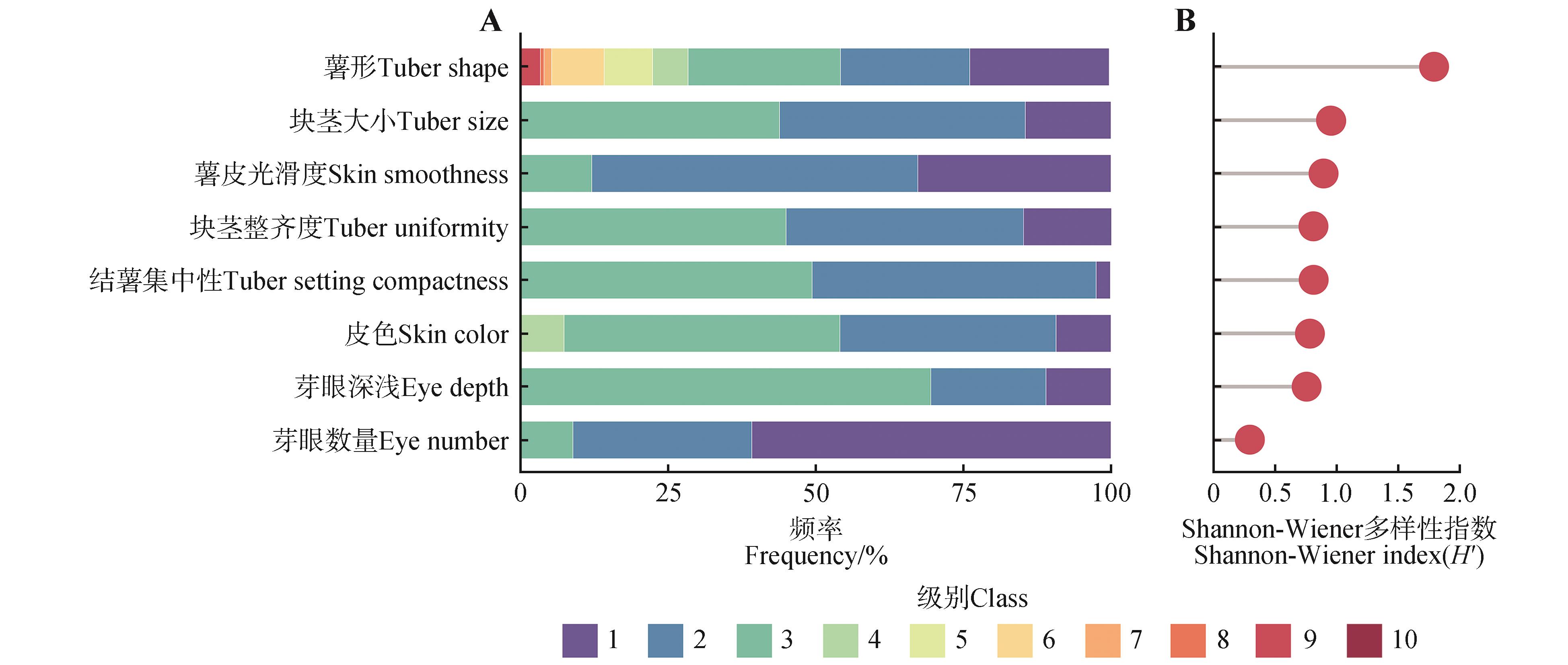
Fig.2
Analysis of genetic variation characteristics of quality traits in the F1 populationA.Frequency distribution of processing quality traits; B.Ranking of genetic diversity index (H').
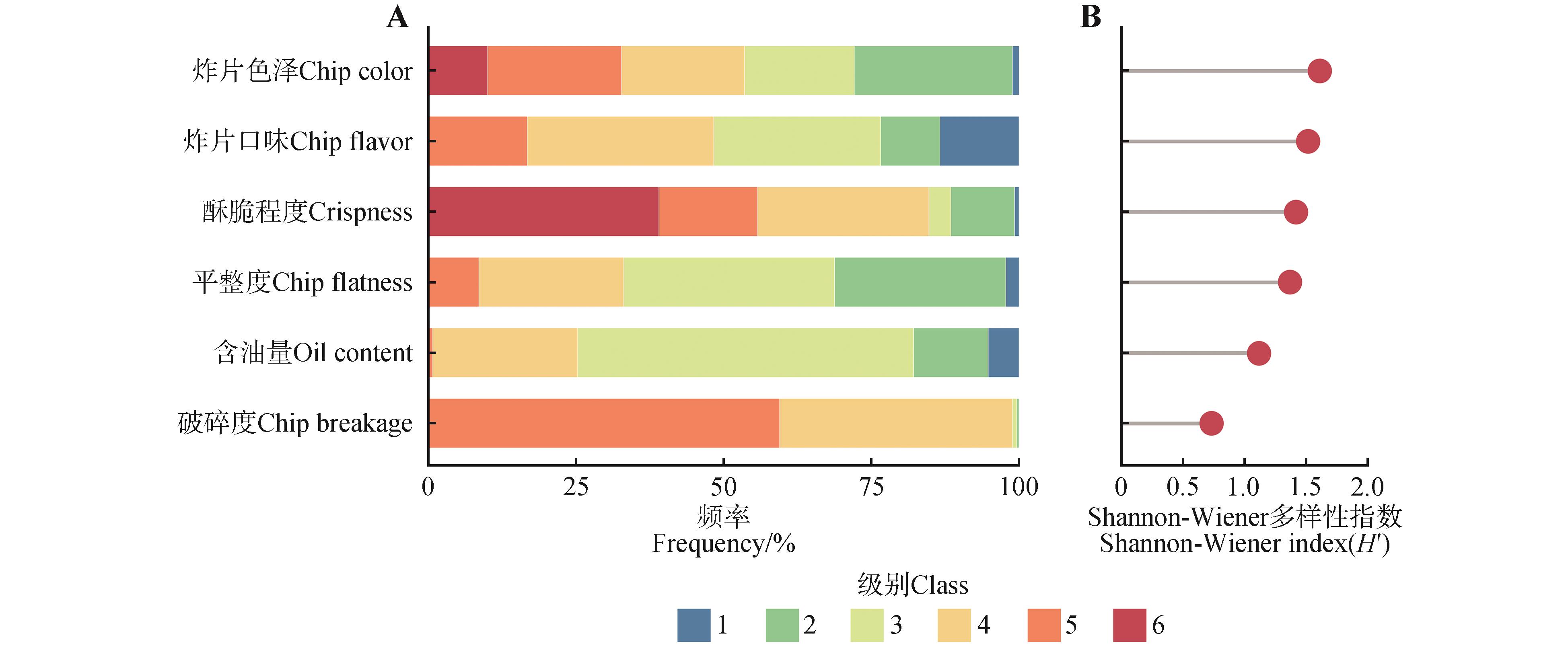
Fig.3
Frequency histograms and normal Q-Q plots of quantitative traits in F1 generation of potato ‘Atlantic’ and ‘Lucinda’A. Probability density distribution of the F1 population; the blue and yellow dashed lines represented the mean values of the female parent ‘Atlantic’ and the male parent ‘Lucinda’, respectively, while the red curve denoted the probability density of the F1 population; B. Normal Q-Q plots for key traits; A1, B1. Theoretical yield(TY); A2, B2. Cohesiveness(TCO); A3, B3. Starch content(SC); A4, B4. Total reducing sugar content (TRSC).
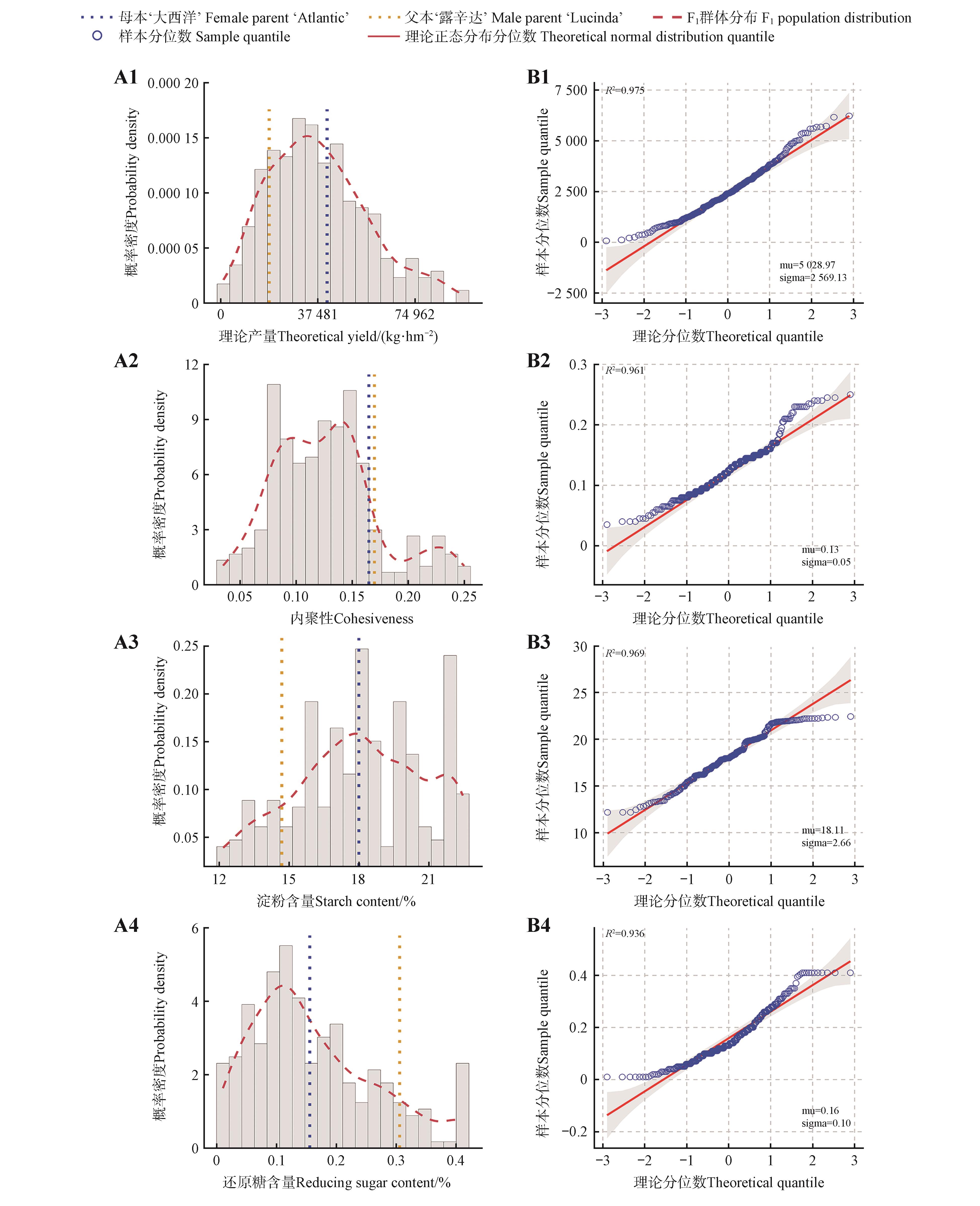
Fig.4
Significance test of inter-annual differences in the F1 populationA. Theoretical yield; B. Total reducing sugar content; C. Starch content; D. Brittleness; E. Browning index; F: Hardness; *,**,**** represented significant differences at P<0.05,P<0.001,P<0.000 1, respectively; ns. No significant difference.
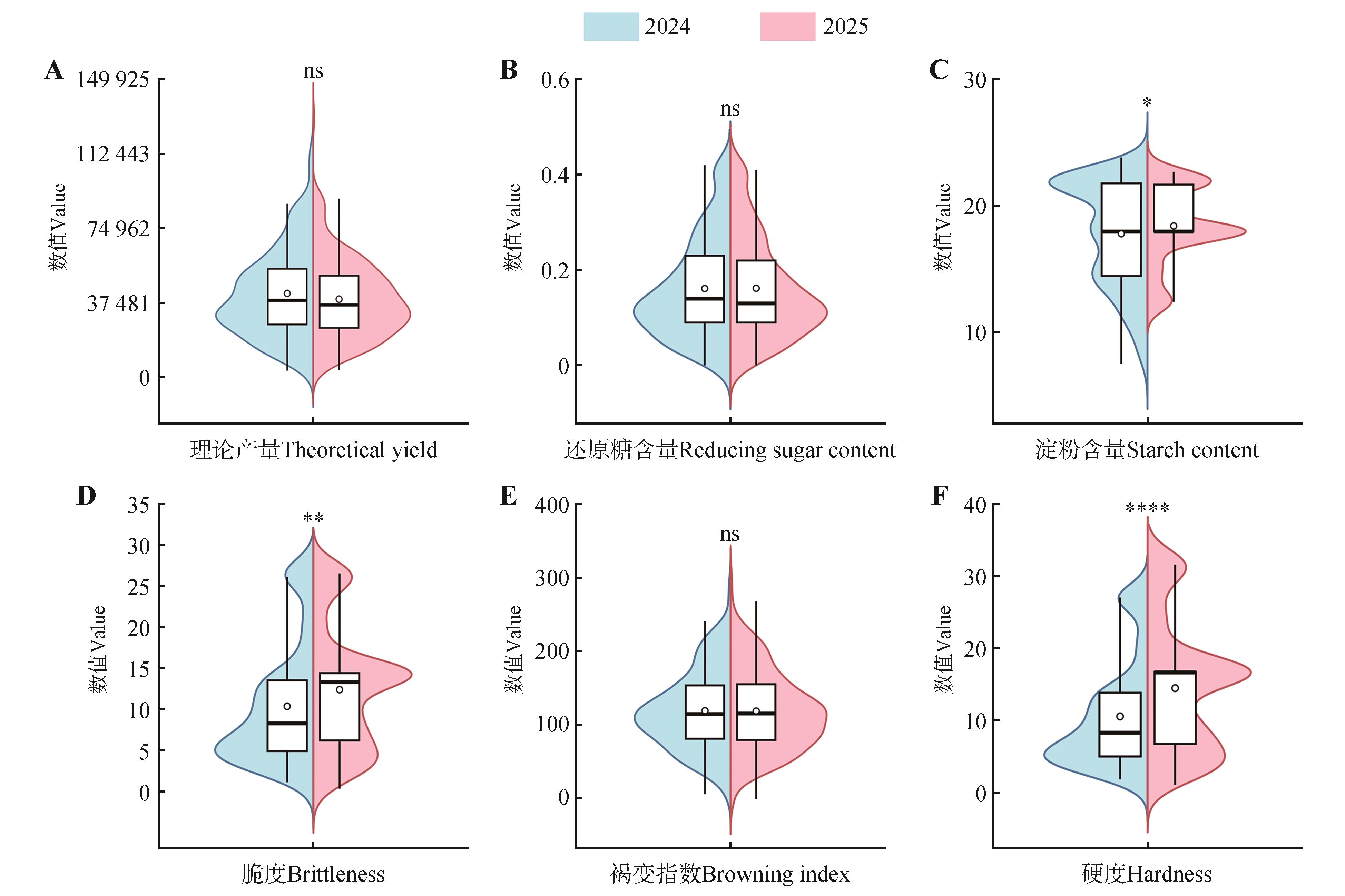
Fig.5
Pearson correlation heatmap of 24 quantitative traits in the F1 population*, *** indicated significant correlation in the parameters at the levels of P<0.05,P<0.001, respectively.
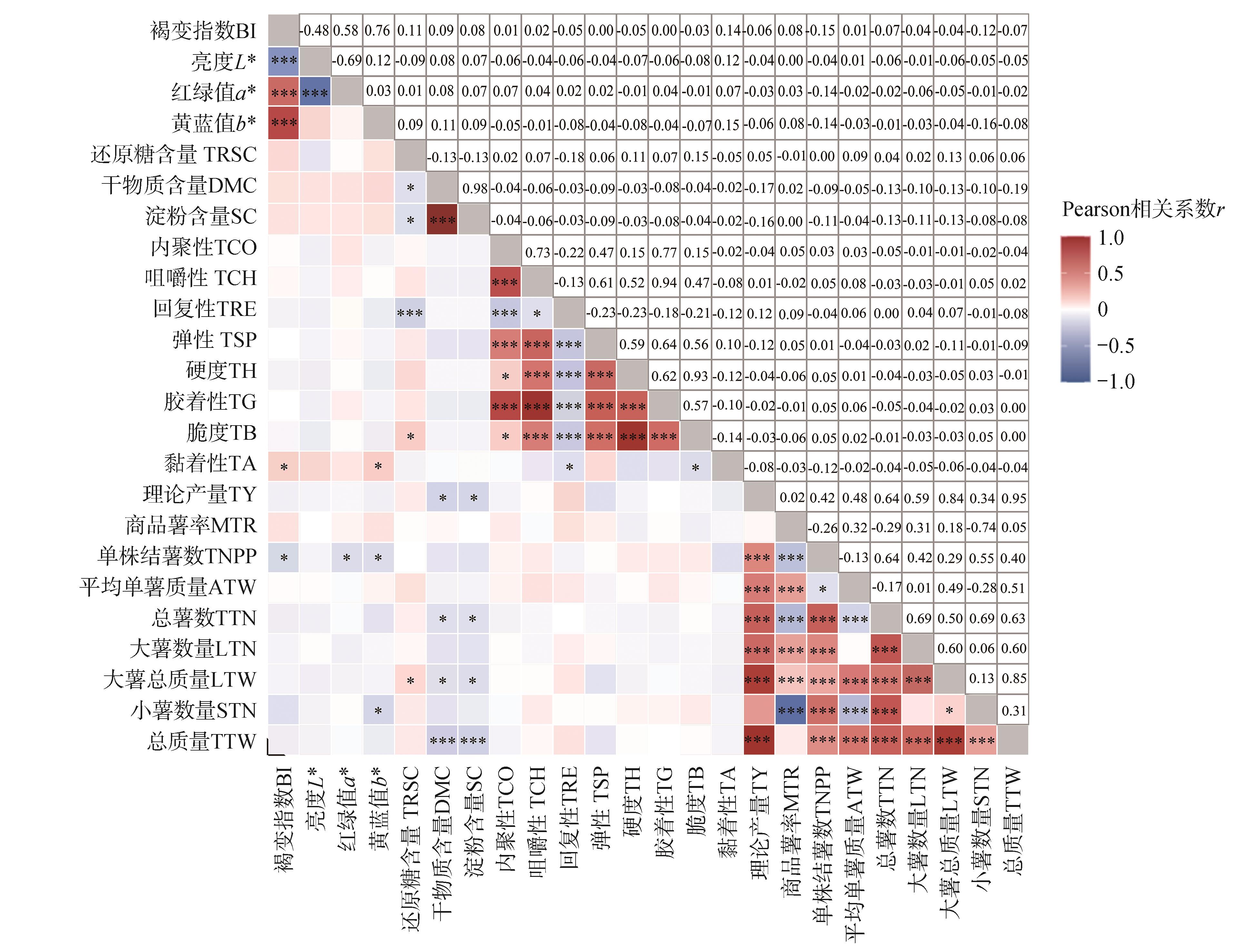
Table 2
Eigenvalues, contribution rates, and loadings of the first nine principal components
性状 Traits | 指标 Index | PC1 | PC2 | PC3 | PC4 | PC5 | PC6 | PC7 | PC8 | PC9 |
|---|---|---|---|---|---|---|---|---|---|---|
| 褐变指数BI | X1 | -0.040 | -0.112 | -0.296 | -0.643 | -0.238 | -0.527 | -0.036 | 0.051 | 0.076 |
| 亮度L* | X2 | 0.112 | 0.038 | 0.375 | 0.703 | 0.123 | 0.374 | -0.073 | -0.008 | -0.226 |
| 红绿值a* | X3 | -0.175 | -0.104 | 0.392 | 0.336 | -0.059 | -0.683 | 0.064 | 0.002 | 0.349 |
| 黄蓝值b* | X4 | -0.174 | -0.029 | 0.544 | 0.728 | 0.075 | -0.263 | 0.033 | -0.024 | 0.151 |
| 还原糖含量TRSC | X5 | 0.086 | 0.160 | 0.117 | 0.096 | 0.191 | -0.226 | 0.393 | 0.194 | 0.246 |
| 干物质含量DMC | X6 | -0.297 | -0.165 | 0.036 | 0.168 | -0.911 | 0.070 | 0.019 | 0.031 | -0.028 |
| 淀粉含量SC | X7 | -0.293 | -0.162 | 0.031 | 0.162 | -0.911 | 0.090 | 0.024 | 0.051 | -0.043 |
| 内聚性TCO | X8 | -0.084 | 0.661 | 0.107 | -0.015 | -0.049 | -0.035 | -0.624 | 0.128 | 0.097 |
| 咀嚼性TCH | X9 | -0.054 | 0.872 | 0.079 | -0.017 | -0.085 | -0.006 | -0.305 | 0.131 | 0.131 |
| 回复性TRE | X10 | 0.106 | -0.303 | 0.066 | -0.082 | 0.070 | 0.434 | -0.141 | -0.001 | 0.266 |
| 弹性TSP | X11 | -0.136 | 0.782 | 0.022 | -0.032 | 0.001 | -0.100 | -0.036 | -0.199 | -0.197 |
| 硬度TH | X12 | -0.073 | 0.786 | -0.048 | -0.026 | -0.091 | 0.064 | 0.511 | -0.125 | -0.089 |
| 胶着性TG | X13 | -0.076 | 0.930 | 0.072 | -0.034 | -0.068 | 0.017 | -0.234 | 0.092 | 0.115 |
| 脆度TB | X14 | -0.054 | 0.762 | -0.039 | -0.011 | -0.080 | 0.071 | 0.545 | -0.116 | -0.068 |
| 黏着性TA | X15 | -0.109 | -0.100 | 0.065 | 0.091 | 0.097 | -0.478 | -0.187 | 0.023 | -0.739 |
| 理论产量YT | X16 | 0.915 | 0.019 | 0.235 | -0.024 | -0.115 | 0.008 | 0.020 | 0.171 | -0.037 |
| 商品薯率MTR | X17 | -0.080 | -0.062 | 0.707 | -0.405 | -0.027 | 0.077 | -0.067 | -0.451 | 0.032 |
| 单株结薯数量TNPP | X18 | 0.620 | 0.129 | -0.385 | 0.183 | -0.110 | -0.041 | -0.069 | -0.168 | 0.119 |
| 平均单薯质量ATW | X19 | 0.271 | 0.038 | 0.624 | -0.349 | -0.061 | 0.070 | 0.131 | 0.512 | -0.110 |
| 总薯数量TTN | X20 | 0.823 | 0.042 | -0.288 | 0.300 | -0.105 | -0.108 | -0.068 | -0.211 | -0.005 |
| 大薯数量LTN | X21 | 0.710 | 0.017 | 0.186 | -0.030 | -0.143 | -0.089 | -0.097 | -0.582 | 0.025 |
| 大薯总质量LTW | X22 | 0.819 | 0.007 | 0.386 | -0.109 | -0.123 | -0.011 | 0.044 | 0.095 | -0.039 |
| 小薯数量STN | X23 | 0.494 | 0.108 | -0.645 | 0.427 | -0.019 | -0.036 | -0.013 | 0.261 | 0.006 |
| 总质量TTW | X24 | 0.912 | 0.051 | 0.260 | -0.045 | -0.091 | 0 | 0.037 | 0.158 | -0.100 |
| 特征值Eigenvalue | 4.551 | 4.117 | 2.571 | 2.240 | 1.906 | 1.489 | 1.363 | 1.164 | 1.014 | |
| 标准差Standard deviation | 2.133 | 2.029 | 1.603 | 1.497 | 1.380 | 1.220 | 1.167 | 1.079 | 1.007 | |
| 贡献率Contribution rate/% | 18.892 | 17.092 | 10.671 | 9.300 | 7.910 | 6.182 | 5.656 | 4.832 | 4.209 | |
| 累计贡献率Cumulative contribution rate/% | 18.892 | 35.984 | 46.655 | 55.955 | 63.865 | 70.048 | 75.704 | 80.536 | 84.746 |
Fig.6
Hierarchical clustering dendrogram of the F1 population based on comprehensive evaluation values (D)
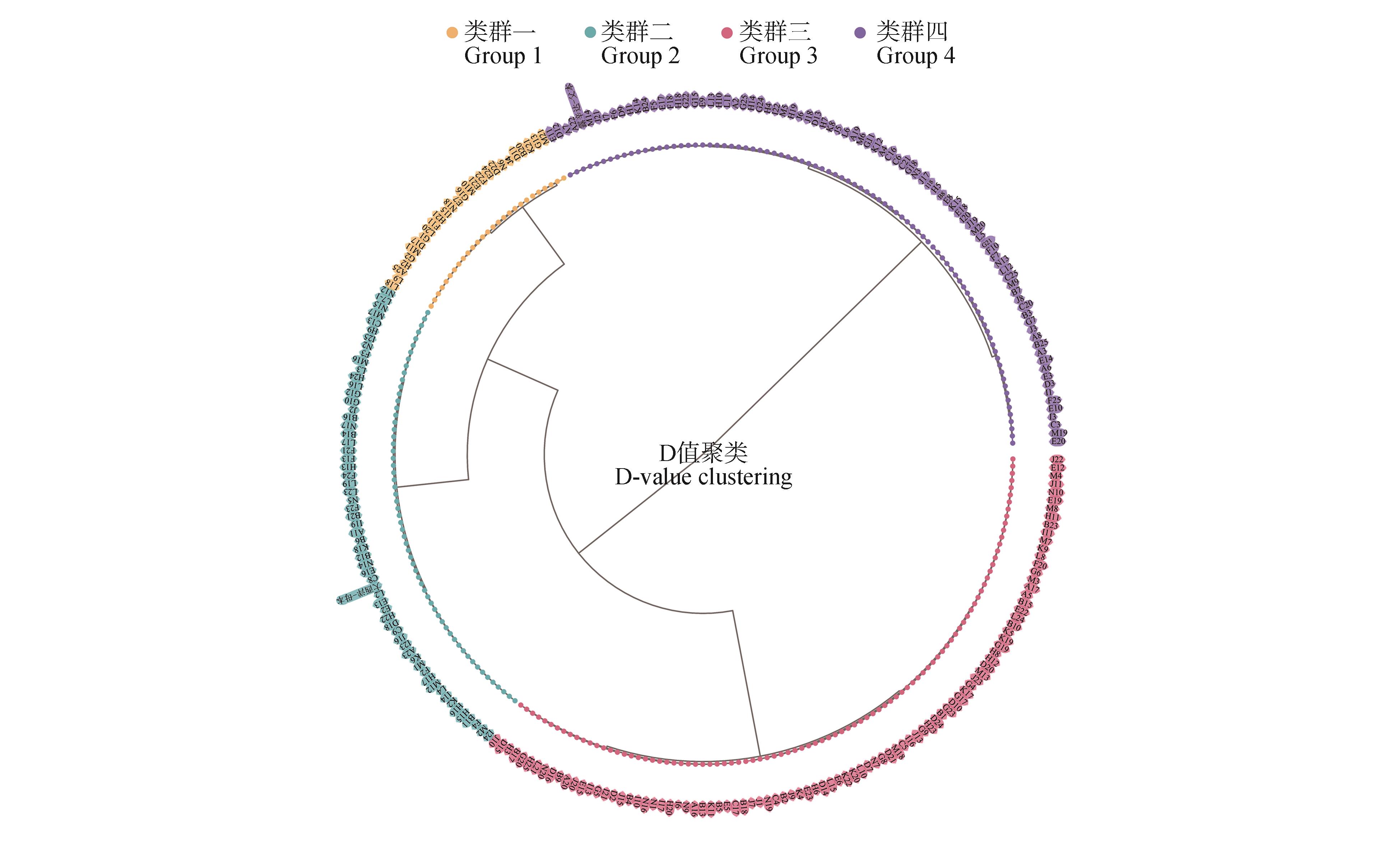
Fig.7
Comprehensive screening map of superior germplasm with excellent chip typeA. Quadrant diagram illustrating the synergy between yield and processing quality(BI) in F1 population; B. Venn diagram of comprehensive screening based on cluster analysis(excellent population), yield-quality synergy(from Fig.7A), and strict threshold indicators of processing quality.
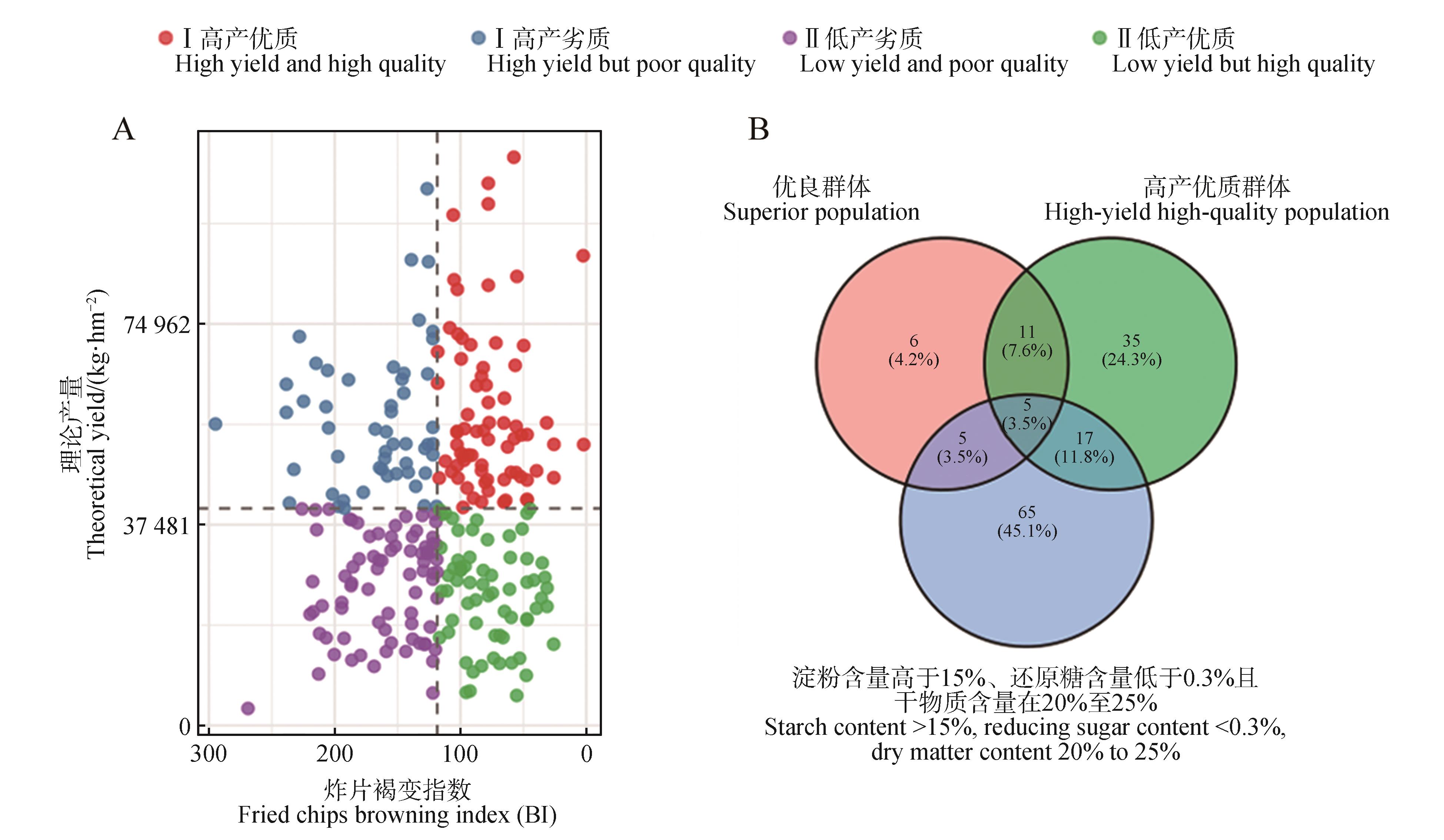
Fig.8
Radar chart of comprehensive traits and chip color performance of core elite germplasms and parentsA. Radar chart showing five key traits (theoretical yield, dry matter content, gumminess, reducing sugar content, and commercial tuber rate) of five elite germplasms and their parents; B. Images of fried potato chips of the corresponding lines and parents.
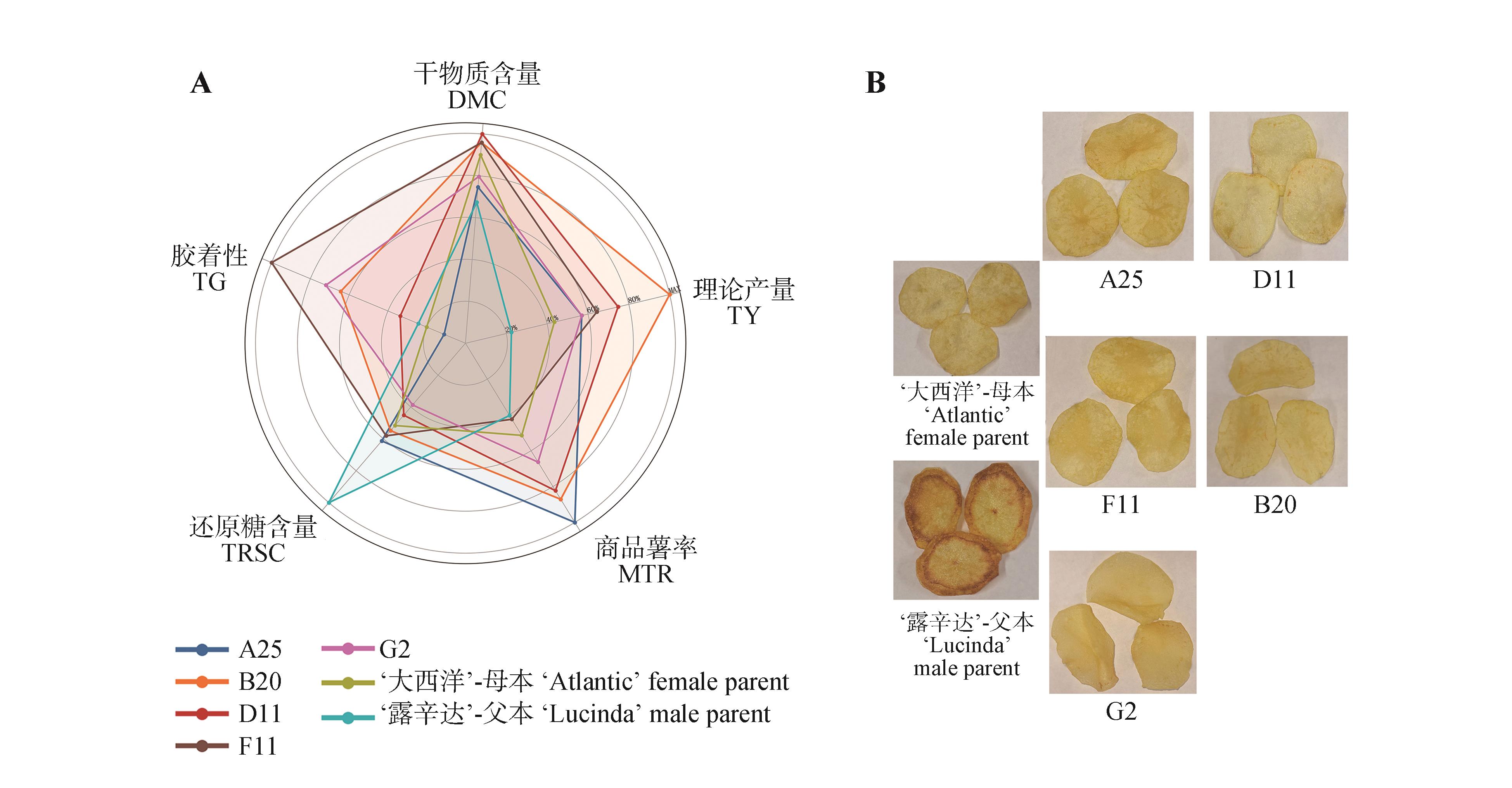
Fig.9
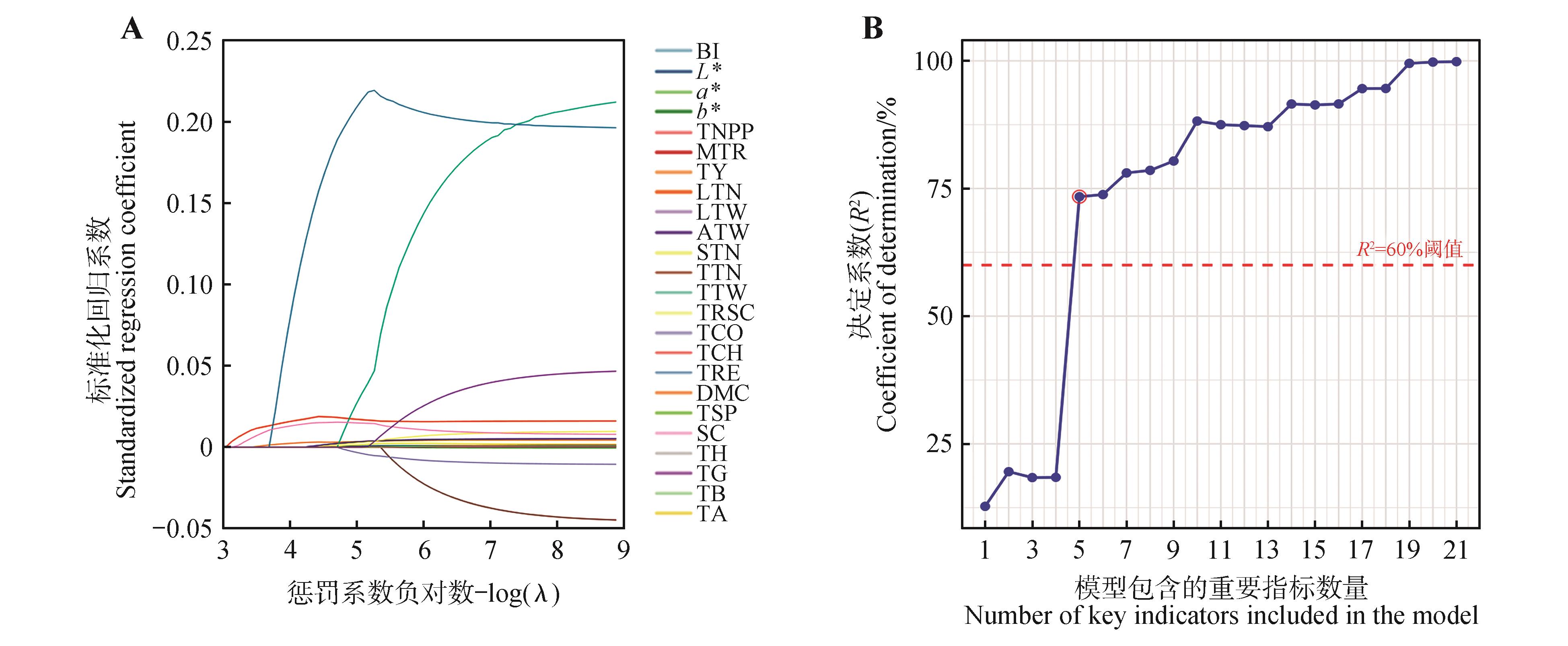
Flowchart for key prediction indicator screening and model simplification using LASSO regression coefficientA. Path diagram of LASSO regression coefficients; B. Plot of prediction performance(R²) of the simplified model versus the number of key indicators.
| [1] | ZHANG K, XU J F, DUAN S G,et al.NBS profiling identifies potential novel locus from Solanum demissum that confers broad-spectrum resistance to Phytophthora infestans [J].Journal of Integrative Agriculture,2014,13(8):1662-1671. |
| [2] | 徐建飞,金黎平.马铃薯遗传育种研究:现状与展望[J].中国农业科学,2017,50(6):990-1015. |
| XU J F, JIN L P.Advances and perspectives in research of potato genetics and breeding[J].Scientia Agricultura Sinica,2017,50(6):990-1015. | |
| [3] | 谢从华,柳俊.中国马铃薯科技发展与创新之回顾[J].华中农业大学学报,2021,40(4):16-26. |
| XIE C H, LIU J.Development and innovation of science and technology of potato in China[J].Journal of Huazhong Agricultural University,2021,40(4):16-26. | |
| [4] | 章孜亮,李婧,高俊,等.不同微生物菌剂在马铃薯种植中的应用效果[J].现代化农业,2023(12):23-25. |
| ZHANG Z L, LI J, GAO J,et al.Application effect of different microbial agents in potato planting[J].Modernizing Agriculture,2023(12):23-25. | |
| [5] | 孔立,李丹,陈峰.大食物观下马铃薯产业发展的政策效应研究[J].世界农业,2024(6):111-122. |
| KONG L, LI D, CHEN F.The policy effects of potato industry development under the concept of big food[J].World Agriculture,2024(6):111-122. | |
| [6] | 刘悦善,第红君,王华,等.甘肃中部旱作区专用型马铃薯品种筛选与评价[J].种子,2023,42(2):133-140. |
| LIU Y S, DI H J, WANG H,et al.Screening and evaluation of special potato varieties in the central arid region of Gansu[J].Seed,2023,42(2):133-140. | |
| [7] | 李玉涛,章宪霞,唐德晶,等.马铃薯主粮化加工专用品种筛选研究[J].江苏农业科学,2022,50(19):98-103. |
| LI Y T, ZHANG X X, TANG D J, et al.Study on screening of special cultivars for potato main grain processing[J].Jiangsu Agricultural Sciences,2022,50(19):98-103. | |
| [8] | 李建武,文国宏,李高峰,等.陇薯系列高淀粉马铃薯品种的淀粉产量及品质性状综合评价[J].核农学报,2020,34(2):329-338. |
| LI J W, WEN G H, LI G F,et al.Evaluation of starch yield and nutrition quality traits in longshu series potato varieties with high starch content[J].Journal of Nuclear Agricultural Sciences,2020,34(2):329-338. | |
| [9] | 王颖,何仁元,蒲宁,等.陇中黄土丘陵区不同品种马铃薯块茎产量和品质比较[J].作物研究,2024,38(3):193-201. |
| WANG Y, HE R Y, PU N,et al.Comparison of tuber yield and quality of different potato varieties in Loess Hilly Region of central Gansu[J].Crop Research,2024,38(3):193-201. | |
| [10] | 周丙月,袁剑龙,张玉梅,等.马铃薯品种(系)农艺性状的适应性和稳定性分析[J].核农学报,2023,37(2):274-289. |
| ZHOU B Y, YUAN J L, ZHANG Y M,et al.Analysis of genotype and environment interaction,adaptability and stability of agronomic traits of potato varieties(lines)[J].Journal of Nuclear Agricultural Sciences,2023,37(2):274-289. | |
| [11] | 王丽,熊兴耀,蔡柳,等.我国不同产区马铃薯栽培品种的主要品质性状比较分析[J].南方农业学报,2023,54(1):80-89. |
| WANG L, XIONG X Y, CAI L,et al.Analysis of main quality traits of potato cultivars from different producing areas in China[J].Journal of Southern Agriculture,2023,54(1):80-89. | |
| [12] | 巩檑.近5年马铃薯基因组及重要性状基因研究进展[J].宁夏农林科技,2023,64(11):6-11. |
| GONG L.Research progress on potato genomics and genes associated with important traits in the past five years[J].Ningxia Journal of Agriculture and Forestry Science and Technology,2023,64(11):6-11. | |
| [13] | 孙邦升,刘喜才,宋继玲,等.鲜食马铃薯种质资源表型性状遗传多样性分析[J].黑龙江农业科学,2020(11):15-19. |
| SUN B S, LIU X C, SONG J L,et al.Genetic diversity of phenotypic traits in fresh potato germplasm resources[J].Heilongjiang Agricultural Sciences,2020(11):15-19. | |
| [14] | 张佳莹,李扬,王靖,等.品种和气象因子对马铃薯主要品质的影响[J].中国生态农业学报(中英文),2022,30(2):216-225. |
| ZHANG J Y, LI Y, WANG J,et al.The impacts of cultivar maturity and meteorological factors on main quality of potato[J].Chinese Journal of Eco-Agriculture,2022,30(2):216-225. | |
| [15] | 何文,张秀芬,郭素云,等.基于主成分分析和聚类分析对22份马铃薯种质的综合评价[J].种子,2021,40(3):80-86. |
| HE W, ZHANG X F, GUO S Y,et al.Comprehensive evaluation of 22 potato germplasms based on principal component analysis and cluster analysis[J].Seed,2021,40(3):80-86. | |
| [16] | 杜培兵,张永福,白小东,等.主成分分析和隶属函数法对马铃薯品种抗旱性的评价[J].种子,2019,38(8):120-126. |
| DU P B, ZHANG Y F, BAI X D,et al.Evaluation of drought resistance of potato varieties by principal component analysis and membership function method[J].Seed,2019,38(8):120-126. | |
| [17] | 叶开梅,牛力立,樊祖立,等.灰色关联度法与DTOPSIS法在马铃薯品种综合评价中的应用比较[J].贵州农业科学,2023,51(3):10-18. |
| YE K M, NIU L L, FAN Z L,et al.Application comparison between grey relational degree and DTOPSIS in comprehensive evaluation of potato varieties[J].Guizhou Agricultural Sciences,2023,51(3):10-18. | |
| [18] | 刘靖宇,李远斌,董昊,等.基于多源时空数据的冬小麦产量预测模型[J].江苏农业科学,2023,51(19):198-208. |
| LIU J Y, LI Y B, DONG H, et al.Winter wheat yield prediction model based on multi-source spatio-temporal data[J].Jiangsu Agricultural Sciences,2023,51(19):198-208. | |
| [19] | 耿娟,聂文倩.基于岭回归和LASSO回归浅析河南省粮食产量影响因素[J].山西农经,2023(23):7-10. |
| GENG J, NIE W Q.Analysis of influencing factors of grain theoretical yield in Henan Province based on ridge regression and LASSO regression[J]. Shanxi Agricultural Economy,2023(23):7-10. | |
| [20] | 刘永强,曹春梅,逯春杏,等.太仆寺旗马铃薯新品种比较试验[J].现代农业科技,2022(20):62-67. |
| LIU Y Q, CAO C M, LU C X,et al.Comparative experiment of new potato varieties in Taibus Banner[J].Modern Agricultural Science and Technology,2022(20):62-67. | |
| [21] | 石瑛,宋雪微,商靖雯,等.东北雨养条件下加工型马铃薯新品种产量与品质表现[J].东北农业大学学报,2023,54(9):1-9. |
| SHI Y, SONG X W, SHANG J W,et al.Yield and quality performance of new processed potato varieties under rain-fed conditions in Northeast China[J].Journal of Northeast Agricultural University,2023,54(9):1-9. | |
| [22] | 中华人民共和国农业部. 农作物优异种质资源评价规范 马铃薯 [S].北京:中国农业出版社,2012. |
| Ministry of Agriculture of the People’s Republic of China. Evaluating standards for elite and rare germplasm resources—Potato(Solanum tuberosumL.)[S].Beijing:China Agriculture Press,2012. | |
| [23] | 国家市场监督管理总局,中国国家标准化管理委员会. 植物品种特异性、一致性和稳定性测试指南 马铃薯 [S].北京:中国标准出版社,2018. |
| State Administration for Market Regulation, Standardization Administration of China. Guidelines for the conduct of tests for distinctness,uniformity and stability—Potato(Solanum tuberosumL.)[S].Beijing:China Standards Press,2018. | |
| [24] | 李文丽,袁剑龙,段惠敏,等.马铃薯块茎质地品质的综合评价[J].中国农业科学,2022,55(12):2278-2293. |
| LI W L, YUAN J L, DUAN H M,et al.Comprehensive evaluation of potato tuber texture[J].Scientia Agricultura Sinica,2022,55(12):2278-2293. | |
| [25] | 刘岳,李学进,王晓冉,等.褪黑素对鲜切马铃薯过冷贮藏期间褐变的影响[J].食品研究与开发,2024, 45(7):81-87. |
| LIU Y, LI X J, WANG X R,et al.Effects of melatonin treatment on browning of fresh-cut potatoes during supercooled storage[J].Food Research and Development,2024,45(7):81-87. | |
| [26] | SHANNON C E.A mathematical theory of communication[J].Bell System Technical Journal,1948,27(3):379-423. |
| [27] | 赵甜甜,袁剑龙,卓峰琦,等.马铃薯全粉品质综合评价及品种筛选[J].中国农业科学,2025,58(13):2522-2537. |
| ZHAO T T, YUAN J L, ZHUO F Q,et al.Comprehensive evaluation of potato flour quality and variety screening[J].Scientia Agricultura Sinica,2025,58(13):2522-2537. | |
| [28] | DENWAR N N, AWUKU F J, DIERS B,et al.Genetic diversity,population structure and key phenotypic traits driving variation within soyabean(Glycine max) collection in Ghana[J].Plant Breeding,2019,138(5):577-587. |
| [29] | GOLOVATSKAYA I F, KADYRBAEV M K, BOYKO E V.Protective role of melatonin and IAA in the regulation of resistance of potato regenerants to cold stress[J].Potato Research,2024,67(2):421-449. |
| [30] | REN S Q, TAN J, ZHOU S N,et al.Germplasm selection and comprehensive evaluation of maize inbred lines at germination and seedling stage for saline-alkali tolerance[J].Agronomy,2025,15(3):626. |
| [31] | LEE K J, SEBASTIN R, CHO G T,et al.Genetic diversity and population structure of potato germplasm in RDA-genebank:utilization for breeding and conservation[J].Plants,2021,10(4):752. |
| [32] | 王海艳,王立春,田国奎,等.马铃薯遗传多样性研究进展[J].中国瓜菜,2024,37(12):9-18. |
| WANG H Y, WANG L C, TIAN G K,et al.Research progress on genetic diversity of potato[J].China Cucurbits and Vegetables,2024,37(12):9-18. | |
| [33] | ROSS H A, MORRIS W L, DUCREUX L J M,et al.Pectin engineering to modify product quality in potato[J].Plant Biotechnology Journal,2011,9(8):848-856. |
| [34] | VAN DIJK C, FISCHER M, BEEKHUIZEN J G,et al.Texture of cooked potatoes (Solanum tuberosum).3.Preheating and the consequences for the texture and cell wall chemistry[J].Journal of Agricultural and Food Chemistry,2002,50(18):5098-5106. |
| [1] | Denggao LI, Rui LIN, Qinghui MU, Na ZHOU, Yanru ZHANG, Wei BAI. Identification and Analysis of the Potato StCRKs Gene Family and Expression Patterns in Response to Stress Signals [J]. Bulletin of Botanical Research, 2022, 42(6): 1033-1043. |
| [2] | Denggao LI, Rui LIN, Qinghui MU, Na ZHOU, Yanru ZHANG, Wei BAI. Cloning and Functional Analysis of StNPR4 gene in Solanum tuberosum [J]. Bulletin of Botanical Research, 2022, 42(5): 821-829. |
| [3] | TAN Chuan-Ting, SONG Wei-Han, ZHU Ming-Ku, XU Tao, DONG Ting-Ting, LI Zong-Yun. Cloning and Expression Analysis of Stress Treatments of a MADS-box Transcription Factor in Sweet Potato [J]. Bulletin of Botanical Research, 2017, 37(4): 587-595. |
| [4] | BAI Jiang-Ping;;CUI Tong-Xia;;ZHANG Jin-Wen;;ZHANG Jun-Lian;;WANG Di;*. GGE-Biplot Analysis on Gene Expression of Seven Key Genes Mediating Biosynthesis of Steroidal Glycoalkaloid in Potato [J]. Bulletin of Botanical Research, 2014, 34(2): 238-244. |
| [5] | GAN Lin;YU Xiao-Xia;JU Tian-Hua;YU Zhuo*;MENG Mei-Lian;ZHANG Zi-Qiang;LI Chang-Qing. ISSR Identification of Clone Plants of Solanum tuberosum Hybrids F1 [J]. Bulletin of Botanical Research, 2013, 33(2): 243-247. |
| [6] | SHI Jin;LUAN Yu-Shi;*;WANG Jing-Yun;TIAN Jun-Ping. Determination of Lutein in Leaves of Sweet Potato by HPLC [J]. Bulletin of Botanical Research, 2008, 28(6): 767-769. |
| Viewed | ||||||
|
Full text |
|
|||||
|
Abstract |
|
|||||